Japanese creative-print movement
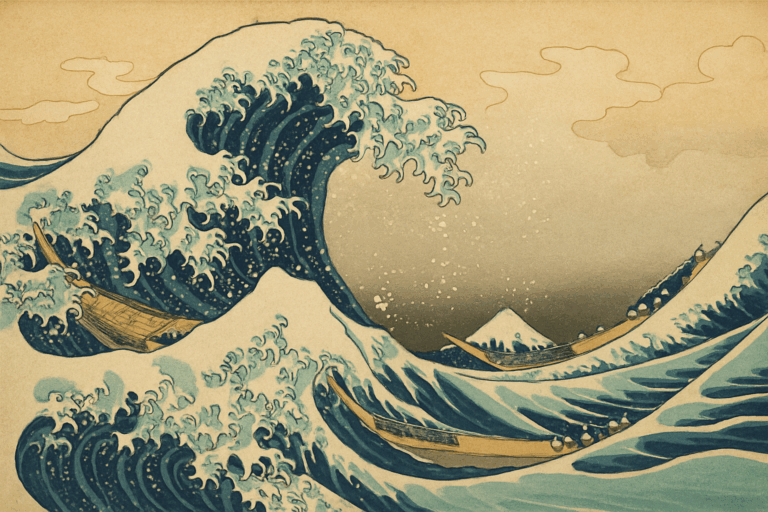
Sōsaku-hanga emphasizes the print as an artist’s own creative expression, with close attention to the work of designing, carving and printing.
A visual introduction
Select an image for a closer look. Use the thumbnails, arrow keys or a swipe to compare examples. Zoom in to inspect details, or share the image that inspires you.


Creative toolbox · take this style further
Choose an input and a destination. Search sends your words to the chosen site; Copy & open puts them on your clipboard to paste there.
Create with AI
Turn your chosen input into an image prompt or a new creative direction.
ChatGPT
Copy your input and paste it into a ChatGPT conversation or image request.
Copy & open ChatGPT (new tab)Claude · Anthropic
Develop an image prompt or explore the style in a new Claude conversation.
Copy & open Claude · Anthropic (new tab)Midjourney
Paste your input into the Imagine bar on the Create page.
Copy & open Midjourney (new tab)Adobe Firefly
Copy your input, open Firefly, and paste it into the prompt field.
Copy & open Adobe Firefly (new tab)Leonardo.Ai
Copy your input, open Leonardo, and paste it into the generation field.
Copy & open Leonardo.Ai (new tab)Image search
Find visual references. Short, concrete keywords usually work best.
Lexica
Search AI images and prompts using your selected input.
Search with this input Lexica (new tab)Pexels
Search the photo and video library. Short keywords often work best.
Search with this input Pexels (new tab)Pixabay
Search photos, illustrations and other images.
Search with this input Pixabay (new tab)Unsplash
Search photographs using the style name or your own keywords.
Search with this input Unsplash (new tab)Wikimedia Commons
Search photographs, artworks and historical images. Check each file for its source and reuse terms.
Search with this input Wikimedia Commons (new tab)Art & research
Explore artists, collections and the ideas behind a style.
Wikipedia
Search for background reading. A style may not have its own article.
Search with this input Wikipedia (new tab)WikiArt
Copy your input into WikiArt’s search to explore artists and artworks.
Copy & open WikiArt (new tab)Europeana
Paste your keywords into the search to explore European museum, library and archive collections.
Copy & open Europeana (new tab)Inspiration
Discover portfolios and visual ideas from creative communities.
Instagram hashtags
Search a hashtag made from your input: spaces and punctuation are removed. Instagram may require sign-in.
Search with this input Instagram hashtags (new tab)ArtStation
Paste your input into artwork search for concept art, environments, characters and visual development.
Copy & open ArtStation (new tab)Behance
Paste your input into project search for illustration, design and visual storytelling.
Copy & open Behance (new tab)A closer look
For an original print-inspired study, think about what each cut or color layer contributes.
An approach to authorship, not one surface effect
Sōsaku-hanga, often translated as creative prints, is a twentieth-century Japanese movement associated with the ideal that an artist should design, carve and print their own work. The Smithsonian explains this emphasis in relation to older systems that divided production among specialized participants. The distinction concerns creative responsibility as well as appearance.
It is an ideal to investigate through individual practices, not a guarantee that every historical print was produced in complete isolation. A rough edge, a visible grain or a signature cannot establish an object’s authorship or production history on its own.
Magazines and artistic exchange mattered
The National Diet Library describes the role of the magazine Hosun, established in 1907 by Ishii Hakutei, Morita Tsunetomo and Yamamoto Kanae, in circulating self-engraved prints and related experiments. This context complicates a romantic image of an entirely solitary maker: individual authorship could develop through publications, conversation and shared artistic networks.
The library distinguishes the movement from shin-hanga, which renewed printmaking through collaboration among artists and specialist craftspeople. These categories are helpful starting points, but they should not replace looking at a particular print and its documentation.
Visual variety is part of the subject
Creative prints can be figurative or abstract, restrained or strongly patterned. The Library of Congress discusses works as different as Sekino Jun’ichirō’s Objects of the Sea and Azechi Umetarō’s mountain subjects. Their relationship to the movement does not depend on sharing one scenic motif or a standardized palette.
Look for the interaction between the paper, the printed shapes and the edges that separate them. A broad dark form may establish the composition while a smaller change in pressure or texture gives it internal movement. The interesting question is what each decision does, rather than how much simulated wear can be added.
Plan a print-inspired study from the cuts outward
Reduce a street corner, a plant or a standing figure to a few major shapes. Decide which parts belong to the paper and which will receive color. Treat an unprinted interval as a structural element, not as an accidental gap to be filled later.
Make one version with clean boundaries and another with selective interruptions. Keep the interruptions related to form and direction. If every edge receives the same roughness, the material effect stops explaining anything about the image.
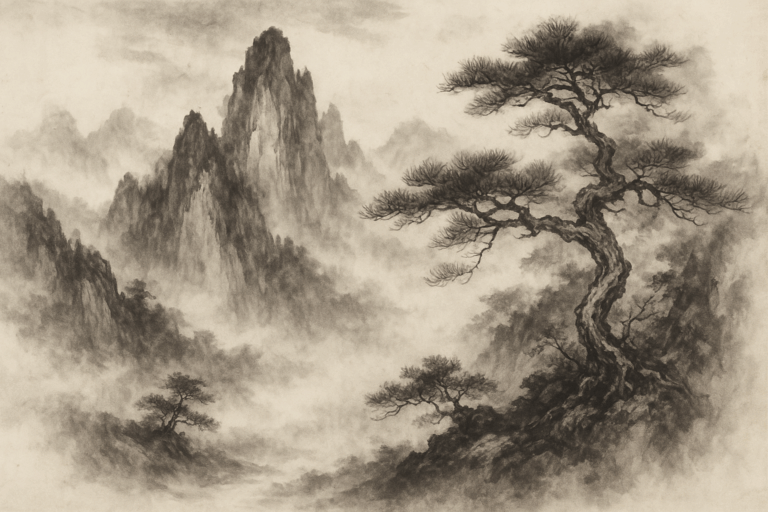
Digital and generated studies can explore these relationships, but they should be identified as interpretations. They do not demonstrate that a woodblock existed or that the image belongs to the historical movement. The retained AOI illustrations serve that exploratory role; the collection links provide documented historical examples.
The prompt workshop
Original creative exercises. These prompts create new illustrations, not documentary evidence.
A carved street
Create an original digital woodcut-inspired image of a quiet narrow street, bold carved-looking shapes, selective grain and a small warm window. Use the paper ground actively and avoid simulated artist seals.
Layers of a garden
Create a contemporary print-inspired garden scene using three color layers, varied edges and deliberate overlaps. Keep plant forms simplified and let a few cuts suggest material resistance.
One block, many marks
Create an original monochrome abstract print interpretation built from broad gouge-like marks and untouched white intervals. Vary mark direction purposefully instead of covering the surface in uniform distress.
Your next inspiration
Discover another art style
Follow a visual thread to the next subject.