
Representation with attention to social conditions
Social Realism connects recognizable situations with questions about work, power and everyday life. Its force comes from the relations within a scene, not merely from making a picture look grim.
A visual introduction
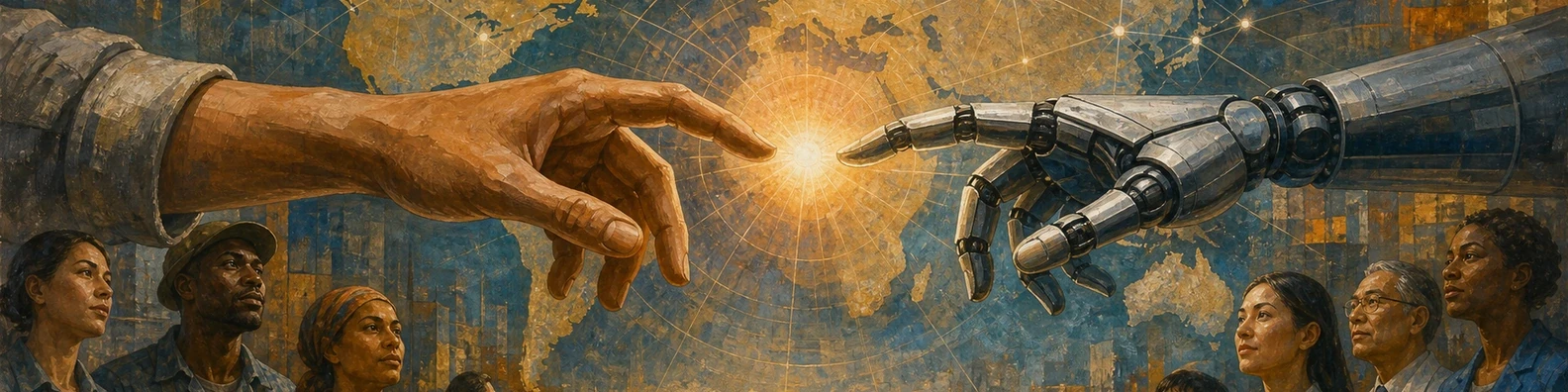
Compare the retained archive studies. The titled collage is modern editorial illustration; its panels are not reproductions of documented works.
Select an image for a closer look. Use the thumbnails, arrow keys or a swipe to compare examples. Zoom in to inspect details, or share the image that inspires you.


Creative toolbox · take this style further
Choose an input and a destination. Search sends your words to the chosen site; Copy & open puts them on your clipboard to paste there.
Create with AI
Turn your chosen input into an image prompt or a new creative direction.
ChatGPT
Copy your input and paste it into a ChatGPT conversation or image request.
Copy & open ChatGPT (new tab)Claude · Anthropic
Develop an image prompt or explore the style in a new Claude conversation.
Copy & open Claude · Anthropic (new tab)Midjourney
Paste your input into the Imagine bar on the Create page.
Copy & open Midjourney (new tab)Adobe Firefly
Copy your input, open Firefly, and paste it into the prompt field.
Copy & open Adobe Firefly (new tab)Leonardo.Ai
Copy your input, open Leonardo, and paste it into the generation field.
Copy & open Leonardo.Ai (new tab)Image search
Find visual references. Short, concrete keywords usually work best.
Lexica
Search AI images and prompts using your selected input.
Search with this input Lexica (new tab)Pexels
Search the photo and video library. Short keywords often work best.
Search with this input Pexels (new tab)Pixabay
Search photos, illustrations and other images.
Search with this input Pixabay (new tab)Unsplash
Search photographs using the style name or your own keywords.
Search with this input Unsplash (new tab)Wikimedia Commons
Search photographs, artworks and historical images. Check each file for its source and reuse terms.
Search with this input Wikimedia Commons (new tab)Art & research
Explore artists, collections and the ideas behind a style.
Wikipedia
Search for background reading. A style may not have its own article.
Search with this input Wikipedia (new tab)WikiArt
Copy your input into WikiArt’s search to explore artists and artworks.
Copy & open WikiArt (new tab)Europeana
Paste your keywords into the search to explore European museum, library and archive collections.
Copy & open Europeana (new tab)Inspiration
Discover portfolios and visual ideas from creative communities.
Instagram hashtags
Search a hashtag made from your input: spaces and punctuation are removed. Instagram may require sign-in.
Search with this input Instagram hashtags (new tab)ArtStation
Paste your input into artwork search for concept art, environments, characters and visual development.
Copy & open ArtStation (new tab)Behance
Paste your input into project search for illustration, design and visual storytelling.
Copy & open Behance (new tab)A closer look
Readable figures, meaningful settings, gestures shaped by work and a composition that shows relationships between people and their conditions.
A social relation, not just a mood
The Fitzwilliam Museum’s terminology record describes Social Realism through realistic situations and social protest, especially associated with the 1930s and 1940s. It distinguishes the term from government-sanctioned Socialist Realism. The two should not be treated as interchangeable labels.
A factory chimney or a worn coat alone does not establish a social argument. Ask what people are doing, what resources they can access and how the setting affects their choices. A believable gesture may reveal more than an emphatic slogan. The subject can be ordinary and still carry a strong account of inequality, solidarity or dignity.
Make the situation legible
Choose one event: a shift ending, a crowded waiting room or workers repairing a shared space. Establish the physical task and the relationships between figures before adding atmosphere. Hands should connect convincingly with tools; bodies should have weight; the arrangement of doors, counters or machinery should explain how the space is used.
The retained portrait and collage imagine industrial labor and collective struggle. They are not documentary photographs, evidence of an actual protest or reproductions of named historical paintings. In an original illustration, avoid turning hardship into decorative grime. Include specific actions and individual differences so that people do not become interchangeable symbols. A restrained palette can support the scene, but accurate observation and clear relationships do more work than brown paint or dramatic smoke.
The prompt workshop
Original creative exercises. These prompts create new illustrations, not documentary evidence.
The shift ends
Create an original figurative painting of three adults leaving a small factory at dusk, carrying work bags and talking quietly. Show individual gestures, believable clothing and a readable entrance. Restrained colors, no slogans or claim to document an actual event.
A shared repair
Create an original socially observant painting of neighbors repairing a broken public bench. Make hands, tools and effort coherent, with different people contributing distinct tasks. Clear daylight, modest setting, no text.
Waiting and access
Create an original figurative illustration of adults waiting at a service counter, with the arrangement of chairs, queue and doorway clearly visible. Convey fatigue and mutual attention through posture rather than caricature. No readable signs or documentary claim.
Sources and further exploration
Fitzwilliam Museum: Social realism terminology and distinction