
Fictional
Scaromantism is an AOI experiment in letting a name become an image before giving it a definition. Across animals, buildings, landscapes, still life and abstraction, this generated series repeatedly brings luminous beauty into contact with scars, fractures and ominous atmosphere. The entry describes this particular visual interpretation, rather than claiming an established historical movement.
An A⊕I –[-.+] creαt¡ve c⊕ncept, n⊕t αn estαbl¡she∂ h¡st⊕r¡cαl m⊕vement.
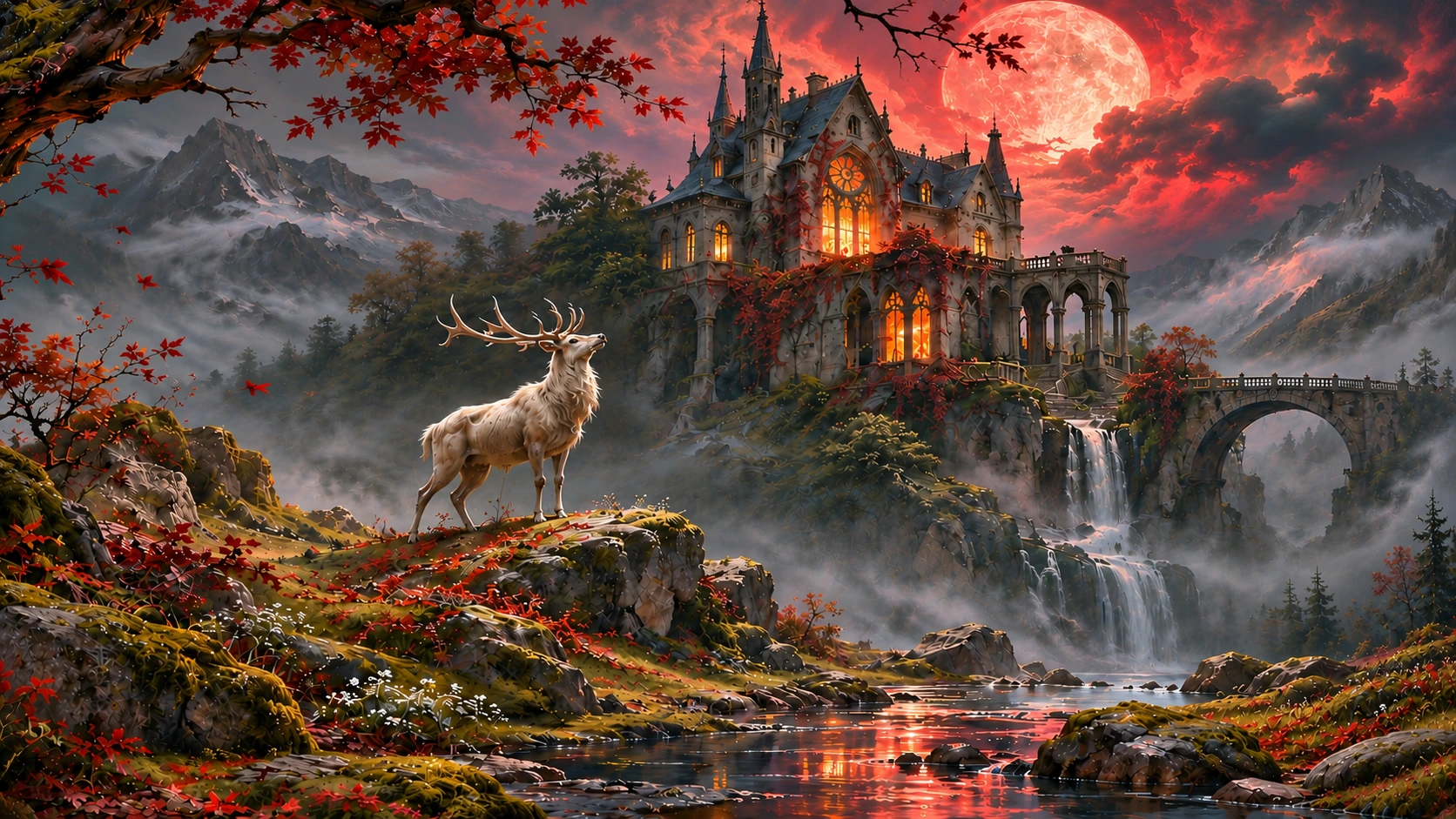
A visual introduction
Seven original AI-generated interpretations test the same open style term across subject families. The banner was edited and reframed to remove unwanted lettering. These images illustrate the AOI experiment; they are not historical examples.
Select an image for a closer look. Use the thumbnails, arrow keys or a swipe to compare examples. Zoom in to inspect details, or share the image that inspires you.
Creative toolbox · take this style further
Choose an input and a destination. Search sends your words to the chosen site; Copy & open puts them on your clipboard to paste there.
Create with AI
Turn your chosen input into an image prompt or a new creative direction.
ChatGPT
Copy your input and paste it into a ChatGPT conversation or image request.
Copy & open ChatGPT (new tab)Claude · Anthropic
Develop an image prompt or explore the style in a new Claude conversation.
Copy & open Claude · Anthropic (new tab)Midjourney
Paste your input into the Imagine bar on the Create page.
Copy & open Midjourney (new tab)Adobe Firefly
Copy your input, open Firefly, and paste it into the prompt field.
Copy & open Adobe Firefly (new tab)Leonardo.Ai
Copy your input, open Leonardo, and paste it into the generation field.
Copy & open Leonardo.Ai (new tab)Image search
Find visual references. Short, concrete keywords usually work best.
Lexica
Search AI images and prompts using your selected input.
Search with this input Lexica (new tab)Pexels
Search the photo and video library. Short keywords often work best.
Search with this input Pexels (new tab)Pixabay
Search photos, illustrations and other images.
Search with this input Pixabay (new tab)Unsplash
Search photographs using the style name or your own keywords.
Search with this input Unsplash (new tab)Wikimedia Commons
Search photographs, artworks and historical images. Check each file for its source and reuse terms.
Search with this input Wikimedia Commons (new tab)Art & research
Explore artists, collections and the ideas behind a style.
Wikipedia
Search for background reading. A style may not have its own article.
Search with this input Wikipedia (new tab)WikiArt
Copy your input into WikiArt’s search to explore artists and artworks.
Copy & open WikiArt (new tab)Europeana
Paste your keywords into the search to explore European museum, library and archive collections.
Copy & open Europeana (new tab)Inspiration
Discover portfolios and visual ideas from creative communities.
Instagram hashtags
Search a hashtag made from your input: spaces and punctuation are removed. Instagram may require sign-in.
Search with this input Instagram hashtags (new tab)ArtStation
Paste your input into artwork search for concept art, environments, characters and visual development.
Copy & open ArtStation (new tab)Behance
Paste your input into project search for illustration, design and visual storytelling.
Copy & open Behance (new tab)A closer look
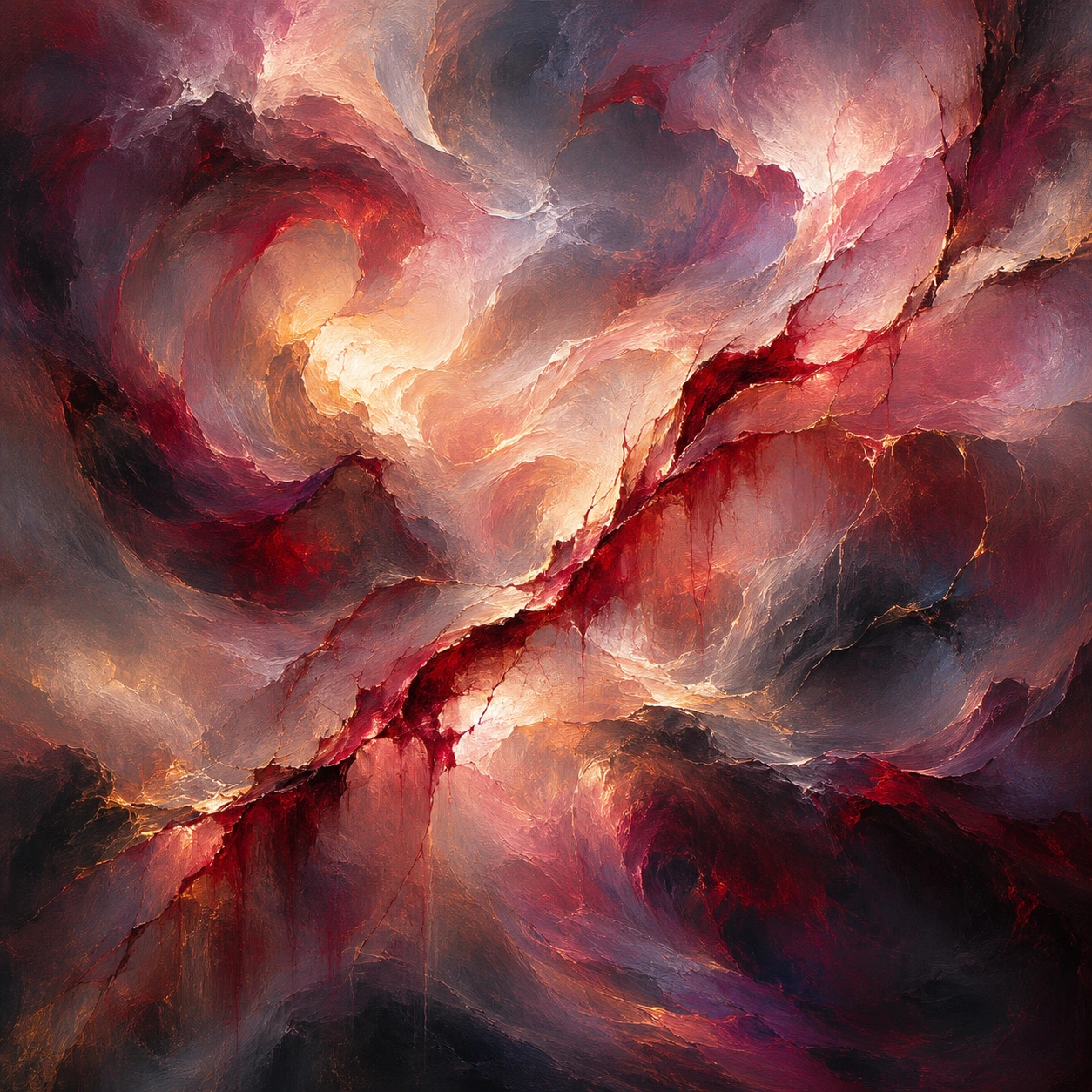
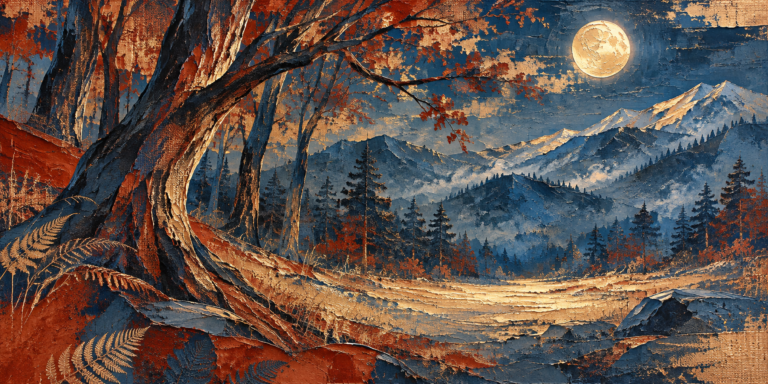
Warm light emerges from dark surroundings. Red foliage, roses and fabric meet pale fur, stone and mist; cracks and damaged edges interrupt otherwise sumptuous surfaces. The abstract study carries the same tension through a crimson fissure crossing luminous, paint-like swirls.
A name first, a theory afterwards
The starting instruction was deliberately open: present the term Scaromantism to the image generator across different subjects, then examine the results. The seven initial requests specified subjects, formats and presentation requirements, but supplied no palette, medium, historical movement or definition. One request also required the central collage title. This reverses the usual process of writing a style manifesto and illustrating it.
The resulting images are the evidence for this AOI interpretation. They cannot reveal a model’s internal representation of the word or establish what every generator would produce. Different prompts, systems or runs could take the name elsewhere. Even an open request is shaped by its chosen subject and framing; this is a documented creative experiment, not a controlled scientific study.
What appeared across the subjects
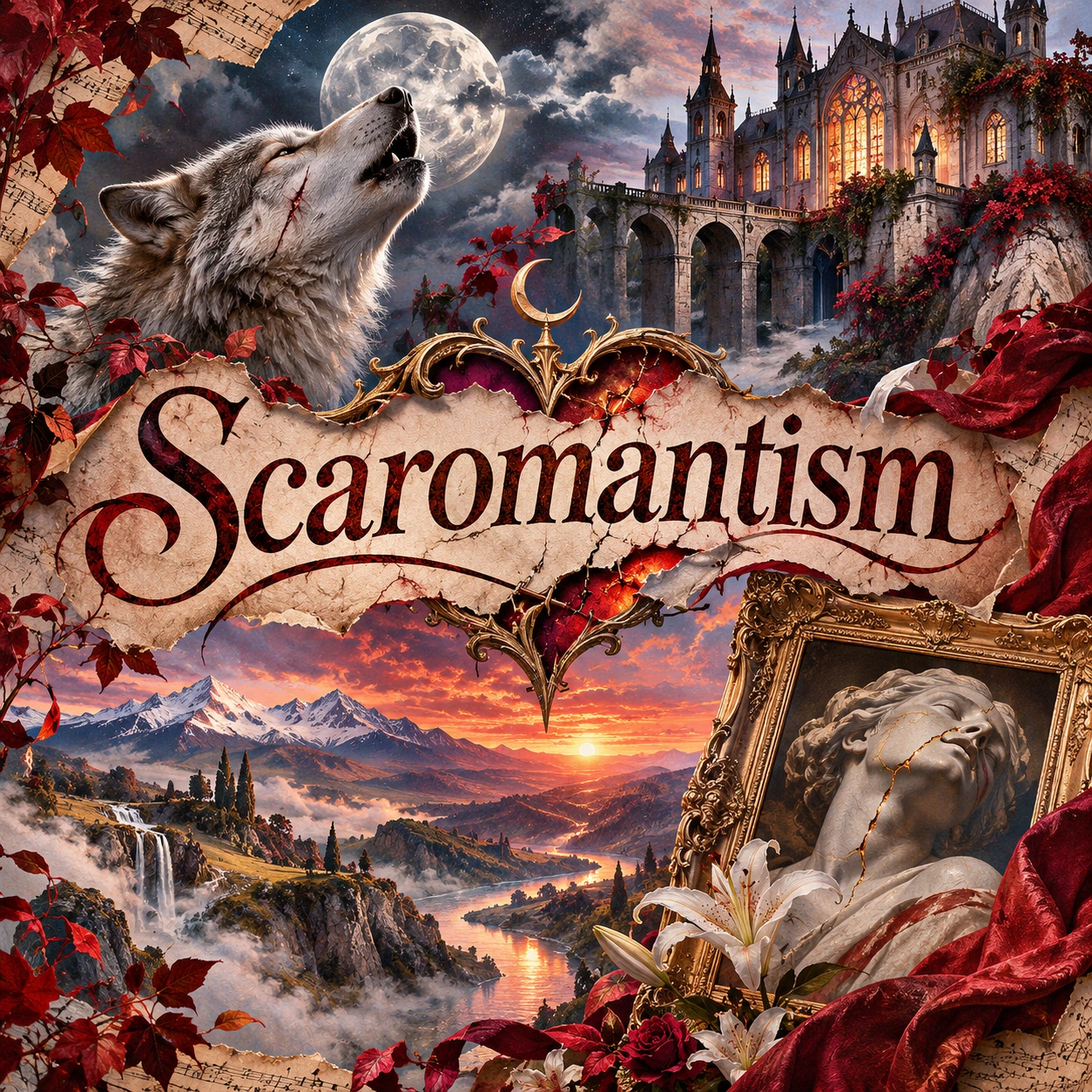
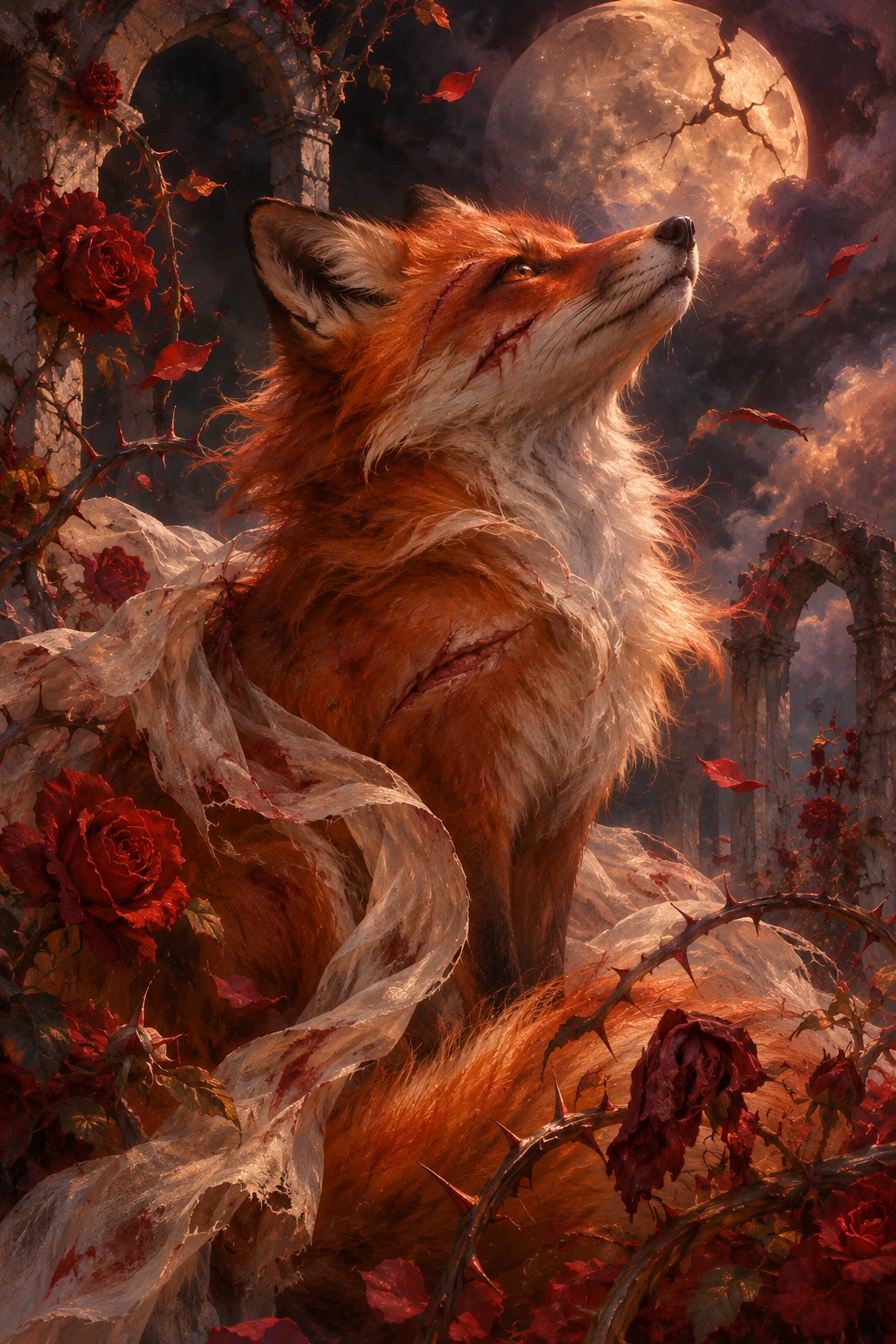
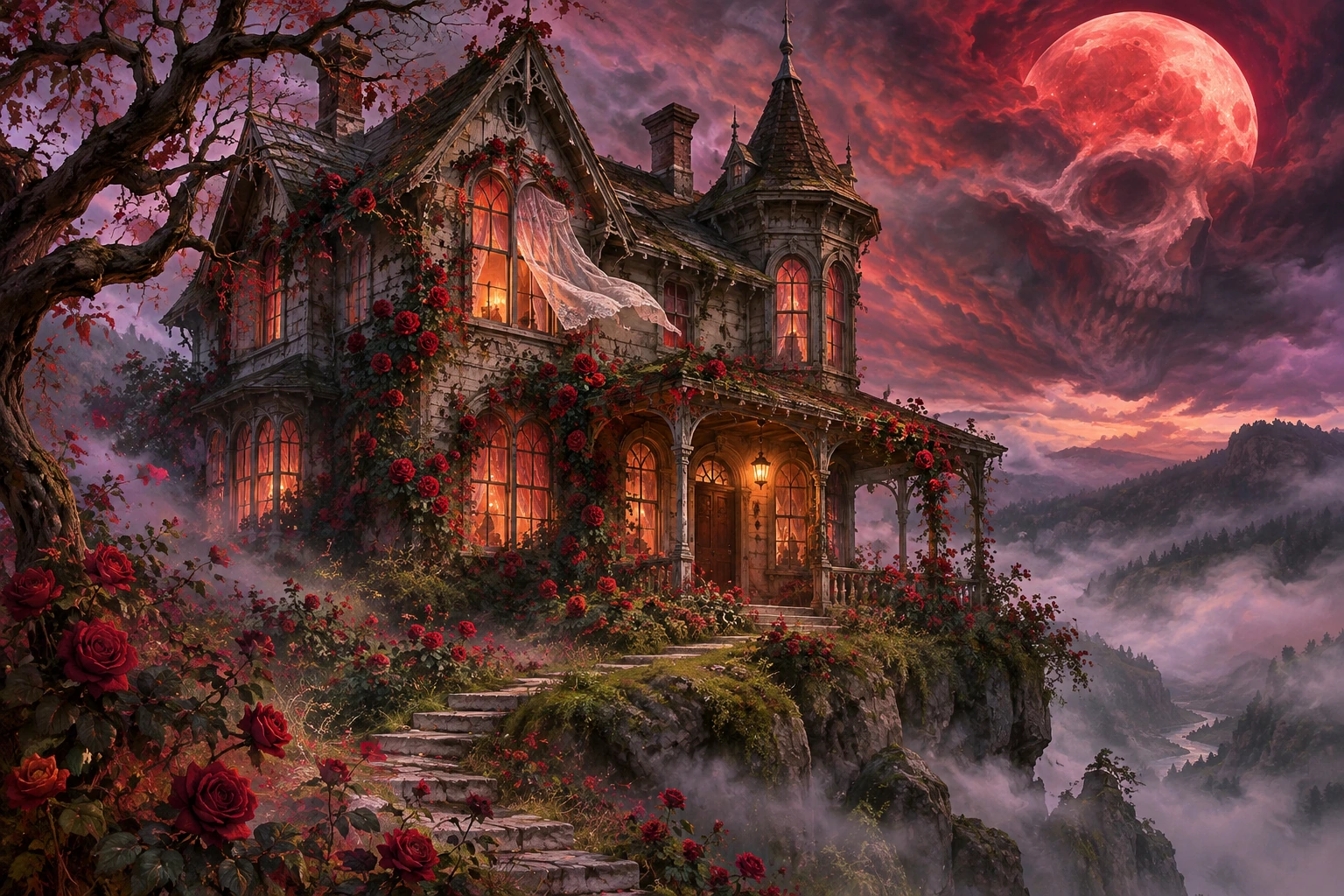
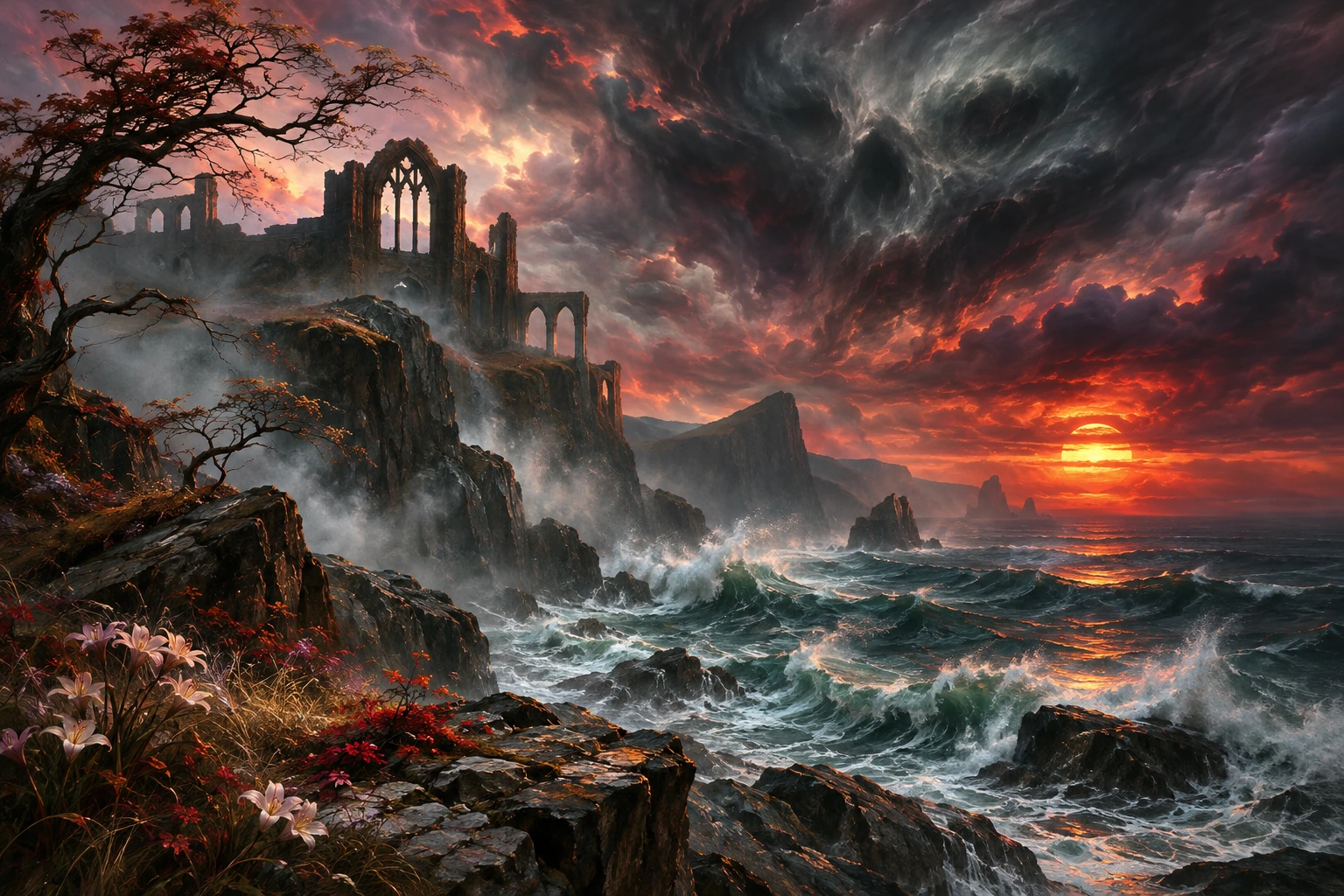
The banner places a pale stag beside a glowing Gothic building, waterfalls and a stone bridge under an enormous red moon. The fox study adds scars, roses, torn fabric and a fractured moon. The house uses warm windows and flowering growth against a skull-shaped cloud. The coast replaces domestic shelter with waves, cliffs and ruined arches, while another skull-like form gathers in the storm.
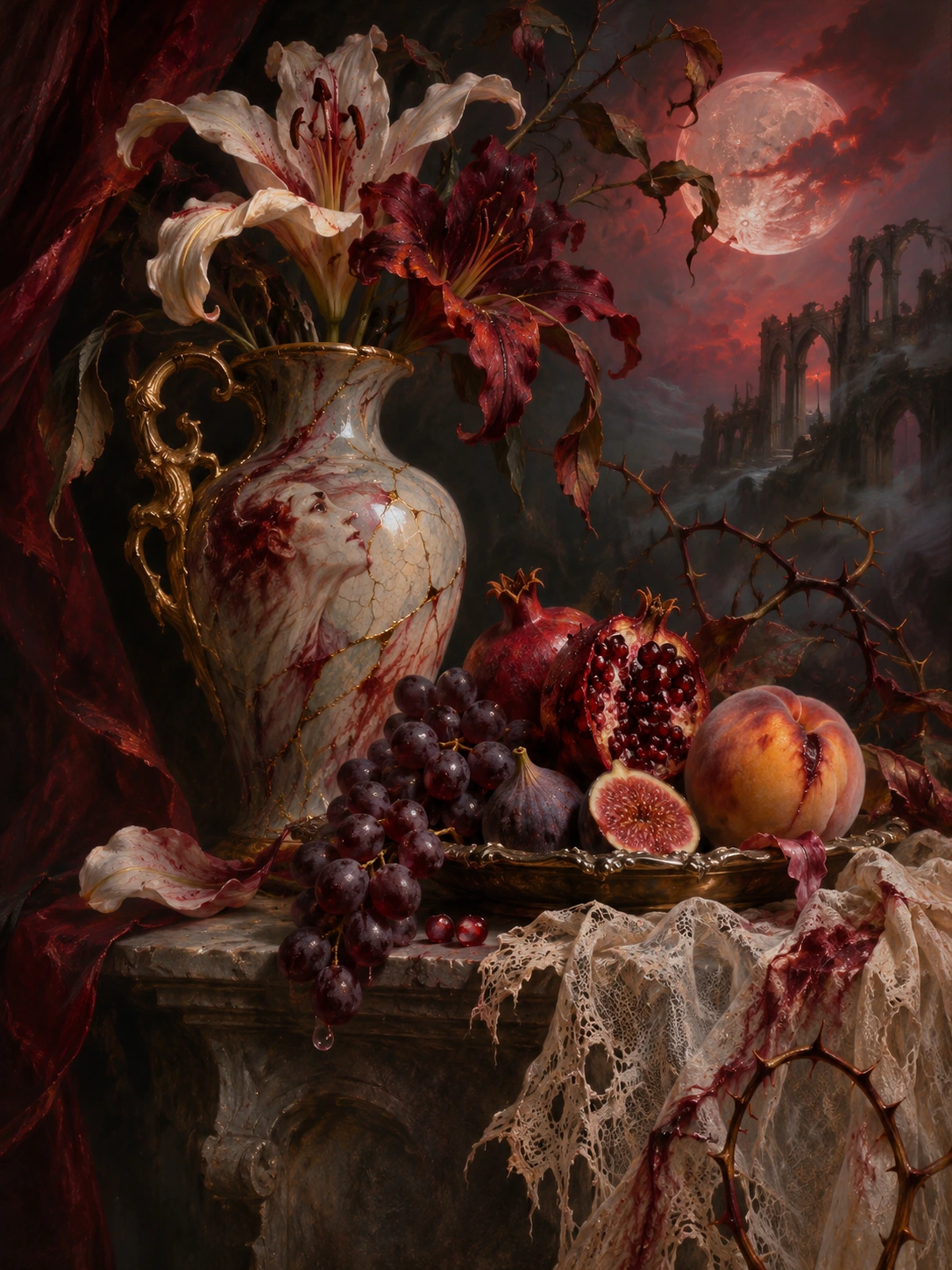
The still life changes scale: the drama moves into a cracked ornate vase, lilies, fruit, lace and thorns. The abstract image goes further, leaving recognizable objects behind. Luminous cream and mauve swirls meet a deep crimson fissure with fine gold-colored edges. This last image gives the proposed style a useful test: can the tension survive when the familiar Gothic scenery disappears? Here, it does.
A working visual grammar
For this series, the most useful principle is beauty interrupted but still present. Keep something lucid and inviting—a face, a window, a gleam, a soft fold—then introduce a disruption that changes how it feels. A crack should cross a meaningful form; an ominous cloud should alter the atmosphere of a place. Damage scattered everywhere becomes texture without consequence.
Composition carries much of the effect. A bright focal area emerges from darker masses; a curve or diagonal leads towards it; mist, fabric or painterly transitions soften the surrounding space. The strongest passages alternate dense detail with areas that let the subject breathe. Red and amber recur here, but they are observations, not mandatory colors. A future monochrome interpretation could test the same relationship through value and edge contrast.
Reading the name without inventing its history
After seeing the images, it is tempting to read Scaromantism as an association between scars and Romanticism. That is an editorial interpretation of the spelling and results, not verified etymology or proof of the generator’s reasoning. No historical school, founding manifesto or artist membership is asserted here.
Romanticism offers a useful comparison rather than a pedigree. The Metropolitan Museum’s account emphasizes imagination, emotion and the power of nature. Those ideas help describe the coast’s overwhelming weather and the banner’s charged landscape. They do not turn these generated pictures into nineteenth-century Romantic works, nor establish Scaromantism as a recognized branch of that movement.
Material appearance and the collage
Several images imitate rich painted surfaces, aged stone, porcelain, fabric and gilt ornament. These are visual effects inside generated illustrations. A gold-colored crack in the vase is not evidence that an object was physically repaired with a particular craft technique. Likewise, the abstract image’s apparent impasto does not establish that paint was applied to a canvas.
The titled collage gathers the subject families around a central strip of torn-looking paper. MoMA’s glossary describes physical collage through materials attached to a support; this image instead creates a digital collage-like appearance. Its wolf, architecture, landscape and sculptural fragment are generated motifs, not documentary photographs of artifacts.
Use the method as well as the look
To repeat the experiment, keep the style term constant and vary the subject while leaving the visual definition open. Record the exact requests and compare outputs before writing rules. Notice absences and exceptions as carefully as repeated motifs. A single successful picture can suggest a direction; it cannot establish a reliable universal style code.
To develop the observed look deliberately, choose one inviting feature and one disturbance. For a book cover, protect a strong silhouette and a calm area for separately designed typography. For wall art, test the tonal structure at a distance. For speculative clothing or interiors, translate the contrast into seams, layered surfaces or controlled weathering rather than covering every object with skulls. These are proposed applications, not additional tested outcomes.
Where the interpretation can fail
The repeated red moons, roses and ruins make this set recognizable, but they also reveal a risk of formula. A new subject can become merely another occupant of the same theatrical backdrop. The abstract study is therefore more than an extra example: it suggests how to retain the relationship between radiance and rupture while dropping the stock scenery.
Scars and decay can carry emotional force, yet their presence alone does not create a story. Ask what remains intact, what has changed and where the viewer should look. The initial banner also acquired unwanted lettering despite the request for none; focused edits and a tighter framing removed it. The published gallery is a reviewed interpretation, with that presentation correction recorded, rather than an untouched claim about perfect prompt compliance.
Positive editorial review (AI-authored)
Scaromantism’s strongest achievement in this series is the persistence of a visual relationship across scale. The luminous window, the fox’s lit fur, the vase’s porcelain and the abstract painting-like glow all remain attractive while something interrupts their completeness. The coastal scene gives that tension breadth; the still life gives it intimacy. The abstract example is especially valuable because its fissure and light sustain the idea without a castle, animal or skull.
Negative editorial review (AI-authored)
The series leans heavily on red moons, Gothic ruins, roses and ominous clouds. These motifs can make a loosely prompted experiment look more varied in subject than in imagination. Some images are so richly decorated that damage risks becoming another luxury finish. A stronger next investigation would vary light, palette and emotional register while preserving only one relational rule, then keep the less predictable results instead of choosing solely for theatrical beauty.
Neutral editorial review (AI-authored)
This entry presents a generator-led AOI concept supported by seven reviewed visual studies, including a titled collage and a corrected banner. Its definition is provisional and specific to the displayed set. It is useful as a dark fantasy art direction and as a method for developing a visual vocabulary from an open term. It does not establish an art-historical movement, a fixed technical process or a reproducible response across all image systems.
A small poetic detour
Original words from the AOI studio.
Poetry
The window keeps a little fire,
The thorn climbs higher than the spire.
A pale flank catches evening’s thread;
The roses lean towards the red.
Across the bowl, a fracture stays;
Light gathers where the surface frays.
The sea pulls darkness through its foam—
And something broken still makes home.
The prompt workshop
Original creative exercises. These prompts create new illustrations, not documentary evidence.
Let the name choose a direction
Create an original artwork in the style of Scaromantism. Subject: a bicycle. Interpret the style term visually without a supplied palette, medium or definition. Keep the subject recognizable. No text or signature. After generation, describe the actual recurring forms, light and material effects before deciding what the style means.
Develop the observed tension
Create a Scaromantism-inspired still life using the visual interpretation developed in this AOI study: one pale ceramic vessel with a meaningful fracture, a soft illuminated fabric fold and a dark surrounding space. Let warmth and damage coexist. Use a strong focal point and restrained supporting detail; avoid filling every surface with cracks. Original artwork, no text.
Test the idea without Gothic props
Explore the AOI Scaromantism interpretation as an abstract composition: a luminous continuous form interrupted by one dark irregular division. Use a monochrome palette and vary hard and soft edges. No moons, roses, skulls, buildings or recognizable objects. Keep the contrast between attraction and disturbance readable at a small viewing size. No text.
Your next inspiration
Discover another art style
Follow a visual thread to the next subject.
A smile from the studio
Jokes
The Scaromantist estate agent described the house as “full of character.” The buyer asked whether that included the skull in the clouds. “That is the weather,” said the agent. “The roses are included, the moon is negotiable, and the structural survey has been replaced by a very moving poem.”