
Fantasy genre in visual storytelling
Explore dark fantasy through impossible architecture, daylight unease and fairytale choices, with original illustrations, a film case study and drawing prompts.
A visual introduction
Seven original AOI illustrations explore unease in daylight, architecture, paper theatre, still life and sequential art. The documented film and prints are discussed in the article and linked below.
Select an image for a closer look. Use the thumbnails, arrow keys or a swipe to compare examples. Zoom in to inspect details, or share the image that inspires you.
Creative toolbox · take this style further
Choose an input and a destination. Search sends your words to the chosen site; Copy & open puts them on your clipboard to paste there.
Create with AI
Turn your chosen input into an image prompt or a new creative direction.
ChatGPT
Copy your input and paste it into a ChatGPT conversation or image request.
Copy & open ChatGPT (new tab)Claude · Anthropic
Develop an image prompt or explore the style in a new Claude conversation.
Copy & open Claude · Anthropic (new tab)Midjourney
Paste your input into the Imagine bar on the Create page.
Copy & open Midjourney (new tab)Adobe Firefly
Copy your input, open Firefly, and paste it into the prompt field.
Copy & open Adobe Firefly (new tab)Leonardo.Ai
Copy your input, open Leonardo, and paste it into the generation field.
Copy & open Leonardo.Ai (new tab)Image search
Find visual references. Short, concrete keywords usually work best.
Lexica
Search AI images and prompts using your selected input.
Search with this input Lexica (new tab)Pexels
Search the photo and video library. Short keywords often work best.
Search with this input Pexels (new tab)Pixabay
Search photos, illustrations and other images.
Search with this input Pixabay (new tab)Unsplash
Search photographs using the style name or your own keywords.
Search with this input Unsplash (new tab)Wikimedia Commons
Search photographs, artworks and historical images. Check each file for its source and reuse terms.
Search with this input Wikimedia Commons (new tab)Art & research
Explore artists, collections and the ideas behind a style.
Wikipedia
Search for background reading. A style may not have its own article.
Search with this input Wikipedia (new tab)WikiArt
Copy your input into WikiArt’s search to explore artists and artworks.
Copy & open WikiArt (new tab)Europeana
Paste your keywords into the search to explore European museum, library and archive collections.
Copy & open Europeana (new tab)Inspiration
Discover portfolios and visual ideas from creative communities.
Instagram hashtags
Search a hashtag made from your input: spaces and punctuation are removed. Instagram may require sign-in.
Search with this input Instagram hashtags (new tab)ArtStation
Paste your input into artwork search for concept art, environments, characters and visual development.
Copy & open ArtStation (new tab)Behance
Paste your input into project search for illustration, design and visual storytelling.
Copy & open Behance (new tab)A closer look
Start with something the eye can trust: a porcelain rim, a bridge rail, a shadow on linen. Give one part of that scene an impossible behavior. The time it takes the viewer to notice the discrepancy is part of the composition.
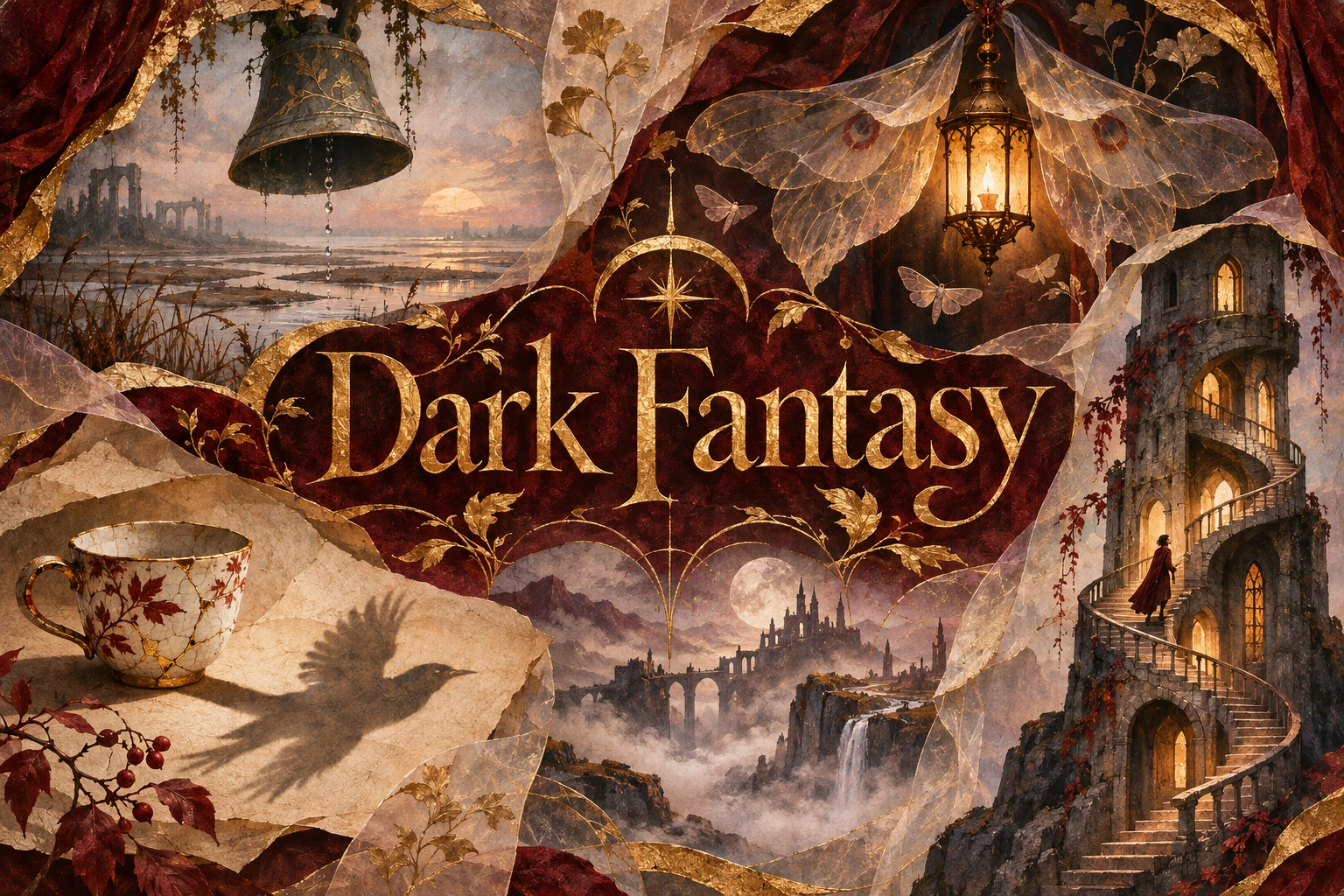
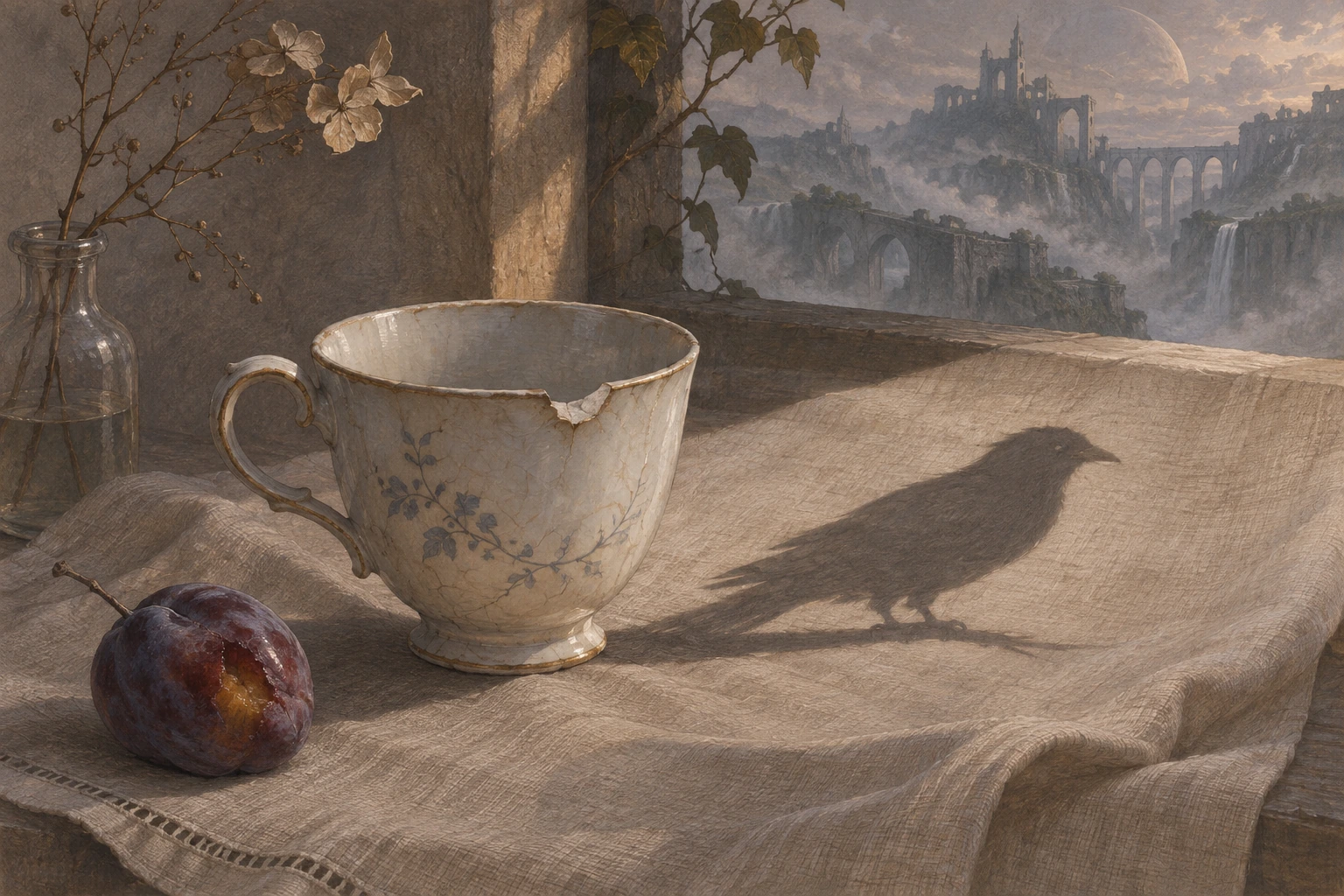
The cup casts a bird
A white cup stands on the table beside a plum. At first the eye reads a domestic still life. Follow the shadow to its tip and it has a beak. Return to the cup and the handle looks just as solid as before. That little journey is one way into dark fantasy. The invented world offers enough dependable detail to make a single breach of its rules feel consequential.
Dark fantasy is a flexible genre across fiction, illustration, film and games. It brings imagined worlds into contact with fear, loss or moral uncertainty. High fantasy can share its elaborate settings, and horror can share its unease. Here a particularly useful question is what the strange encounter asks of the person facing it. Can the visitor trust a beautiful guide? What would they give up to cross the water?
A guide who grows more beautiful
In Pan’s Labyrinth (2006), Ofelia encounters a faun in Spain under Franco in 1944. In his interview with Mark Kermode for Sight and Sound, Guillermo del Toro connects her freedom to choose in the fairy world with the coercion surrounding her in daily life. He also describes a striking design decision. The faun becomes more physically attractive as Ofelia has greater reason to distrust him.
That reversal gives an illustrator something precise to try. Draw a guide twice. In the second version soften the folds of its coat and let more light reach its face. Keep its outstretched hand in exactly the same position. Then change what lies beyond the hand. A sweeter expression can make an invitation harder to accept. The tension comes from the relationship between the images.
Two prints worth looking at slowly
In Goya’s The Sleep of Reason Produces Monsters, plate 43 of Los Caprichos (1799), a figure folds over a desk while bats and owls crowd the air behind him. Etched lines define the desk and sleeve. Aquatint lets the background take on a grainy density. Cover the animals for a moment and the desk feels sturdy enough to work at. Uncover them and the same bright rectangle looks like a very small refuge. The Met places the print within a satirical series concerned with Spanish society.
Piranesi’s The Round Tower, from his Imaginary Prisons, offers another way to unsettle a viewer. Trace one architectural route until an intervening mass obscures its destination. The eye keeps trying to complete the walk. These prints belong to their own historical projects. A contemporary illustrator can study their handling of tone and interrupted space without assigning either artist a modern genre identity.
Make the uncanny legible in daylight
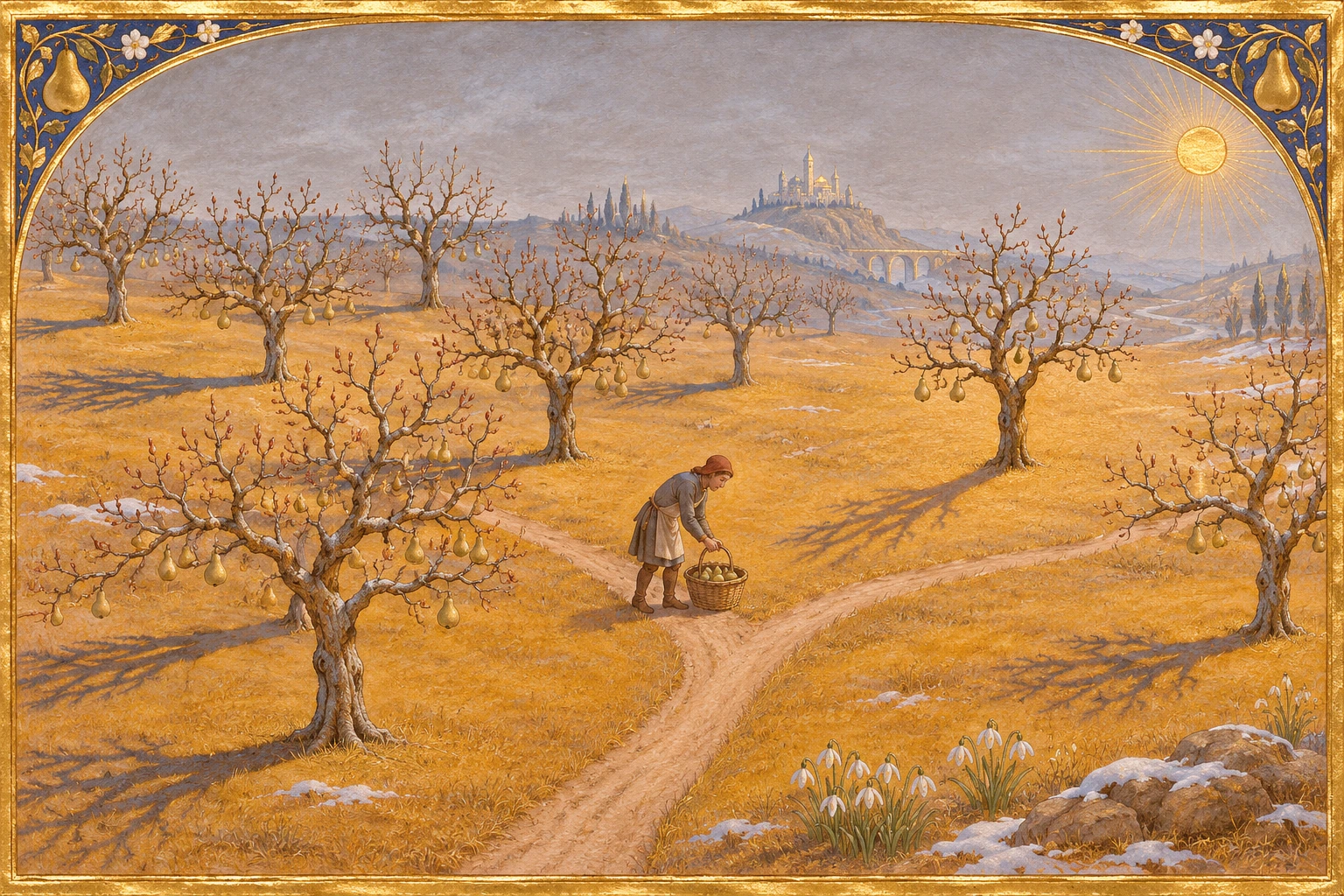
In the orchard study, pale branches spread against a gold field and a gardener bends toward a basket. Start with the direction of the sun. Compare the shadows beside two neighboring trunks before looking for a story in the distant buildings. Brightness gives the viewer enough information to test whether the place makes sense. A picture can raise doubt on a cloudless afternoon.
For a thumbnail exercise, block the picture in three values. Give the basket and the gardener a shared silhouette at the fork in the path. Introduce one change in the direction or length of a tree shadow. Read the sketch from arm’s length. If the clue is invisible, improve the separation between ground and shadow before adding leaves or increasing saturation.
Paper, thread and the price of a crossing
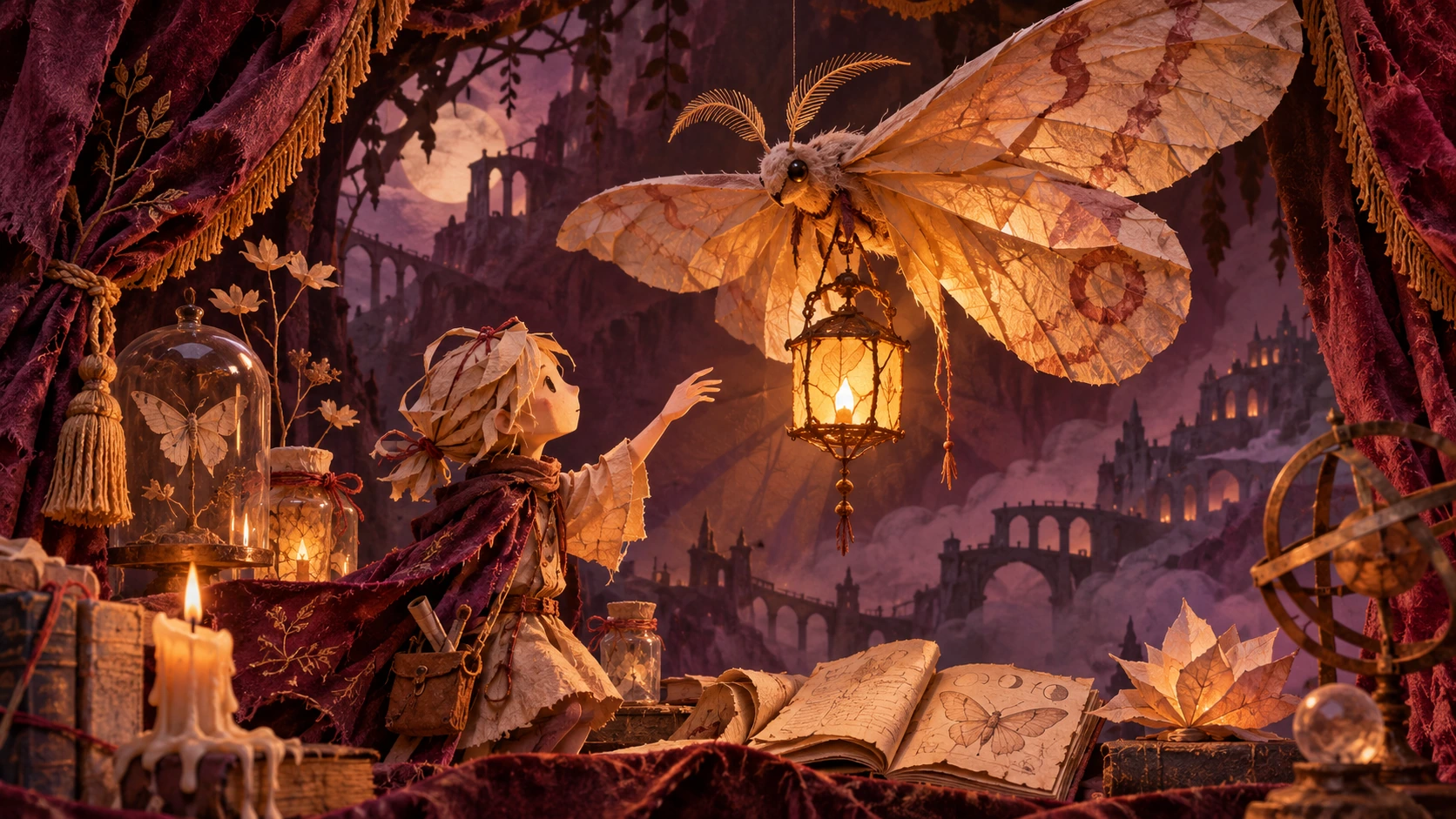
In the puppet-theatre study, the moth’s wings filter the lantern light. The paper edge catches amber, velvet absorbs it, and the keeper reaches up into the gap. These differences give the creature weight and also suggest a bargain. The light is close enough to want. Its bearer is free to leave. A convincing supernatural creature often begins with an ordinary observation about material.
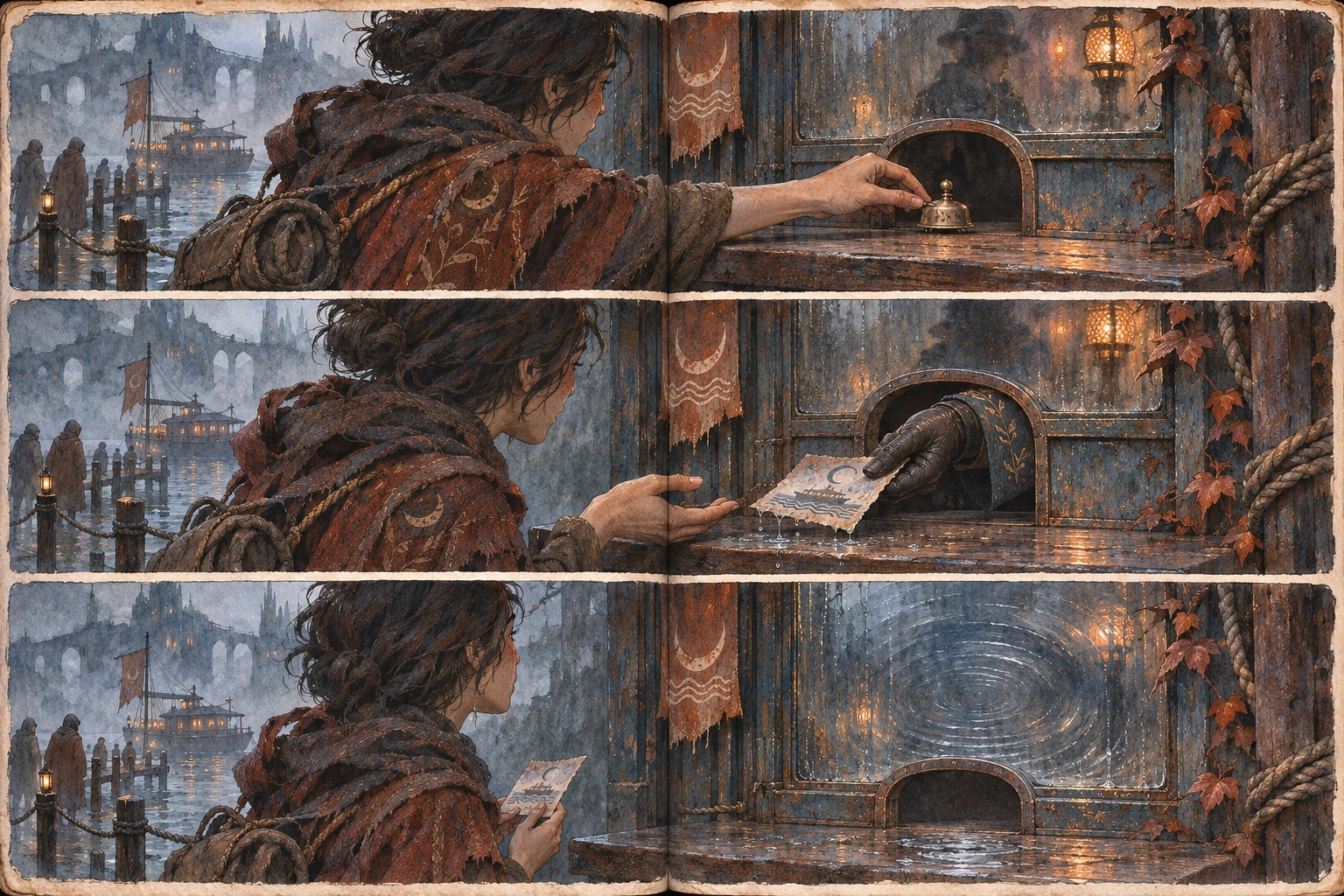
A sequence brings another resource: the interval between images. In the ticket-window study the counter stays in place across three panels. An object offered in one panel and a ticket returned in the next establish a transaction. When ripples occupy the window, the reader must supply the missing moment. For a book cover, compress that interval into one image with a trace of what just happened. For a game environment, put the trace where a returning visitor will recognize the change.
A practical test for an invented world
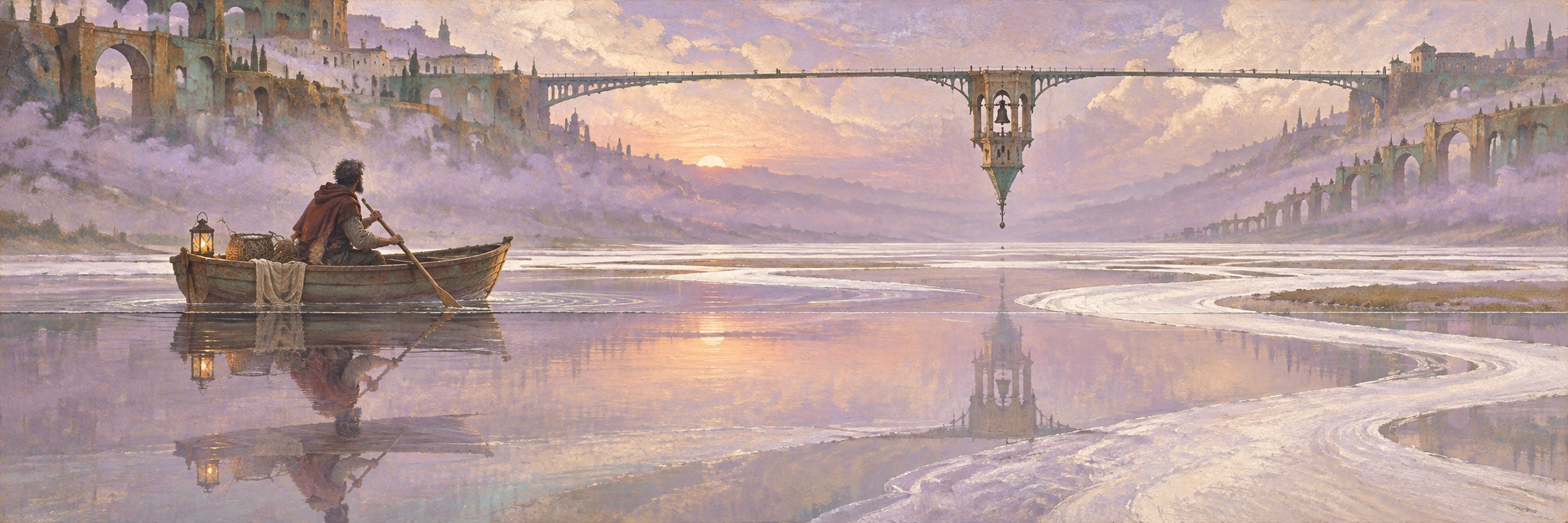
Choose one person, one ordinary rule and one visible exception. Give the person a reason to approach the exception, then draw the instant before the decision. A ferryman paid to cross at first light might notice that the bell tower under the bridge has no counterpart above it. Show the bow pointing toward the tower while his head turns toward the bank. The viewer can discover the competing possibilities before reading a caption.
Positive critical reading
The teacup study earns its surprise. The softened chip on the rim, the woven cloth and the ordinary purple plum invite slow looking. Only after those materials have become convincing does the eye meet the bird on the table. The possibility that it might fly away gives the quiet still life an unusually long afterlife.
Negative critical reading
A world in which every doorway glows and every shadow has teeth soon becomes predictable. Add enough ominous detail and the viewer loses the ability to tell a clue from wallpaper. Cover half the ornament in a thumbnail. If the choice confronting the character becomes clearer, leave that half out.
Neutral critical reading
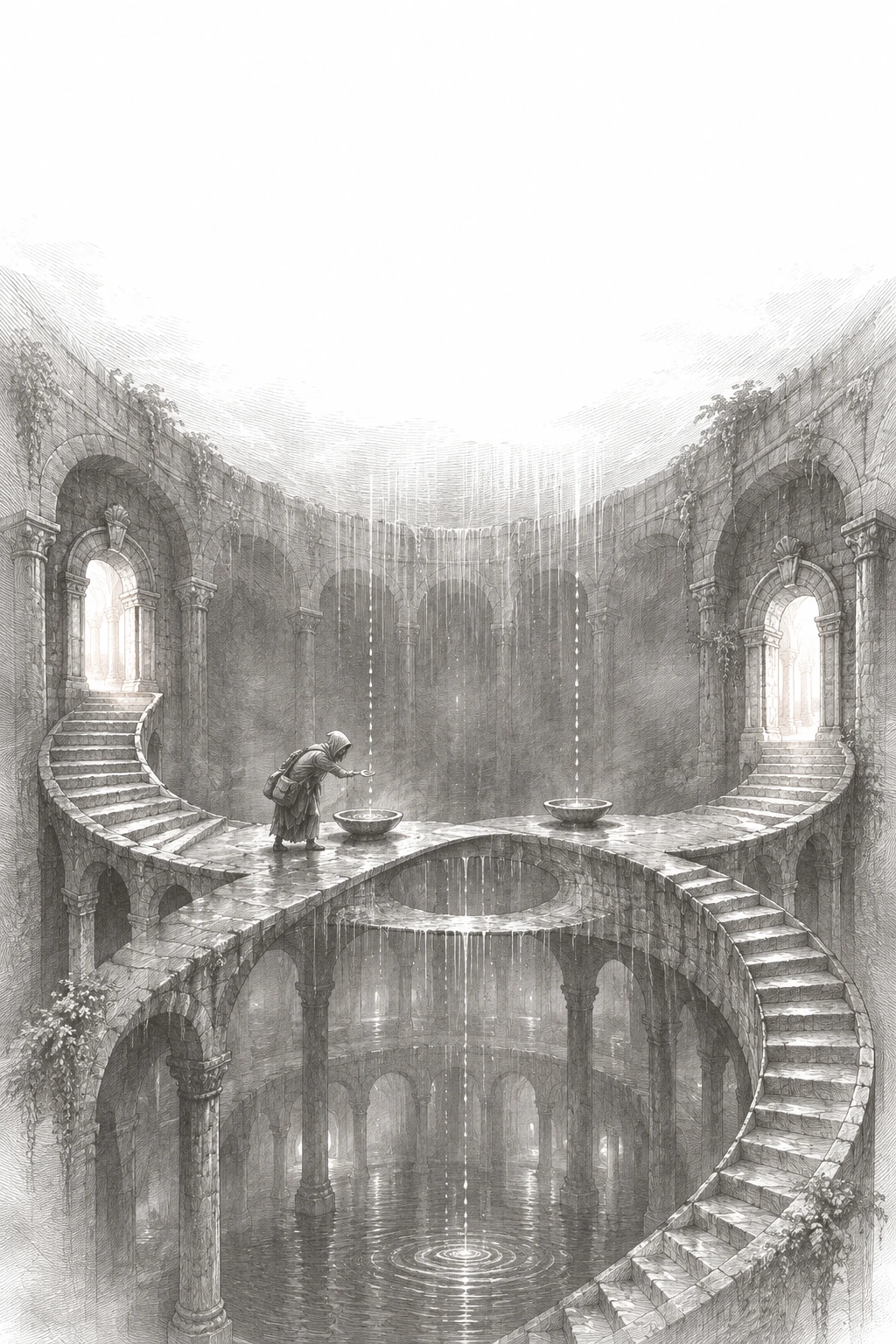
The stairwell can be read as an architectural puzzle or an anxious place to stand. Following the outer rails emphasizes symmetry. Following the solitary figure emphasizes the distance to either door. Both readings depend on the same lines, and the scale of the reproduction affects which one arrives first.
A small poetic detour
Original words from the AOI studio.
Poetry
The cup has cooled. Its shadow lifts a wing.
A spoon lies still where someone set it down.
Outside, the ferry bell begins to ring.
A second bell replies beneath the town.
I leave the window open just a crack.
Whatever leaves can find its own way back.
The prompt workshop
Original creative exercises. These prompts create new illustrations, not documentary evidence.
Let daylight give the game away
Draw a bright pear orchard with a gardener at a fork in the path. Establish the sun with three clear shadows. Let one shadow lean toward the sun. Keep the clue visible at thumbnail size.
Give the guide a choice
Build a miniature paper theatre with a moth carrying a lantern in front of a blue velvet curtain. Show a traveler reaching for the light and a clear way to leave. Make the paper transmit light and the velvet absorb it.
Change a room between visits
Draw three views of the same ferry ticket counter in ink. In the first panel a visitor offers a bell, in the second a ticket comes back wet, and in the third ripples cross the glass. Hold the viewpoint still. Use the interval between panels to suggest the price of the passage.
People & works to explore
References discussed in this article. Consult the sources below for context.
Artists and practitioners
Guillermo del Toro (film case study)
Francisco de Goya and Giovanni Battista Piranesi (historical comparisons)
Paintings and other works
Pan’s Labyrinth (2006), Guillermo del Toro
The Sleep of Reason Produces Monsters (1799), Francisco de Goya
The Round Tower, from Imaginary Prisons, Giovanni Battista Piranesi
A smile from the studio
Jokes
The ferryman charges one secret for the crossing. The baker whispers the ending of a book. He slides it back across the counter. He is only on chapter three.