
Drawing medium and group of distinct practices
Sand drawing makes images by displacing, arranging or removing grains. A finger can cut a line into a level surface; a rake can change the texture of a beach; loose sand on illuminated glass can form a moving silhouette. These methods share a material, but they do not belong to one movement with a single origin or cultural meaning.
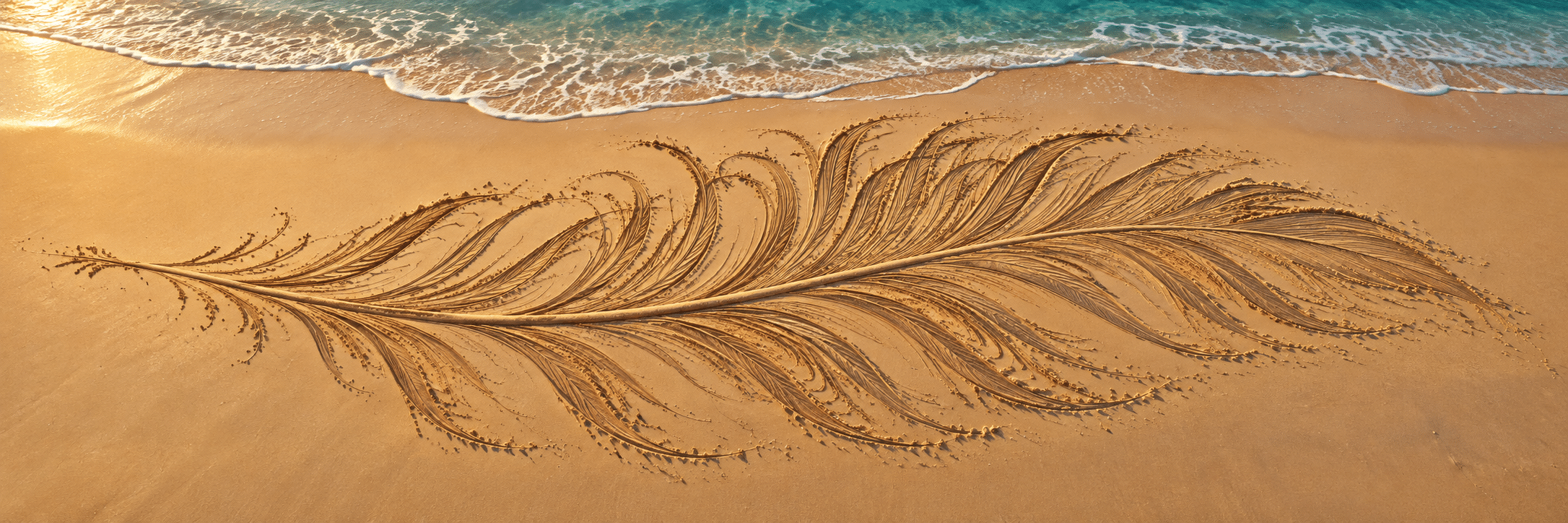
A visual introduction
Select an image for a closer look. Use the thumbnails, arrow keys or a swipe to compare examples. Zoom in to inspect details, or share the image that inspires you.


Creative toolbox · take this style further
Choose an input and a destination. Search sends your words to the chosen site; Copy & open puts them on your clipboard to paste there.
Create with AI
Turn your chosen input into an image prompt or a new creative direction.
ChatGPT
Copy your input and paste it into a ChatGPT conversation or image request.
Copy & open ChatGPT (new tab)Claude · Anthropic
Develop an image prompt or explore the style in a new Claude conversation.
Copy & open Claude · Anthropic (new tab)Midjourney
Paste your input into the Imagine bar on the Create page.
Copy & open Midjourney (new tab)Adobe Firefly
Copy your input, open Firefly, and paste it into the prompt field.
Copy & open Adobe Firefly (new tab)Leonardo.Ai
Copy your input, open Leonardo, and paste it into the generation field.
Copy & open Leonardo.Ai (new tab)Image search
Find visual references. Short, concrete keywords usually work best.
Lexica
Search AI images and prompts using your selected input.
Search with this input Lexica (new tab)Pexels
Search the photo and video library. Short keywords often work best.
Search with this input Pexels (new tab)Pixabay
Search photos, illustrations and other images.
Search with this input Pixabay (new tab)Unsplash
Search photographs using the style name or your own keywords.
Search with this input Unsplash (new tab)Wikimedia Commons
Search photographs, artworks and historical images. Check each file for its source and reuse terms.
Search with this input Wikimedia Commons (new tab)Art & research
Explore artists, collections and the ideas behind a style.
Wikipedia
Search for background reading. A style may not have its own article.
Search with this input Wikipedia (new tab)WikiArt
Copy your input into WikiArt’s search to explore artists and artworks.
Copy & open WikiArt (new tab)Europeana
Paste your keywords into the search to explore European museum, library and archive collections.
Copy & open Europeana (new tab)Inspiration
Discover portfolios and visual ideas from creative communities.
Instagram hashtags
Search a hashtag made from your input: spaces and punctuation are removed. Instagram may require sign-in.
Search with this input Instagram hashtags (new tab)ArtStation
Paste your input into artwork search for concept art, environments, characters and visual development.
Copy & open ArtStation (new tab)Behance
Paste your input into project search for illustration, design and visual storytelling.
Copy & open Behance (new tab)A closer look
Grooves and ridges, granular edges, changes between dense and sparse deposits, and a strong relationship between untouched surface and worked areas. Light can reveal shallow relief or pass through cleared spaces, depending on the method.
Begin with the action that makes the mark
A line drawn into sand is a small displacement of material. Its edge may include a raised ridge, a shadow and scattered grains. A line made by pouring sand is an accumulation instead. Both can produce a drawing, but their visual behaviour differs. Describe the action before deciding what the finished image should resemble.
Distinguish relatively flat sand drawings from sculpted volumes and from pictures made with sand fixed to a support. Temporary work is common, but impermanence is not an absolute definition of every sand-based artwork. Nor does the medium require intricate geometry: a single path, silhouette or erased patch may be enough.
Distinct histories deserve distinct names
UNESCO documents Vanuatu sand drawing as a living cultural practice with communicative and other social functions. Its account describes a finger tracing a continuous line through an imagined grid, using sand, volcanic ash or clay. The patterns belong to a system of knowledge and interpretation, not simply a collection of interchangeable decorative designs.
That example does not establish a universal history for all drawing in sand. A contemporary beach intervention, a studio experiment and a culturally specific practice may use related materials while having different purposes and responsibilities. Learn from the named practitioners and communities when discussing a particular tradition. The original gallery exercises here do not claim Vanuatu provenance or reproduce its named patterns.
Contemporary beach work and moving images
Andres Amador describes his earthscape practice through large temporary drawings raked into beach sand. In his account, worked and undisturbed areas produce visible differences, while the returning tide gives the work a limited duration. His practice provides a specific contemporary example rather than an origin story for the whole medium.
Sand also supports animation. The Harvard Film Archive documents Caroline Leaf’s early film Sand, or Peter and the Wolf and her work with sand animation. Here, a camera records successive changes to the material. A drawing can become another drawing through pushing, clearing and redistributing grains. Live sand performance and frame-by-frame filmmaking are related possibilities, but their timing and production methods should not be treated as identical.
Three useful visual systems
In a grooved drawing, think about the width, depth and continuity of the path. Side lighting can make a shallow cut visible through its shadow. Keep nearby marks far enough apart that their ridges do not collapse into one unreadable area. On a large site, the final viewing position matters as much as the view from the maker’s feet.
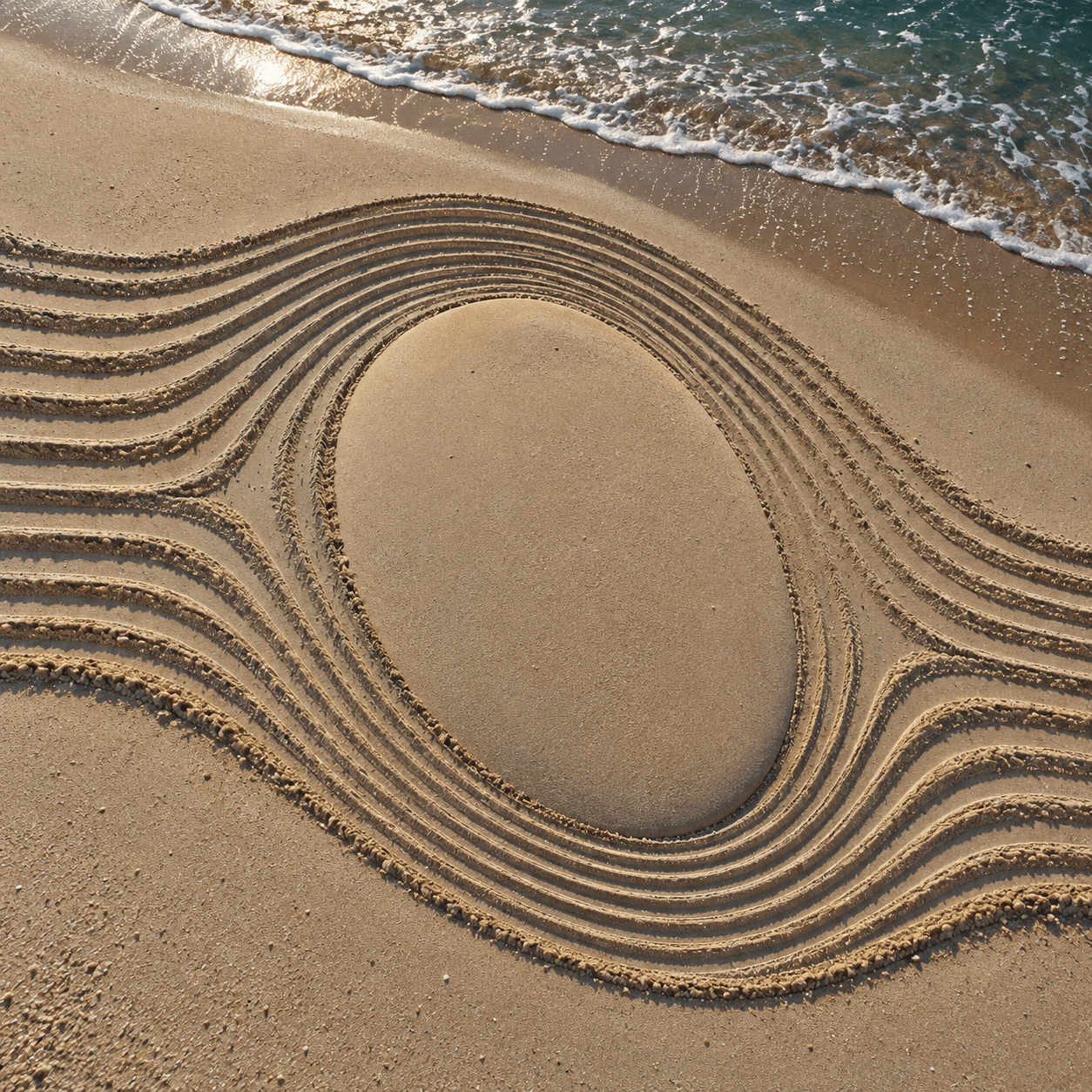
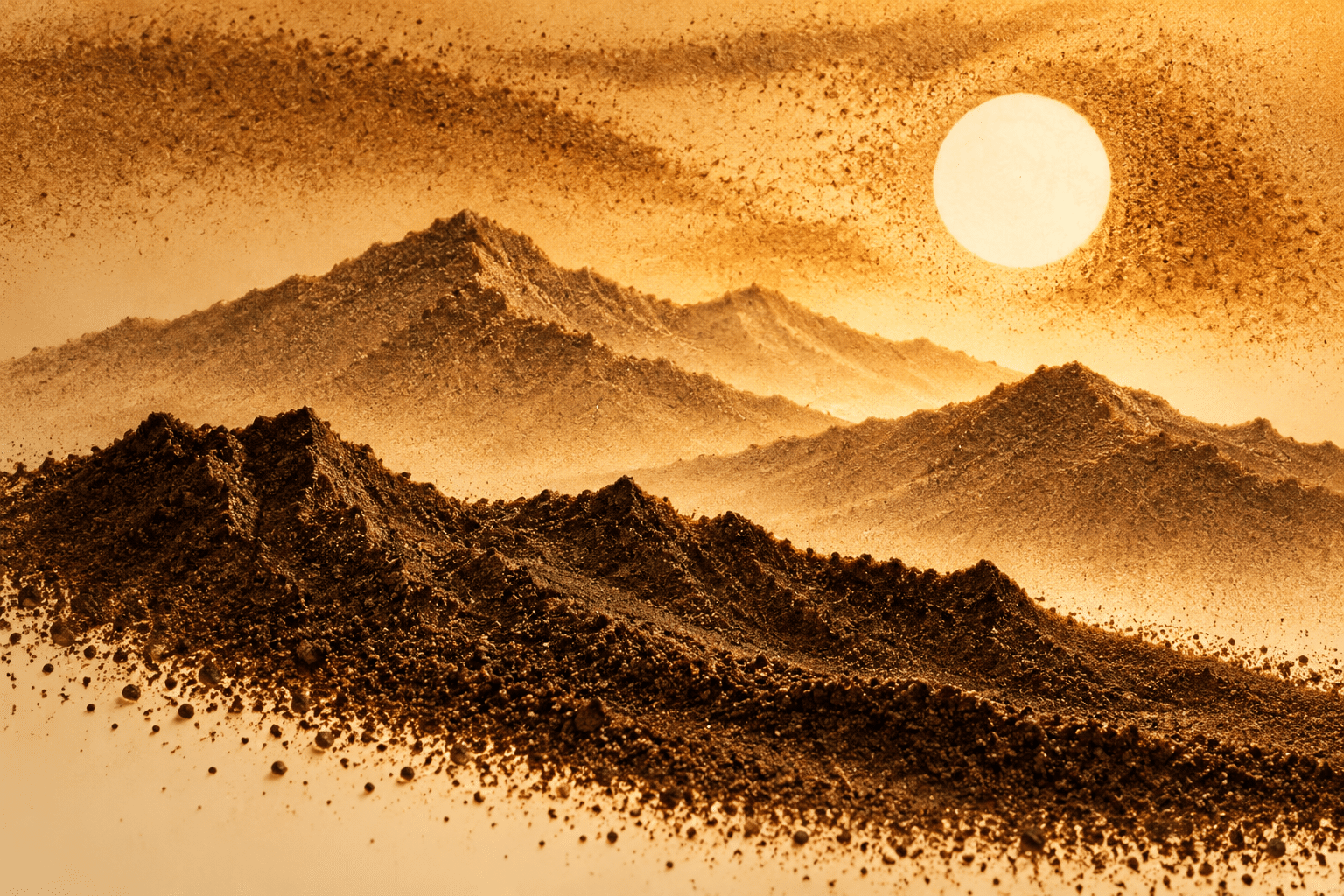
In a raked field, compare smooth and rough areas. Repeated lines can suggest flow, while an untouched shape becomes a quiet focal point. On a lightbox, thicker sand blocks more light and cleared glass becomes bright. A sparse dusting gives intermediate tones. These are different systems of contrast; a prompt or demonstration should make its chosen system explicit.
Composition: give the eye somewhere to rest
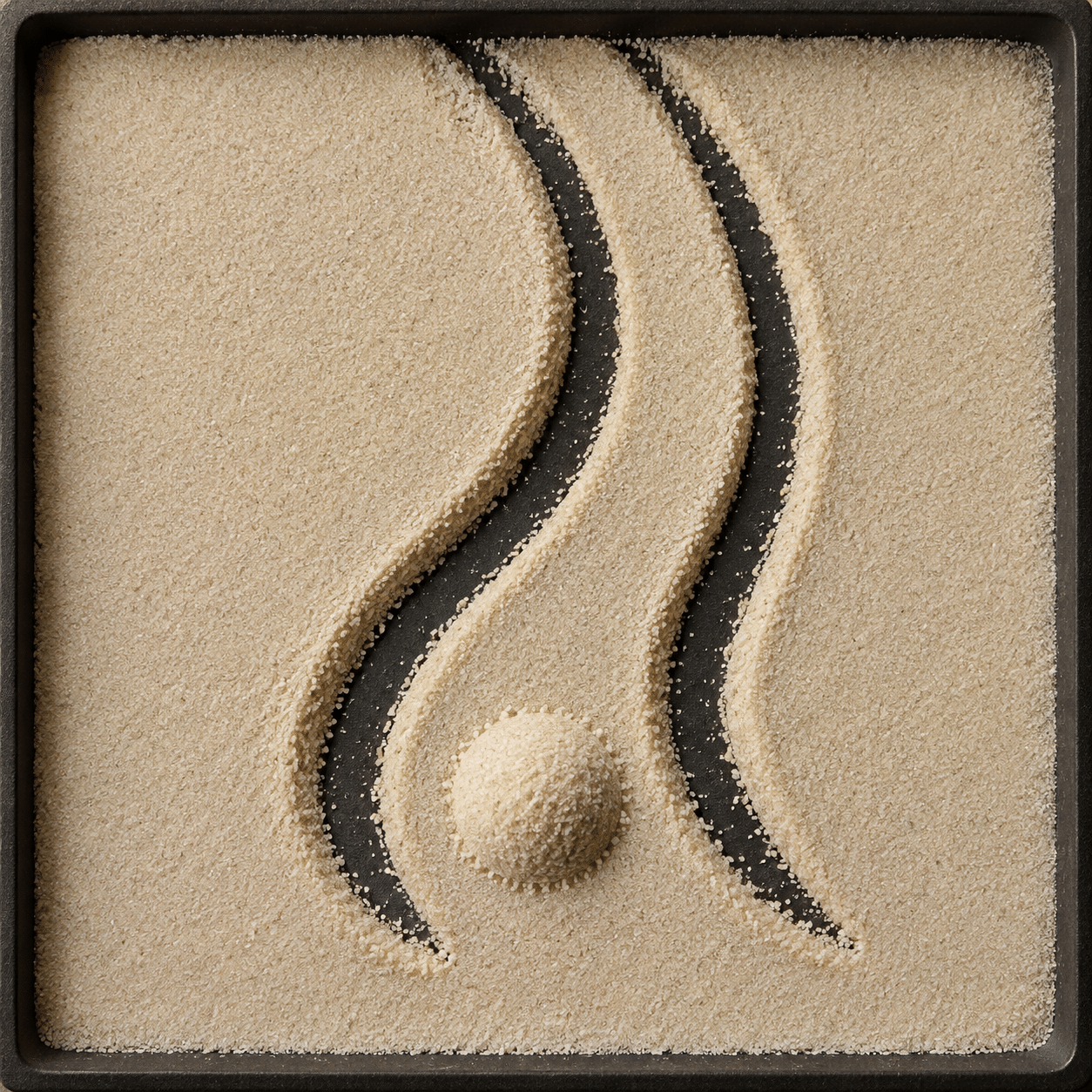
Choose a principal shape or direction before adding detail. A curved channel can lead toward a shell-like outline; a dark silhouette can emerge from a wide luminous field; a series of raked bands can break around one smooth island. Empty areas are active parts of the design, not unfinished spaces waiting to be filled.
Match detail to scale. Fine grains can reward close looking in a small tray, but a large outdoor drawing needs broad relationships that remain readable from its intended viewpoint. Test the composition as a small sketch or photograph. If every region has equal density, simplify one region so the main gesture can carry farther.
An accessible studio exercise
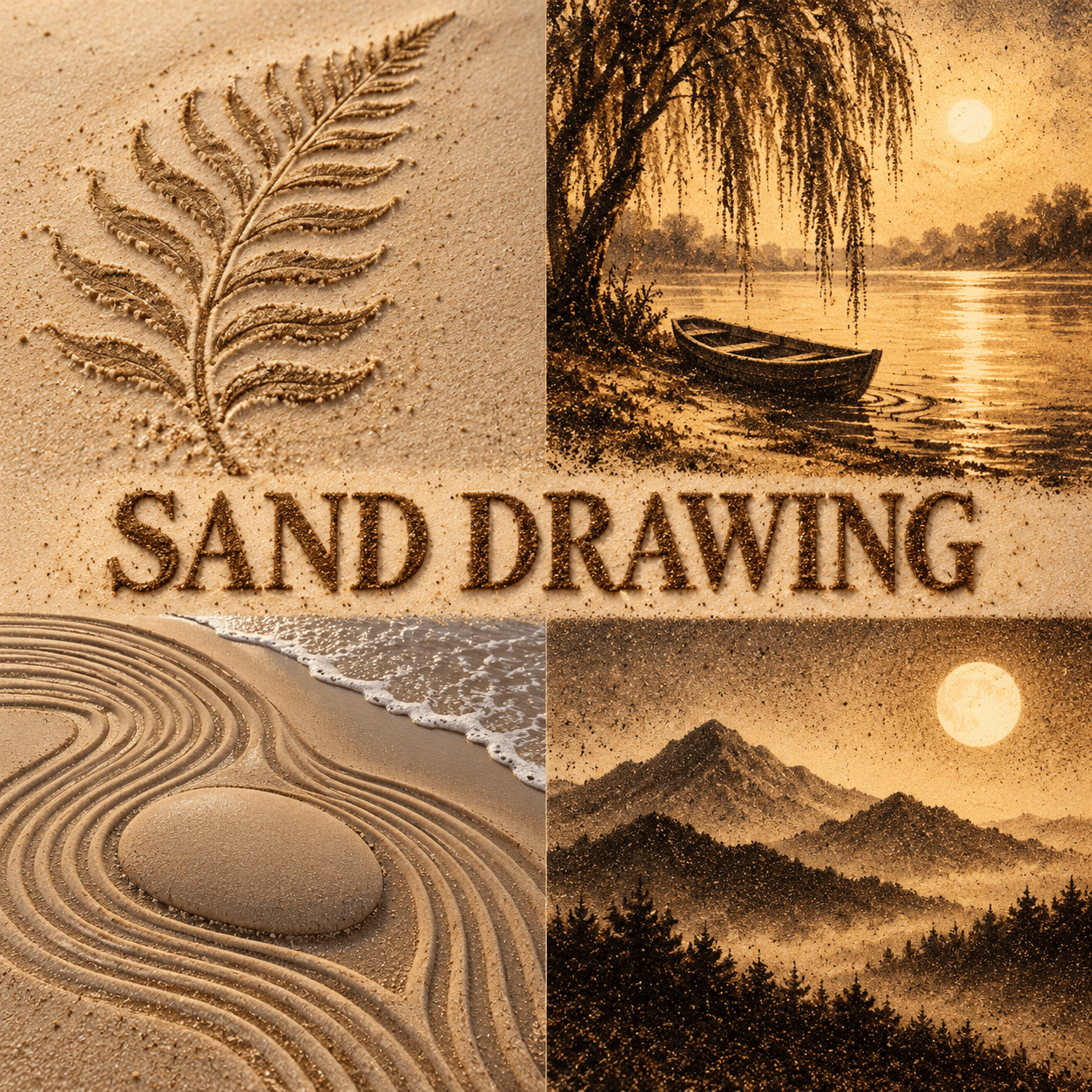
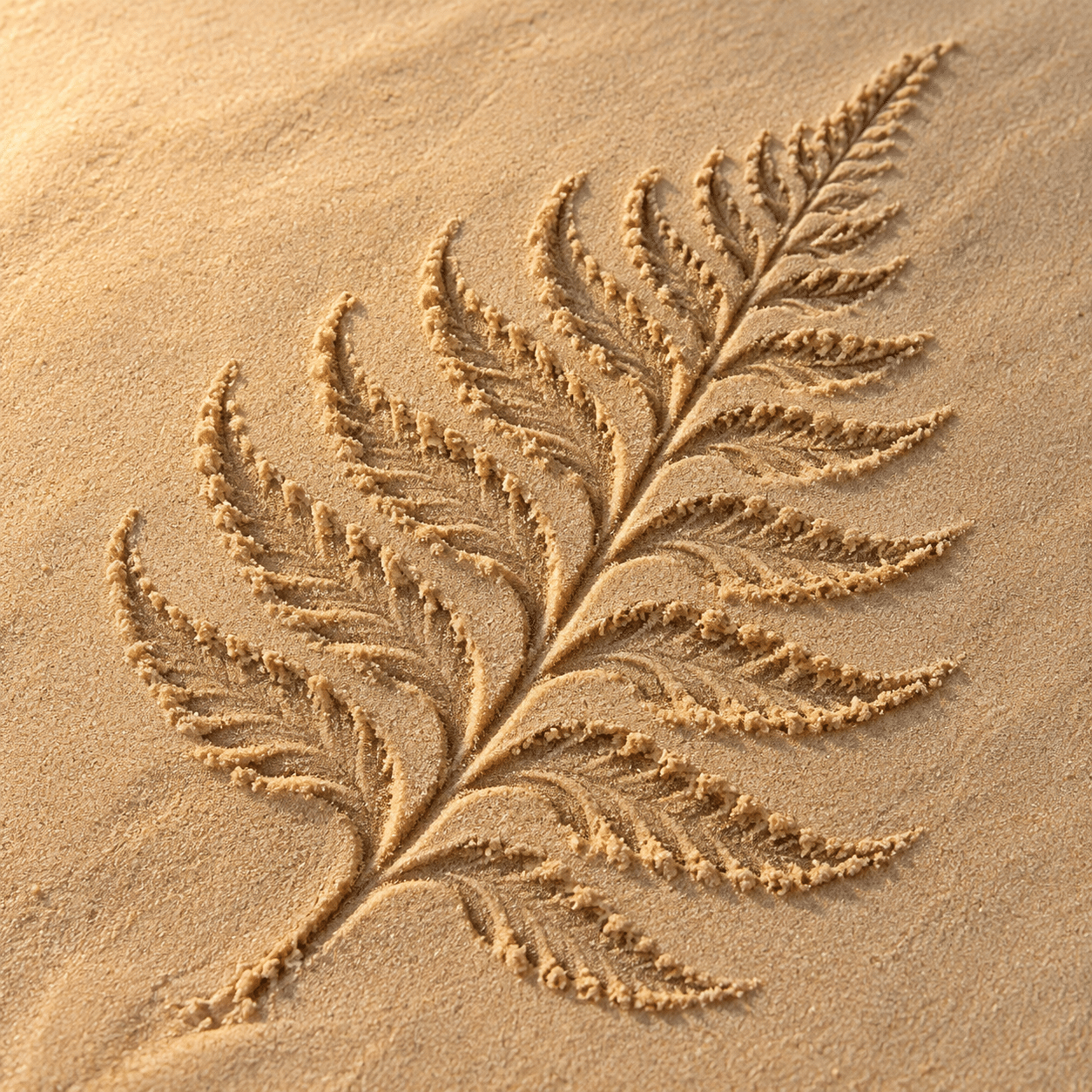
Spread a shallow, even layer of clean sand in a tray. Draw three versions of one leaf: first with an incised outline, then with a filled shape, then by clearing the background around it. Keep the subject simple so that the difference comes from material handling rather than from decorative complexity.
Photograph each version from the same position. Try light from the side and then from above, observing which marks remain legible. For an animation experiment, keep the camera fixed and make small, deliberate changes between frames. Plan where the image will transform, because redistributing the sand can remove information that cannot be recovered exactly.
Site, duration and documentation
For outdoor work, use an appropriate permitted surface and consider how the drawing meets the existing site. Avoid introducing pigments, glue or glitter into a natural setting. An apparently empty beach may contain living systems and shared uses; temporary art still occupies a real place.
Decide what the photograph should preserve: the whole drawing, the texture of a mark, the maker’s action or its gradual disappearance. A dramatic aerial view can explain geometry while hiding the scale and feel of individual grains. Document more than one aspect when those differences matter. The photograph is a representation of the work, with its own choices of framing and light.
Reading the generated studies
The new images are AI-generated material studies. They explore an incised botanical line, a luminous sand silhouette, a raked field, a layered landscape and a sparse negative-space composition. They are not photographs of completed physical installations, historical documents or evidence of traditional cultural authorship.
When generating a concept, specify the support, grain behaviour, lighting and intended viewpoint. Ask for shallow grooves if the subject is drawing, rather than inadvertently producing a deep sand sculpture. Avoid impossible suspended grains and metallic-looking surfaces unless those departures are the explicit subject. For physical work, let an actual material test decide what is achievable.
Positive editorial assessment — AI-authored
Sand drawing makes a gesture tangible. The meeting of a clear path with unstable grains can give even a modest shape a sense of time and touch. Its ability to be redrawn encourages experimentation, while light can reveal distinctions that a plain outline on paper would conceal.
Critical editorial assessment — AI-authored
The medium is easily reduced to intricate patterns photographed from above. Repetition alone does not provide meaning, and generic spiritual language can erase the specificity of cultural practices. Strengthen a work through a clear material decision, an appropriate site and an honest account of what the image represents.
Neutral editorial assessment — AI-authored
Sand drawing encompasses several ways of making relatively flat images with granular material. Evaluate the chosen process, composition, context and documentation separately. A quiet personal exercise can be rewarding without claiming therapeutic effects, sacred authority or a single worldwide tradition.
Pocket-sized facts
Drawing into sand, depositing grains and clearing sand from a lightbox create different kinds of contrast.
Vanuatu sand drawing has specific cultural and communicative contexts documented by UNESCO.
The generated gallery consists of original conceptual studies, not documented traditional designs or completed physical artworks.
A small poetic detour
Original words from the AOI studio.
Poetry
A finger parts the waiting grains;
a small ridge keeps the path in view.
The light arrives, the shadow remains,
and makes a second drawing too.
Then one soft sweep unsettles all
the little edges I had planned;
the picture answers to its fall,
and leaves its room within the sand.
The prompt workshop
Original creative exercises. These prompts create new illustrations, not documentary evidence.
A line in sand
Create an original AI-generated material study of a single fern-like leaf incised into smooth pale sand, top-down view, shallow finger-width grooves with tiny raised grain ridges, low warm side light and generous untouched margins. No traditional symbolic attribution, text, shells or deep sculpture.
Light through grains
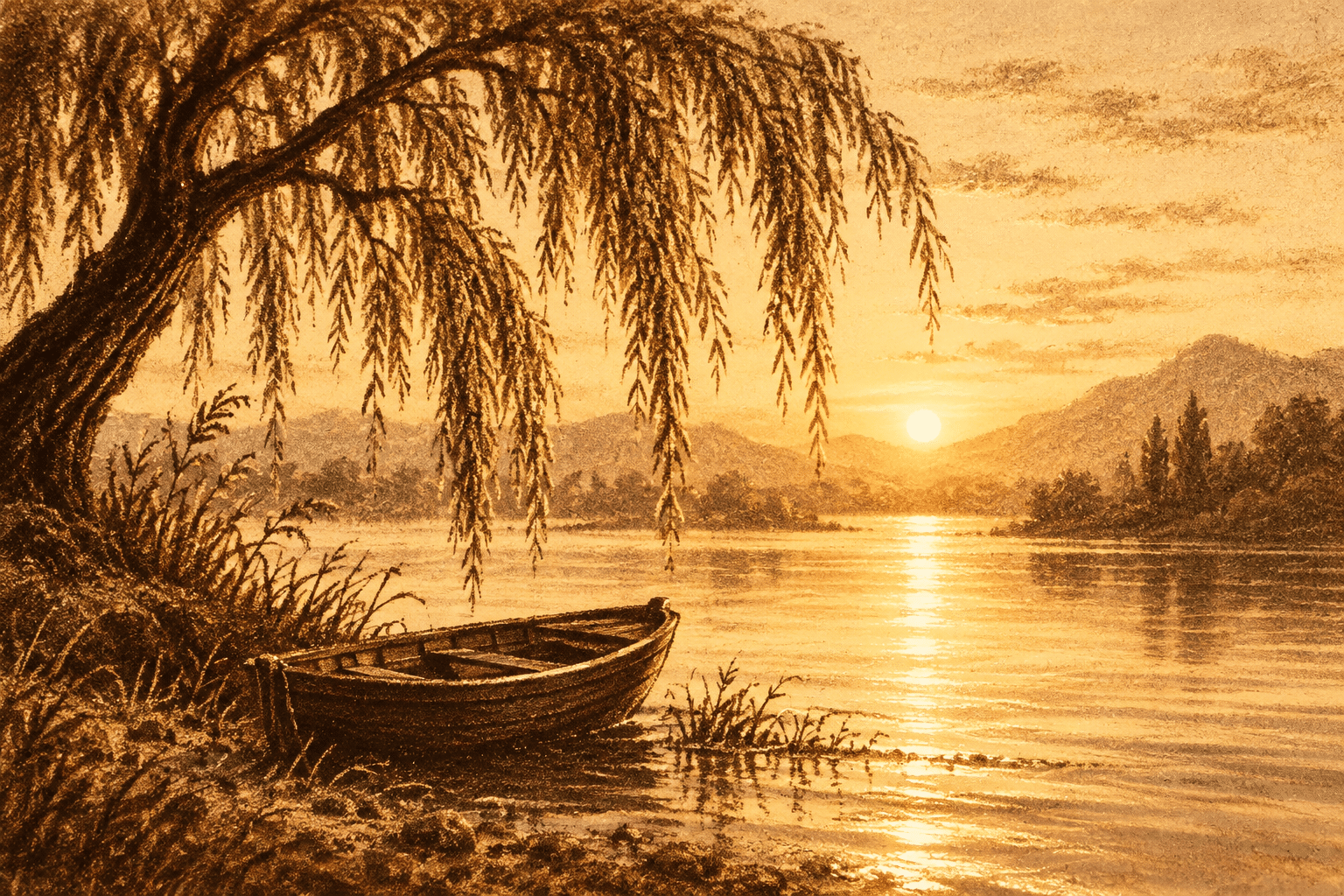
Create an original AI-generated sand-on-lightbox concept: a dark granular silhouette of a small boat beneath a willow, warm light shining through a cleared river and a thinly dusted sky, rich tonal gradation and visibly loose grains. No lettering, painted surface or claim of a real animation frame.
A field and an interruption
Create an original AI-generated aerial concept of broad curved rake lines in damp beach sand that divide around a smooth oval island and rejoin beyond it. Strong directional rhythm, visible shallow parallel grooves and an approaching but separate tide line. Natural materials only, no people, text, pigment or claimed historical motif.
Your next inspiration
Discover another art style
Follow a visual thread to the next subject.
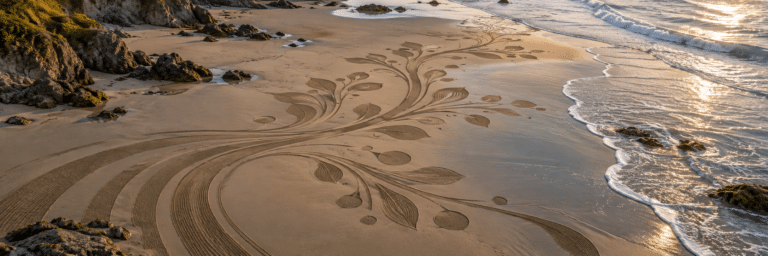
Beach Art: Drawing with Sand, Shoreline and Time
Explore the shoreline as a site and the tide as a time limit.
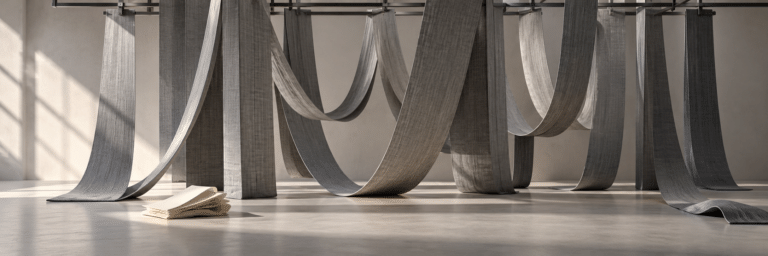
Process Art: Letting Actions and Materials Shape the Work
Consider how material actions and change shape an artwork.
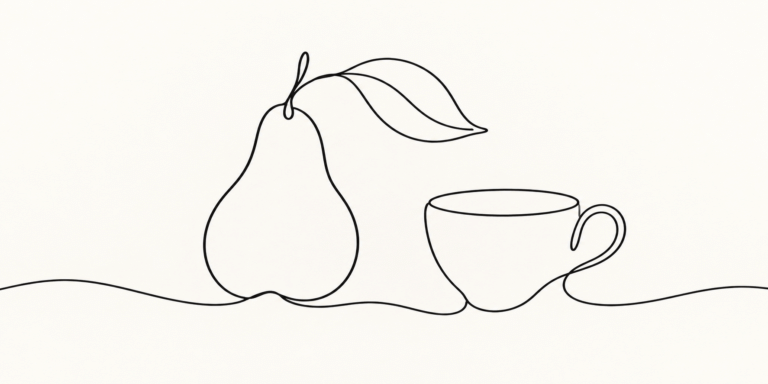
One Line Drawing: A Continuous Path, a Deliberate Choice
Compare the continuity of a path across a different drawing approach.
A smile from the studio
Jokes
I gave my sand drawing a permanent title. The tide was not consulted.
Sources and further exploration
UNESCO: Vanuatu sand drawings — a specific living tradition and its cultural context
Andres Amador: artist’s account — raking, natural materials and temporary earthscapes
Harvard Film Archive: Caroline Leaf Collection — documented sand animation and production history