
Site-based art practice
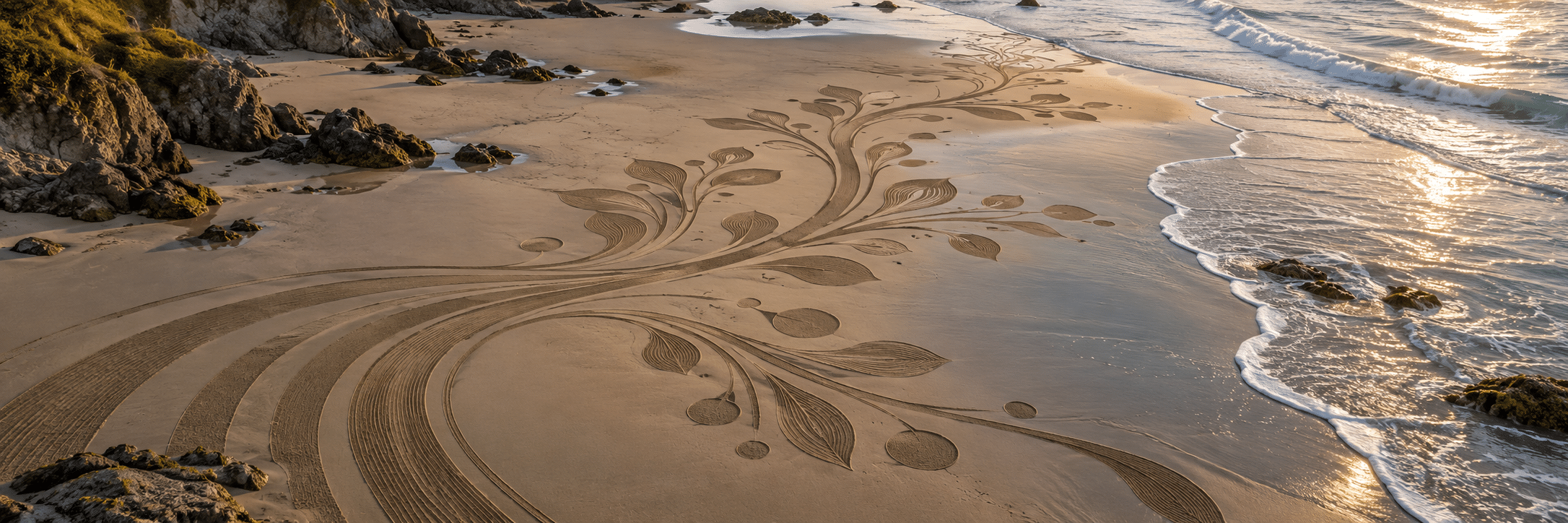
Beach art uses the shore as a working surface, material and changing context. Explore raked drawings, shallow relief, temporary arrangements and compositions that make the tide part of the idea.
A visual introduction
Select an image for a closer look. Use the thumbnails, arrow keys or a swipe to compare examples. Zoom in to inspect details, or share the image that inspires you.


Creative toolbox · take this style further
Choose an input and a destination. Search sends your words to the chosen site; Copy & open puts them on your clipboard to paste there.
Create with AI
Turn your chosen input into an image prompt or a new creative direction.
ChatGPT
Copy your input and paste it into a ChatGPT conversation or image request.
Copy & open ChatGPT (new tab)Claude · Anthropic
Develop an image prompt or explore the style in a new Claude conversation.
Copy & open Claude · Anthropic (new tab)Midjourney
Paste your input into the Imagine bar on the Create page.
Copy & open Midjourney (new tab)Adobe Firefly
Copy your input, open Firefly, and paste it into the prompt field.
Copy & open Adobe Firefly (new tab)Leonardo.Ai
Copy your input, open Leonardo, and paste it into the generation field.
Copy & open Leonardo.Ai (new tab)Image search
Find visual references. Short, concrete keywords usually work best.
Lexica
Search AI images and prompts using your selected input.
Search with this input Lexica (new tab)Pexels
Search the photo and video library. Short keywords often work best.
Search with this input Pexels (new tab)Pixabay
Search photos, illustrations and other images.
Search with this input Pixabay (new tab)Unsplash
Search photographs using the style name or your own keywords.
Search with this input Unsplash (new tab)Wikimedia Commons
Search photographs, artworks and historical images. Check each file for its source and reuse terms.
Search with this input Wikimedia Commons (new tab)Art & research
Explore artists, collections and the ideas behind a style.
Wikipedia
Search for background reading. A style may not have its own article.
Search with this input Wikipedia (new tab)WikiArt
Copy your input into WikiArt’s search to explore artists and artworks.
Copy & open WikiArt (new tab)Europeana
Paste your keywords into the search to explore European museum, library and archive collections.
Copy & open Europeana (new tab)Inspiration
Discover portfolios and visual ideas from creative communities.
Instagram hashtags
Search a hashtag made from your input: spaces and punctuation are removed. Instagram may require sign-in.
Search with this input Instagram hashtags (new tab)ArtStation
Paste your input into artwork search for concept art, environments, characters and visual development.
Copy & open ArtStation (new tab)Behance
Paste your input into project search for illustration, design and visual storytelling.
Copy & open Behance (new tab)A closer look
Large readable patterns in wet sand; raked and untouched tonal contrasts; shallow shadows; shoreline-responsive geometry; temporary forms whose scale changes with the viewpoint.
The beach is more than a backdrop
Beach art is a broad description of art made on or with the beach, rather than a single historical movement. It includes raked sand drawings, sand sculpture, low relief and temporary arrangements. A painting of a beach is a different category: the shore is its subject, while in site-based beach art the place itself helps make the work.
Contemporary earthscape artist Andres Amador describes making temporary geometric and organic designs in wet sand at low tide. His account explains how raking reveals tonal differences between disturbed and undisturbed areas. It offers a documented example of a living practice, not a claim that one person invented every form of beach art.
Surface, scale and viewpoint
At ground level a raked line may feel like a path; from above it becomes part of a larger figure. Design for an intended viewpoint. A pattern meant to read from a cliff needs large intervals and strong grouping. A close study can depend on small ridges, footprints or the transition between dry and wet sand. Neither view substitutes for the other.
Begin with the existing shoreline rather than imposing a generic mandala everywhere. A curved inlet can suggest nested arcs, a long flat beach can support a horizontal rhythm, and a patch of darker wet sand can act as a natural frame. Empty sand is an active compositional element. A large unworked area can make a small intervention feel deliberate and clarify the scale of a dense pattern.
A palette made by weather and material
Beach art can be almost monochrome while remaining visually rich. Wet sand, dry sand, shadow, foam and reflected sky create different values and temperatures. Low light makes shallow relief more legible; diffuse light can reveal tonal pattern without strong shadows. For an imagined image, specify which of these mechanisms is responsible for contrast.
Raking creates lines and fields; shallow ridges create relief; found objects introduce volume and cast shadows. Keep those processes distinct in the description. A digitally generated sand drawing is an illustration of a possible composition, not proof that the work was made at a real beach. The new studies are labeled accordingly.
Time, access and restraint
The returning tide can complete the work by changing or removing it. Documentation therefore involves a choice: record a pristine arrangement, a partial erasure or the almost empty surface afterwards. These stages communicate different ideas. Do not claim a generated image records an actual event or an ecological restoration.
For physical projects, choose an appropriate permitted area, respect local access conditions and wildlife, and use methods that leave no persistent debris. An ambitious design is not automatically worth disturbing a sensitive shoreline. The most useful creative constraint may be to work smaller, use the existing surface and allow ordinary tidal change to finish the piece.
Five ways to develop a study
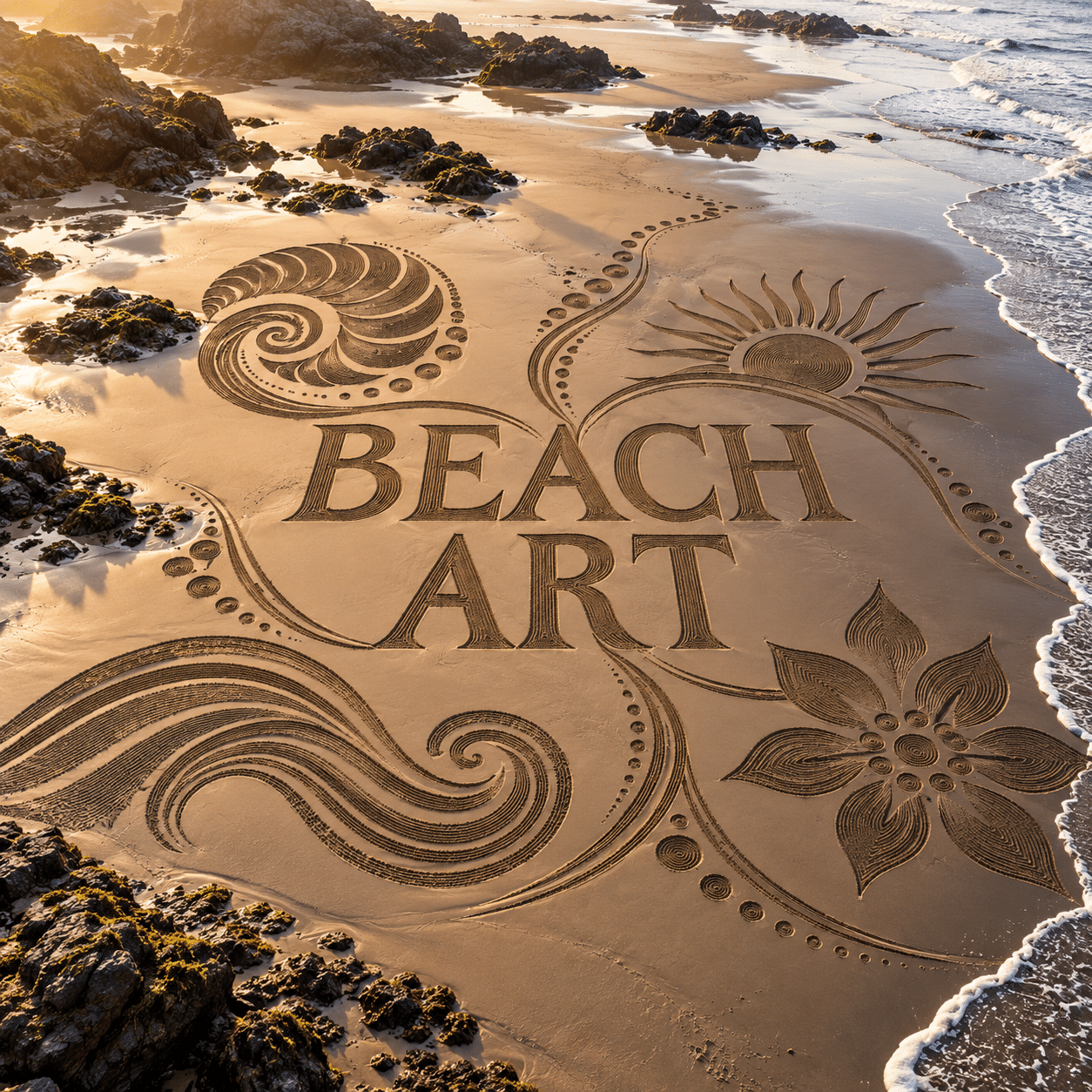
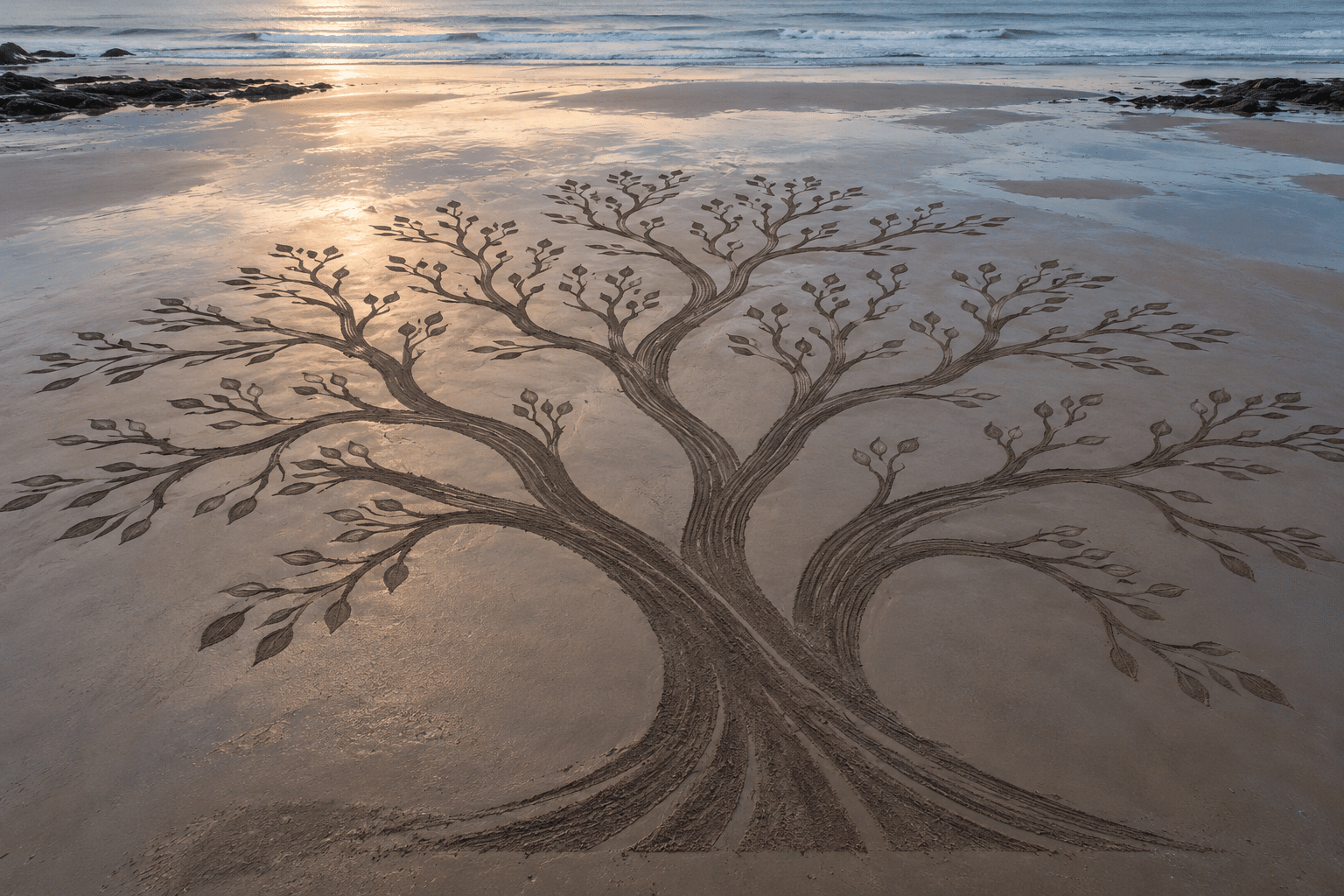
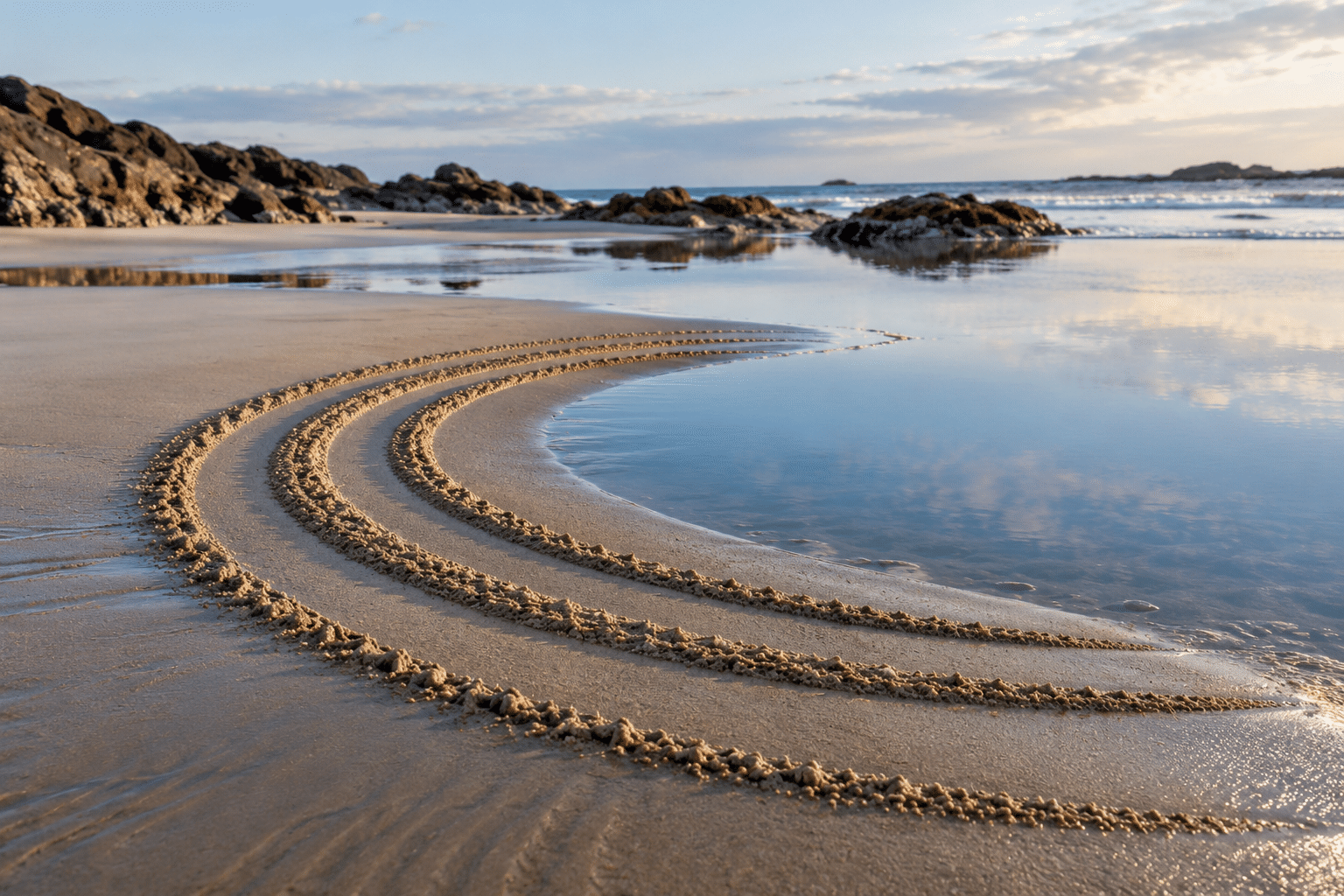
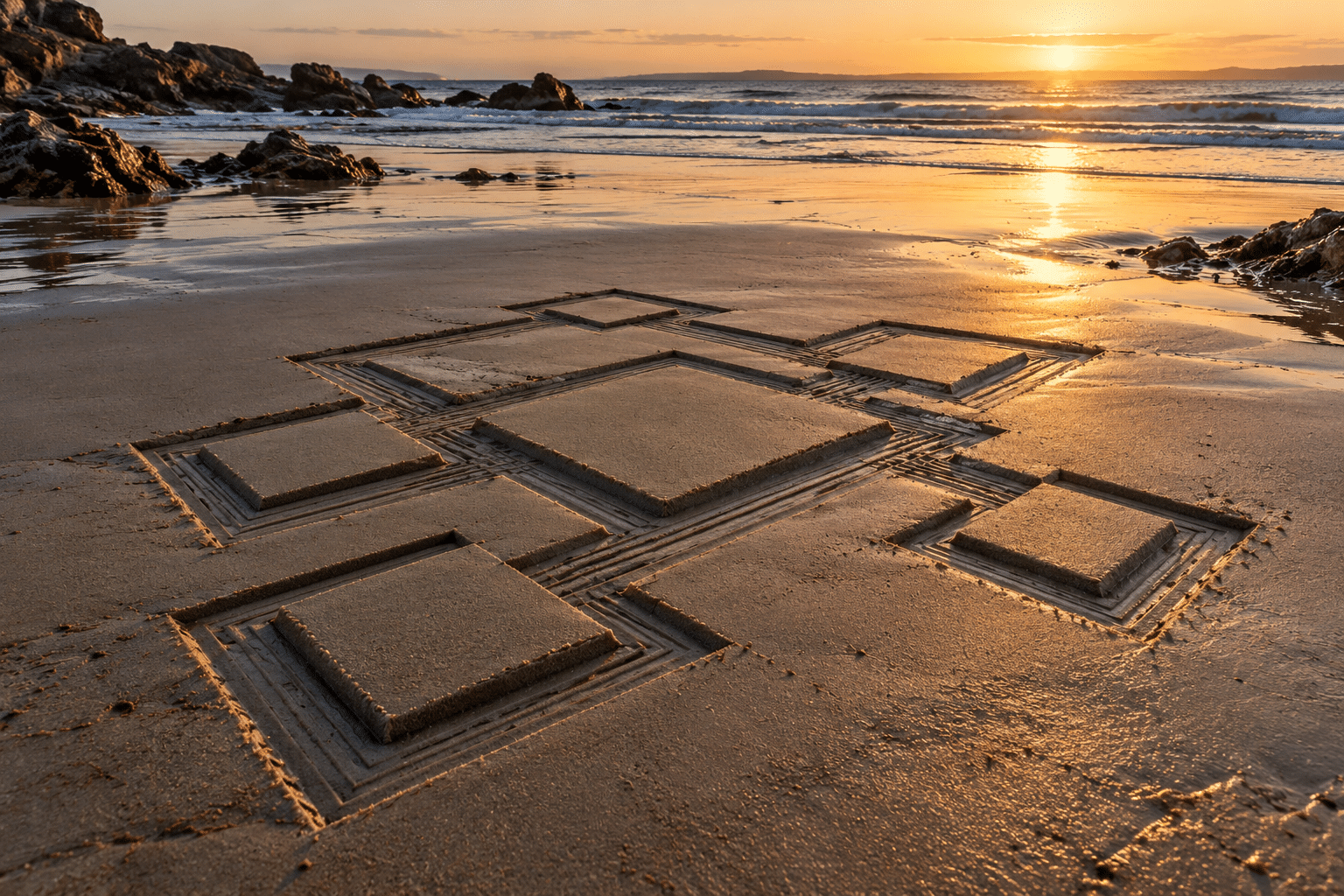
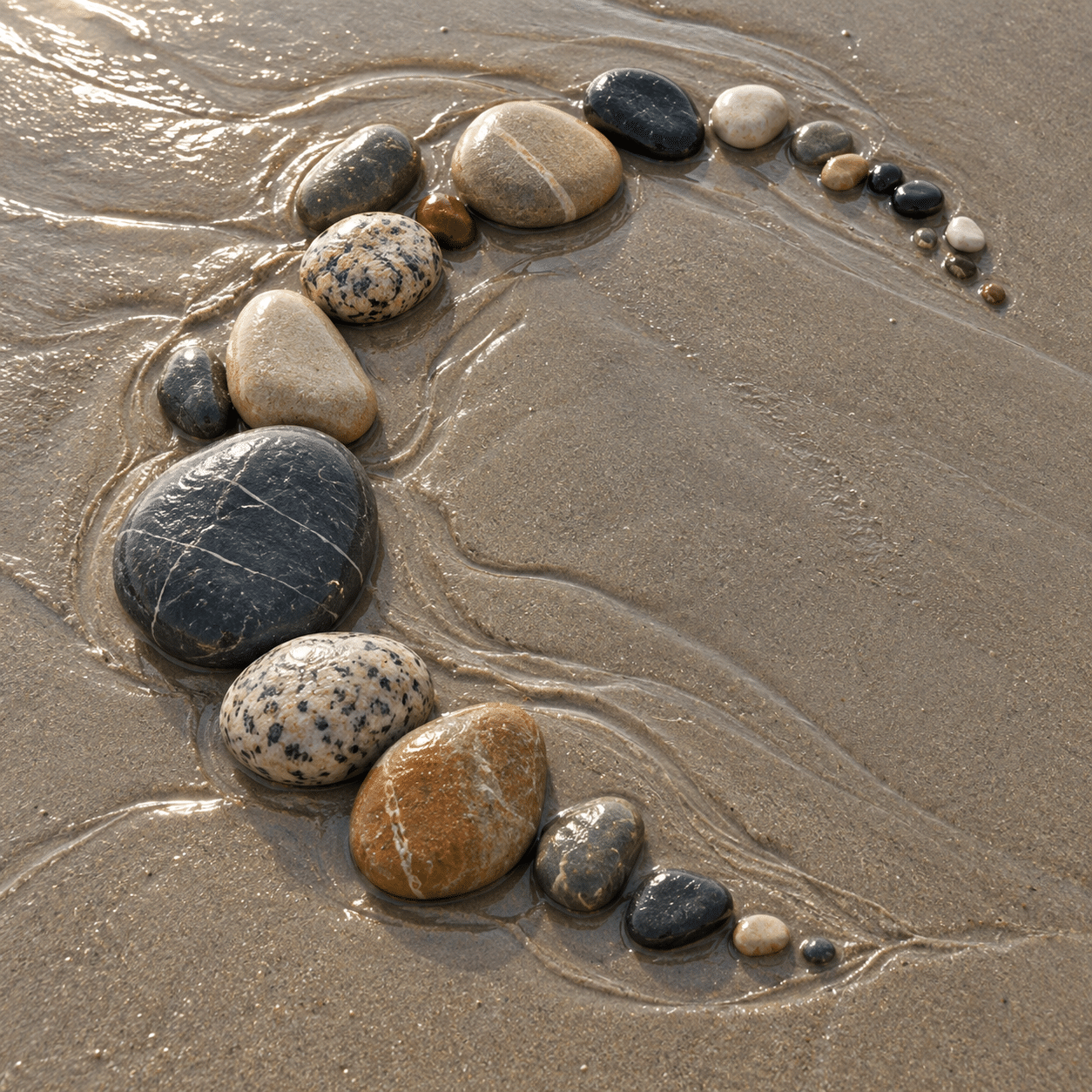
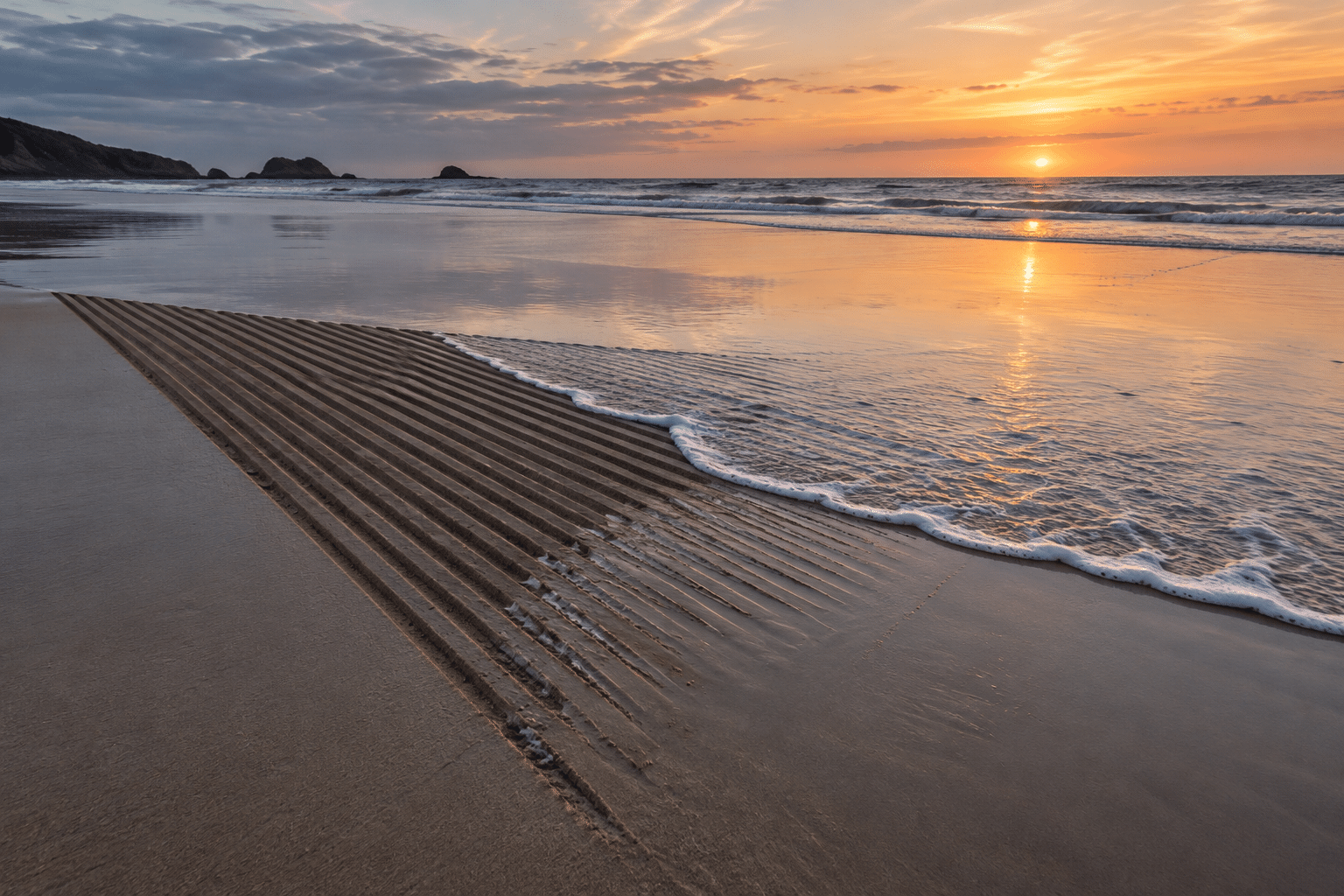
The gallery proposes branching raked lines, nested arcs, low geometric relief, a sparse pebble arrangement and a pattern partly erased by water. Each tests a different relationship between mark and place. Land art provides a broader context; sand drawing describes a method, while environmental art may pursue aims that go beyond the temporary appearance of a work.
When prompting, name the material action and camera position before mood words. “Raked parallel grooves in wet sand viewed obliquely from a low dune” gives more control than “beautiful beach art.” Ask for consistent scale and believable contact shadows. Leave the surroundings simple enough that the intervention remains readable.
Positive editorial assessment — AI-authored
Beach art can make scale and impermanence immediately visible. A modest line repeated across a large surface becomes a landscape event, while the tide prevents the image from pretending to permanence. The strongest compositions respond to the particular bend, texture and openness of their site.
Critical editorial assessment — AI-authored
Aerial spectacle can overwhelm the actual experience of the place. Repeated symmetrical designs may become interchangeable, and an attractive photograph can conceal an insensitive intervention. Improve the work by making the shoreline influence the design, clarifying its material logic and treating the untouched beach as part of the composition.
Neutral editorial assessment — AI-authored
Beach art suits temporary spatial drawing, collaborative making and studies of change. It depends on conditions and viewpoints that differ from a studio image. Its artistic and environmental merits should be judged separately; transience alone does not prove ecological benefit.
A small poetic detour
Original words from the AOI studio.
Poetry
The shore accepts a borrowed line,
then folds it in a sheet of foam.
A thousand grains refuse to sign
the little shape we called a home.
The pattern leaves, the looking stays;
the water changes what we drew.
We give the sand a few brief ways
to show the light that passes through.
The prompt workshop
Original creative exercises. These prompts create new illustrations, not documentary evidence.
Start with the shoreline
Original imagined beach artwork: three nested raked arcs following the curve of a quiet inlet, dark wet sand against untouched pale sand, low oblique viewpoint, no people or logos. Clearly an AI interpretation of a temporary design.
A larger field
An original branching sand drawing across a broad flat beach, viewed from an elevated dune. Wide trunk-like lines divide into smaller raked channels; reserve a large untouched region beside the sea. Plausible scale, soft overcast light, no impossible raised paint.
Let the tide participate
An invented temporary geometric sand pattern partly washed away by a thin incoming wave. Preserve a clear transition from crisp raked grooves to softened traces and empty wet sand. Restrained colour and low evening light; no claim of a real location.
Your next inspiration
Discover another art style
Follow a visual thread to the next subject.
Process Art: Letting Actions and Materials Shape the Work
Consider change, duration and material process.
A smile from the studio
Jokes
The tide declined to store the original. It offered an excellent clean canvas for tomorrow.
Sources and further exploration
Andres Amador: About — the artist explains temporary earthscapes, raking and tidal change