
Drawing technique
One line drawing builds an image with a continuous stroke. Its challenge is to connect observation, movement and composition without lifting the drawing tool; a simple-looking result can require careful decisions about where the line travels.
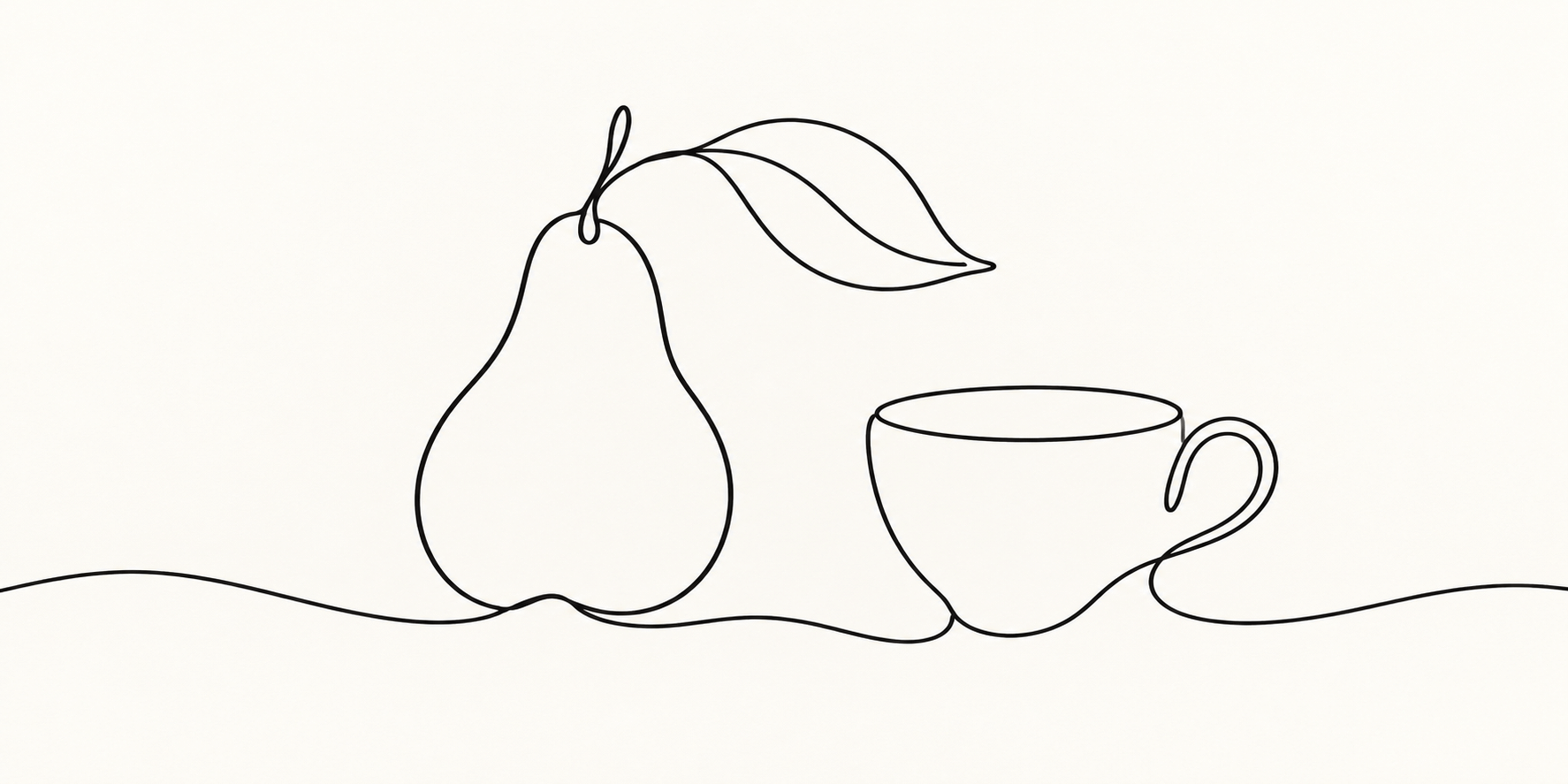
A visual introduction
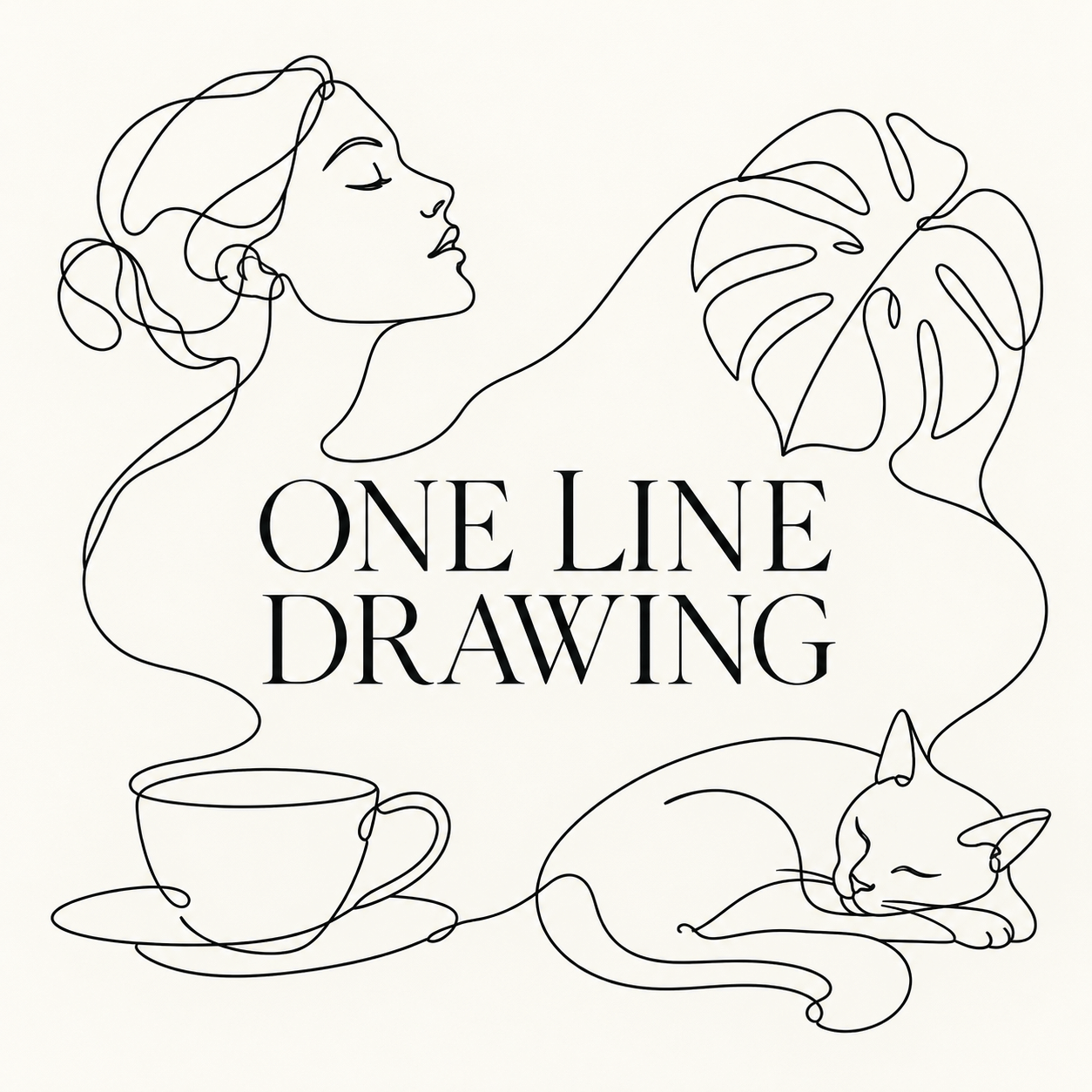
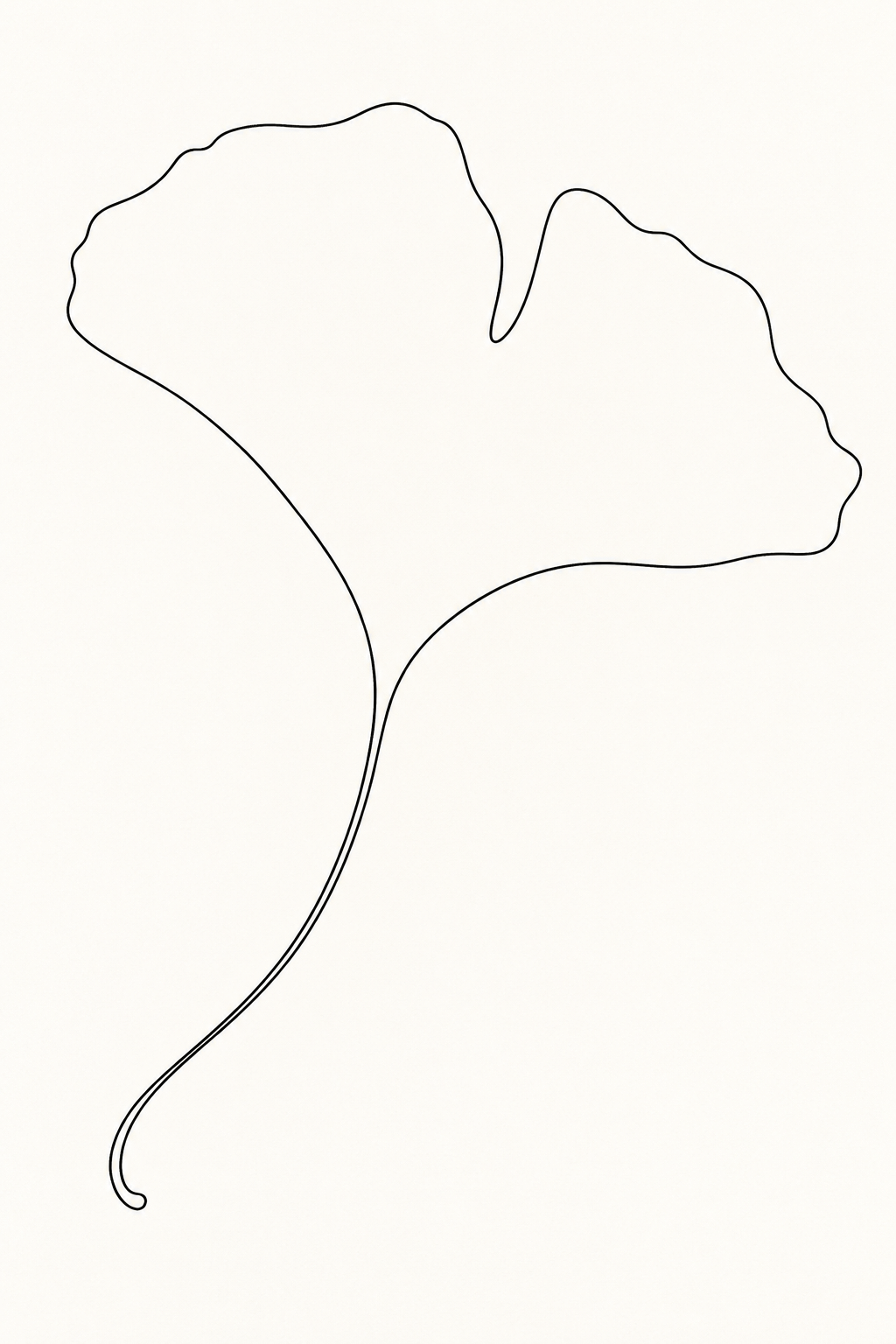
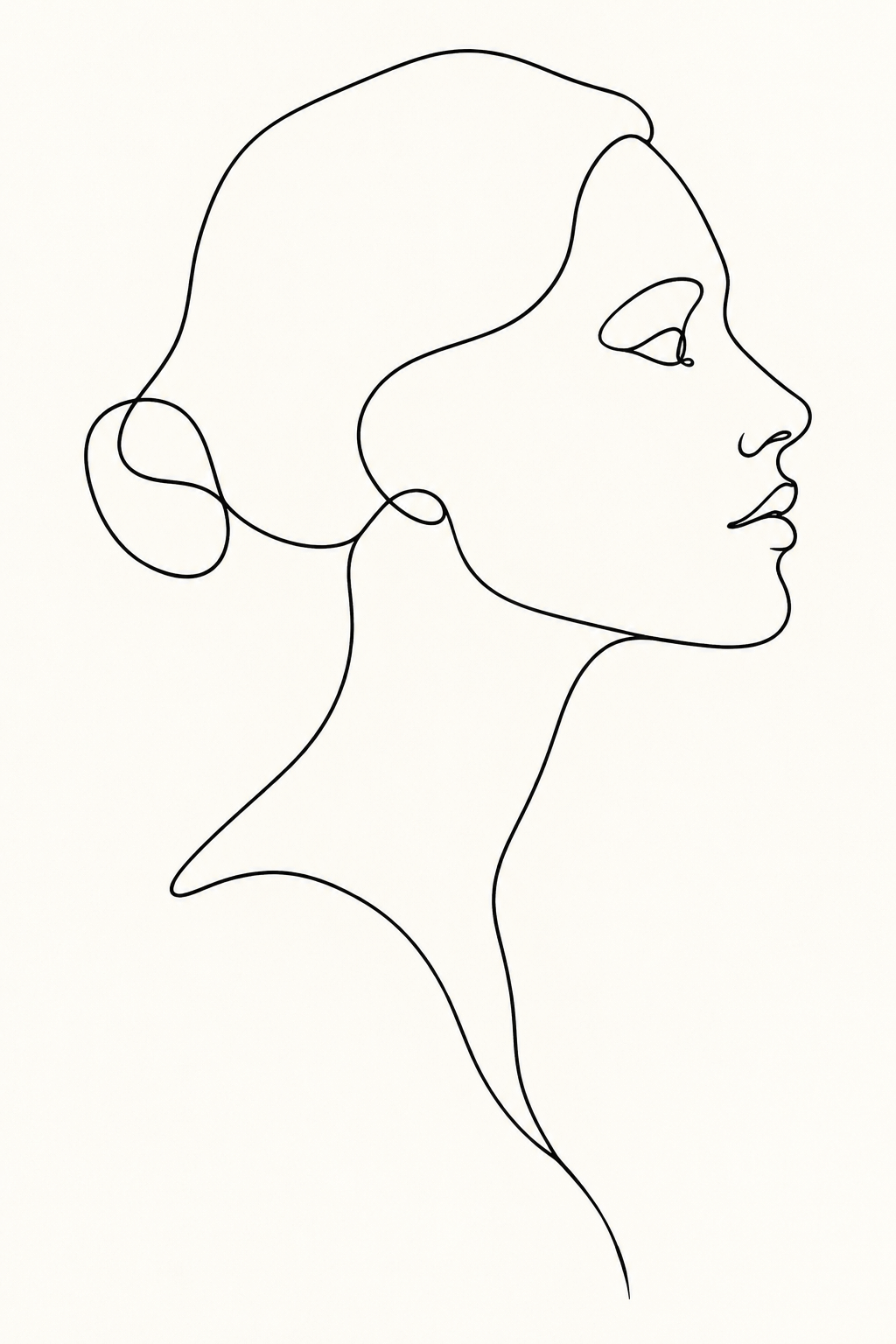
Five new AI-generated studies and the retained earlier collage. The leaf emphasizes a connected outline; other studies include detached details and are explicitly labelled as interpretations, not verified one-stroke performances.
Select an image for a closer look. Use the thumbnails, arrow keys or a swipe to compare examples. Zoom in to inspect details, or share the image that inspires you.
Creative toolbox · take this style further
Choose an input and a destination. Search sends your words to the chosen site; Copy & open puts them on your clipboard to paste there.
Create with AI
Turn your chosen input into an image prompt or a new creative direction.
ChatGPT
Copy your input and paste it into a ChatGPT conversation or image request.
Copy & open ChatGPT (new tab)Claude · Anthropic
Develop an image prompt or explore the style in a new Claude conversation.
Copy & open Claude · Anthropic (new tab)Midjourney
Paste your input into the Imagine bar on the Create page.
Copy & open Midjourney (new tab)Adobe Firefly
Copy your input, open Firefly, and paste it into the prompt field.
Copy & open Adobe Firefly (new tab)Leonardo.Ai
Copy your input, open Leonardo, and paste it into the generation field.
Copy & open Leonardo.Ai (new tab)Image search
Find visual references. Short, concrete keywords usually work best.
Lexica
Search AI images and prompts using your selected input.
Search with this input Lexica (new tab)Pexels
Search the photo and video library. Short keywords often work best.
Search with this input Pexels (new tab)Pixabay
Search photos, illustrations and other images.
Search with this input Pixabay (new tab)Unsplash
Search photographs using the style name or your own keywords.
Search with this input Unsplash (new tab)Wikimedia Commons
Search photographs, artworks and historical images. Check each file for its source and reuse terms.
Search with this input Wikimedia Commons (new tab)Art & research
Explore artists, collections and the ideas behind a style.
Wikipedia
Search for background reading. A style may not have its own article.
Search with this input Wikipedia (new tab)WikiArt
Copy your input into WikiArt’s search to explore artists and artworks.
Copy & open WikiArt (new tab)Europeana
Paste your keywords into the search to explore European museum, library and archive collections.
Copy & open Europeana (new tab)Inspiration
Discover portfolios and visual ideas from creative communities.
Instagram hashtags
Search a hashtag made from your input: spaces and punctuation are removed. Instagram may require sign-in.
Search with this input Instagram hashtags (new tab)ArtStation
Paste your input into artwork search for concept art, environments, characters and visual development.
Copy & open ArtStation (new tab)Behance
Paste your input into project search for illustration, design and visual storytelling.
Copy & open Behance (new tab)A closer look
A connected contour moves between outer edges and internal details, using turns, crossings, retracing and open space to suggest a subject without filling every surface.
What makes it one line?
In the strict exercise, the pen or pencil remains in contact with the paper from the first mark to the last. The line may cross itself, retrace a route or wander through the subject. The result need not be minimalist: one continuous stroke can form a dense network. Conversely, a sparse drawing with several disconnected strokes may be line art without being a one-line drawing.
The Phillips Collection uses continuous-line observation as a way to examine a natural object from different angles. The Whitney offers a related exercise inspired by natural forms and Ruth Asawa’s wire sculpture. These museum activities demonstrate a flexible drawing practice, not a single historical movement or an invention that should automatically be attributed to one famous artist.
Continuous contour and blind contour
Continuity concerns the movement of the drawing tool. Blind contour adds a different restriction: looking at the subject rather than looking down at the drawing. The Tucson Museum of Art distinguishes these ideas in its portrait activity. They can be combined, but a drawing can be continuous while the artist checks the paper.
Neither exercise requires a polished likeness. Blind contour can produce displaced features because the hand follows sustained observation without frequent visual correction. A planned single-line illustration may instead prioritise economy, recognisable silhouettes and a carefully routed path. Judge the work according to its purpose rather than expecting both methods to produce the same finish.
Plan a route through the subject
Begin with a subject that has a clear outer shape: a leaf, cup, shoe or seated figure. Decide where the line enters, which features matter and how it will reach them. A handle can connect the rim of a cup to its body; a stem can carry the path between leaves. Think about the spaces enclosed by the line as well as the line itself.
A connecting stroke should have a reason. It may describe an edge, a fold, a direction of movement or a deliberately visible bridge. If it crosses an important feature, consider whether the crossing clarifies the drawing or merely solves the routing problem. Retracing a short section can be more effective than adding an elaborate loop that distracts from the subject.
Weight, speed and negative space
A continuous line does not need an identical thickness throughout. Pressure, speed and the chosen tool can produce emphatic turns and quieter passages. A fine pen gives an even graphic voice; a soft pencil can vary with pressure; a brush introduces a wider range but also demands more control. Choose a tool whose behavior supports the intended scale.
Leave enough open paper for the drawing to breathe. A face can become difficult to read if every feature is connected by equally dark loops. Reduce the number of internal details and allow the outer contour to carry more information. At small sizes, the spacing between lines may matter more than the delicacy of individual strokes.
From an observed study to a designed image
Make a slow observational version first, then a second version using fewer decisions. Compare what survives: the tilt of a head, the weight of an object or the rhythm of a plant. The designed image should retain something specific from looking. Otherwise economy can become a generic symbol that could have been drawn without observing the subject at all.
For a digital vector drawing, inspect whether the artwork actually consists of one connected path if continuity is part of the claim. A raster image can resemble one-line work without proving how it was made. AI-generated examples on this page are visual interpretations, not recordings of an uninterrupted physical drawing performance. Their captions should describe visible structure rather than certify an unseen process.
Three exercises with different goals
For attention, follow the contour of a leaf slowly and keep the tool down. For composition, draw a cup and its handle while leaving generous white space. For expressive movement, follow a seated figure’s posture with a longer flowing route. Keep each exercise focused on one question so a tangled result gives you something specific to revise.
Change one variable between attempts: the scale, starting point, tool or amount of internal detail. Date the studies and compare them together. A version with fewer marks is not automatically better; a lively crossing may express the subject more clearly than a smooth but anonymous outline. The aim is a purposeful continuous journey through the image.
Read the examples critically
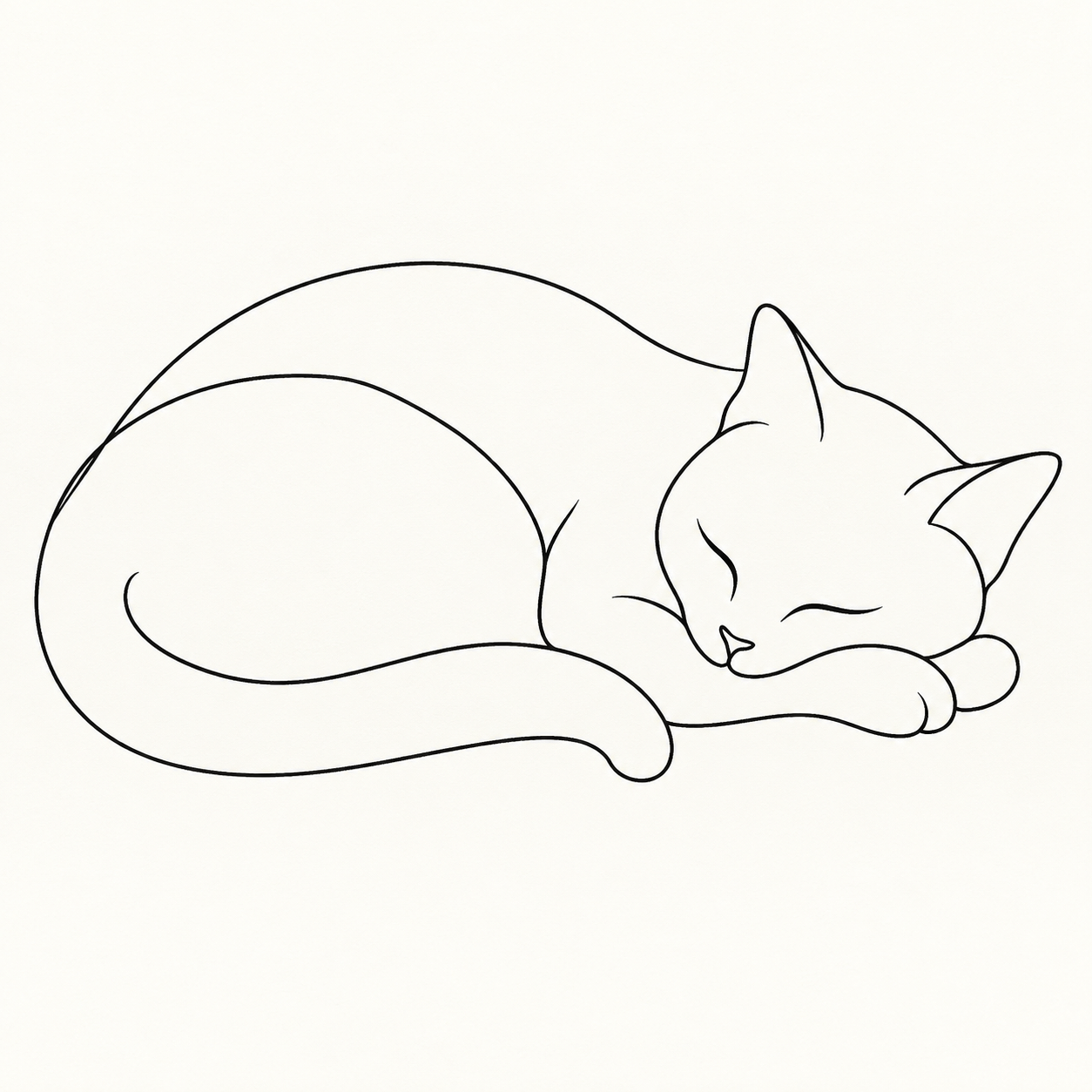
The leaf study provides the simplest connected contour in the new gallery. The portrait and sleeping cat introduce more complex routing, but they also contain detached detail marks. Those marks are visible departures from a strict one-stroke exercise. They make useful comparisons: how could an eye or an inner fold be reached without lifting the tool, and would that connection improve the drawing?
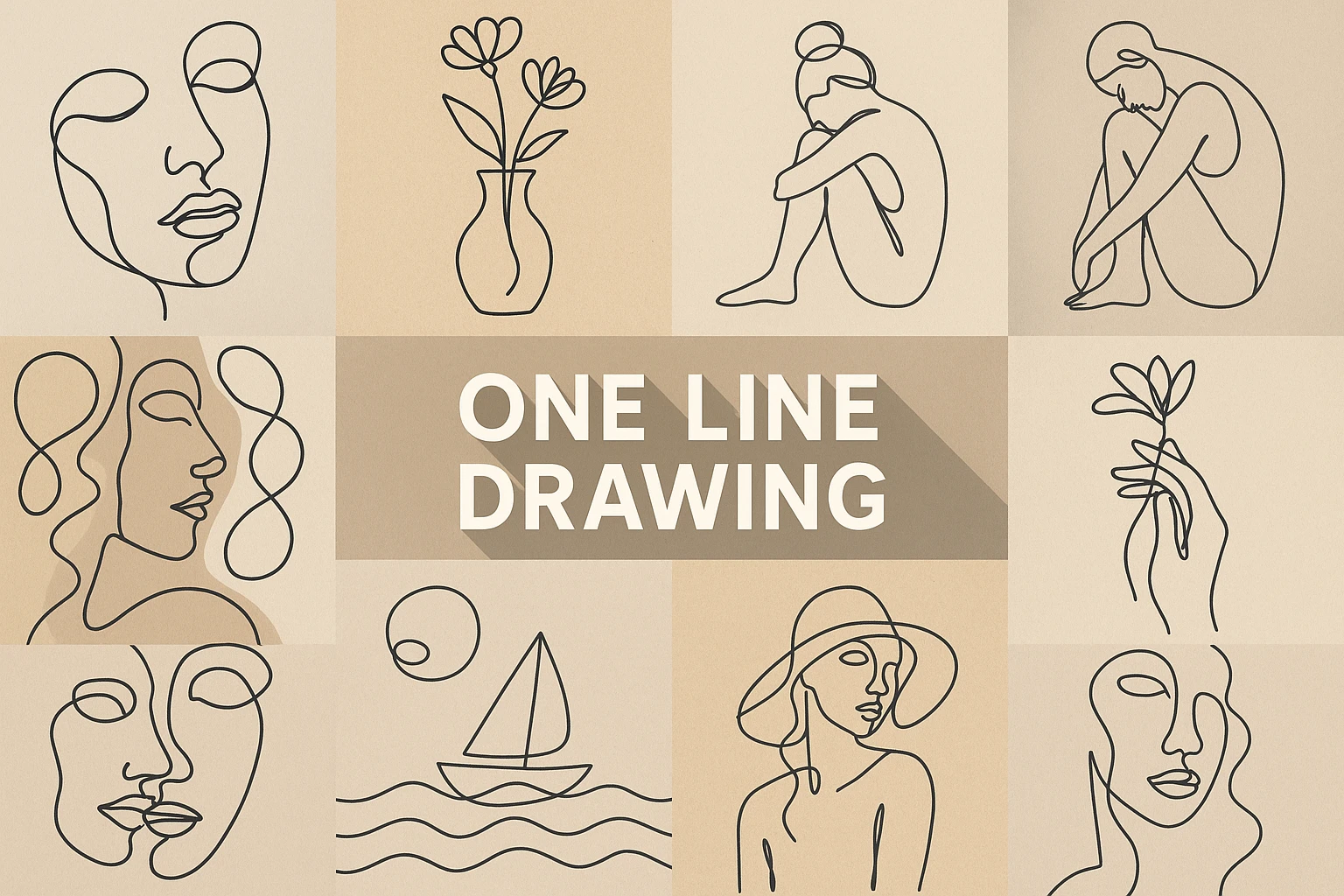
The banner explores a linked still life, while the collage gathers several motifs around the title. These generated illustrations demonstrate visual economy and the limits of an appearance-based label. For a verified continuous-line result, draw the route yourself or inspect a digital path. The older collage remains available in the archive section of the gallery.
A small poetic detour
Original words from the AOI studio.
Poetry
A Line Takes Its Time
It leaves the stem and finds a leaf,
then turns where light has bent the rim;
a small return, a crossing made,
the paper bright around the limb.
No lift, no leap to start again:
one wandering thought becomes a pen.
The prompt workshop
Original creative exercises. These prompts create new illustrations, not documentary evidence.
An observed leaf
Create an original continuous-line interpretation of one curled leaf and its stem, one visibly connected black path on warm white paper, generous empty space, no detached marks or lettering.
A quiet portrait
Create an original single-line portrait interpretation of an adult in profile, a flowing connected contour linking forehead, nose, lips, chin and shoulder, restrained internal detail, no shading or signature.
A useful route
Design an original one-line still life of a cup and pear, one connected route using deliberate crossings and spacious white ground; make the connection between objects part of the composition rather than a decorative tangle.
A smile from the studio
Jokes
The line asked for a shortcut. The artist said it would have to stay connected.
Sources and further exploration
The Phillips Collection: A Sense of Place — continuous-line observation from changing viewpoints
Tucson Museum of Art: Exploring Portraits — continuous line and blind contour distinguished
Whitney Museum: Continuous Line — a nature-based drawing exercise inspired by Ruth Asawa