
Modern Indian art movement · symbolic social and political critique
Samikshavad is a modern Indian art movement associated with painter and critic Ram Chandra Shukla and dated to 1974. Its defining concern is critical engagement with society through visual form. Approach it through the argument an image makes about power, behaviour or inequality, rather than a supposed formula of bright colours and geometric shapes. [1]
A visual introduction
Original AI-generated visual exercises. Historical works and artists are identified separately in the text and sources.
Select the collage for a closer look; press Escape to return to the guide.
Creative toolbox · take this style further
Choose an input and a destination. Search sends your words to the chosen site; Copy & open puts them on your clipboard to paste there.
More tools
Additional destinations selected for this article.
ChatGPT
Copy your input and paste it into a ChatGPT conversation or image request.
Copy & open ChatGPT (new tab)Claude · Anthropic
Develop an image prompt or explore the style in a new Claude conversation.
Copy & open Claude · Anthropic (new tab)Midjourney
Paste your input into the Imagine bar on the Create page.
Copy & open Midjourney (new tab)Adobe Firefly
Copy your input, open Firefly, and paste it into the prompt field.
Copy & open Adobe Firefly (new tab)Leonardo.Ai
Copy your input, open Leonardo, and paste it into the generation field.
Copy & open Leonardo.Ai (new tab)Lexica
Search AI images and prompts using your selected input.
Search with this input Lexica (new tab)Pexels
Search the photo and video library. Short keywords often work best.
Search with this input Pexels (new tab)Pixabay
Search photos, illustrations and other images.
Search with this input Pixabay (new tab)Unsplash
Search photographs using the style name or your own keywords.
Search with this input Unsplash (new tab)Wikipedia
Search for background reading. A style may not have its own article.
Search with this input Wikipedia (new tab)WikiArt
Copy your input into WikiArt’s search to explore artists and artworks.
Copy & open WikiArt (new tab)Instagram hashtags
Search a hashtag made from your input: spaces and punctuation are removed. Instagram may require sign-in.
Search with this input Instagram hashtags (new tab)A closer look
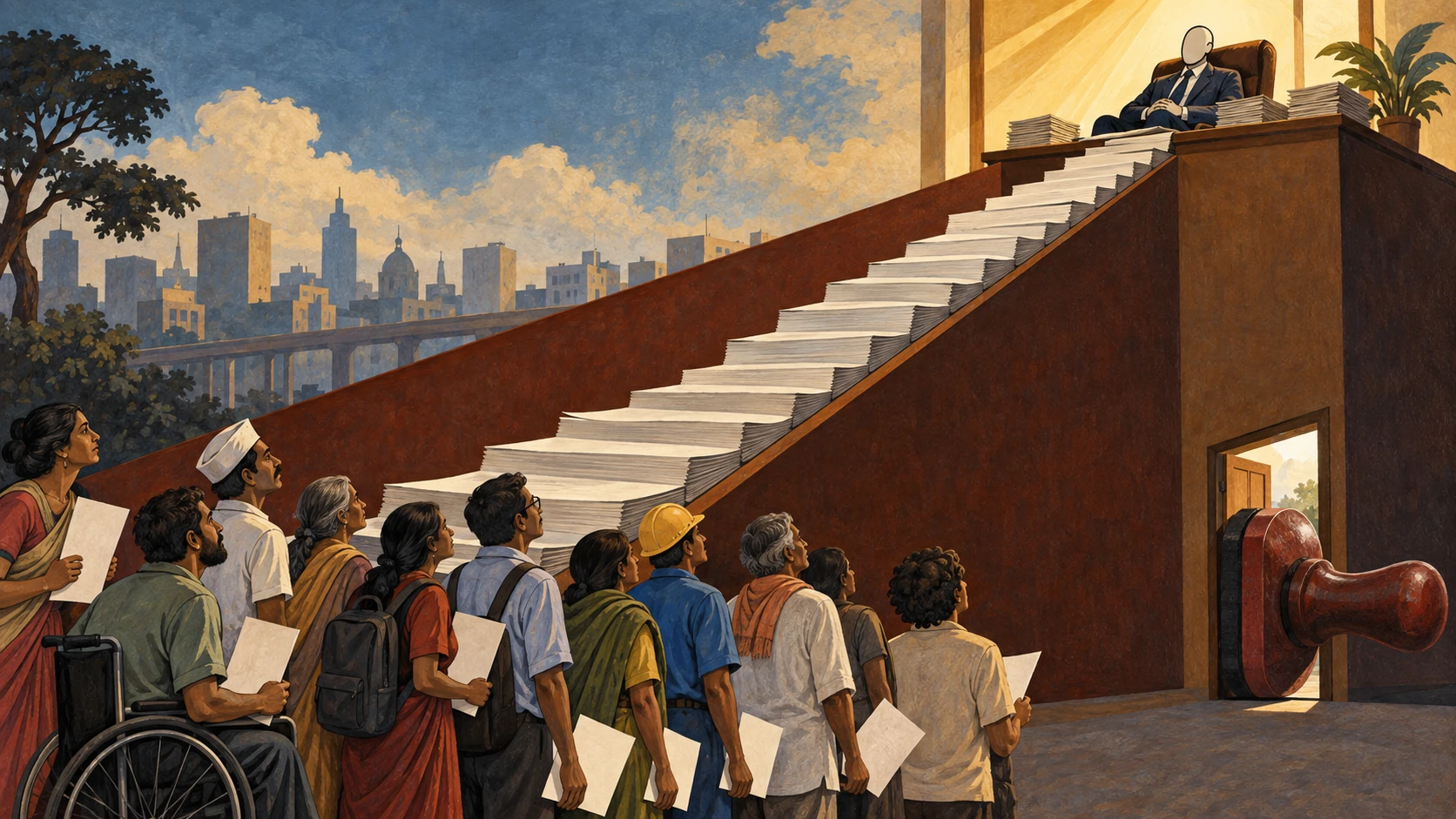
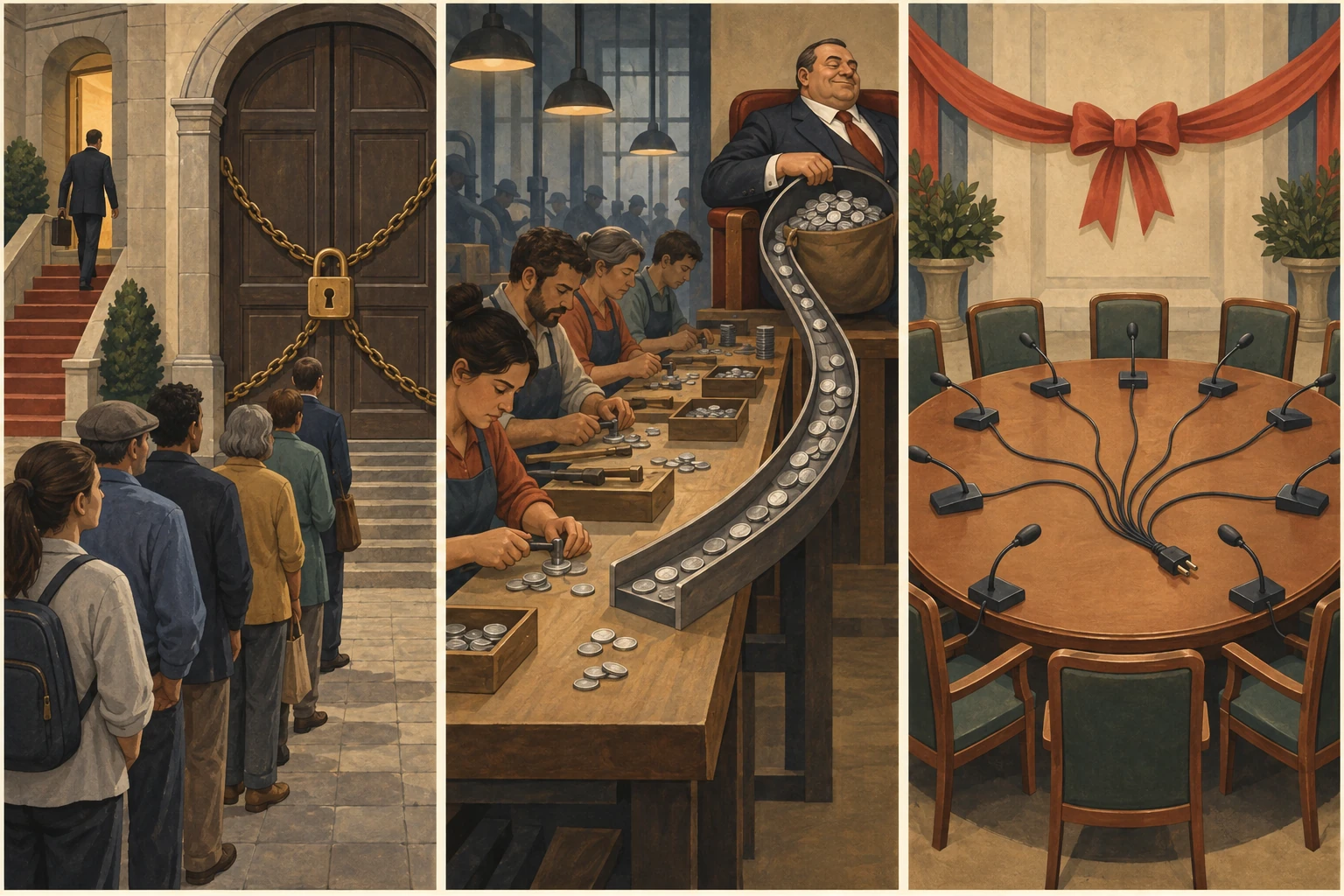
Our new banner turns access to a public service into an unequal architecture: waiting people occupy the lower level while an oversized desk and elevated official control the route upward. The collage offers three further visual arguments. All are original AI-generated AOI exercises, not historical Samikshavad works or evidence about real individuals.
A movement, not a decorative mood
Samikshavad belongs to the history of modern Indian painting. Shukla’s official tribute describes its founding in 1974 and its use of symbolic composition to engage social and political realities. His painterly identity should not be confused with that of the earlier Hindi literary historian of a similar name. [1][2]
The movement’s critical purpose matters more than a convenient appearance tag. An image might be colourful, sombre, densely populated or spare; those choices need to serve what the picture examines. A loud palette is not a manifesto. The test is whether a viewer can discover a relationship, contradiction or abuse of power in the way the image is organised.
This replaces the earlier entry’s unsupported Gupta-period dating, supposed village history and invented nineteenth-century paintings. Famous Indian modernists should not be attached to the movement merely because their work is expressive. Association requires evidence. The reliable starting point here is Shukla, followed by careful study of documented works and movement literature.
What the critical programme asks of painting
The commonly circulated account of Samikshavad’s programme stresses social criticism, opposition to exploitation and a locally grounded modern art. It also describes resistance to imitation and to technique becoming an end in itself. This is a summary of the movement’s stated position, not proof that any art develops in complete isolation. The readily available encyclopedia account has citation warnings, so sweeping claims about being India’s “first” indigenous movement are not adopted here. [3]
That distinction makes the movement more interesting, not less. A declaration of independence is an artistic argument with a historical setting. It invites questions about whom art addresses, which experiences it treats as important and whether a work communicates beyond a specialist circle. It should not become an excuse to flatten the many other histories of Indian modernism.
For a reader, begin with a plain question: what is this picture asking us to examine? If the answer is only “it feels intense,” keep looking. Identify the people, objects or spatial relationships that carry the criticism. A meaningful reading should point to visible decisions rather than rely entirely on the caption.
Symbolic realism: make the mechanism visible
A symbol works through a relationship. A large desk alone may suggest authority; a desk that blocks a line of applicants makes a more specific claim. A tilted balance is familiar, but what is being weighed, who adjusts it and who must accept the result? The action around the object turns a general emblem into an argument.
Scale, repetition and compressed space are useful tools for an original exercise. Enlarge the obstacle, repeat the waiting forms, or give a privileged figure an implausibly short route. Keep enough ordinary detail to make the situation understandable. Symbolic distortion should clarify the problem rather than bury it beneath mysterious accessories.
These are AOI’s practical interpretations of critical image-making, not a compulsory checklist for every Samikshavad painting. Nor does a generated satire automatically become a historical member of the movement. A work’s relation to an artist, group and moment cannot be established by visual resemblance alone.
Reading the new illustrations
In the banner, compare the space available to the waiting people with the height and comfort assigned to the official. The paper staircase makes administrative procedure look like architecture. The point is unequal access, not the supposed wickedness of a particular face. Ask whether the composition communicates that without being explained.
The collage tests three different mechanisms. One panel contrasts a queue with a privileged side route. Another shows value from work being redirected away from its makers. The third presents the equipment of public consultation without an effective connection to a listener. Read each as an invented proposition that can be criticised and revised.
An attractive picture can still make a weak argument. Follow the visual sequence from cause to consequence. If the coins seem unrelated to the labour, or the doorway does not actually bypass the queue, the picture needs revision. The model may supply eloquent textures while forgetting the very injustice it was asked to explain. Beautiful paperwork remains paperwork.
Satire without turning people into props
Aim the criticism at decisions, institutions and distributions of power. Preserve the individuality of those experiencing the problem. A row of interchangeable sufferers can reproduce the erasure that a picture supposedly condemns. Give at least one person a gesture, task or response that establishes agency rather than decorative helplessness.
Equally, avoid making clothing, religion or ethnicity do the work of identifying a villain. A critic can describe a corrupt mechanism without pretending that a whole community embodies it. This matters especially when a model fills vague prompts with borrowed stereotypes. Inspect who receives dignity, who becomes a caricature and whether that difference was actually intended.
For an accessible exercise, choose a small system you understand: a repair queue, a workplace suggestion box or a service designed around the wrong people. State the contradiction in one sentence. Sketch a composition before generating. Then ask a reader what they think happens in the picture, before showing your explanation.
Research notes and a useful next step
The central historical identification is stronger than the online detail surrounding it. Shukla’s official tribute is the artist-centred reference; the encyclopedia entries offer a secondary route into bibliography and terminology. Some artist-site pages were unavailable during this review, and this guide does not pretend to have inspected a complete catalogue or an original printed manifesto. [1][2][3]
We have therefore omitted an inflated roster of followers and unverified artwork titles. When adding a historical image later, require a reliable artist attribution, title or catalogue identifier, date where known, and permission or a clear reuse basis. The invented teaching images on this page meet a different purpose and are labelled accordingly.
The best outcome is not a recognisable filter. It is a picture whose formal choices make a specific social question easier to see. Begin with the question; make the image answer for its choices. That is a more demanding exercise than requesting “bold Indian art,” and a much more rewarding one.
A small poetic detour
Original words from the AOI studio.
Poetry
The queue bends downstairs.
One door opens without waiting.
Count the missing steps.
The prompt workshop
Original creative exercises. These prompts create new illustrations, not documentary evidence.
Starting point: an unequal doorway
Create an original symbolic social-criticism painting of a public-service queue. An oversized desk blocks the ordinary route; one anonymous privileged figure uses a short side entrance. Use scale and spatial contrast to explain unequal access. Give the waiting adults individual gestures and dignity. Matte paint, restrained colour, no real officials, party logos or text. Label as a contemporary invented exercise.
Original AOI exercise; a generated image is not historical or documentary evidence.
Richer composition: follow the value
Paint a fictional workplace in which the relationship between effort and reward is visible. Skilled people work at a long table; a simple channel diverts most of the resulting coins to a comfortable supervisor. Make the route of value legible before adding detail. Avoid ethnic caricatures or decorative poverty. This is original social satire, not a historical Samikshavad artwork.
Original AOI exercise; a generated image is not historical or documentary evidence.
Experiment: consultation without listening
Design a three-stage visual study of a suggestion system. First show ordinary people contributing; next show a mechanism that prevents their messages reaching a listener; finally remove all explanatory labels and test whether the criticism survives. Use only a few repeated objects, coherent perspective and a controlled focal point. No claim to depict an actual organisation.
Original AOI exercise; a generated image is not historical or documentary evidence.
People & works to explore
References discussed in this article. Consult the sources below for context.
Artists and practitioners
Ram Chandra Shukla (1925–2016) — painter and critic associated with Samikshavad; sources 1–2