
Period-inspired animation aesthetic
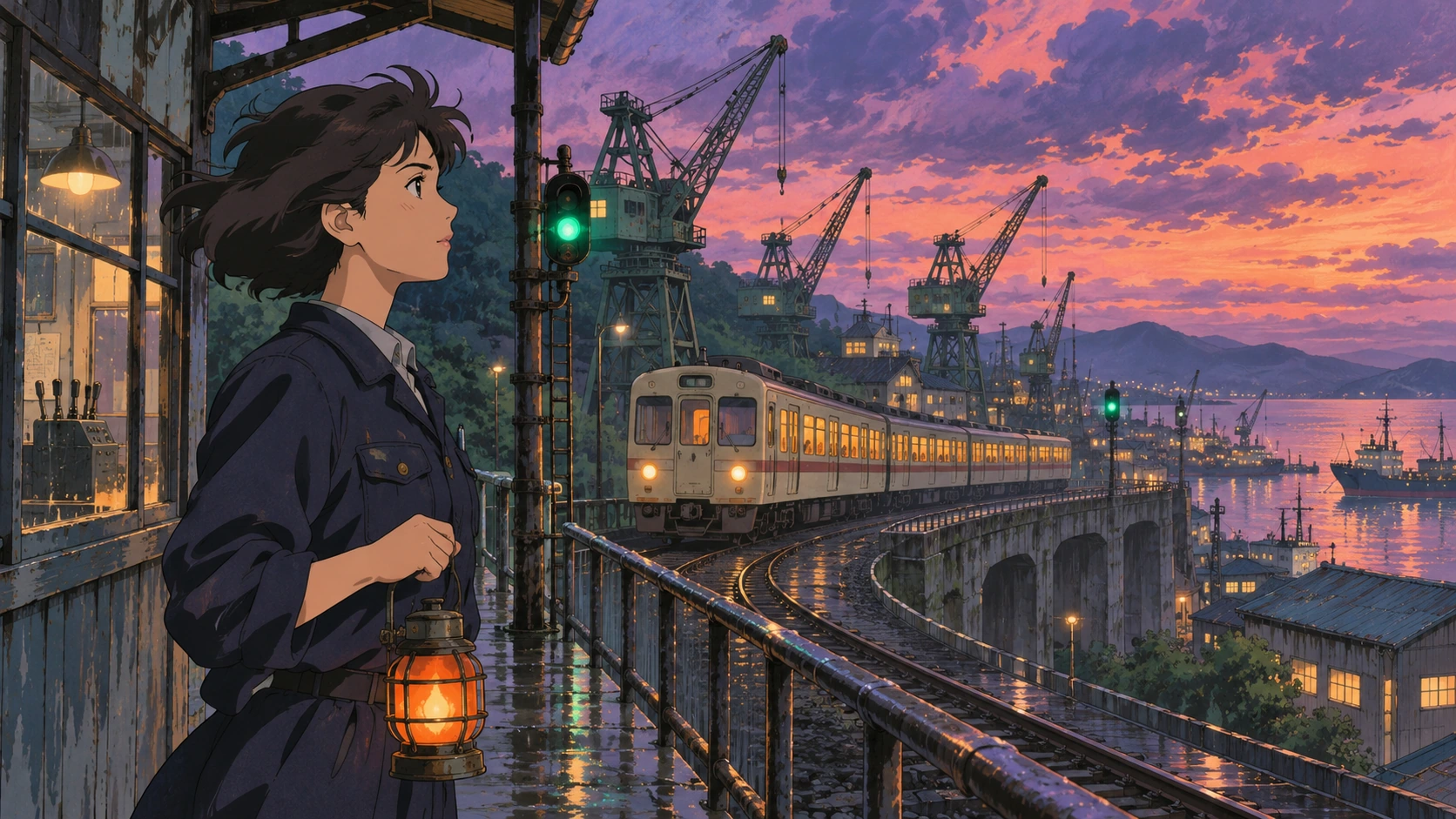
A railway signal glows against violet evening. A face carries two clean shadow shapes while the harbour behind it contains a hundred small observations. Retro 90s Anime explores that productive tension between economical character drawing, rich environments and cinematic feeling.
A visual introduction
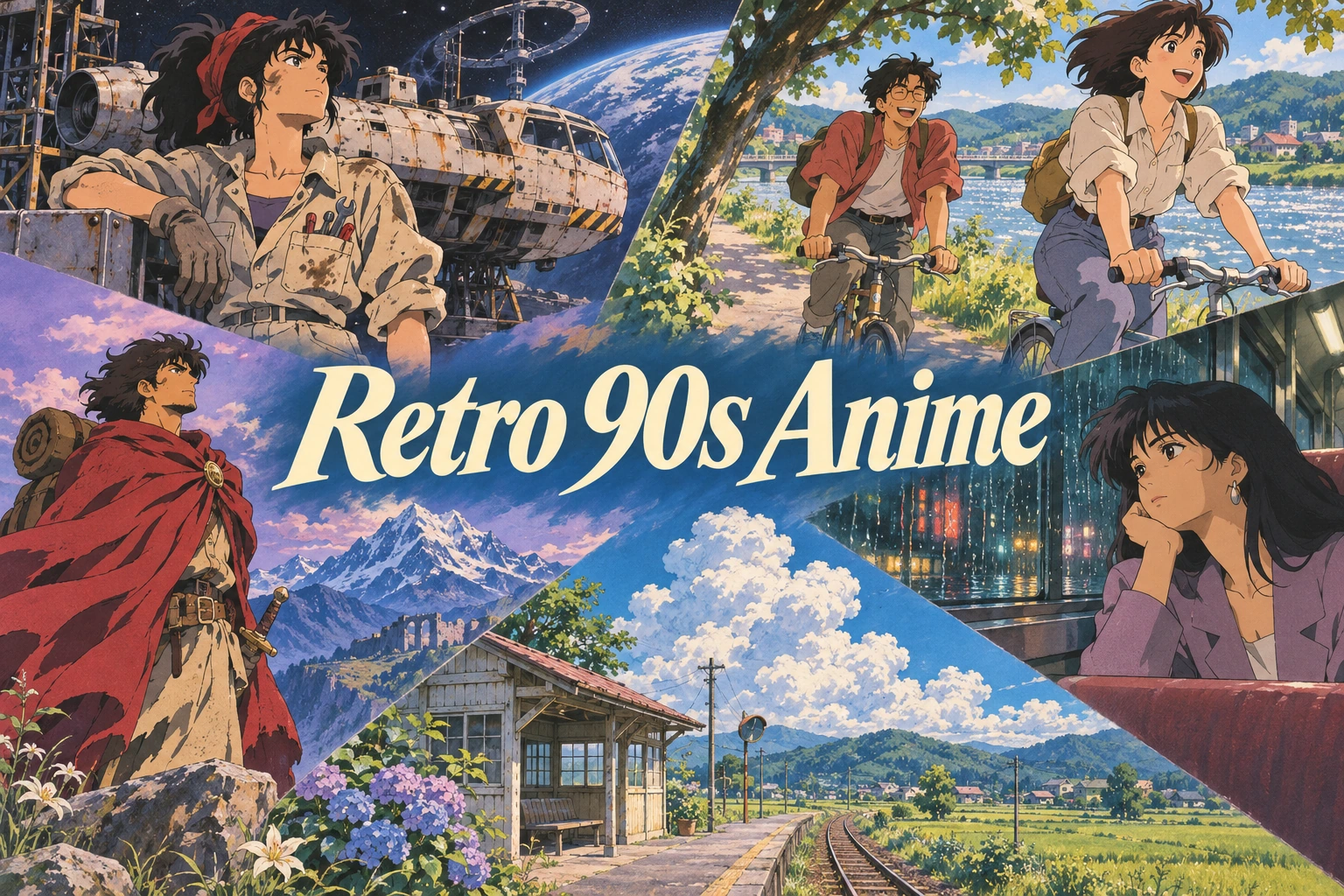
Five original AI-generated interpretations explore a period-inspired appearance. The invented scenes include a harbour banner, a centrally titled collage and three standalone studies. Historical film references are linked in the sources.
Select an image for a closer look. Use the thumbnails, arrow keys or a swipe to compare examples. Zoom in to inspect details, or share the image that inspires you.
Creative toolbox · take this style further
Choose an input and a destination. Search sends your words to the chosen site; Copy & open puts them on your clipboard to paste there.
Create with AI
Turn your chosen input into an image prompt or a new creative direction.
ChatGPT
Copy your input and paste it into a ChatGPT conversation or image request.
Copy & open ChatGPT (new tab)Claude · Anthropic
Develop an image prompt or explore the style in a new Claude conversation.
Copy & open Claude · Anthropic (new tab)Midjourney
Paste your input into the Imagine bar on the Create page.
Copy & open Midjourney (new tab)Adobe Firefly
Copy your input, open Firefly, and paste it into the prompt field.
Copy & open Adobe Firefly (new tab)Leonardo.Ai
Copy your input, open Leonardo, and paste it into the generation field.
Copy & open Leonardo.Ai (new tab)Image search
Find visual references. Short, concrete keywords usually work best.
Lexica
Search AI images and prompts using your selected input.
Search with this input Lexica (new tab)Pexels
Search the photo and video library. Short keywords often work best.
Search with this input Pexels (new tab)Pixabay
Search photos, illustrations and other images.
Search with this input Pixabay (new tab)Unsplash
Search photographs using the style name or your own keywords.
Search with this input Unsplash (new tab)Wikimedia Commons
Search photographs, artworks and historical images. Check each file for its source and reuse terms.
Search with this input Wikimedia Commons (new tab)Art & research
Explore artists, collections and the ideas behind a style.
Wikipedia
Search for background reading. A style may not have its own article.
Search with this input Wikipedia (new tab)WikiArt
Copy your input into WikiArt’s search to explore artists and artworks.
Copy & open WikiArt (new tab)Europeana
Paste your keywords into the search to explore European museum, library and archive collections.
Copy & open Europeana (new tab)Inspiration
Discover portfolios and visual ideas from creative communities.
Instagram hashtags
Search a hashtag made from your input: spaces and punctuation are removed. Instagram may require sign-in.
Search with this input Instagram hashtags (new tab)ArtStation
Paste your input into artwork search for concept art, environments, characters and visual development.
Copy & open ArtStation (new tab)Behance
Paste your input into project search for illustration, design and visual storytelling.
Copy & open Behance (new tab)A closer look
Readable ink contours, deliberate cel shadows, expressive silhouettes, painted atmospheric depth and selective effects form the core vocabulary. Quiet daylight, mechanical science fiction and romantic fantasy each use it differently.
A decade with several visual languages
Retro 90s Anime is a present-day descriptive label for images recalling Japanese animation of the 1990s. It gathers a period, production habits and remembered viewing experiences. The broader Anime guide introduces the field. This companion asks how to build a convincing still image from the decade's drawing and staging decisions.
The range matters. Studio Ghibli records Hayao Miyazaki's Princess Mononoke in 1997. Sunrise records Shinichiro Watanabe's Cowboy Bebop in 1998. The BFI's historical survey also discusses the decade's mechanical science fiction and psychological cinema. Those references give a creator several directions to investigate. Akira belongs to 1988, although its influence and international circulation are central to many viewers' memories of 1990s anime.
The cel, the background and the composite
In a cel-based production, character drawing and colour occupy transparent sheets that can be placed over separately painted scenery and photographed. This division encourages a useful visual contrast. A jacket may have a flat local colour and one decisive shadow, while clouds, foliage and weather receive more continuous painterly treatment. The design can remain economical at the moving figure and expansive in its surroundings.
The decade also contains mixed workflows. Computer Graphics World's production reporting describes how Princess Mononoke combined hand-drawn cels with digital paint, compositing and CG elements, including work designed to blend with the painted appearance. Yale's programme notes corroborate that combination. For a visual study, identify which part of the picture carries a flat painted shape, a soft background transition or a composited glow.
A generated PNG demonstrates a finished appearance. Building an animation from it would require further character models, layouts, drawings and timing decisions. In these studies the language of cel painting is a visual reference for still illustration.
Let the drawing carry the character
Start with a silhouette that tells us what someone is doing. A slight turn of the shoulders can establish anticipation. A lowered hand can give a tool weight. Hair works best as a few coherent masses with selected loose strands. Keep the nose, jaw, ear and eye in the same perspective, especially in three-quarter views.
Place shadow boundaries where they explain form. A narrow shadow beneath the fringe can connect to a larger plane along the cheek. A dark sleeve can meet the torso without dissolving the gesture. Reserve a bright edge for the side facing a signal, window or sun. Multiple unrelated rim lights can make the scene look assembled from different lighting setups.
The harbour banner uses a compact figure and a strongly separated lantern against an expansive painted setting. The warm train windows repeat the lantern's colour farther into the scene. That repetition leads the eye through space while leaving the engineer's expression quiet.
Give the background a believable life
A convincing environment contains decisions about use. Rails must arrive somewhere. A platform needs room beside the train. A bicycle needs a frame that can connect its wheels. Those ordinary relationships make an invented world inhabitable. Texture becomes more persuasive when it follows weather, wear and construction.
Build depth in layers. Let a dark foreground post overlap the figure, place the action in a readable middle distance and soften distant hills or cranes. Background detail can decrease toward the horizon. A broad band of sky gives the eye somewhere to rest after a cluster of mechanical lines.
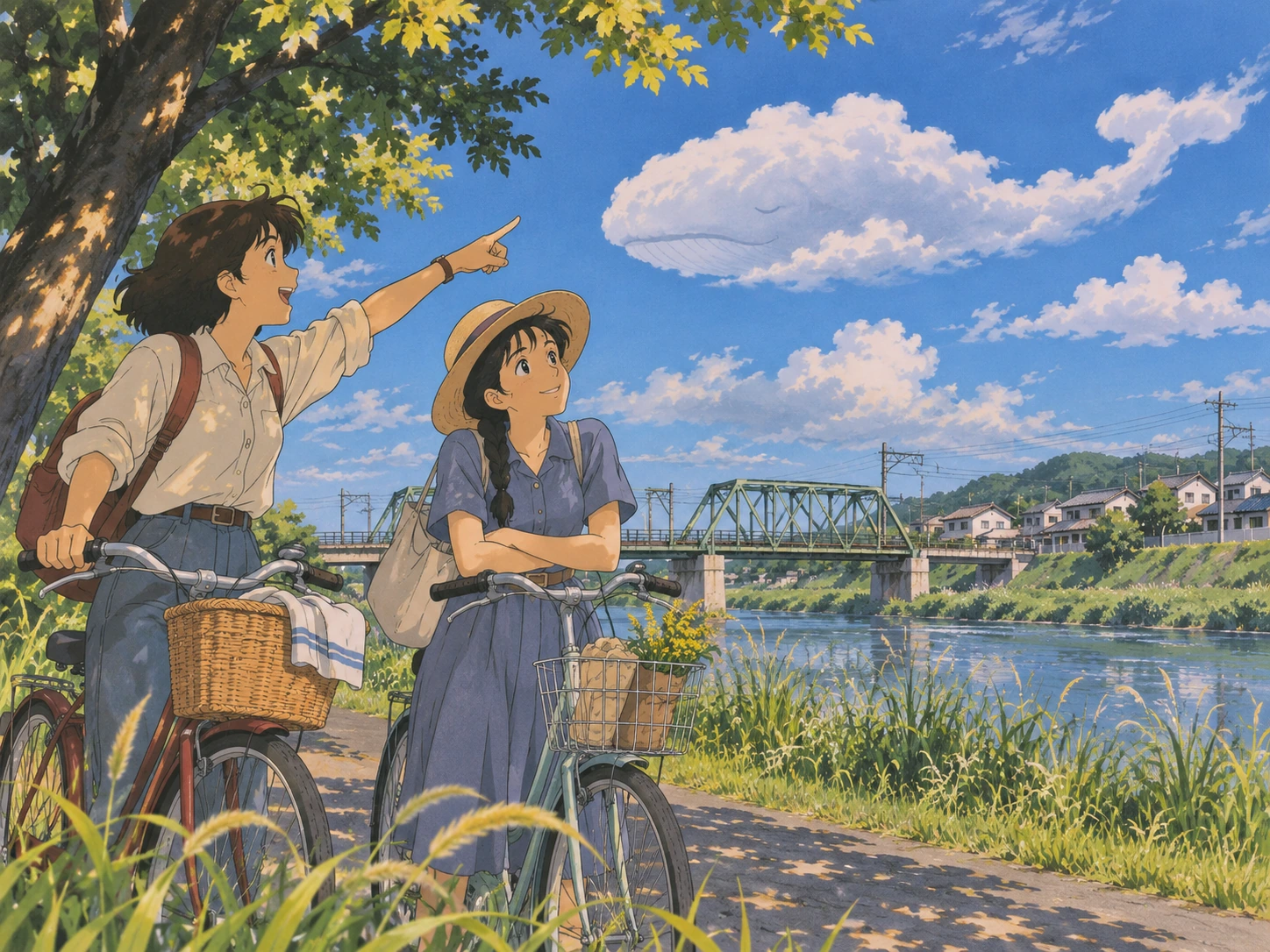
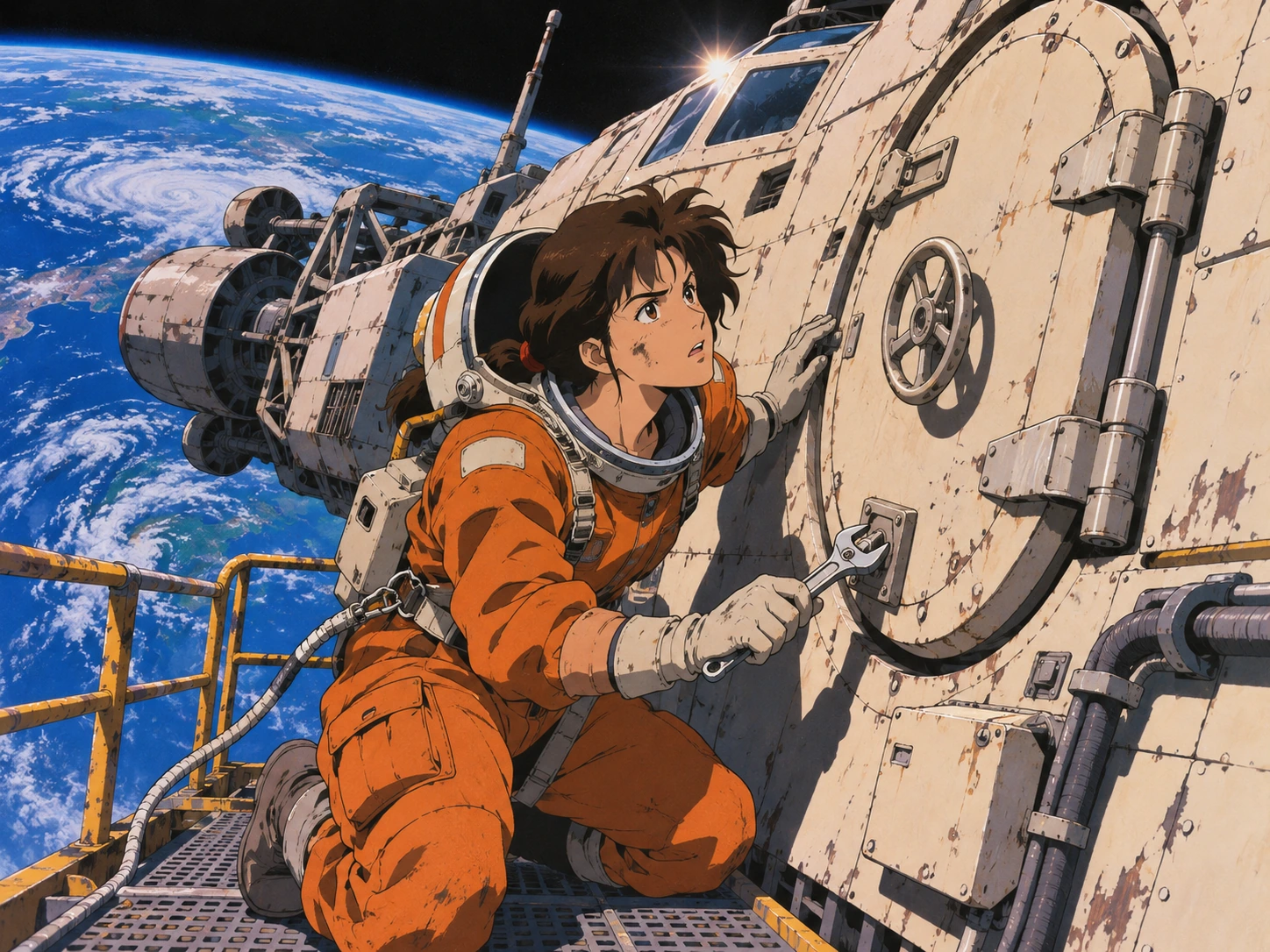
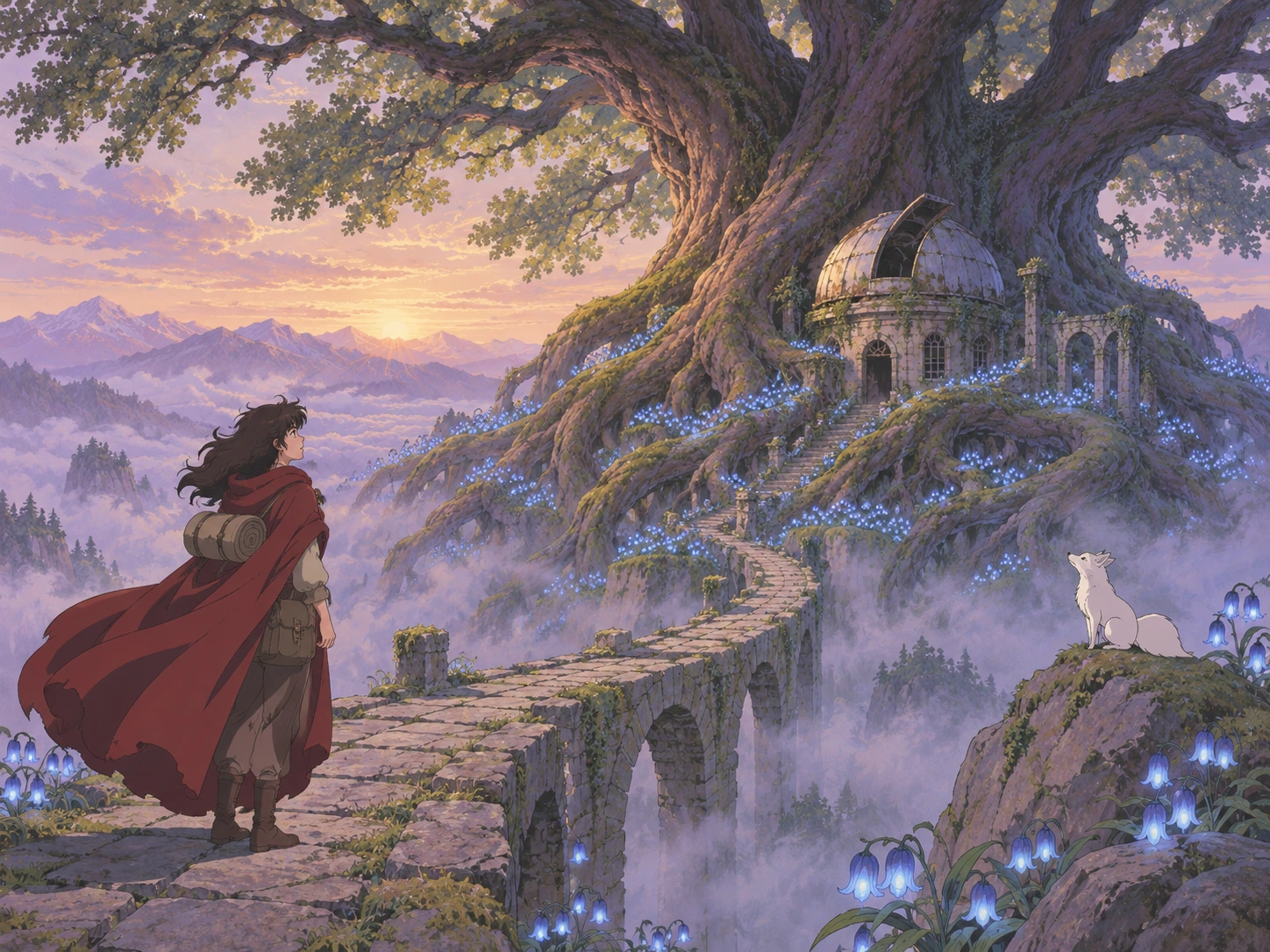
The riverside study uses summer foliage and open sky to carry a pause in the story. The orbital repair study tests harder silhouettes and a small warm figure against the planet. The fantasy scene changes the scale again, placing a traveller beneath an immense tree. Together they show how much atmosphere can change while the drawing remains legible.
Choose the shot before choosing the texture
Describe a moment with a possible before and after. Someone has stopped cycling to notice a cloud. A mechanic is checking a hatch. A traveller has reached a causeway and has yet to cross it. A strong still often leaves just enough unfinished action for the viewer to complete mentally.
A 4:3 frame can recall television and home-video presentation. A wider composition can emphasize cinematic space or serve a contemporary banner. Both can use the same drawing grammar. Frame the subject deliberately and leave important gestures intact when making a crop.
Photochemical softness, grain and restrained glow can unify the layers. Heavy scan lines, tracking damage and colour fringing describe a display or a worn copy. Add them only when that viewing experience is part of the brief. The original drawing deserves to remain visible.
A practical prompt and review method
Name the scene, the shot, the character's action and the relationship between foreground and background. Then specify economical cel shadows, controlled ink contours and a painted environment. Choose one lighting condition and a small number of dominant colours. The phrase '90s anime' becomes more useful when these decisions accompany it.
Review the result in two passes. At thumbnail size, check the silhouette, focal point and direction of light. Enlarged, inspect hands, eyes, machinery and perspective. Give a revision one concrete job, such as simplifying the hair or repairing a bicycle frame. Adding more style adjectives rarely repairs a structural error.
This approach suits narrative posters, game-world mood studies, music imagery and character-led editorial work. Its familiar motifs can become repetitive, especially when every scene defaults to rain and neon. A sunlit kitchen, a repair shed or a windy footpath can carry the same period sensibility with a different emotional register.
A small poetic detour
Original words from the AOI studio.
Poetry
The last warm carriage rounds the bend.
A signal holds its little green.
The harbour wears a painted dusk,
the wind moves somewhere in between.
One hand is waiting by the rail.
The next frame has not happened yet.
The prompt workshop
Original creative exercises. These prompts create new illustrations, not documentary evidence.
Begin with a small everyday event
Create an original 4:3 animation-style still recalling 1990s Japanese cel production. Two adult friends pause with bicycles beside a summer river to look at a strange cloud. Use clear ink contours, two-tone character shadows and a richly painted background. Keep the bicycles coherent and the gestures natural. Warm daylight, calm blue sky, no text.
Compose a mechanical world
Show an adult engineer in an orange pressure suit repairing a cream orbital tug above a curved blue Earth. Give the hatch plausible hinges and panels. Use crisp cel shadows on the figure and machinery, a painted atmosphere and one strong direction of sunlight. Make the gesture and tether readable in a 4:3 composition.
Change the genre while keeping the drawing
Compose a romantic fantasy still with a red-cloaked traveller on a stone causeway below an enormous tree that cradles an abandoned observatory. Use economical character drawing, layered painted mist and a few small blue lights among the roots. Let scale and a pause in the action carry the wonder. Original setting and characters.
Your next inspiration
Discover another art style
Follow a visual thread to the next subject.
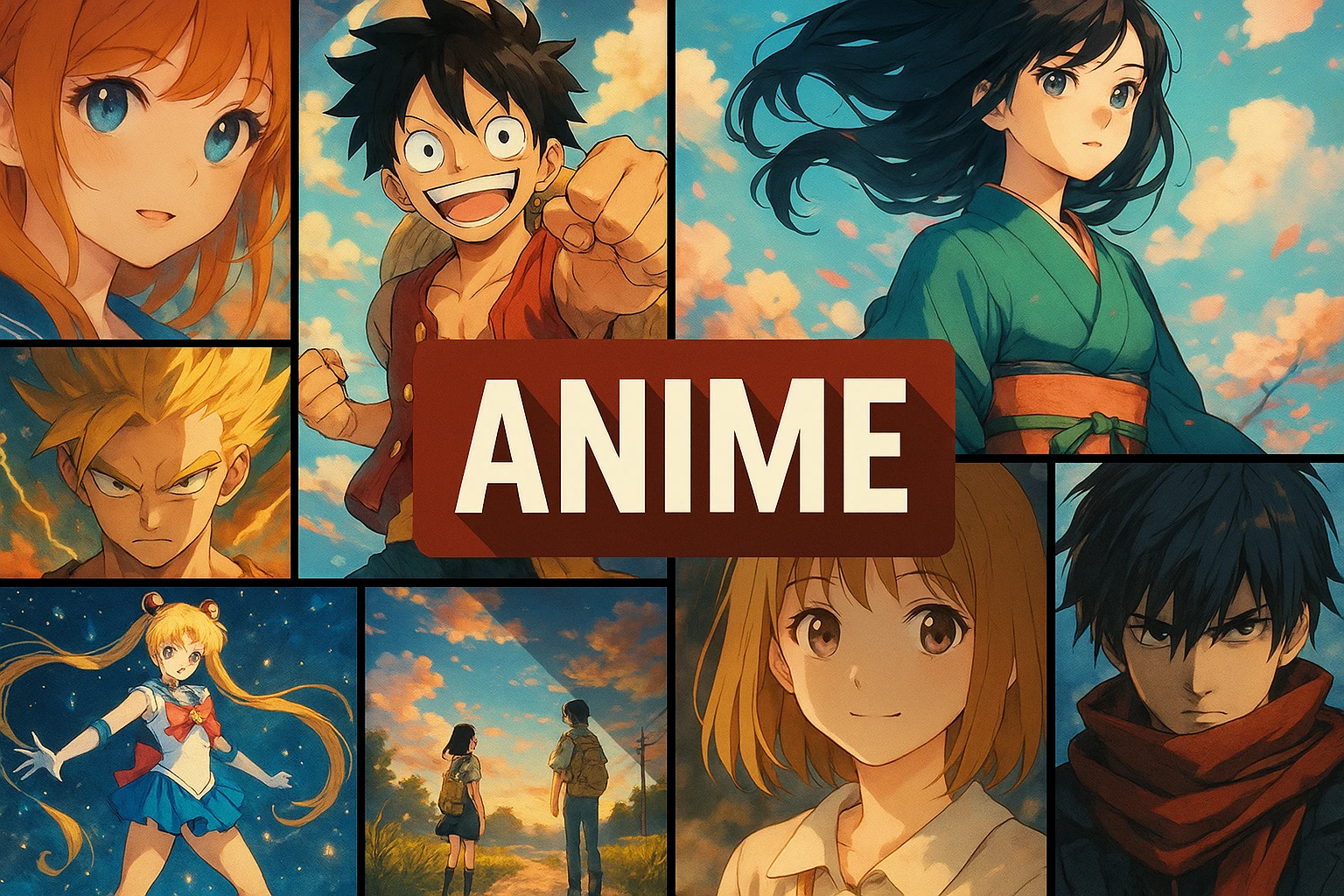
Anime: A Medium of Movement, Design and Many Visual Languages
Explore the wider field of Japanese animation and its visual vocabulary.
People & works to explore
References discussed in this article. Consult the sources below for context.
Artists and practitioners
Hayao Miyazaki — director of Princess Mononoke, documented by Studio Ghibli
Shinichiro Watanabe — director of Cowboy Bebop, documented by Sunrise
Paintings and other works
Princess Mononoke (1997) — Studio Ghibli production record
Cowboy Bebop (1998) — Sunrise production record
A smile from the studio
Jokes
The background painter delivered an entire harbour. The character animator asked whether the hero could spend this shot thinking very deeply and moving only an eyebrow.