
Japanese animation and visual storytelling
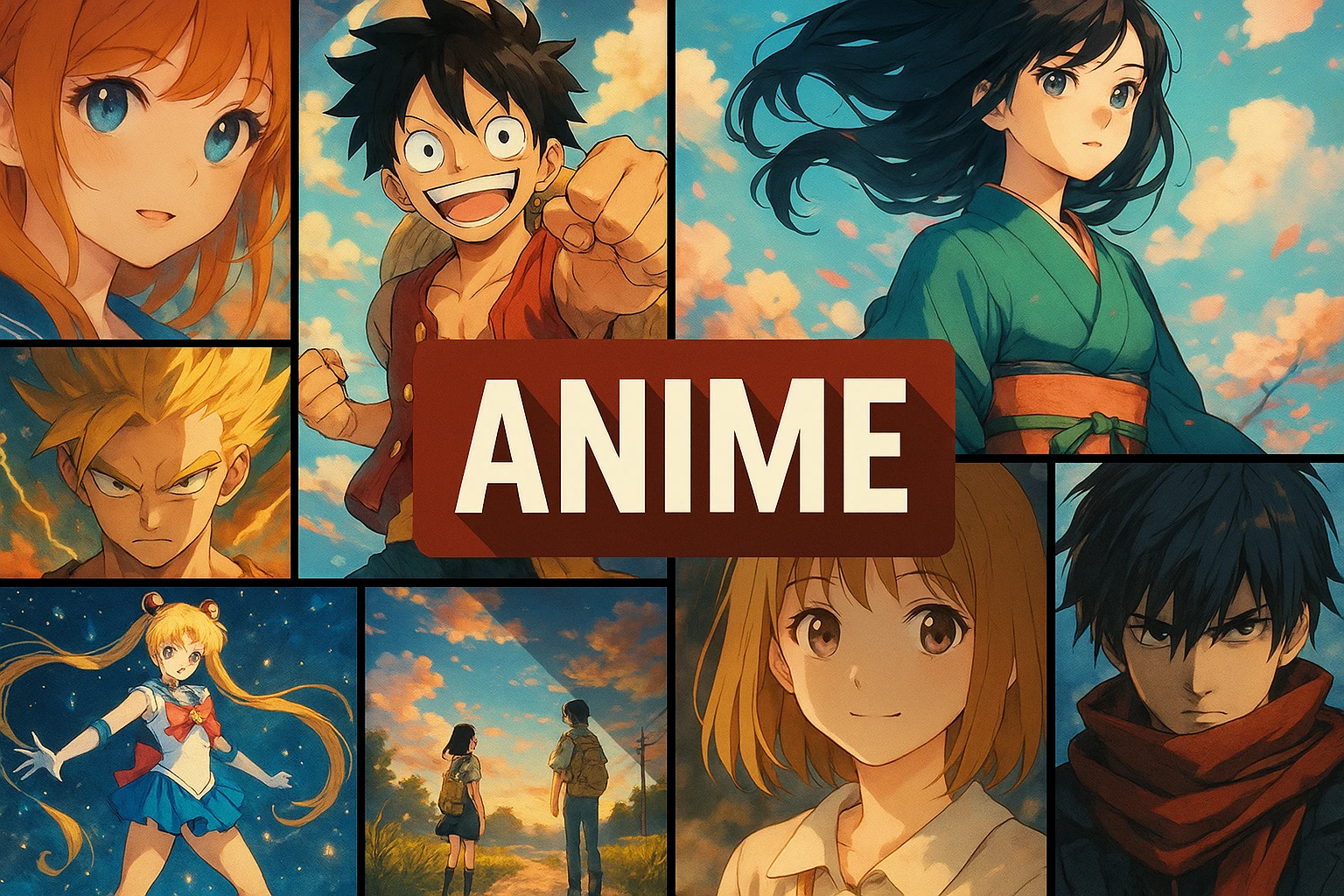
Anime encompasses many kinds of Japanese animation. A useful visual study looks at a particular work, period or production approach instead of treating the medium as one genre or a single face design.
A visual introduction
Select an image for a closer look. Use the thumbnails, arrow keys or a swipe to compare examples. Zoom in to inspect details, or share the image that inspires you.
Creative toolbox · take this style further
Choose an input and a destination. Search sends your words to the chosen site; Copy & open puts them on your clipboard to paste there.
Create with AI
Turn your chosen input into an image prompt or a new creative direction.
ChatGPT
Copy your input and paste it into a ChatGPT conversation or image request.
Copy & open ChatGPT (new tab)Claude · Anthropic
Develop an image prompt or explore the style in a new Claude conversation.
Copy & open Claude · Anthropic (new tab)Midjourney
Paste your input into the Imagine bar on the Create page.
Copy & open Midjourney (new tab)Adobe Firefly
Copy your input, open Firefly, and paste it into the prompt field.
Copy & open Adobe Firefly (new tab)Leonardo.Ai
Copy your input, open Leonardo, and paste it into the generation field.
Copy & open Leonardo.Ai (new tab)Image search
Find visual references. Short, concrete keywords usually work best.
Lexica
Search AI images and prompts using your selected input.
Search with this input Lexica (new tab)Pexels
Search the photo and video library. Short keywords often work best.
Search with this input Pexels (new tab)Pixabay
Search photos, illustrations and other images.
Search with this input Pixabay (new tab)Unsplash
Search photographs using the style name or your own keywords.
Search with this input Unsplash (new tab)Wikimedia Commons
Search photographs, artworks and historical images. Check each file for its source and reuse terms.
Search with this input Wikimedia Commons (new tab)Art & research
Explore artists, collections and the ideas behind a style.
Wikipedia
Search for background reading. A style may not have its own article.
Search with this input Wikipedia (new tab)WikiArt
Copy your input into WikiArt’s search to explore artists and artworks.
Copy & open WikiArt (new tab)Europeana
Paste your keywords into the search to explore European museum, library and archive collections.
Copy & open Europeana (new tab)Inspiration
Discover portfolios and visual ideas from creative communities.
Instagram hashtags
Search a hashtag made from your input: spaces and punctuation are removed. Instagram may require sign-in.
Search with this input Instagram hashtags (new tab)ArtStation
Paste your input into artwork search for concept art, environments, characters and visual development.
Copy & open ArtStation (new tab)Behance
Paste your input into project search for illustration, design and visual storytelling.
Copy & open Behance (new tab)A closer look
Silhouette, line hierarchy, color grouping, background design and the selection of animated movement work together; their balance changes greatly between productions.
A broad field, not one drawing formula
Anime includes stories for different audiences, from intimate everyday observation to speculative worlds and experimental filmmaking. The BFI's selections place very different films alongside one another, including work by Isao Takahata, Satoshi Kon, Hayao Miyazaki and Masaaki Yuasa. Their differences are a reason to investigate the medium rather than compress it into oversized eyes and dramatic hair.
Manga and anime are related but different forms. A comic organizes drawn images on a page; animation organizes images and sound through time. An illustration described as anime-inspired can borrow visual choices, but a single still cannot demonstrate timing, editing or performance on its own.
Design for recognition and performance
Start with a readable silhouette and a deliberate proportion system. Test a character in profile, at a distance and with a small change of posture. Accessories should support identity without making every pose visually crowded. The face is only one part of expression: the angle of the shoulders and the space between figures can carry a scene.
Separate the contour, internal details and shadow shapes. A clear hierarchy helps a small drawing remain readable. Flat color and sharply bounded shadow can be useful choices, but neither is compulsory across all anime. Ask which treatment belongs to the particular visual reference you are studying.
Let backgrounds do narrative work
A carefully observed room can establish routine through the arrangement of objects. A broad landscape can isolate a small figure. An abstract field can redirect attention toward an emotional or rhythmic moment. Do not automatically give every scene the same saturated sunset and glossy highlights.
Keep the character and setting in a compatible light environment. Simplified character rendering can coexist with detailed backgrounds when perspective, scale and focal emphasis remain convincing. Reserve the strongest contrast for what the scene asks the viewer to notice.
Turn a still into a sequence
Draw three original frames: anticipation, action and aftermath. Change as little as possible while making the event understandable. This exercise reveals whether the image's pose and staging carry information or merely look dynamic. A more elaborate picture is not always a clearer frame.
For prompts, specify subject, camera distance, line behavior, shadow design and mood. Use original characters and describe the visual decisions you want. Name a documented film when discussing it critically; do not present a generated image as a frame from that film.
The prompt workshop
Original creative exercises. These prompts create new illustrations, not documentary evidence.
An ordinary moment
Original anime-inspired still of an adult commuter sheltering from rain, medium-wide composition, clear silhouette, restrained linework, flat shadow shapes, reflective pavement and one warm shop window, no franchise characters.
Background as storytelling
An original animated-film environment: a small seaside repair shop after closing, tools arranged by use, a quiet figure in the doorway, detailed background with simplified character shading, coherent evening light.
Three-frame action study
Create a three-panel original animation storyboard of a person noticing and catching a windblown scarf: anticipation, reach, recovery; consistent costume and camera, clear poses, minimal background, no dialogue.