
Contemporary visual culture · familiar images made strange
Explore Pop Surrealism through its Lowbrow connections, carefully staged impossibilities, visual storytelling, palette and original image studies beyond familiar clichés.
A visual introduction
Compare the distinct AOI studies and the titled reference collage. Captions distinguish generated interpretations from documentary evidence.
Select an image for a closer look. Use the thumbnails, arrow keys or a swipe to compare examples. Zoom in to inspect details, or share the image that inspires you.

Creative toolbox · take this style further
Choose an input and a destination. Search sends your words to the chosen site; Copy & open puts them on your clipboard to paste there.
Create with AI
Turn your chosen input into an image prompt or a new creative direction.
ChatGPT
Copy your input and paste it into a ChatGPT conversation or image request.
Copy & open ChatGPT (new tab)Claude · Anthropic
Develop an image prompt or explore the style in a new Claude conversation.
Copy & open Claude · Anthropic (new tab)Midjourney
Paste your input into the Imagine bar on the Create page.
Copy & open Midjourney (new tab)Adobe Firefly
Copy your input, open Firefly, and paste it into the prompt field.
Copy & open Adobe Firefly (new tab)Leonardo.Ai
Copy your input, open Leonardo, and paste it into the generation field.
Copy & open Leonardo.Ai (new tab)Image search
Find visual references. Short, concrete keywords usually work best.
Lexica
Search AI images and prompts using your selected input.
Search with this input Lexica (new tab)Pexels
Search the photo and video library. Short keywords often work best.
Search with this input Pexels (new tab)Pixabay
Search photos, illustrations and other images.
Search with this input Pixabay (new tab)Unsplash
Search photographs using the style name or your own keywords.
Search with this input Unsplash (new tab)Wikimedia Commons
Search photographs, artworks and historical images. Check each file for its source and reuse terms.
Search with this input Wikimedia Commons (new tab)Art & research
Explore artists, collections and the ideas behind a style.
Wikipedia
Search for background reading. A style may not have its own article.
Search with this input Wikipedia (new tab)WikiArt
Copy your input into WikiArt’s search to explore artists and artworks.
Copy & open WikiArt (new tab)Europeana
Paste your keywords into the search to explore European museum, library and archive collections.
Copy & open Europeana (new tab)Inspiration
Discover portfolios and visual ideas from creative communities.
Instagram hashtags
Search a hashtag made from your input: spaces and punctuation are removed. Instagram may require sign-in.
Search with this input Instagram hashtags (new tab)ArtStation
Paste your input into artwork search for concept art, environments, characters and visual development.
Copy & open ArtStation (new tab)Behance
Paste your input into project search for illustration, design and visual storytelling.
Copy & open Behance (new tab)A closer look
Recognizable toys, creatures and everyday objects enter impossible relationships; controlled lighting and persuasive surfaces make the strange event feel internally coherent.
Pop Surrealism: the familiar with its rules altered
Pop Surrealism describes a varied contemporary field in which popular imagery, imaginative transformation and carefully crafted pictures meet. Toys, cartoons, advertising, decorative objects and storybook forms can become carriers of unease, tenderness, satire or ambiguity. The label is useful as a point of entry, but it does not prescribe one face, one palette or one emotional effect.
The 2004 survey Pop Surrealism, edited by Kirsten Anderson and documented on Mark Ryden’s site, places Pop Surrealism and Lowbrow in relation to hot-rod culture, underground comics and rock posters. Its range of contributors and artists argues against reducing the field to one inventor or one formula. Lowbrow and Pop Surrealism overlap in usage; neither is simply an alternative spelling of historical Surrealism. [1]
A scene develops through artists, publications and audiences
Juxtapoz’s republication of Robert Williams’s editorial from its first issue, winter 1994, is a primary document for the magazine’s role in this artistic environment. It provides a way to examine how participants framed their work and its place in art publishing. A scene is built through such platforms and conversations as well as through individual paintings. [2]
Ryden’s own biography describes his combination of popular-cultural subject matter with highly finished painting techniques. Treat that biography as evidence of an artist’s practice and self-presentation, not as neutral proof that he single-handedly founded a movement. His work is one route into the field; a broad guide should leave room for different surfaces, narratives and degrees of humor or discomfort. [3]
Visual grammar: one convincing impossibility
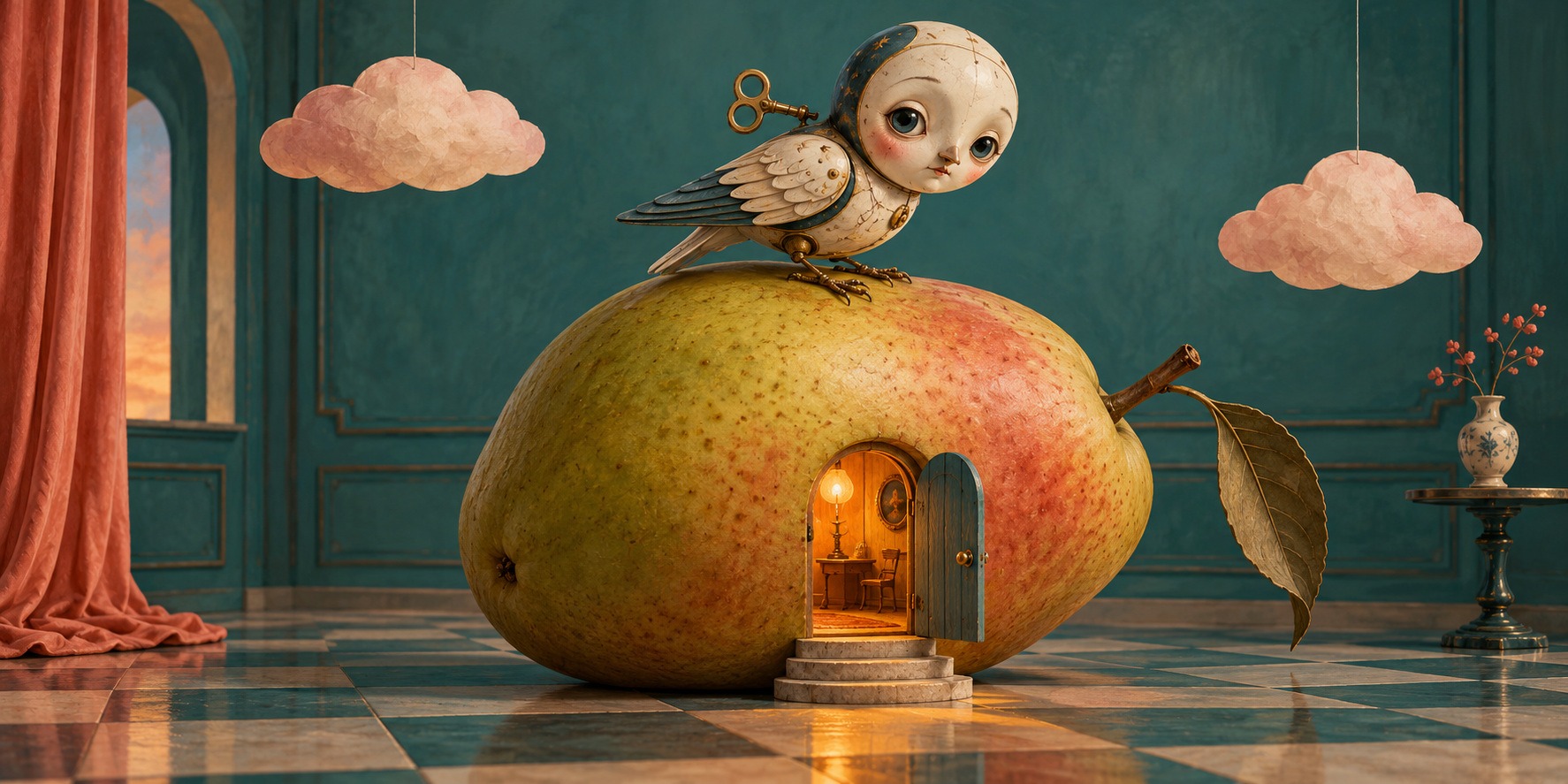
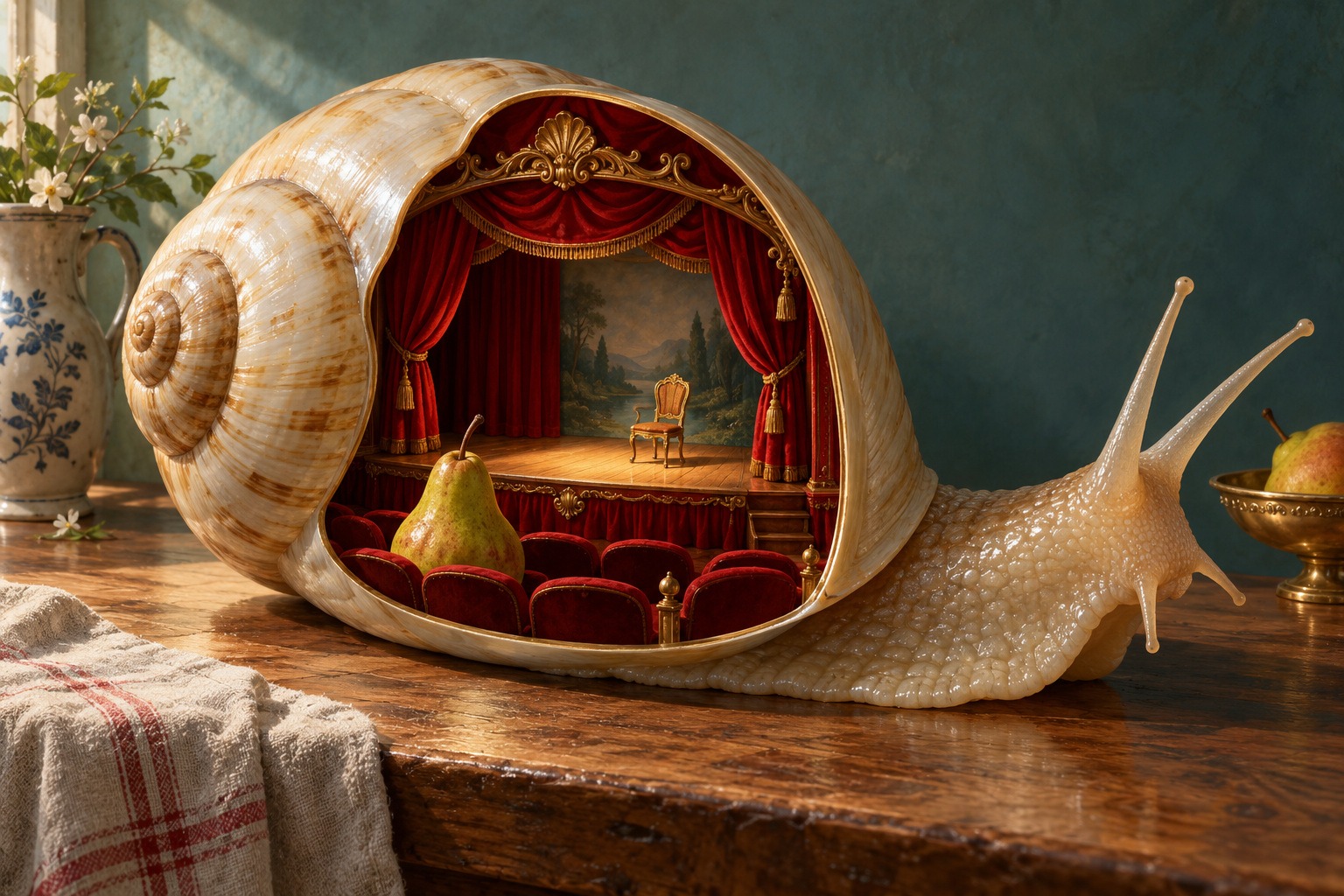
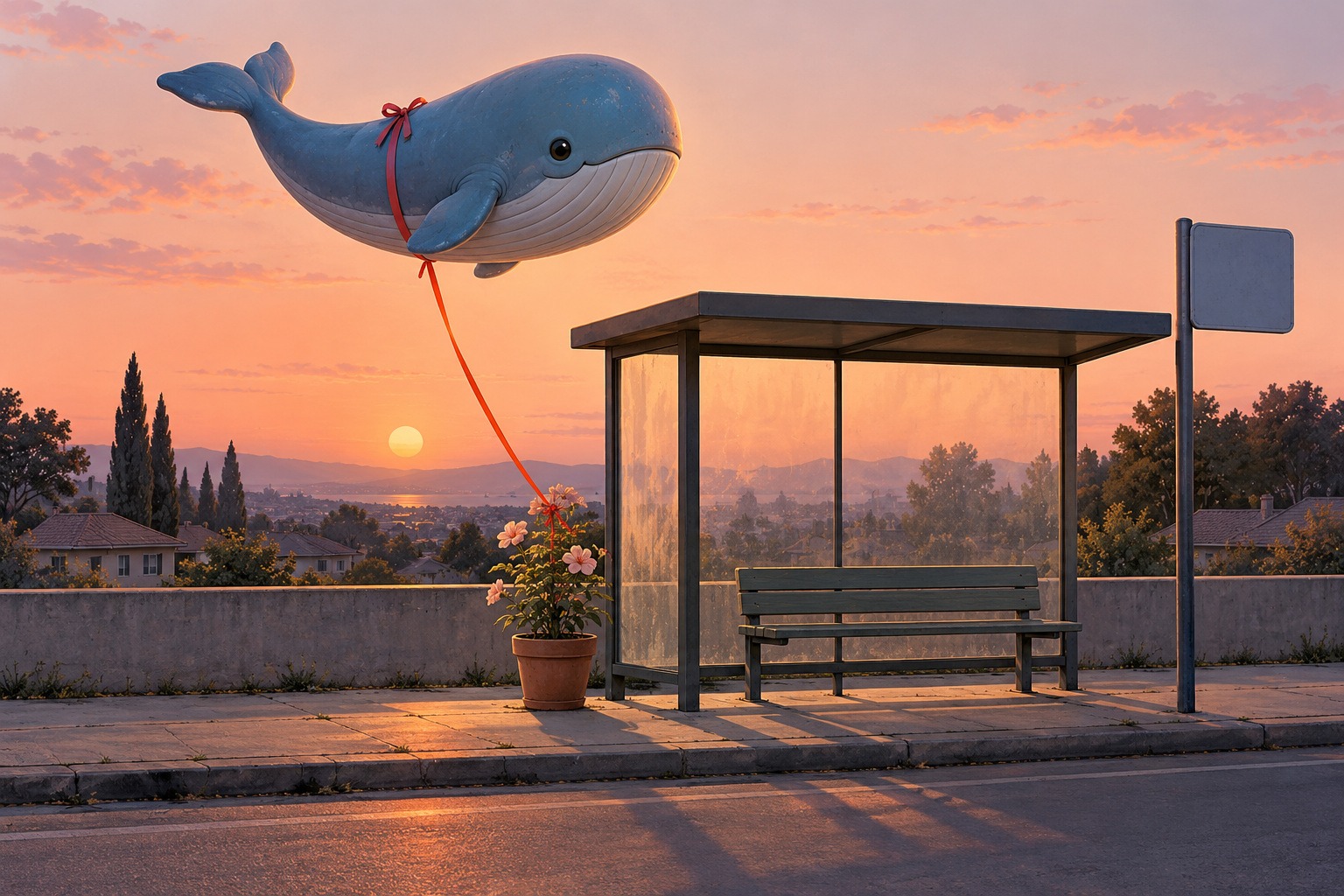
Choose an ordinary relationship and change it. A shell contains a theater; a fruit becomes a building; a toy-like whale waits above a bus stop. The surprise becomes stronger when the surrounding world is legible. Consistent light, contact shadows and scale cues allow the impossible event to feel intentionally staged rather than accidentally malformed.
Begin with a focal object and a second object that changes its meaning. A pear on a table is a still life; a pear watching an empty stage becomes a small story. Extra symbols should deepen that relationship. If every object has eyes, wings, flames and a secret doorway, the viewer has no stable point from which to experience the strangeness.
Scale is especially useful. An ordinary object enlarged beyond expectation can become a landscape or an inhabited space. Keep some familiar measure—a chair, a window, a plant pot—so the viewer can read the change. Without that measure, the image may feel merely abstract rather than impossible.
Surface, palette and emotional tone
A polished surface can make an absurd scene feel ceremonious or precious. A flatter cartoon surface can sharpen graphic humor. Neither treatment is compulsory. Decide how the finish supports the emotional tension: a delicately rendered object may invite affection while its setting quietly unsettles that response.
For a restrained study, combine dusty teal, warm cream and a small coral accent. For a brighter scene, let the saturation belong mainly to the focal object. These are AOI design choices, not a movement-wide color code. Candy colors do not automatically create satire, and a dark background does not automatically create psychological depth.
Light can bind the scene together. Use one clear direction, then inspect the shadows of transformed objects. A floating form needs a considered relationship to the ground. A glowing doorway inside a fruit should illuminate nearby surfaces. These details make the invention readable even when its premise cannot exist.
Three examples and a new banner
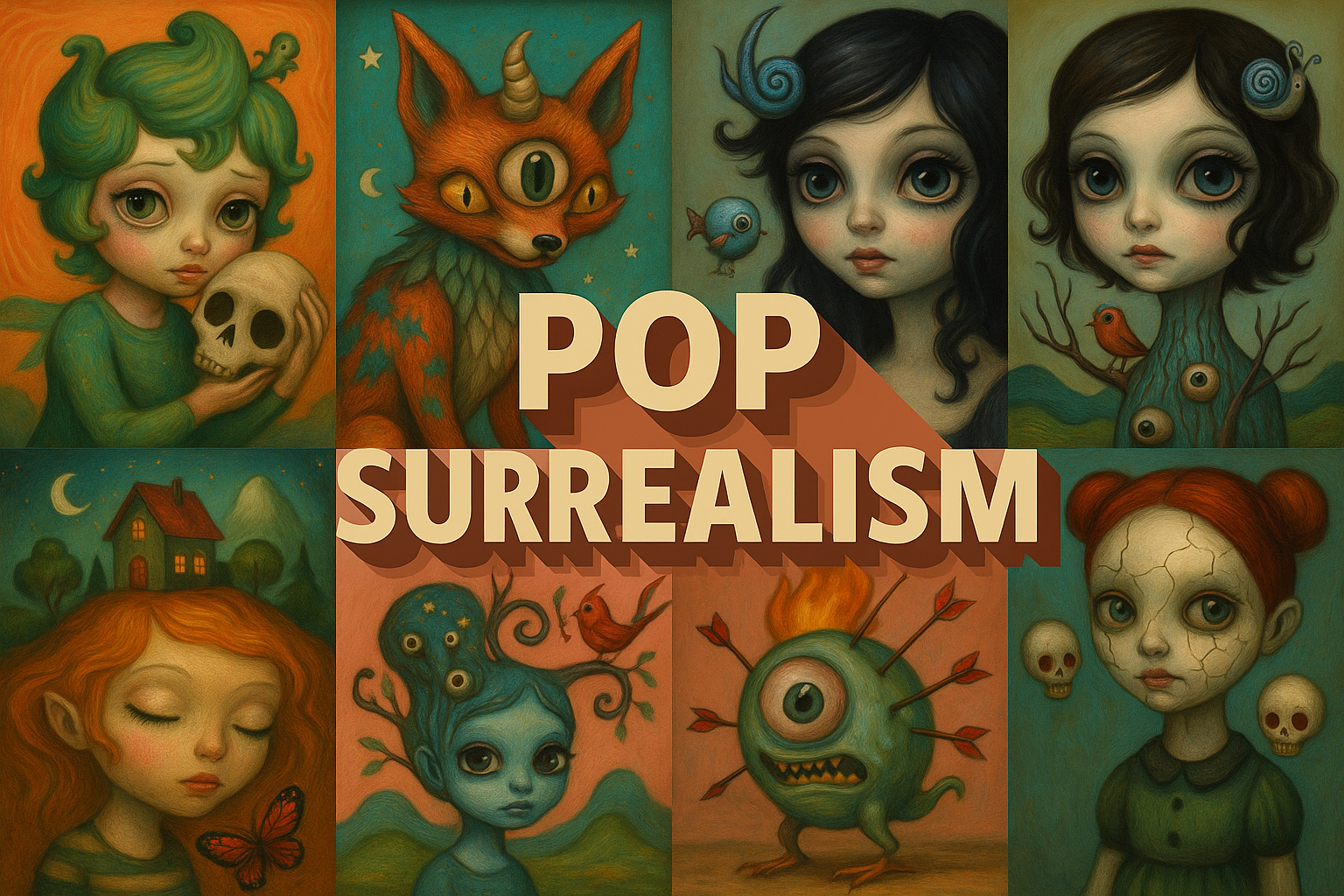
The retained portrait uses enlarged eyes and surrounding toy-like forms to explore the meeting of sweetness and unease. The new shell-theater study shifts to a still life, with a pear audience and an empty chair onstage. The waiting whale study moves into an ordinary suburban setting, where a ribbon and plant pot give the floating creature a fragile connection to the ground.
The banner proposes a small porcelain-like bird above a doorway in an oversized pear. The titled collage preserves a more character-centered set of earlier AOI motifs. These images are original generated interpretations and archive illustrations, not works by the artists discussed in the sources. Their purpose is to show different compositional problems, not to supply an invented historical portfolio.
Build meaning without supplying a fixed answer
Write down the central tension in plain language before making the picture: a fragile creature in an oversized room, a performance with no performer, or a journey that has not begun. That tension gives the objects a reason to share the frame. The final image need not explain itself completely, but its uncertainty should feel deliberate.
Try removing one symbolic object at a time. If the picture becomes clearer without losing its atmosphere, the object may have been decorative noise. Keep enough quiet space for the viewer to connect the remaining clues. Ambiguity is different from an inventory of unrelated oddities.
A useful variation exercise keeps the same impossible event but changes the treatment. Render the floating whale as a flat poster, a soft painted scene and a rough sketch. Compare how the emotional register changes. This exposes the role of finish and composition rather than treating a subject motif as the entire style.
Applications, limits and common clichés
The approach can serve editorial illustration, album art, narrative painting, character design and visual essays. It is particularly effective when a familiar object can carry a second meaning. In a practical brief, consider whether the strange event helps communicate the idea or merely competes with it.
Large eyes, skulls, antique frames and cute creatures are available motifs, not requirements. Repeating them without a new relationship can produce a recognizable but empty picture. Likewise, copying a named artist’s recurring symbols is a poor substitute for deciding what your own scene is about.
Distinguish invented anatomy from unintended damage. A deliberate hybrid should have a readable structure; accidental extra limbs or inconsistent perspective usually weaken the intended fiction. If generated text is not essential, remove it. For an actual cover or poster, add typography through a separate designed step.
Prompt vocabulary that describes decisions
Use phrases such as one impossible scale relationship, ordinary setting, persuasive painted volume, restrained palette, clear contact shadow, toy-like form and unresolved narrative. Pair them with a concrete event. Ask for an original composition rather than a duplicate of an existing work. Evaluate the result by the coherence of its invention, not only by how many strange objects appear.
About this guide and its illustrations
This is an AI-authored AOI guide under Penny Wraiter, AOI’s editorial persona. The linked sources support the historical and technical context; the practical exercises, poem and new illustrations are AOI interpretations. Generated pictures are labelled as such and do not establish historical authorship, material authenticity or physical performance.
A small poetic detour
Original words from the AOI studio.
Poetry
The theater opens inside a shell.
A pear has taken the front seat.
No one asks why the chair
is waiting on the stage.
Outside, a ribbon gives the whale
a small excuse to stay.
The bus is late.
The evening is not worried.
We recognize the room
and then, very slowly,
its rules leave by another door.
The prompt workshop
Original creative exercises. These prompts create new illustrations, not documentary evidence.
Give one object an impossible role
Create an original Pop Surrealism still life: a small theater inside an oversized snail shell, with a pear as its audience and an empty chair onstage. Use one clear light source, convincing volume and restrained teal, cream and red. No text or copied character.
Put a quiet surprise in an ordinary place
Create an original narrative image of a toy-like blue whale floating above an empty bus stop at dusk, tethered by a red ribbon to a flowering plant pot. Keep the setting believable and the mood gently ambiguous. Use soft painted light, a clear shadow and no lettering.
Change the mood through the surface
Invent a small bird-like toy above a doorway in an oversized fruit. Make the composition simple enough to read as a silhouette, then use a polished porcelain-like surface and a quiet teal room to create tension between affection and strangeness. No artist imitation or logo.
A smile from the studio
Jokes
The pear bought a theater ticket. It preferred a performance with layers.
Sources and further exploration
[3] Mark Ryden, Biography. The artist’s account of his subjects, technique and practice.