
Object-based art overview
Understand how selecting, combining, altering and arranging objects create different artistic effects. A sourced guide to readymades, assemblage, material decisions and spatial presentation.
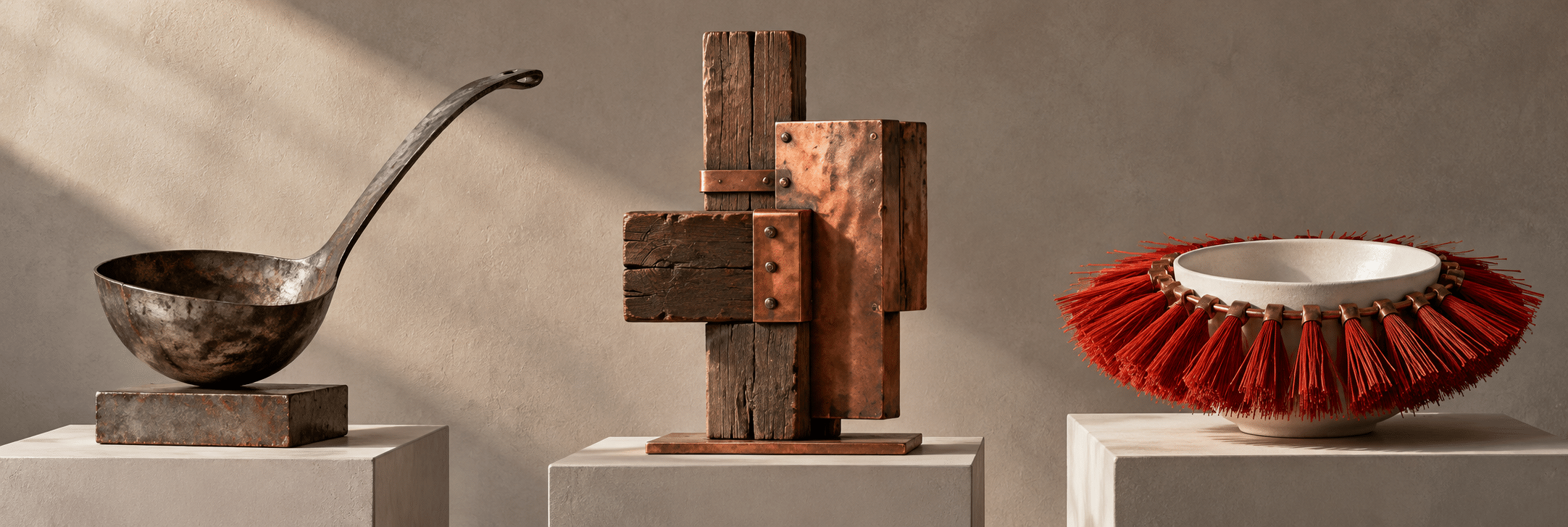
A visual introduction
Select an image for a closer look. Use the thumbnails, arrow keys or a swipe to compare examples. Zoom in to inspect details, or share the image that inspires you.


Creative toolbox · take this style further
Choose an input and a destination. Search sends your words to the chosen site; Copy & open puts them on your clipboard to paste there.
Create with AI
Turn your chosen input into an image prompt or a new creative direction.
ChatGPT
Copy your input and paste it into a ChatGPT conversation or image request.
Copy & open ChatGPT (new tab)Claude · Anthropic
Develop an image prompt or explore the style in a new Claude conversation.
Copy & open Claude · Anthropic (new tab)Midjourney
Paste your input into the Imagine bar on the Create page.
Copy & open Midjourney (new tab)Adobe Firefly
Copy your input, open Firefly, and paste it into the prompt field.
Copy & open Adobe Firefly (new tab)Leonardo.Ai
Copy your input, open Leonardo, and paste it into the generation field.
Copy & open Leonardo.Ai (new tab)Image search
Find visual references. Short, concrete keywords usually work best.
Lexica
Search AI images and prompts using your selected input.
Search with this input Lexica (new tab)Pexels
Search the photo and video library. Short keywords often work best.
Search with this input Pexels (new tab)Pixabay
Search photos, illustrations and other images.
Search with this input Pixabay (new tab)Unsplash
Search photographs using the style name or your own keywords.
Search with this input Unsplash (new tab)Wikimedia Commons
Search photographs, artworks and historical images. Check each file for its source and reuse terms.
Search with this input Wikimedia Commons (new tab)Art & research
Explore artists, collections and the ideas behind a style.
Wikipedia
Search for background reading. A style may not have its own article.
Search with this input Wikipedia (new tab)WikiArt
Copy your input into WikiArt’s search to explore artists and artworks.
Copy & open WikiArt (new tab)Europeana
Paste your keywords into the search to explore European museum, library and archive collections.
Copy & open Europeana (new tab)Inspiration
Discover portfolios and visual ideas from creative communities.
Instagram hashtags
Search a hashtag made from your input: spaces and punctuation are removed. Instagram may require sign-in.
Search with this input Instagram hashtags (new tab)ArtStation
Paste your input into artwork search for concept art, environments, characters and visual development.
Copy & open ArtStation (new tab)Behance
Paste your input into project search for illustration, design and visual storytelling.
Copy & open Behance (new tab)A closer look
Material contrast, traces of use, deliberate placement, actual or imagined joins, silhouette, scale, repetition and the relationship between an object and its display context.
When the object becomes the work
Object Art Styles is an overview of ways artists use actual objects as artistic material, subjects of selection or parts of spatial arrangements. It is not one movement with a fixed appearance. The central distinction is between depicting an object and presenting or transforming the object itself. A painting of a cup and a cup placed in an artwork may invite related questions, but they operate through different material situations.
An everyday thing carries prior uses and associations: a worn handle suggests touch, a container implies contents, a tool implies work. An artist may emphasise those associations, contradict them or make them newly visible through context. Beauty is one possible outcome; humour, unease, memory and institutional questioning are others. The object does not need to become colourful, intricate or conventionally attractive to matter.
Selection, combination and alteration are different decisions
A readymade foregrounds the artist’s selection and presentation of an existing object. An assisted readymade combines or modifies components. Assemblage builds a three-dimensional work from multiple materials and objects. These terms overlap in practice, but they are not interchangeable recipes. Installation shifts attention toward the viewer’s encounter with a spatial arrangement; it can include objects without being reducible to one portable object.
Ask which operation carries the meaning. Is a familiar thing simply relocated? Are fragments joined into a new structure? Has a material change made the original function impossible? Does a sequence of objects organise a room? Naming that operation is more informative than calling everything mixed media. It also helps a maker decide what to leave unchanged.
Three documented works, three useful distinctions
MoMA’s Bicycle Wheel by Marcel Duchamp is a 1951 third version, after the lost 1913 original. Its metal wheel is mounted on a painted wooden stool. That version history matters: an image of the museum object should not silently be captioned as the surviving 1913 construction. The combination makes ordinary components available to a different kind of attention.
Picasso’s Guitar of January–February 1914, also at MoMA, is made from ferrous sheet metal and wire. It constructs an instrument-like form through planes and openings rather than merely displaying an unaltered guitar. Daniel Spoerri’s Kichka’s Breakfast I (1960) preserves an arrangement of everyday remnants in a work that includes a chair hung on a wall and a board across its seat. Compare construction, relocation and retained traces of use; do not flatten all three into the same found-object technique.
Composition has weight, joints and a viewing distance
In object-based work, negative space may be an actual opening and a shadow may change as the viewer moves. Consider the centre of gravity, contact points, visible fasteners and the relation between front, side and back. A plausible rendering can still depict an impossible joint. Generated concepts should therefore be labelled as proposals, not evidence that a sculpture has been built or tested.
Work at more than one distance. From across the room, the silhouette and overall rhythm should communicate. At close range, wear, texture, joining and repetition can reward attention. An isolated object may need generous space; a dense assemblage may need one clear directional structure. More components do not automatically create more meaning.
Five exercises that change the operation
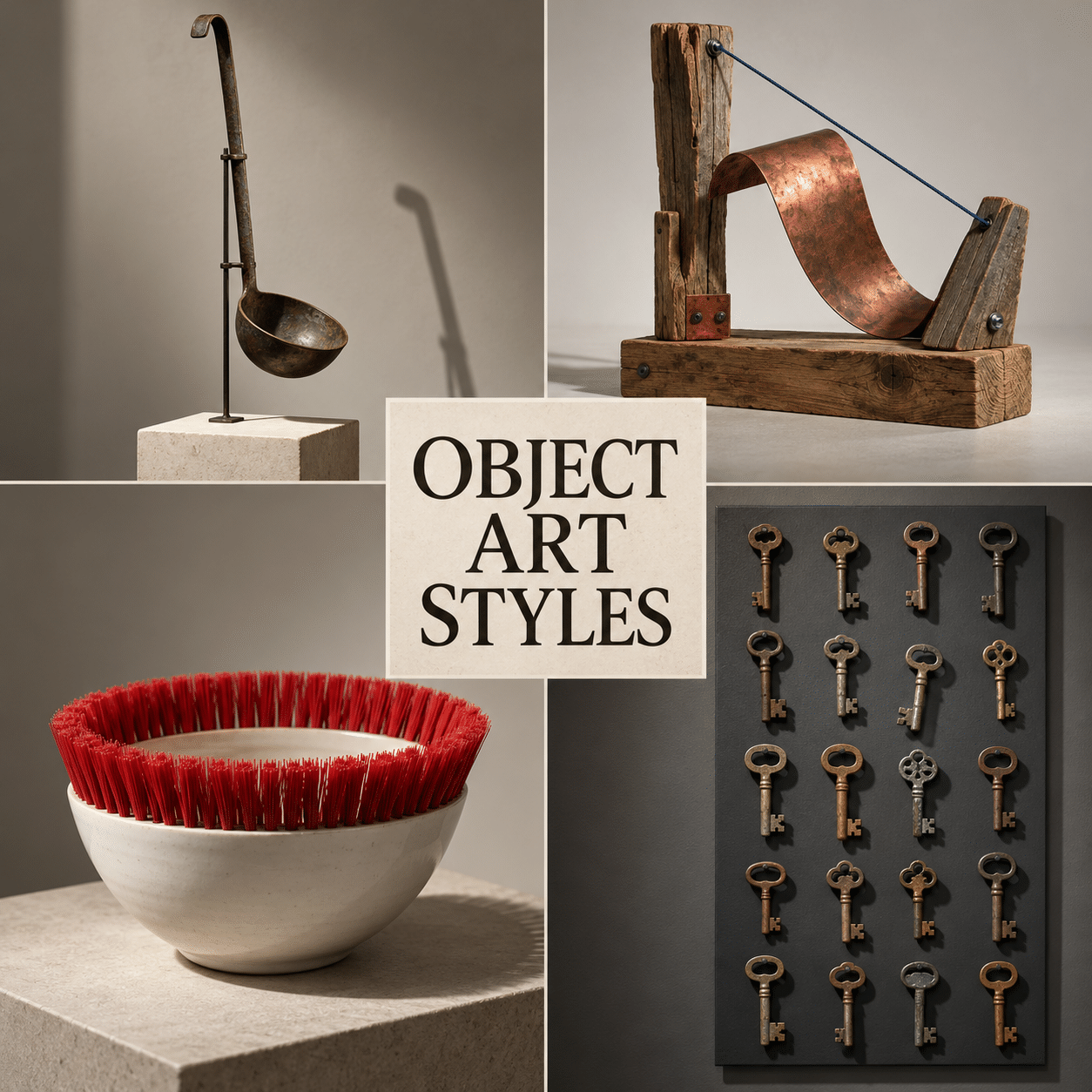
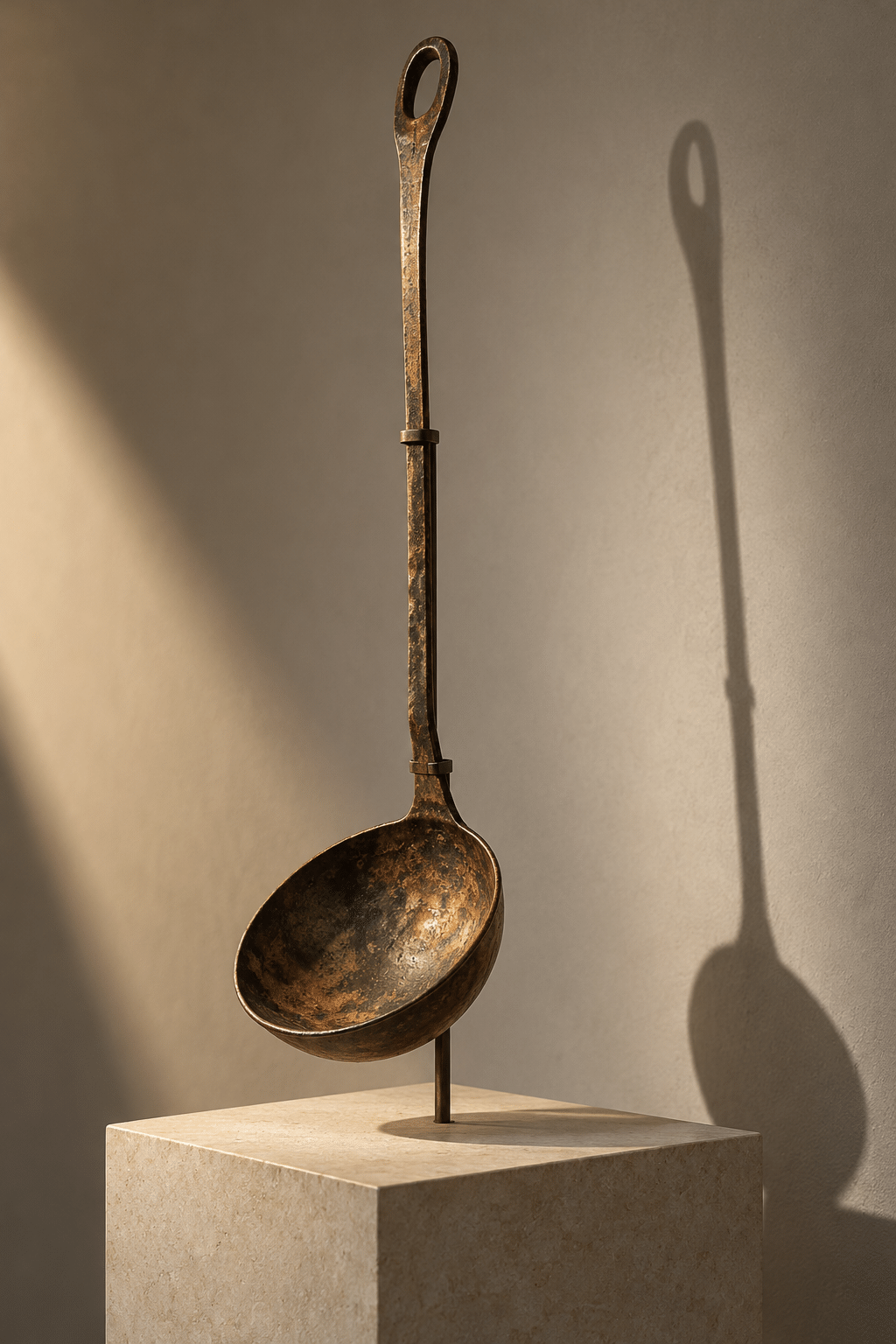
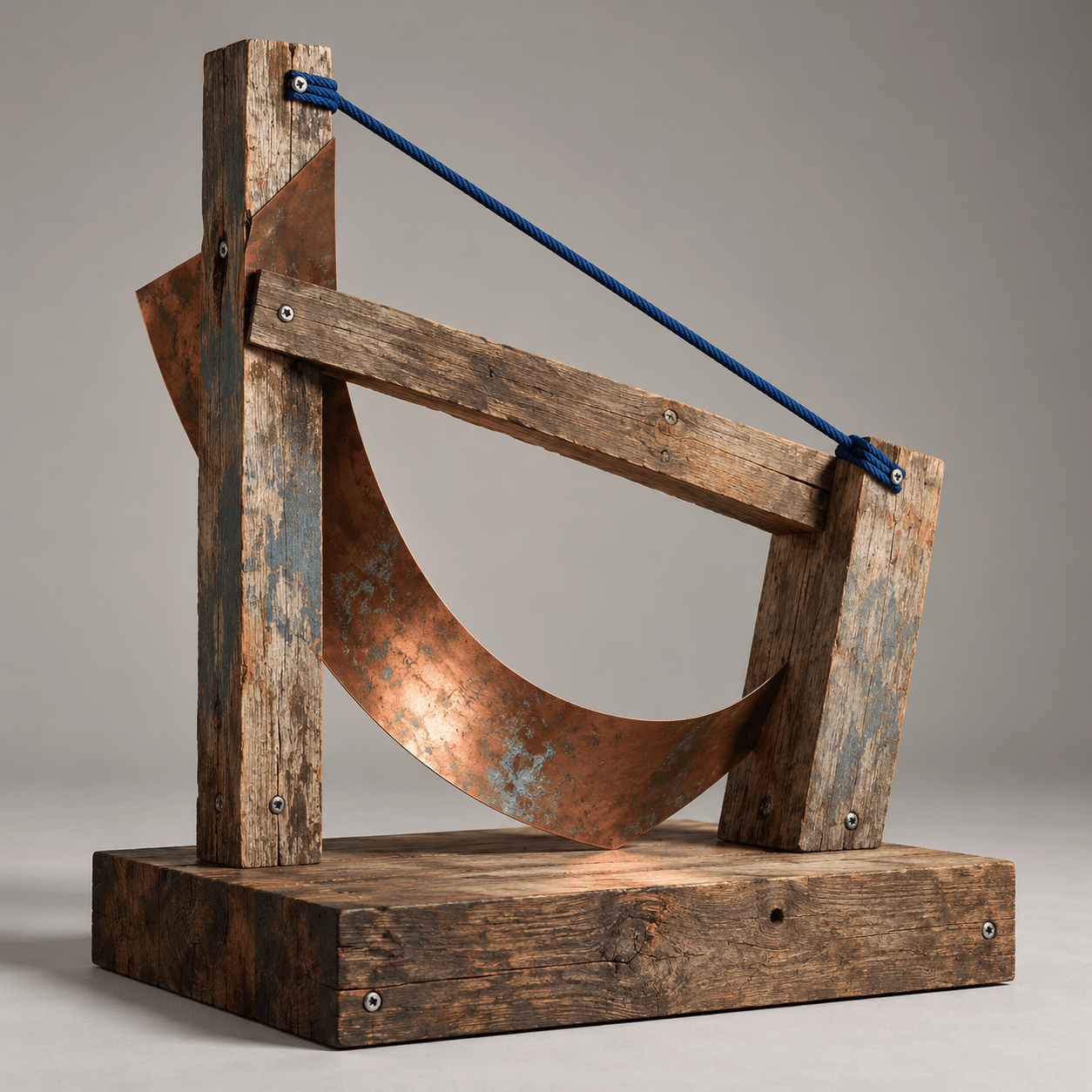
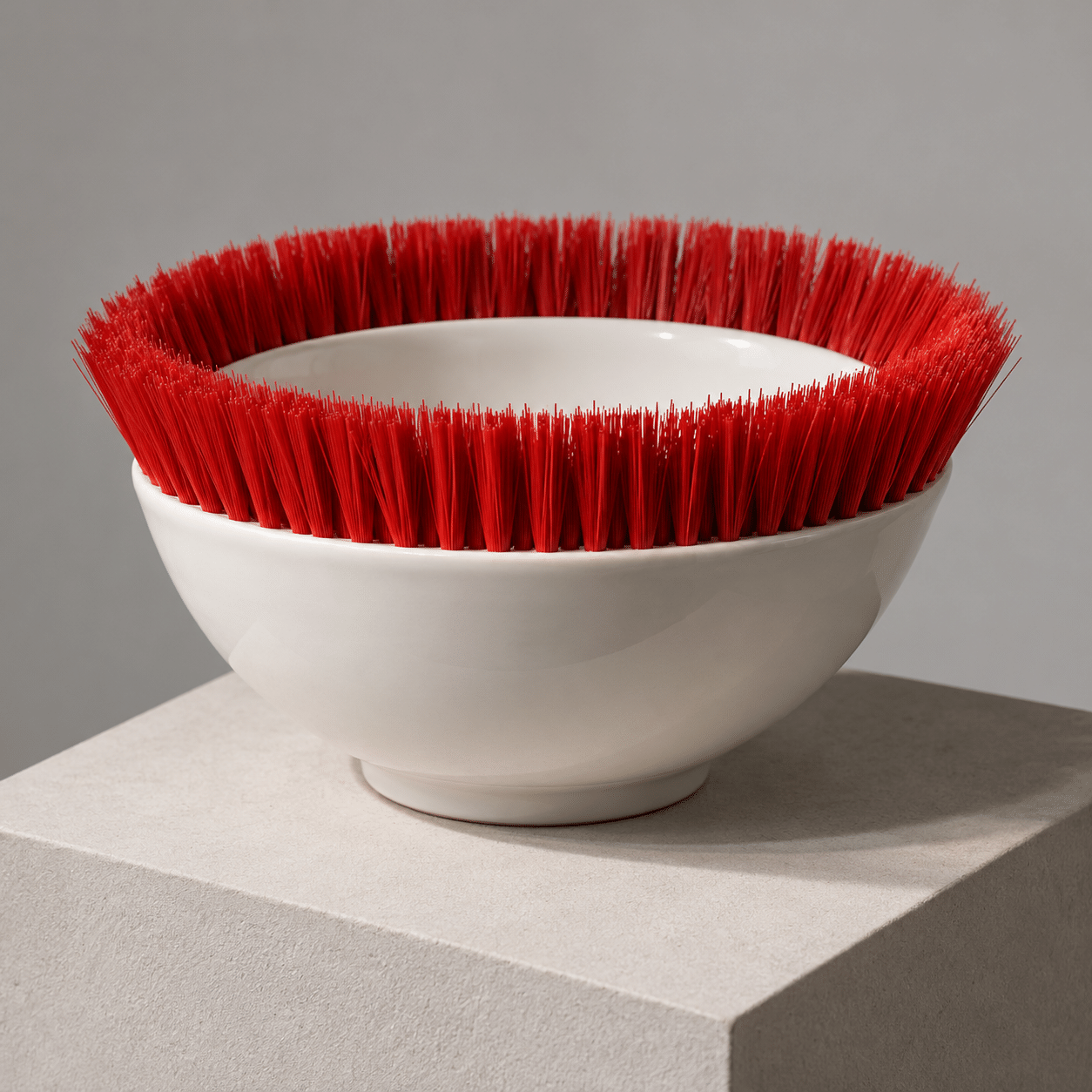
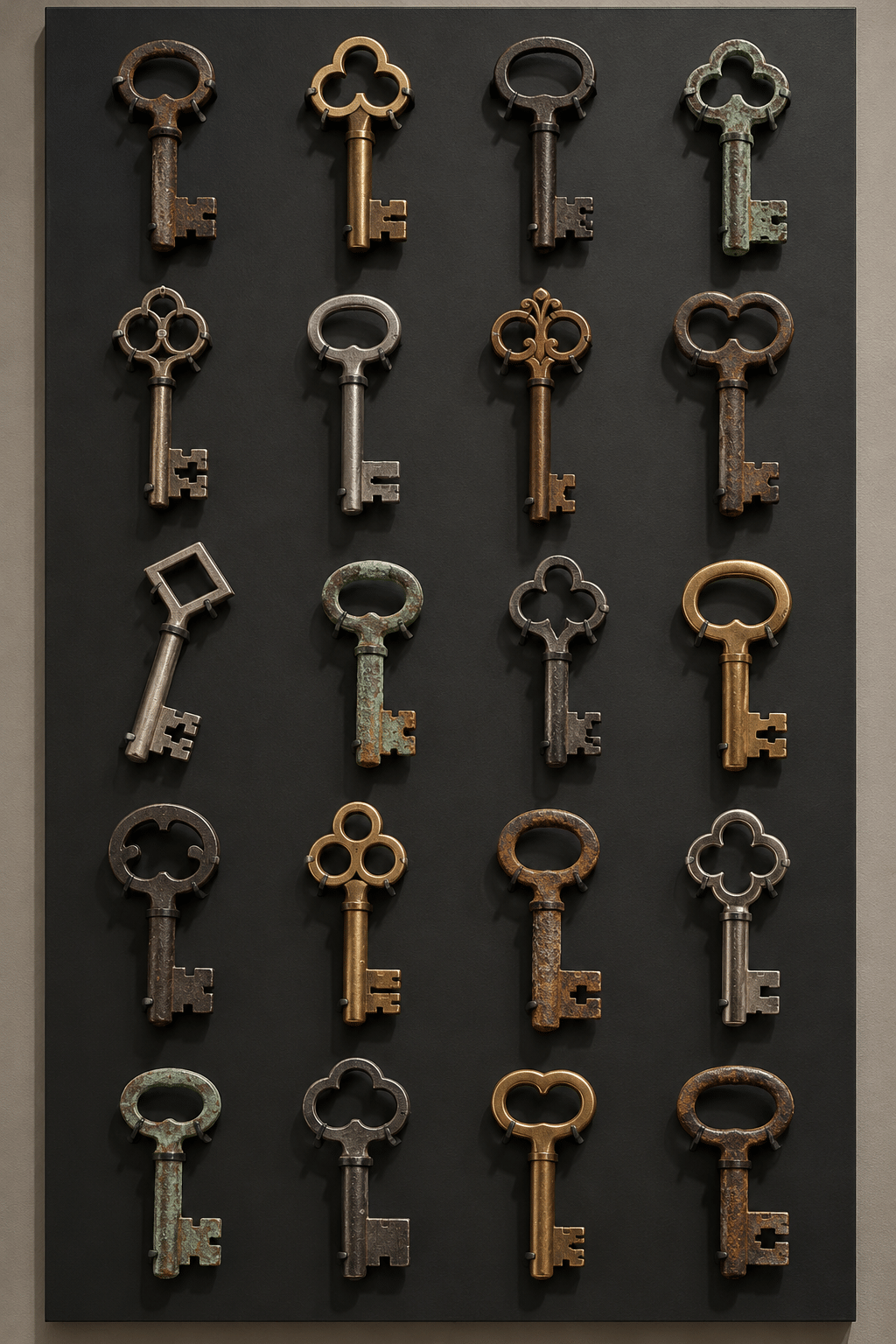
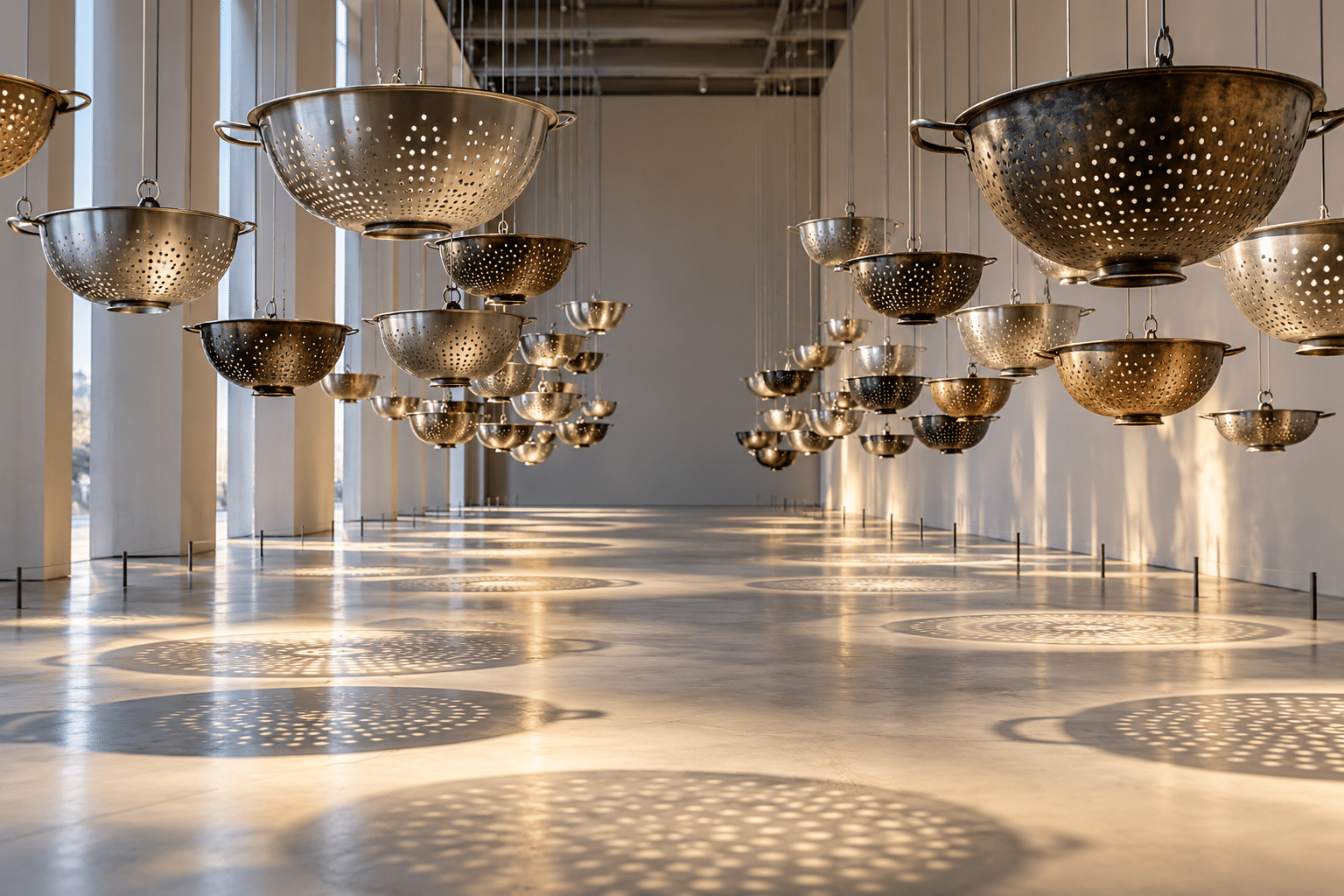
The new gallery presents an isolated household implement, a constructed assemblage, a materially altered vessel, an ordered wall of small objects and a room-scale hanging arrangement. Each is an original AI-generated study. None is a reproduction of the museum works discussed above, an authenticated found-object provenance record or a photograph of a completed exhibition.
For a practical study, choose one ordinary thing and write down its original use before changing it. Make three proposals: change only its context, combine it with one unlike material, then change its scale or repetition. Compare what each operation adds and what it erases. If the result depends entirely on an explanatory caption, simplify the arrangement until the object itself carries some of the question.
Documentation is part of the work’s clarity
Record materials, dimensions, orientation and whether the arrangement is fixed or variable. Distinguish an actual found object from a newly fabricated imitation and from a digital image of either. In an AI illustration, describe visible material effects without claiming physical manufacture. For real installations, mounting, conservation and safe access require their own competent assessment; an attractive concept image supplies none of those checks.
Positive perspective — AI-authored editorial assessment
Objects can bring ordinary experience into art with unusual immediacy. A modest change of context or relationship can make use, labour and memory newly perceptible. The strongest work lets material evidence and conceptual purpose reinforce one another, giving viewers something to discover beyond recognition of the original thing.
Critical perspective — AI-authored editorial assessment
A pile of interesting objects is not automatically a convincing assemblage, and a pedestal does not automatically create a meaningful readymade. Decorative accumulation can obscure the central decision. Ask why these particular components belong together, what their placement changes and whether the same idea could be expressed more precisely with fewer parts.
Neutral perspective — AI-authored editorial assessment
Object-based art covers several practices and historical contexts. This overview offers distinctions and comparative exercises rather than a single style formula. A generated image can help explore placement, material contrast and presentation, but the physical, historical and institutional meanings of an actual object need evidence beyond its appearance.
A small poetic detour
Original words from the AOI studio.
Poetry
A handle keeps the absent hand,
A vessel holds a space.
A borrowed thing is set aside
And finds another place.
Three fragments make a doubtful bridge,
A shadow joins the floor;
The object has not learned to speak—
We ask it something more.
The prompt workshop
Original creative exercises. These prompts create new illustrations, not documentary evidence.
Change only the context
Concept image of one ordinary worn metal ladle presented upright on a small neutral plinth, supported by a clearly visible thin bracket. Quiet gallery light, long readable shadow, no labels. Original object-art exercise, not a documented historical artwork.
Build a meaningful relationship
Original assemblage concept combining three weathered wooden offcuts, one curved copper sheet and a taut blue cord. Clear stable base, visible joins, asymmetrical balance and generous negative space. Neutral studio photograph-like rendering; not a claim of physical construction.
Turn repetition into a spatial question
Speculative installation of many ordinary metal colanders suspended at different heights along a clear path, coherent hanging wires, perforated shadows crossing a plain gallery floor. Strong rhythm and one deliberate gap. No text, visitors or historical attribution.
A smile from the studio
Jokes
The ladle expected a soup course. The curator offered a new context.