
Cultural overview · distinct Native nations, artists and living practices
A starting point for Native American art, with distinct community contexts, documented museum examples and contemporary artist resources. Separate from Indian art of India.
A visual introduction
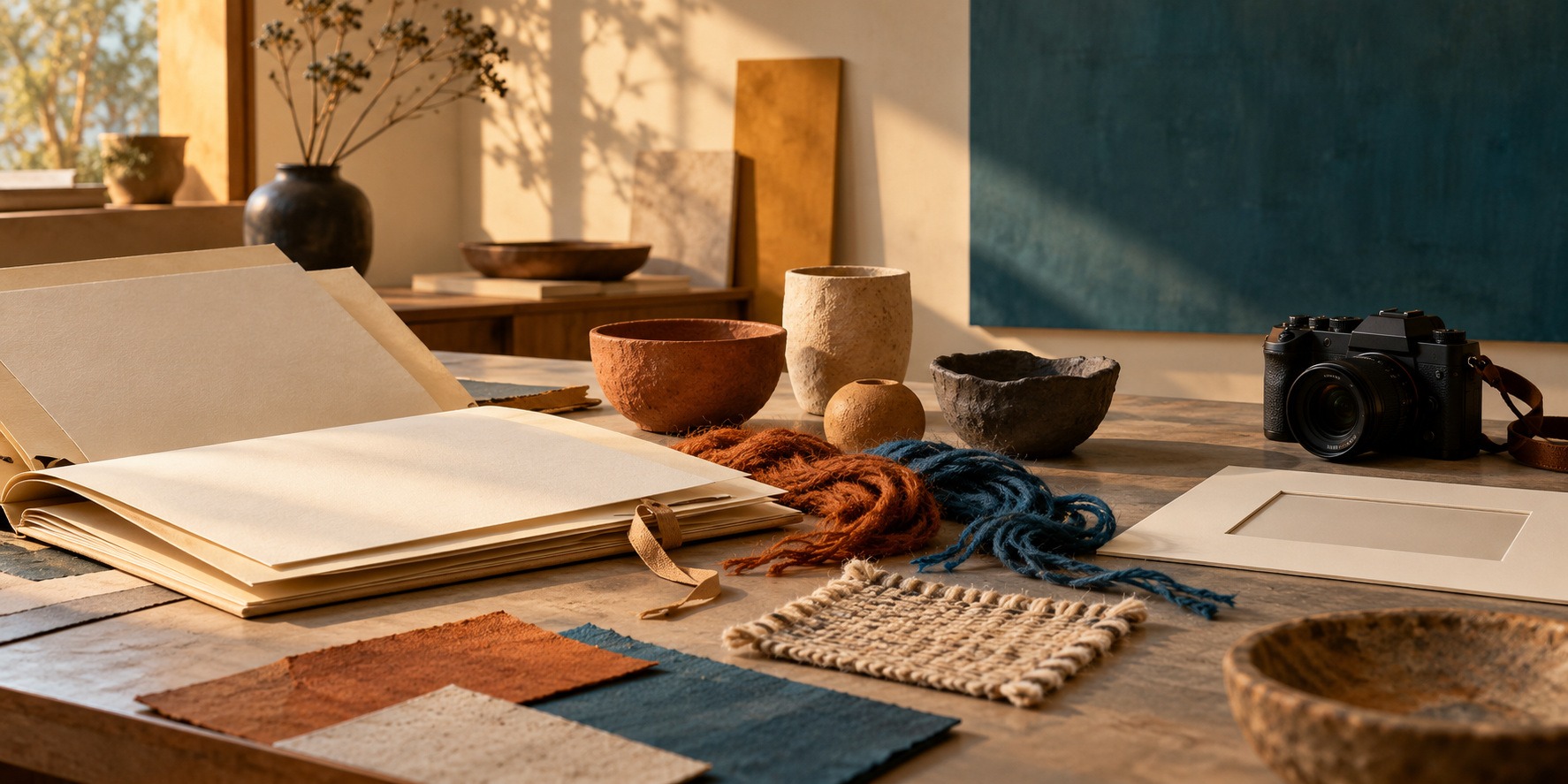
Three documented collection objects introduce distinct materials and community contexts. Museum photographs carry collection credits; the banner and title collage are separate AI-generated editorial illustrations.
Select an image for a closer look. Use the thumbnails, arrow keys or a swipe to compare examples. Zoom in to inspect details, or share the image that inspires you.
Creative toolbox · take this style further
Choose an input and a destination. Search sends your words to the chosen site; Copy & open puts them on your clipboard to paste there.
Create with AI
Turn your chosen input into an image prompt or a new creative direction.
ChatGPT
Copy your input and paste it into a ChatGPT conversation or image request.
Copy & open ChatGPT (new tab)Claude · Anthropic
Develop an image prompt or explore the style in a new Claude conversation.
Copy & open Claude · Anthropic (new tab)Midjourney
Paste your input into the Imagine bar on the Create page.
Copy & open Midjourney (new tab)Adobe Firefly
Copy your input, open Firefly, and paste it into the prompt field.
Copy & open Adobe Firefly (new tab)Leonardo.Ai
Copy your input, open Leonardo, and paste it into the generation field.
Copy & open Leonardo.Ai (new tab)Image search
Find visual references. Short, concrete keywords usually work best.
Lexica
Search AI images and prompts using your selected input.
Search with this input Lexica (new tab)Pexels
Search the photo and video library. Short keywords often work best.
Search with this input Pexels (new tab)Pixabay
Search photos, illustrations and other images.
Search with this input Pixabay (new tab)Unsplash
Search photographs using the style name or your own keywords.
Search with this input Unsplash (new tab)Wikimedia Commons
Search photographs, artworks and historical images. Check each file for its source and reuse terms.
Search with this input Wikimedia Commons (new tab)Art & research
Explore artists, collections and the ideas behind a style.
Wikipedia
Search for background reading. A style may not have its own article.
Search with this input Wikipedia (new tab)WikiArt
Copy your input into WikiArt’s search to explore artists and artworks.
Copy & open WikiArt (new tab)Europeana
Paste your keywords into the search to explore European museum, library and archive collections.
Copy & open Europeana (new tab)Inspiration
Discover portfolios and visual ideas from creative communities.
Instagram hashtags
Search a hashtag made from your input: spaces and punctuation are removed. Instagram may require sign-in.
Search with this input Instagram hashtags (new tab)ArtStation
Paste your input into artwork search for concept art, environments, characters and visual development.
Copy & open ArtStation (new tab)Behance
Paste your input into project search for illustration, design and visual storytelling.
Copy & open Behance (new tab)A closer look
There is no single Native American style or palette. Material, construction, community, individual authorship and purpose give each work its particular visual relationships.
An overview of many artistic practices
Native American art encompasses work by many distinct Indigenous peoples and individual artists. It is not a single movement, a universal ornament system or a historical phase that ended. This introduction focuses mainly on selected traditions and contemporary resources from what is now the United States, with a Northwest Coast connection extending across present-day borders. It is not an exhaustive survey of the Indigenous arts of all the Americas.
For art from India, use the separate Indian Art (India) guide linked below. Here, use a maker’s own identification and a specific nation or community when known. Terms such as Native American, American Indian and Indigenous have different uses and preferences; the name of a broad category cannot replace the identity of a particular artist.
Start with people, place and a particular object
The National Museum of the American Indian’s Native Knowledge 360° framework emphasizes that there is no single American Indian culture and that Native societies are dynamic and contemporary. That is the foundation for looking at art here. A woven blanket, a ceramic vessel, a carved design and a digital artwork may have very different makers, functions and histories.
For each work, ask who made it, where and when it was made, what it is made from, and what reliable sources say about its use. If an individual maker is not recorded, say so. A museum’s missing name does not mean that the work lacked an author. Keep the distinction between an observed formal feature and a documented cultural meaning.
Example 1: a Diné (Navajo) wearing blanket
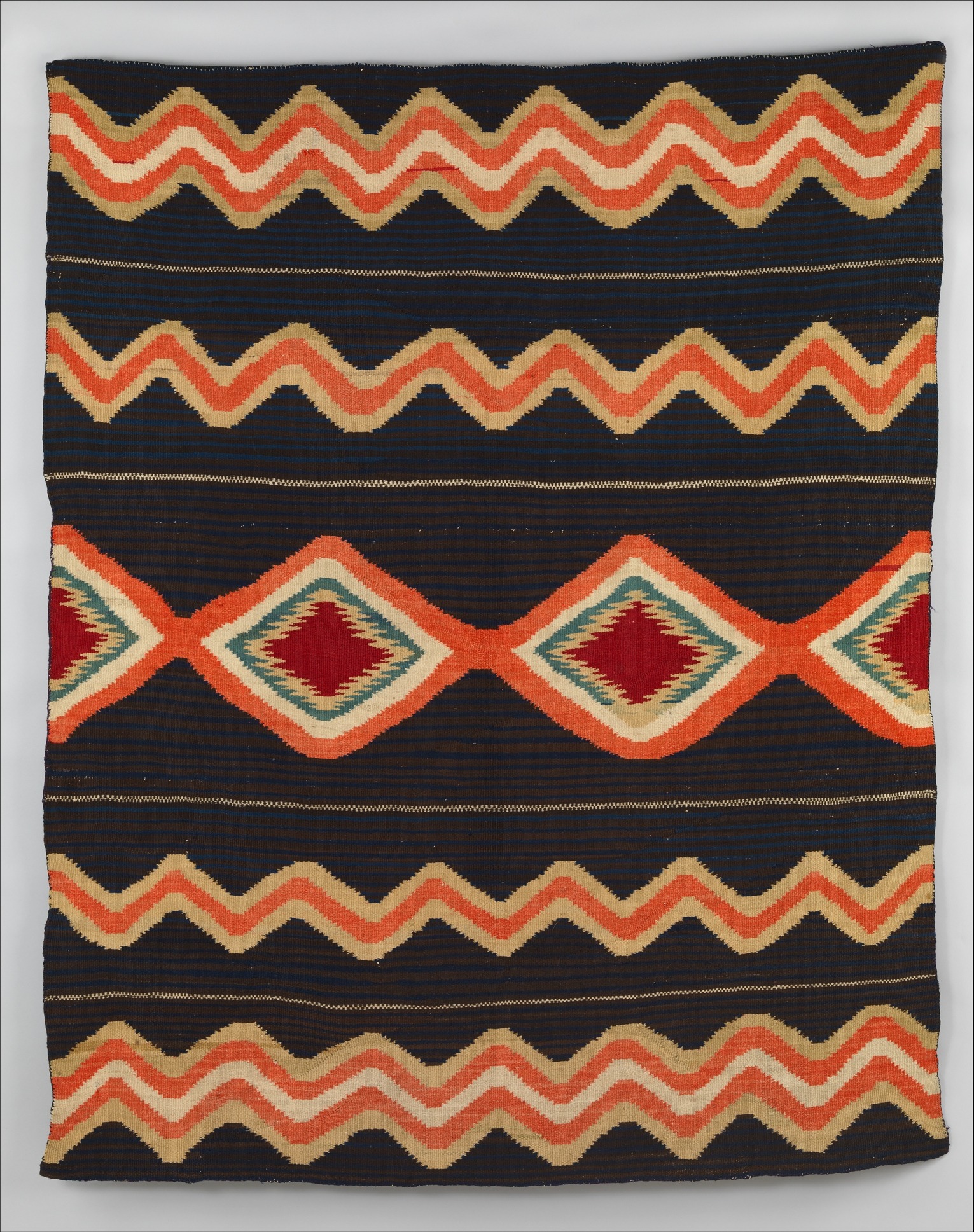
The first museum example is a wool Wearing Blanket dated 1865–75 in The Metropolitan Museum of Art, accession 10.107.3. The museum identifies it as Navajo, from Arizona or New Mexico; its published record does not name an individual maker. The photograph shows dark horizontal fields, strong red-and-cream zigzags and a prominent central band of diamond forms.
Look at the relationship between the broad dark intervals and the narrower patterned bands. The repeat operates through woven structure, and the design belongs to a wearable object rather than a neutral graphic rectangle. This is one documented example, not a pattern dictionary for all Diné weaving. Follow the museum record for its stated date, material and collection history.
Example 2: an Acoma Pueblo water jar
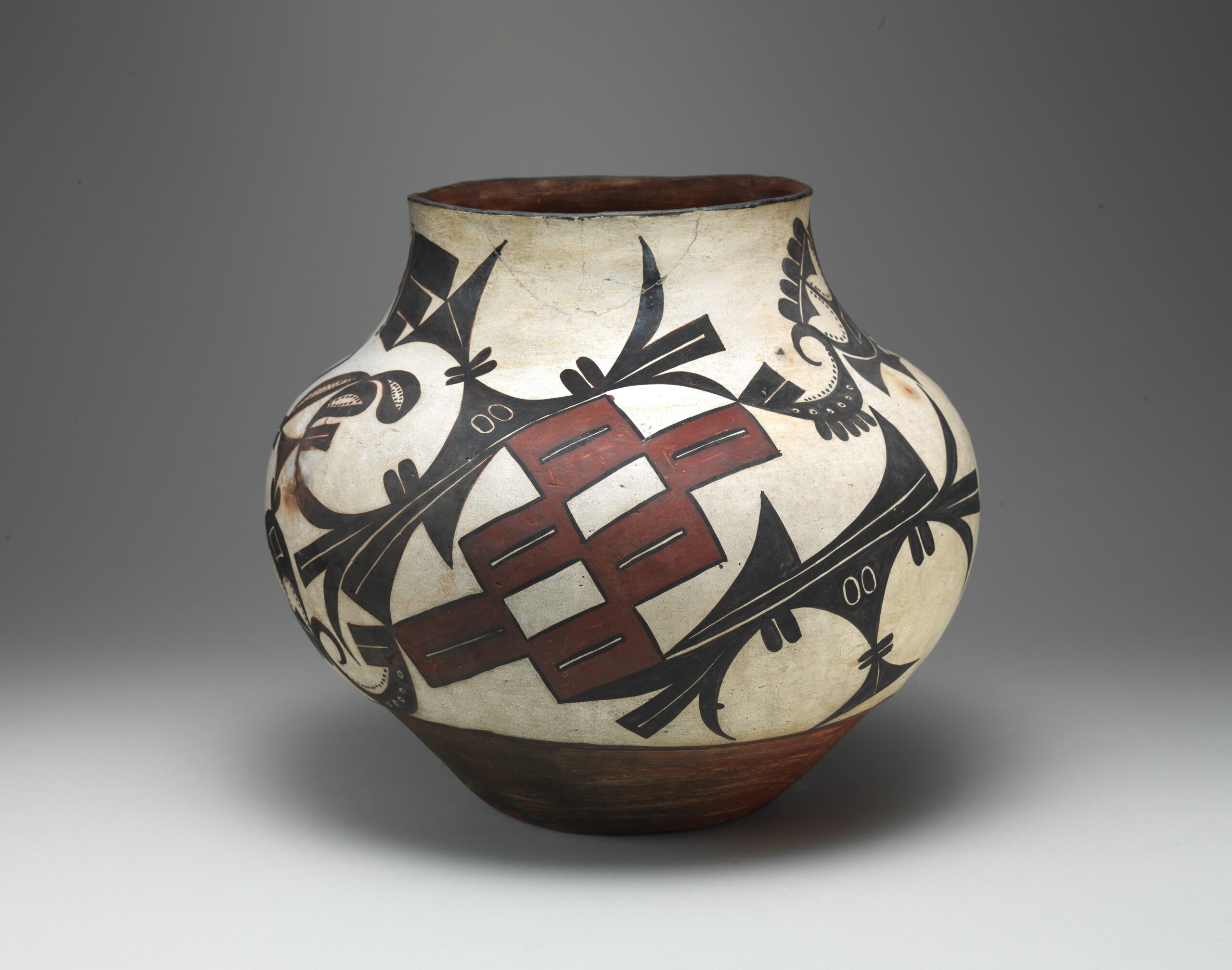
The second example is an Acoma Pueblo Water Jar, dated about 1880, in The Met, accession X.2.418. Its light ground, dark curving forms and red-brown elements wrap around a swelling ceramic body. The neck, shoulder and lower curve change how the decoration appears from different viewpoints.
Compare the vessel’s silhouette with the direction of its painted forms. A photograph provides one view; the object is not a flat repeat. The museum’s record identifies the cultural context and material but does not provide a complete explanation for every motif. We do not assign universal symbolic meanings to those marks or treat this vessel as representative of all Pueblo pottery.
Example 3: a Yokuts presentation bowl
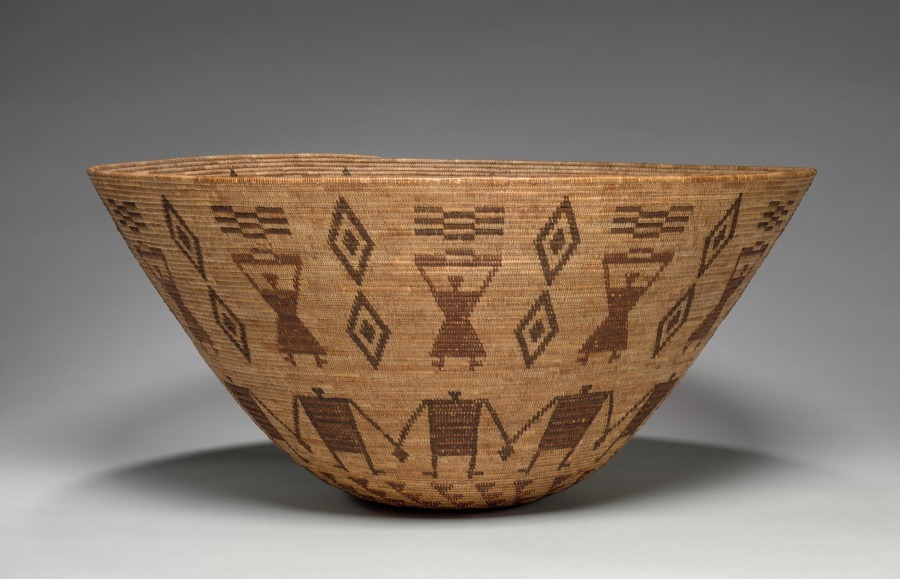
The Cleveland Museum of Art identifies its Presentation Bowl, dated 1900, as Yokuts, California, accession 1917.492. Its medium is redbud and bracken fern, coiled on a grass foundation. The published photograph shows closely worked horizontal texture and bands of dark figures around a broad, rounded bowl.
The museum discusses shared motifs in relation to contact with a neighboring community. That is a more specific account than calling the pattern generically “tribal.” Look at how the widening shape affects spacing and how the dark figures remain legible against the fiber ground. The construction and visual organization deserve attention together.
A different design system: Northwest Coast formline
Sealaska Heritage Institute describes Northwest Coast formline through shapes including ovoids and split U forms, organized into balanced compositions. Its arts program provides a route into a particular design system and the teaching that sustains it. It should not be collapsed into the same category as the blanket, jar or basket shown here.
If you study formline, begin with the institute’s educational resources and the work of identified artists. Pay attention to the relationships among shapes and to the cultural context of a specific design. Recognizing an ovoid is a beginning, not evidence that a newly invented image belongs to a community or carries an established meaning.
Contemporary artists are not an appendix to the past
The Smithsonian’s artist spotlight on Jeffrey Gibson combines his own statement, biography, artwork and teaching resources. Gibson is identified as a member of the Mississippi Band of Choctaw Indians and of Cherokee descent. His account of collage offers a way to think about relationships among materials, references and experiences rather than demanding that Native art conform to an inherited-looking surface.
Explore the linked gallery and listen to the artist’s own framing before interpreting a work. Contemporary practice can include painting, sculpture, photography, moving images, installation and other media. A camera or digital process does not make an Indigenous artist less connected to their community, and a historical-looking motif does not make a work authentically Indigenous by itself.
How to compare works responsibly and precisely
Use a shared set of looking questions without forcing a shared style. How is the object constructed? What determines the rhythm of the surface? Where does empty space matter? How does the work change with use, movement or viewpoint? What is known about its audience? What remains uncertain in the available record?
Do not infer a universal palette, spiritual meaning or national identity from an appearance. Community-specific teachings, imagery and permissions can matter even when an image circulates widely. For a creative response, work from general material or compositional observations and name the result as your own experiment. For a cultural explanation, prioritize the artist, community institution and documented source.
What this page’s images do and do not show
The three collection photographs are documentary images with museum records and open-access credits. They show particular historical objects, not a complete sample of Native American art. Follow the contemporary artist resources to broaden that time frame. The new banner and title collage are AI-generated editorial studies of materials and research; they are not Indigenous-made artworks, real workshops or museum displays.
This distinction is especially important in an AI art guide. A plausible generated basket or portrait would not establish a maker, community or historical context. The prompt workshop therefore focuses on observation, independent material studies and original responses grounded in the reader’s own experience. It does not offer a formula for manufacturing cultural authenticity.
A useful next step
Choose one museum object and one work by a living artist. Read each record or statement, then write a short comparison that separates facts from your visual interpretation. Include the maker where known, the community as identified by the source, the date and material, and a direct link. The aim is a more informed encounter with specific works, not a single image that claims to summarize many nations.
About this guide and its illustrations
This is an AI-authored AOI overview under Penny Wraiter, AOI’s editorial persona. Museum photographs are separately credited documentary images. The banner, title collage, poem and exercises are AOI editorial creations, not Indigenous-authored works or community endorsements. Sources support the stated object records and context; visual comparisons are editorial interpretation.
Build a comparison around a documented question
Choose two objects with reliable collection records and ask one limited question: how does a vessel’s shape guide the placement of its painted design, or how does a woven structure affect the rhythm of a pattern? Start with the maker or community attribution, place, date range and material information available for each object.
Describe observable differences before proposing cultural explanations. Similar colors or repeated geometric shapes do not by themselves establish shared meaning, exchange or a common origin. Where a record leaves a question open, preserve that uncertainty.
Then seek a contemporary artist’s account of their own practice. This can complicate a comparison based only on museum categories and historical objects. The aim is a better question about particular works and people, rather than a reusable recipe for a supposedly universal Native aesthetic.
A small poetic detour
Original words from the AOI studio.
Poetry
Before the label, a maker.
Before the photograph, a thing
held, carried, worked, or seen
from more than one side.
Leave room beside the caption
for the name we have not learned.
The present has not closed its doors.
Another work is being made.
The prompt workshop
Original creative exercises. These prompts create new illustrations, not documentary evidence.
Begin with close observation
Choose one documented object from the linked museum records. Write a visual study of its silhouette, construction, surface rhythm and negative space. Separate what the record establishes from your own interpretation. Preserve maker, community, date and collection credit; say when the maker is unidentified. Do not invent a symbolic meaning.
Make an independent material study
Create an original contemporary still life using undecorated clay samples, plain woven fiber, loose wool threads and blank drawing paper. Use oblique light to distinguish surfaces and a restrained composition. No borrowed community patterns or ceremonial objects. Label the result as your own material experiment, not as an Indigenous-made artwork.
Respond through your own experience
After reading a contemporary artist’s statement, choose a question about place, memory or material that relates to your own experience. Make an original collage from your own photographs and marks. Describe the decisions you made without copying the artist’s motifs or claiming their identity. Keep a source note acknowledging the work that prompted your reflection.
A smile from the studio
Jokes
The label said “mixed media.” The materials asked to be introduced individually.
Sources and further exploration
NMAI Native Knowledge 360°: diversity and contemporary Native life
The Met: Wearing Blanket, Navajo, 1865–75, accession 10.107.3
The Met: Acoma Pueblo Water Jar, about 1880, accession X.2.418
Cleveland Museum of Art: Yokuts Presentation Bowl, 1900
Sealaska Heritage Institute: Northwest Coast arts and teaching
NMAI and Jeffrey Gibson: artist statement, works and learning resources