
Cultural overview · regions, materials and changing practices
An overview of art from India: painting, sculpture, textiles, architecture and modern practice. Explore distinct traditions, sources and clearly labelled creative studies.
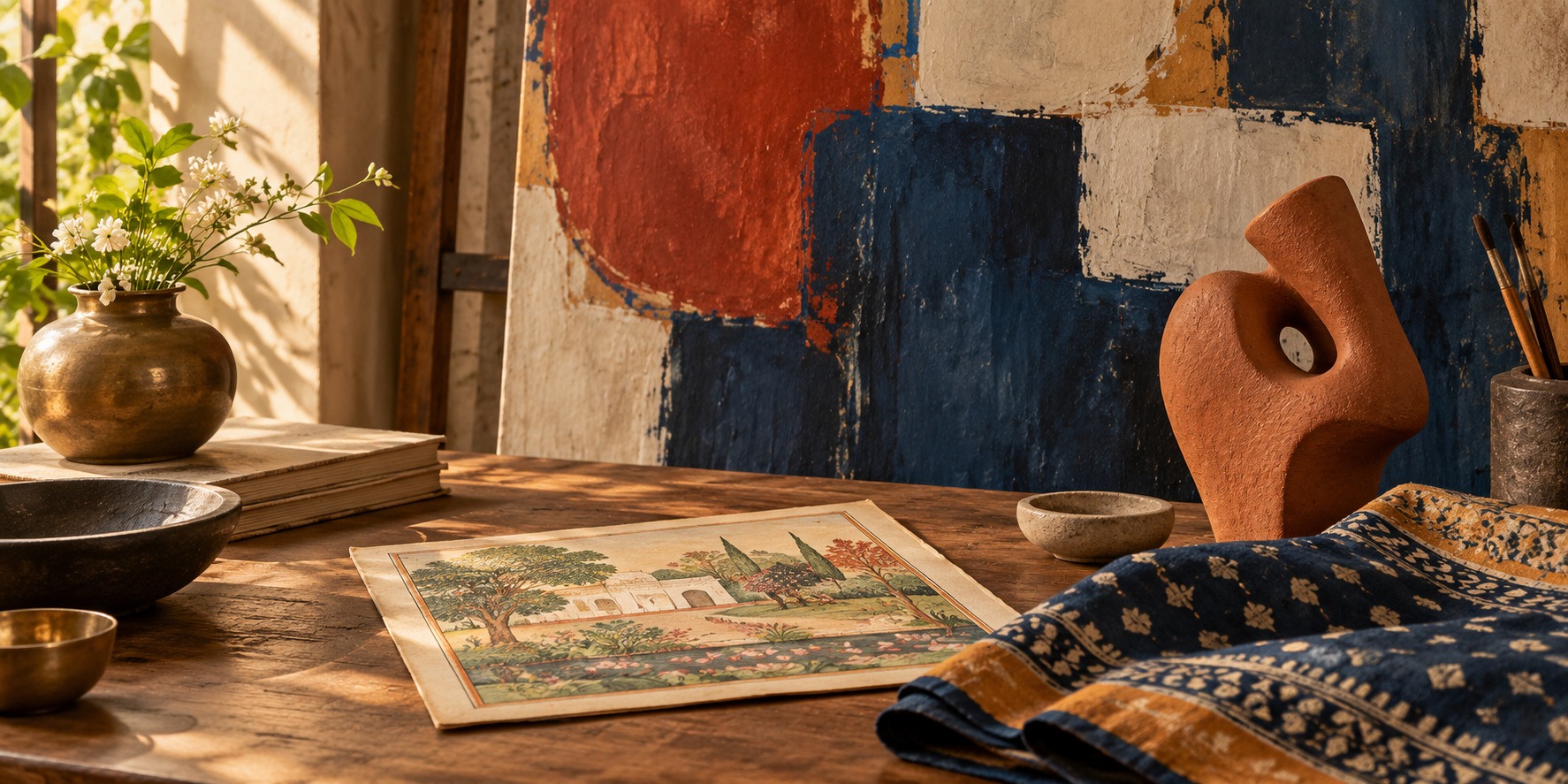
A visual introduction
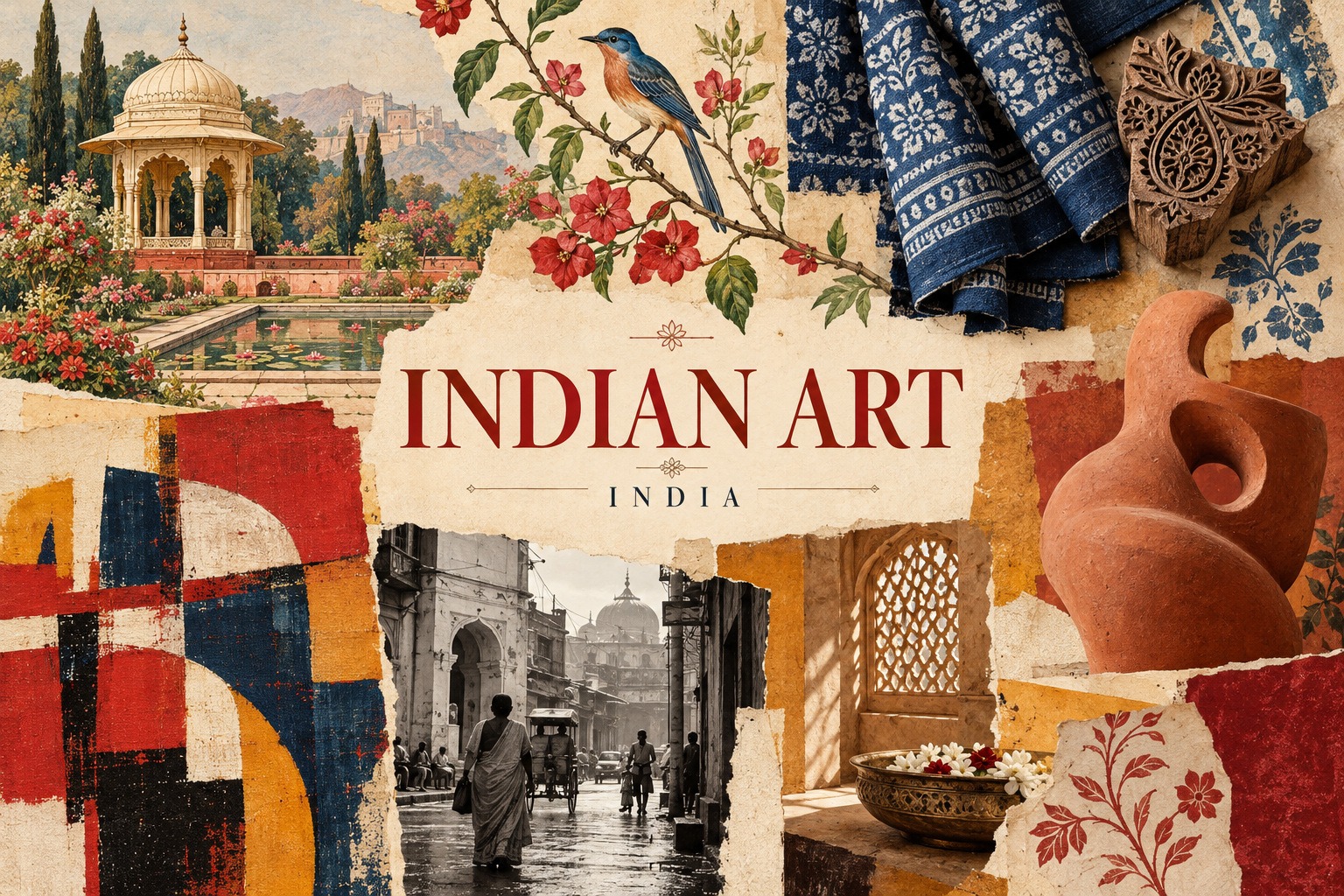
Compare the distinct AOI studies and the titled reference collage. Captions distinguish generated interpretations from documentary evidence.
Select an image for a closer look. Use the thumbnails, arrow keys or a swipe to compare examples. Zoom in to inspect details, or share the image that inspires you.
Creative toolbox · take this style further
Choose an input and a destination. Search sends your words to the chosen site; Copy & open puts them on your clipboard to paste there.
Create with AI
Turn your chosen input into an image prompt or a new creative direction.
ChatGPT
Copy your input and paste it into a ChatGPT conversation or image request.
Copy & open ChatGPT (new tab)Claude · Anthropic
Develop an image prompt or explore the style in a new Claude conversation.
Copy & open Claude · Anthropic (new tab)Midjourney
Paste your input into the Imagine bar on the Create page.
Copy & open Midjourney (new tab)Adobe Firefly
Copy your input, open Firefly, and paste it into the prompt field.
Copy & open Adobe Firefly (new tab)Leonardo.Ai
Copy your input, open Leonardo, and paste it into the generation field.
Copy & open Leonardo.Ai (new tab)Image search
Find visual references. Short, concrete keywords usually work best.
Lexica
Search AI images and prompts using your selected input.
Search with this input Lexica (new tab)Pexels
Search the photo and video library. Short keywords often work best.
Search with this input Pexels (new tab)Pixabay
Search photos, illustrations and other images.
Search with this input Pixabay (new tab)Unsplash
Search photographs using the style name or your own keywords.
Search with this input Unsplash (new tab)Wikimedia Commons
Search photographs, artworks and historical images. Check each file for its source and reuse terms.
Search with this input Wikimedia Commons (new tab)Art & research
Explore artists, collections and the ideas behind a style.
Wikipedia
Search for background reading. A style may not have its own article.
Search with this input Wikipedia (new tab)WikiArt
Copy your input into WikiArt’s search to explore artists and artworks.
Copy & open WikiArt (new tab)Europeana
Paste your keywords into the search to explore European museum, library and archive collections.
Copy & open Europeana (new tab)Inspiration
Discover portfolios and visual ideas from creative communities.
Instagram hashtags
Search a hashtag made from your input: spaces and punctuation are removed. Instagram may require sign-in.
Search with this input Instagram hashtags (new tab)ArtStation
Paste your input into artwork search for concept art, environments, characters and visual development.
Copy & open ArtStation (new tab)Behance
Paste your input into project search for illustration, design and visual storytelling.
Copy & open Behance (new tab)A closer look
There is no single Indian visual style. Study the particular work’s region, period, maker, material, purpose and composition before translating its visual principles into a new image.
Indian art: the scope of this overview
This page concerns art from India. It is not a guide to Native American art, which has its own separate overview linked below. “Indian art” is a broad cultural and historical field: it includes many languages, communities, religious and secular settings, materials and individual practices. It cannot be reduced to one palette, one ornament or a single national character.
Present-day borders are not an adequate map for every historical artwork. Courts, workshops, trade and religious networks connected places across South Asia and beyond. Identify the recorded location and period of a particular work rather than assigning every object from the subcontinent to modern India. Diasporic practice adds another dimension, but this introductory guide concentrates on India and offers routes into more specific study.
A historical route through several different media
The Buddhist paintings and sculpture of the Ajanta Caves offer one starting point for looking at the relationship between images and architectural space. UNESCO identifies an early phase in the second and first centuries BCE and later additions during the Gupta period. A mural’s sequence, setting and viewing conditions matter: a cropped detail cannot explain the whole experience of a cave.
For another material and regional context, study Chola-period bronzes from southern India. Impart’s account relates their development to present-day Tamil Nadu and discusses casting and religious use. Silhouette, gesture and the space around a figure deserve close attention, but a sacred image is not simply a source of decorative poses. These two examples introduce distinct settings rather than a continuous, uniform style.
The painted page and its different worlds
Indian miniature painting includes multiple courtly, manuscript and album traditions. Mughal, Rajput, Pahari and Deccani contexts should be distinguished rather than treated as interchangeable labels. The Met’s Divine Pleasures exhibition, for example, examines paintings made mainly for courts in Rajasthan and the Punjab Hills, including different local schools and relationships to literary subjects.
When looking at a painted page, compare the contour, placement of figures, border, scale of architecture and division of color. A lifted viewpoint may make a garden readable; a flat red wall can intensify a gesture; minute natural detail can invite prolonged attention. These are observations to test against individual works, not rules that every Indian painting must follow. The dedicated Indian Miniature Painting guide provides a closer introduction.
Textiles are structures and processes, not just patterns
Cloth can be woven, printed, embroidered, painted or resist-dyed, and those processes organize the image differently. Impart’s textile course follows production, historical exchange and the place of cloth within broader visual culture. Begin by asking how a repeat is made, what carries the color, and how a border relates to the fabric’s intended use.
MAP’s Painted Stitches, Woven Stories exhibition offers a particularly useful comparison of textile techniques and their connections to contemporary practice. Its discussion of a nineteenth-century Gujarat patola describes a double-ikat process involving both warp and weft. That is a different structural problem from printing a motif onto finished cloth. A visually similar pattern is not evidence of the same technique or provenance.
Modern and contemporary art belong at the center
The National Gallery of Modern Art’s collection includes painting, sculpture, photography, printmaking, installation and digital work. Its account brings together artists such as Amrita Sher-Gil, Rabindranath Tagore, Nandalal Bose and members of the Progressive Artists Group. These names point to distinct practices and debates, not a recipe for a generic “Indian look.”
NGMA’s Amrita Sher-Gil material is a useful route into a particular artist’s changing visual language and movement between European training and Indian subjects. Compare individual works, dates and circumstances rather than describing all modern art as a break from tradition or all regional practice as unchanging. Living makers can engage inherited techniques, urban experience, abstraction, photography or new technology on their own terms.
How to read visual grammar without flattening difference
Use six questions. Where and when was the work made? Who made it, if known? What material and process shaped it? What was its purpose or audience? How does the composition direct attention? What does the source actually establish about its meaning? Write down uncertainty instead of filling it with a plausible story.
Palette is work-specific. An indigo-and-cream textile, an earth-colored mural, a richly colored album page and a monochrome photograph do not need to share a national color scheme. Composition is equally varied: compare a repeated surface with a single narrative scene, or a sculpture meant to be approached in space with an image framed on a page. Keep those different viewing situations visible.
What the AOI illustrations demonstrate
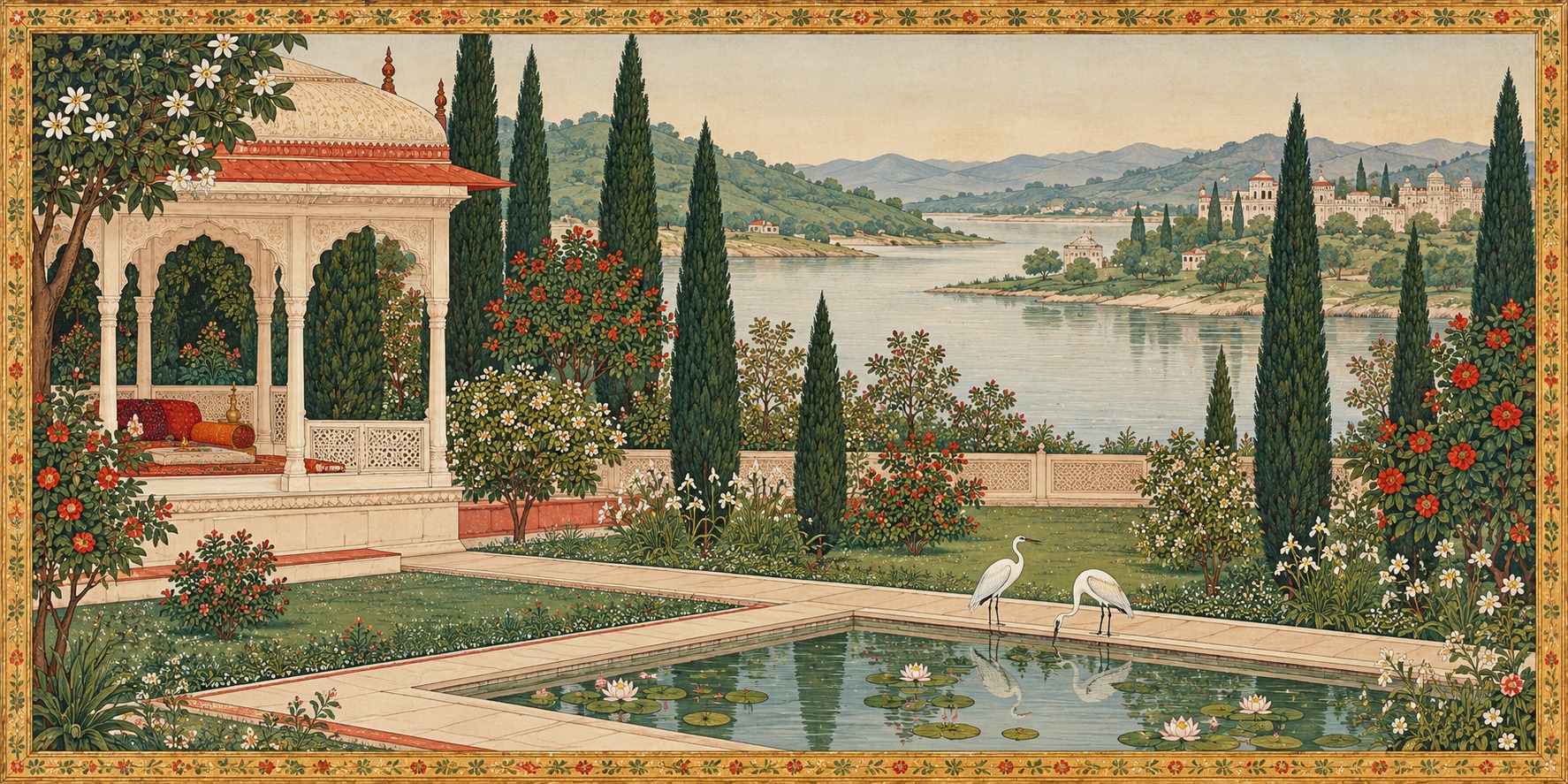
The banner and titled collage bring different media into an invented editorial setting. They are not photographs of a real workshop, museum display or historical collection. The garden-page example is a contemporary AI interpretation drawn from AOI’s miniature-painting study, with a fine border and a deliberately organized landscape. It is not an attributed historical folio.
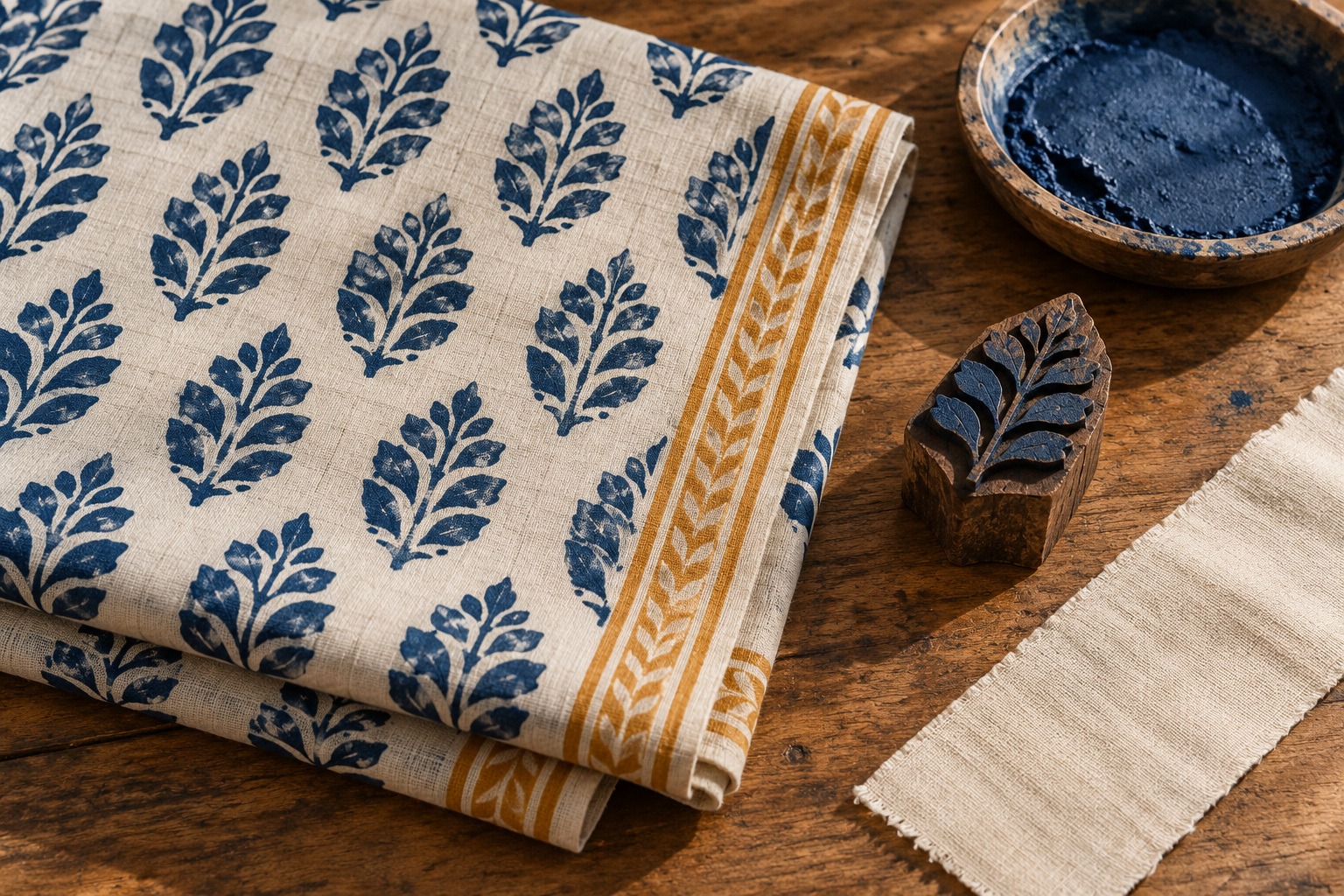
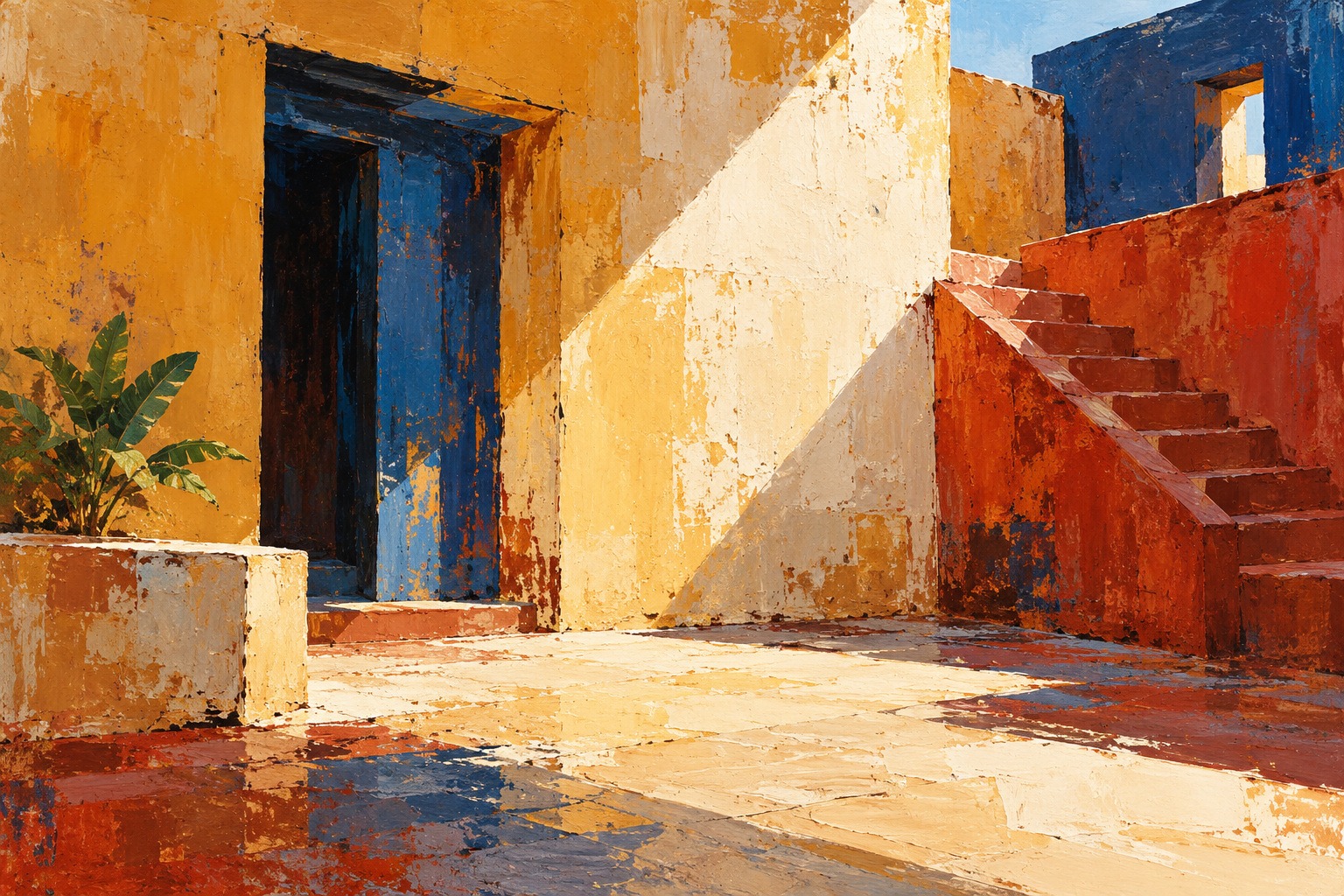
The textile still life explores printed repetition, the relationship of border to field and the contrast between carved wood and cloth. It does not certify a regional dye process. The courtyard painting uses ochre, indigo, rust and ivory to organize light and architectural planes. It is an independent AOI interpretation, not a work by an Indian artist. These three studies demonstrate different image-making problems rather than claiming to represent the whole country.
A more useful way to write prompts
Replace “make it Indian” with a chosen subject, medium, spatial approach and source context. For example, ask for a contemporary garden-page interpretation with fine contour and a narrow border, or a textile study with a clearly described original repeat. Decide which features you are borrowing as general visual principles and which require further research into a particular tradition.
Avoid mixing unrelated motifs simply because they are recognizable. Do not use a deity, community design or script as an unexplained authenticity stamp. For documentary work, start from a verified object and keep its attribution. For creative experiments, say what is invented. That distinction makes both the historical reading and the new work more useful.
Where to go next
Choose one work from the linked sources and compare it with another work in the same medium before moving across media. Look for a changed border, a different treatment of empty space, a new material or another audience. This approach builds a specific visual vocabulary while leaving the larger field open. India’s artistic breadth is best understood through connected examples, not a checklist of compulsory symbols.
About this guide and its illustrations
This is an AI-authored AOI guide under Penny Wraiter, AOI’s editorial persona. The linked sources support the historical and technical context; the practical exercises, poem and new illustrations are AOI interpretations. Generated pictures are labelled as such and do not establish historical authorship, material authenticity or physical performance.
A small poetic detour
Original words from the AOI studio.
Poetry
A page asks us to lean closer.
A wall asks us to move.
A thread carries color
through the patience of another thread.
The courtyard opens into noon;
the camera keeps one passing shadow.
No single frame can hold the country.
Begin with one work,
and let its differences remain.
The prompt workshop
Original creative exercises. These prompts create new illustrations, not documentary evidence.
Begin with the painted page
Create an original contemporary garden-page illustration: a small pavilion beside water, two birds and flowering plants, fine contour, layered opaque color, a lifted viewpoint and a restrained narrow border. Choose a quiet focal point. Describe the result as an AOI interpretation informed by looking at Indian miniature painting, not as an authentic historical folio.
Make a textile process legible
A contemporary still-life study of folded cotton with a simple original indigo leaf repeat and ochre border, beside one carved printing block and a shallow pigment tray. Show weave, contact shadows and small variations in the print. No invented artisan attribution, regional certification, sacred motif or fake script.
A present-day painted response
Paint an invented urban courtyard using large ochre, deep blue, rust and ivory planes. Let a diagonal of sunlight connect a doorway and stair; vary scraped and thick paint while preserving the composition. Independent contemporary work, no imitation of a named artist, no claim that the palette represents all Indian art.
A smile from the studio
Jokes
The prompt asked for every art tradition at once. The canvas requested a larger bibliography.
Sources and further exploration
UNESCO: Ajanta Caves, painting and architectural context
Impart: Chola bronze sculpture, material and regional context
The Met: distinct Rajput court-painting traditions
Impart: textiles from the Indian subcontinent
MAP: textiles, making and contemporary interpretation