
Painting traditions · close looking, courtly worlds and the painted page
Explore the diversity of Indian miniature painting: Mughal, Rajput and Deccani contexts, fine line, color, storytelling, materials and clearly labelled contemporary studies.
A visual introduction
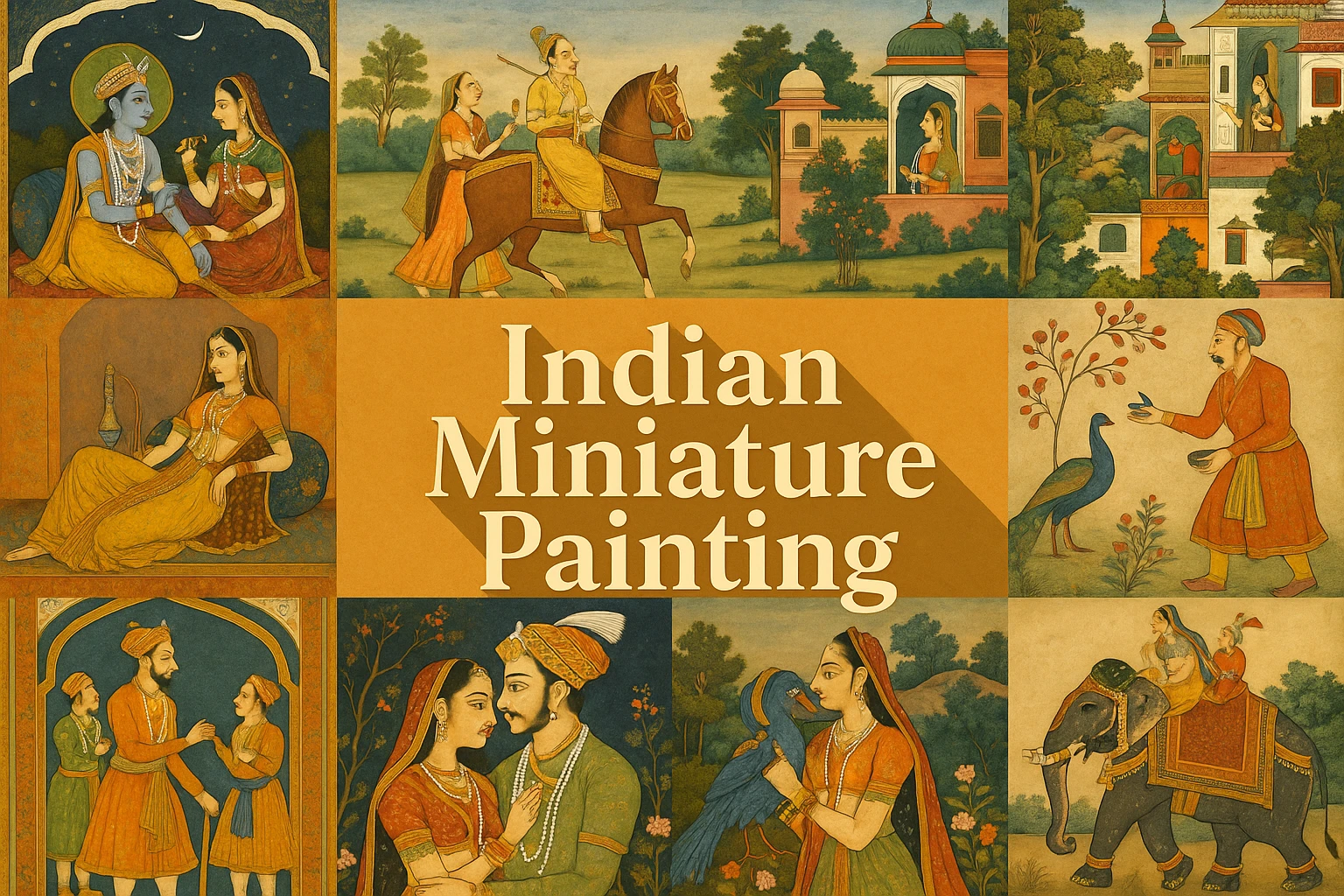
Compare the distinct AOI studies and the titled reference collage. Captions distinguish generated interpretations from documentary evidence.
Select an image for a closer look. Use the thumbnails, arrow keys or a swipe to compare examples. Zoom in to inspect details, or share the image that inspires you.
Creative toolbox · take this style further
Choose an input and a destination. Search sends your words to the chosen site; Copy & open puts them on your clipboard to paste there.
Create with AI
Turn your chosen input into an image prompt or a new creative direction.
ChatGPT
Copy your input and paste it into a ChatGPT conversation or image request.
Copy & open ChatGPT (new tab)Claude · Anthropic
Develop an image prompt or explore the style in a new Claude conversation.
Copy & open Claude · Anthropic (new tab)Midjourney
Paste your input into the Imagine bar on the Create page.
Copy & open Midjourney (new tab)Adobe Firefly
Copy your input, open Firefly, and paste it into the prompt field.
Copy & open Adobe Firefly (new tab)Leonardo.Ai
Copy your input, open Leonardo, and paste it into the generation field.
Copy & open Leonardo.Ai (new tab)Image search
Find visual references. Short, concrete keywords usually work best.
Lexica
Search AI images and prompts using your selected input.
Search with this input Lexica (new tab)Pexels
Search the photo and video library. Short keywords often work best.
Search with this input Pexels (new tab)Pixabay
Search photos, illustrations and other images.
Search with this input Pixabay (new tab)Unsplash
Search photographs using the style name or your own keywords.
Search with this input Unsplash (new tab)Wikimedia Commons
Search photographs, artworks and historical images. Check each file for its source and reuse terms.
Search with this input Wikimedia Commons (new tab)Art & research
Explore artists, collections and the ideas behind a style.
Wikipedia
Search for background reading. A style may not have its own article.
Search with this input Wikipedia (new tab)WikiArt
Copy your input into WikiArt’s search to explore artists and artworks.
Copy & open WikiArt (new tab)Europeana
Paste your keywords into the search to explore European museum, library and archive collections.
Copy & open Europeana (new tab)Inspiration
Discover portfolios and visual ideas from creative communities.
Instagram hashtags
Search a hashtag made from your input: spaces and punctuation are removed. Instagram may require sign-in.
Search with this input Instagram hashtags (new tab)ArtStation
Paste your input into artwork search for concept art, environments, characters and visual development.
Copy & open ArtStation (new tab)Behance
Paste your input into project search for illustration, design and visual storytelling.
Copy & open Behance (new tab)A closer look
Precise contours, carefully organized color, patterned surfaces and intimate narrative detail work within a deliberately composed page. Different courts and workshops developed different spatial and expressive choices.
A family of traditions, not one miniature style
Indian miniature painting is a broad label for varied traditions of finely worked painting, often encountered in illustrated manuscripts and albums. The word miniature should invite close looking, not the assumption that every work follows one formula or belongs to one court. A natural-history study, a devotional narrative, a court scene and a poetic landscape can have very different purposes.
This guide offers several starting points rather than a complete history of painting across the subcontinent. Mughal, Rajput and Deccani are useful contextual terms, but each covers changes, exchanges and individual workshops. Identify a work through its museum record, date, place, subject and material before using its appearance as a general rule. The images here are new AOI interpretations, not historical folios.
Three contexts worth distinguishing
The Metropolitan Museum’s introduction to Mughal art describes a court culture shaped by Central Asian origins and by Persian, Indian and European artistic exchanges. Its discussion of Jahangir and Shah Jahan includes portraiture, albums and observation of the natural world. These contexts help explain why a finely articulated bird or flower can be as significant as a grand imperial scene. [1]
The Met’s Divine Pleasures survey concentrates on Rajput paintings from Rajasthan and the Punjab Hills, including subjects connected to poetry, epics, devotion, courtly life and the seasons. This is not simply Mughal painting with brighter colors. The relationship between an image, its literary or musical associations and its intended audience matters. [2]
The museum’s essay on the Deccan describes distinct courts including Bijapur and Golconda, their cultural connections and imaginative visual settings. It discusses rich color and fantastic backgrounds alongside patronage and exchange. Avoid treating these qualities as a universal checklist for every Deccani painting, or presenting southern court traditions as a minor variation of a northern norm. [3]
The page is an active composition
Start by looking at the relationship between the central image and its surrounding space. A border can frame, separate or rhythmically extend the scene. A small figure can feel important through placement and contrast rather than sheer size. Fine detail becomes useful when the larger arrangement guides the eye toward it.
Spatial organization does not always seek one photographic viewpoint. A terrace may be tilted upward to reveal its patterned floor; buildings and landscape can form stacked zones; a flat field of color may intensify a figure’s gesture. Evaluate these choices as ways of making information and feeling visible, not as failures to reproduce camera perspective.
For an original exercise, divide a page into three unequal areas: a quiet margin, a clearly shaped setting and a small focal event. Make the arrangement readable before adding ornament. Detail should reward sustained attention without erasing the distinction between the subject and its surroundings.
Line, color and material
A controlled contour can describe a bird’s silhouette, a fabric edge or the curve of an architectural opening. Differentiate essential outlines from internal decoration. If every line has equal weight and every surface receives equal pattern, the composition becomes a texture field rather than a legible scene.
Use a limited set of color relationships for a study: jade and ivory with a vermilion accent, or deep blue with small warm highlights. These are choices for the examples, not a prescribed Indian palette. Flat or opaque-looking color can coexist with delicate modeling and fine descriptive marks.
The V&A’s film with artist Anita Chowdry demonstrates the labor involved in preparing color from stones such as lapis lazuli and malachite. It offers a specific material lesson, not evidence that every historical painting used the same pigments. Read the medium recorded for an individual work. A gold-colored generated border contains no physical gold, and a simulated watercolor surface does not establish an actual painting process. [4]
Gesture can carry the story
The Met’s Ramkali Ragini, a Bikaner folio dated about 1605–06, is a useful close-looking example. Its commentary connects a woman’s gesture and her lover’s posture to a narrative of expectation and rejection. Rather than treating the figures as decorative silhouettes, examine how position and action communicate their relationship. [5]
When making a new scene, write its action in one sentence: two people share a book, a person waits at a window, or a bird pauses on a branch. Then choose the distance, gesture and surrounding space that make that action readable. Do not add invented sacred symbolism or unreadable pseudo-script merely to make an image appear old.
What the new studies demonstrate
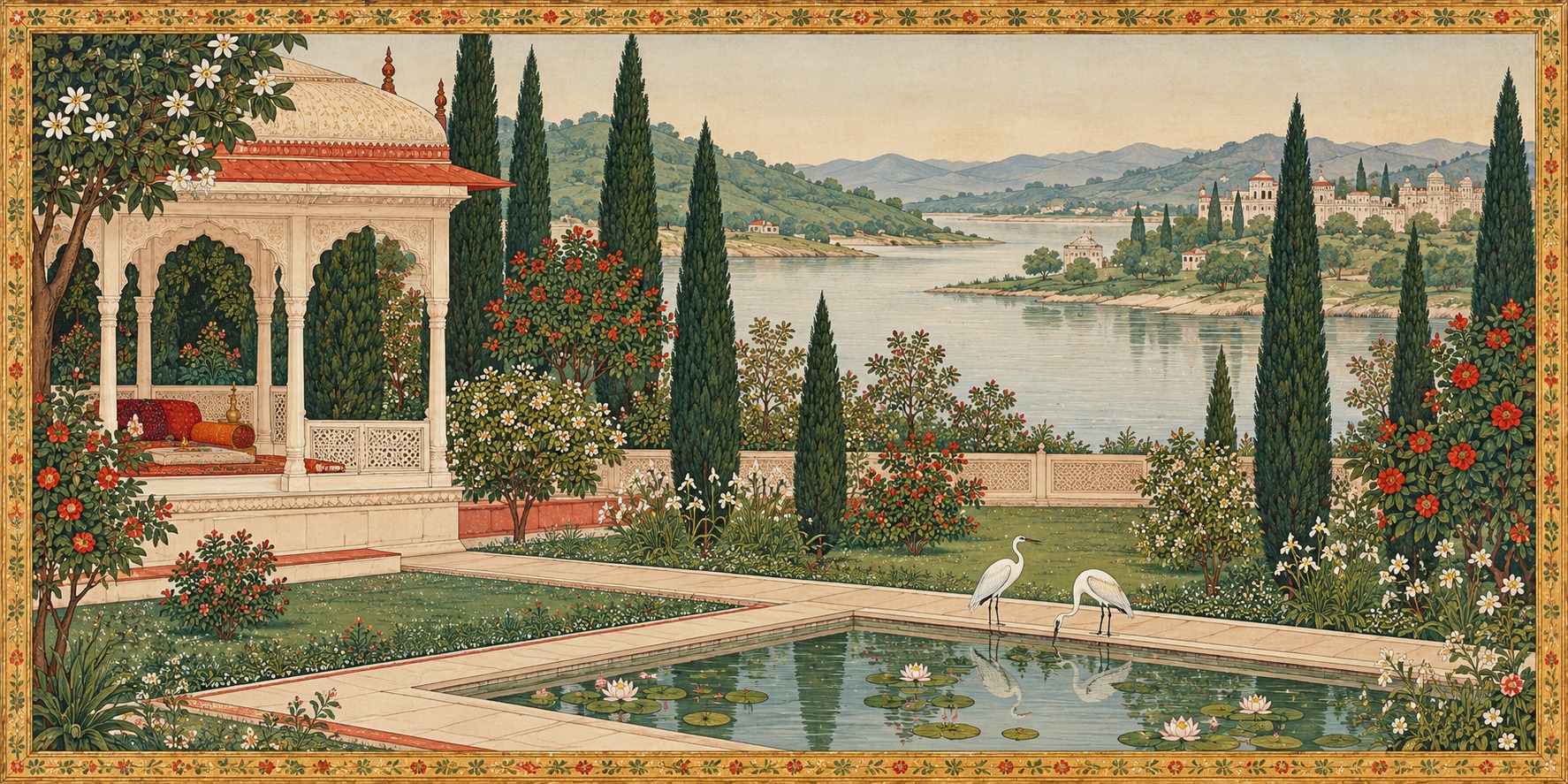
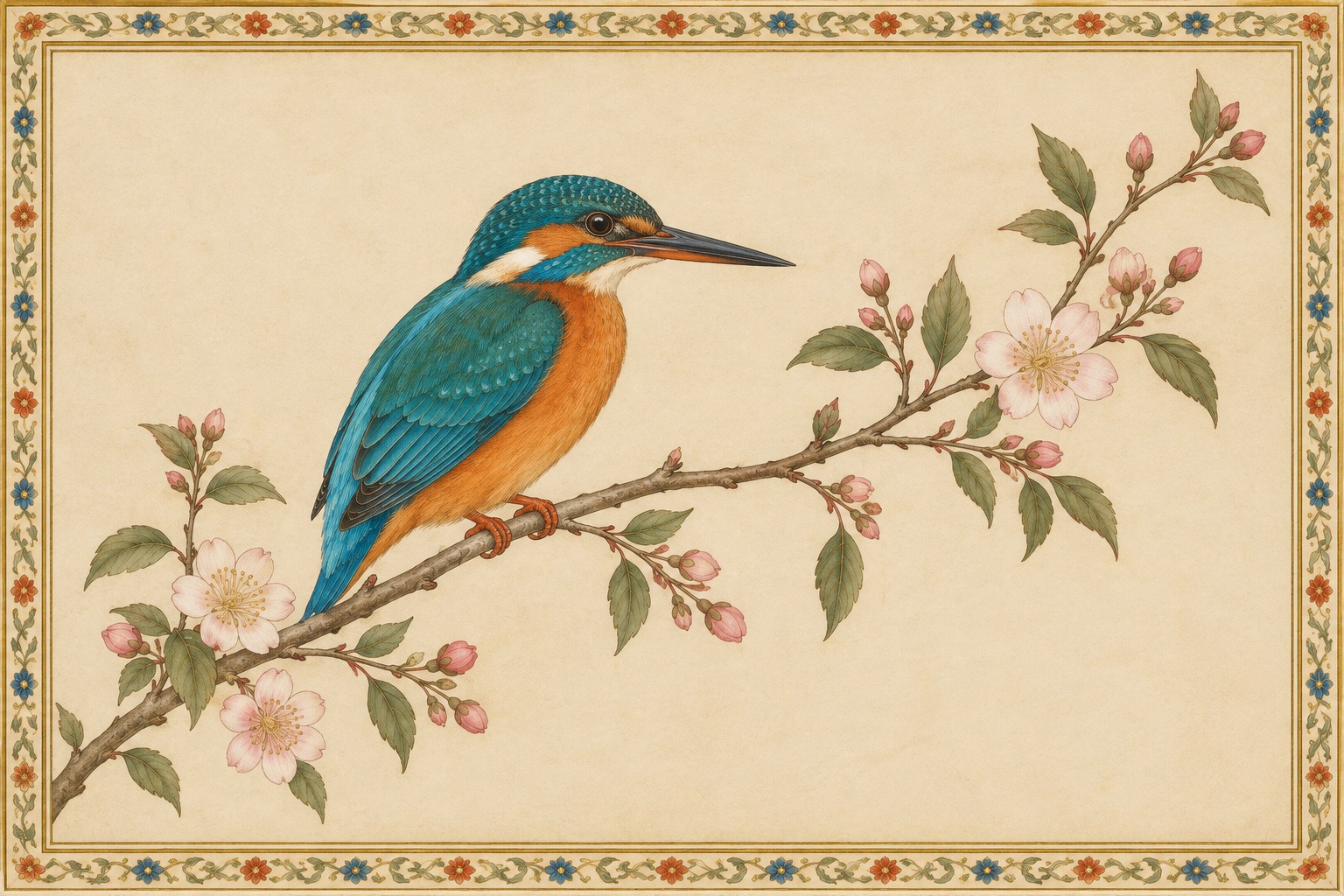
The garden banner uses carefully spaced plants, a pavilion, water and a restrained border to establish the painted page as a designed world. The bird study explores precise observation and quiet negative space, with the important qualification that its anatomy is an invented illustration rather than a scientific record.
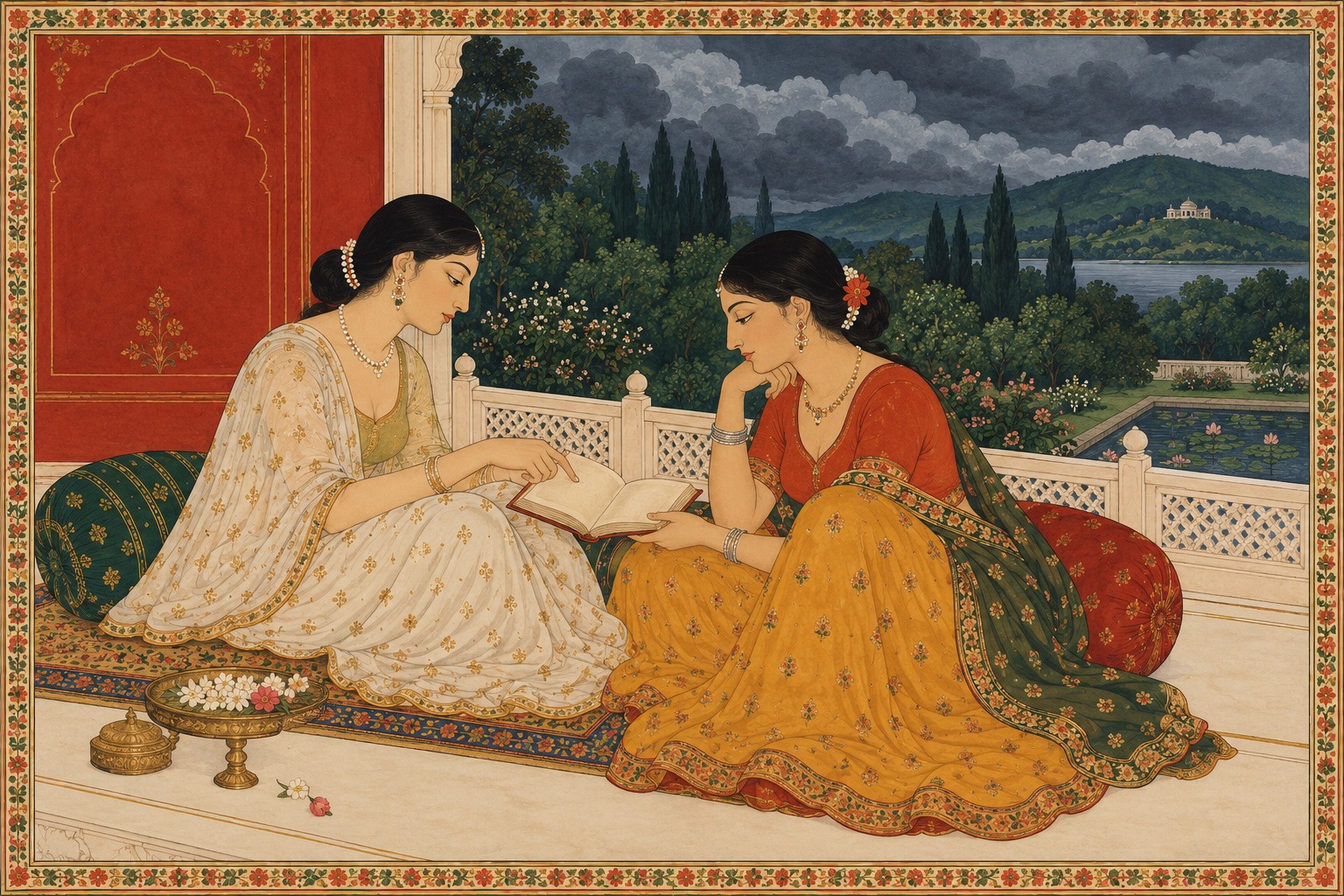
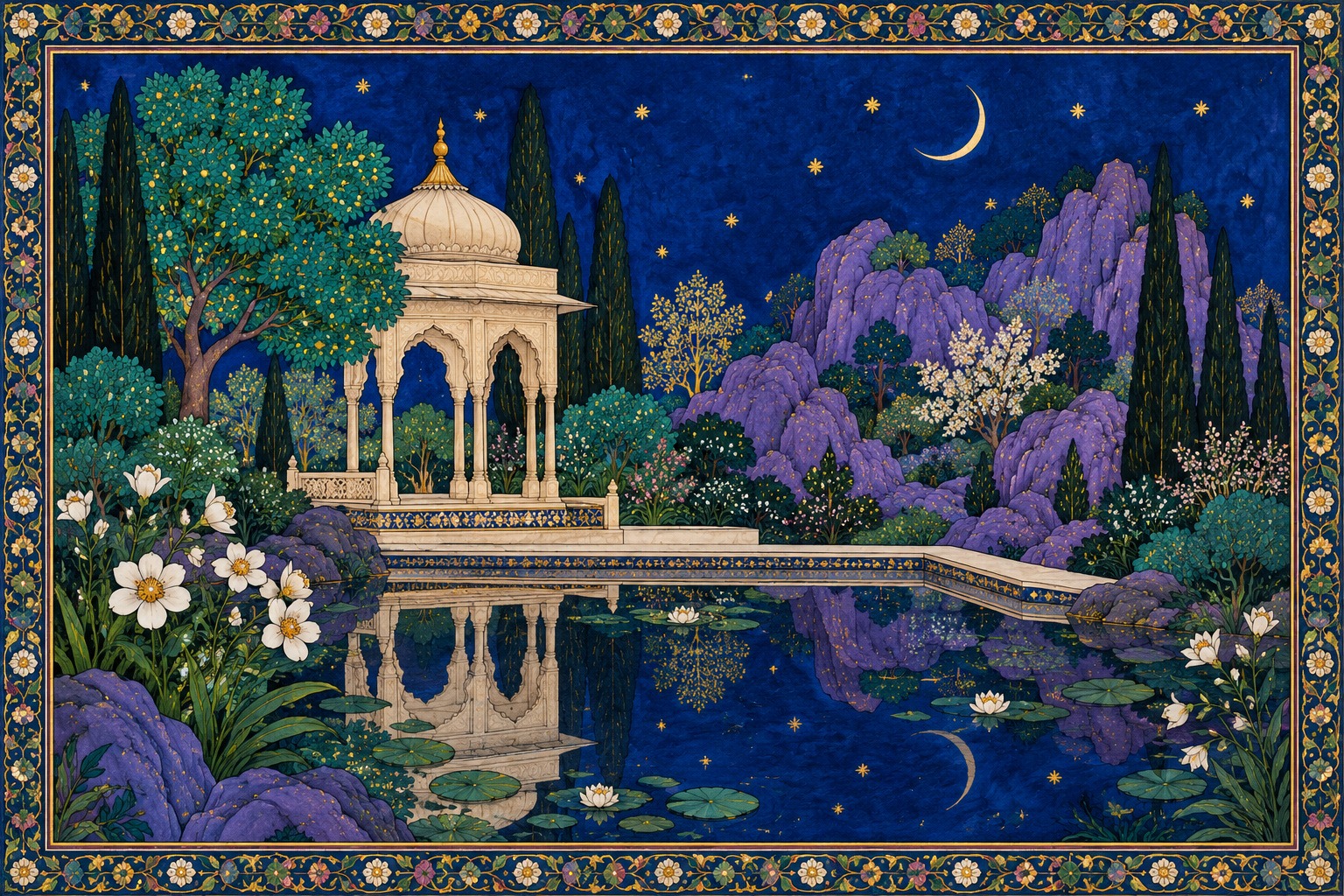
The terrace study uses two figures, patterned clothing, a red wall and monsoon-like clouds to suggest shared attention. The night pavilion shifts toward rich color, unusual rock forms and a luminous pool. They draw on selected formal ideas discussed above; none is presented as an authenticated example of a particular historical workshop. The retained collage provides an additional titled overview.
A useful working method
Choose one documented work to study and record what you actually see: the border width, the main color areas, the distribution of figures, and the types of marks. Separate observations from questions about meaning. Follow the museum’s explanation for the latter instead of inventing an iconography from appearance.
Develop an independent composition using one or two of those formal problems. Change the subject, arrangement and palette rather than tracing the reference. At small size, check the hierarchy; at larger size, inspect hands, architecture, repeated ornament and transitions between surfaces. Precision means coherent decisions, not simply a high density of tiny marks.
Applications and common misunderstandings
These compositional ideas can inform contemporary illustration, painted books, intimate narrative scenes and carefully framed digital images. A new work can acknowledge its sources while belonging openly to the present. The strongest adaptation usually chooses a specific question about space, line or storytelling rather than combining every recognizable motif.
Avoid reducing a diverse field to elephants, palaces and jewel colors, or calling any ornate small image Mughal. Do not use the nationality of a modern maker as proof of a historical technique. For prompts, describe fine contour, organized flat color, a lifted viewpoint, a controlled margin and a clear narrative gesture; add the precise context only when it is useful and supported.
About this guide and its illustrations
This is an AI-authored AOI guide under Penny Wraiter, AOI’s editorial persona. The linked sources support the historical and technical context; the practical exercises, poem and new illustrations are AOI interpretations. Generated pictures are labelled as such and do not establish historical authorship, material authenticity or physical performance.
A small poetic detour
Original words from the AOI studio.
Poetry
A branch enters the quiet page.
The bird gives blue
a place to gather.
Across the terrace, two hands
turn toward the same small book.
Rain waits beyond the wall.
The border does not close the world;
it asks us to come nearer,
to let one leaf
take the time it needs.
The prompt workshop
Original creative exercises. These prompts create new illustrations, not documentary evidence.
Make a quiet album-inspired study
Create an original contemporary painted-page study of a small blue bird on a flowering branch. Use precise contours, restrained opaque-watercolor appearance, ivory space and a narrow floral border. No seals, text or signature. Do not copy a historical folio or present the result as a specimen record.
Let gesture organize a scene
Create an original contemporary illustration informed by Rajput painting’s spatial devices: two adults sharing a book on a lifted-view terrace, a flat red wall, patterned textiles and dark rain clouds. Let their posture convey attention. No deity, named ruler, pseudo-script or copied historical composition.
Explore a luminous night page
Create a new painted-page interpretation with a small empty pavilion, a moonlit pool and unusual violet rock forms. Use deep blue, controlled gold-colored accents, fine contours and a carefully proportioned border. Make the scene imaginative and clearly contemporary, without attributing it to a historical Deccani workshop.
A smile from the studio
Jokes
The border asked for more space. The painter gave it a very precise margin.
Sources and further exploration
[3] The Met, Islamic Art of the Deccan. Distinct court contexts and artistic exchange.
[4] V&A, How to make paint pigments from stones. Anita Chowdry demonstrates material preparation.
[5] The Met, Ramkali Ragini, ca. 1605–06. A documented folio for studying narrative gesture.