
Historical movement and pictorial approach
Metaphysical painting, or Pittura Metafisica, is associated especially with Giorgio de Chirico and Carlo Carrà in the 1910s. Familiar objects and architectural spaces become strangely still and uncertain through displacement, unusual relationships and disrupted expectations.
A visual introduction
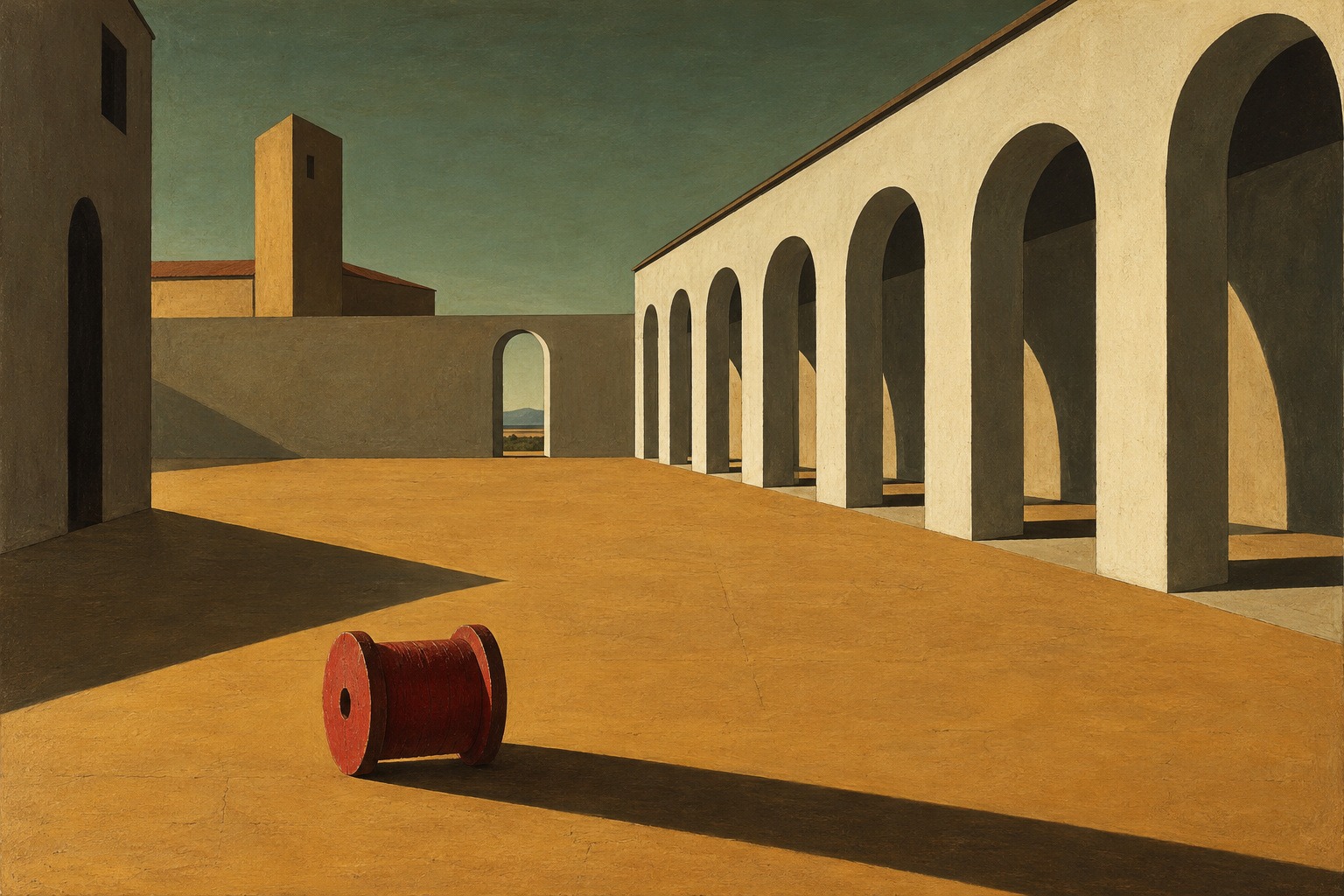
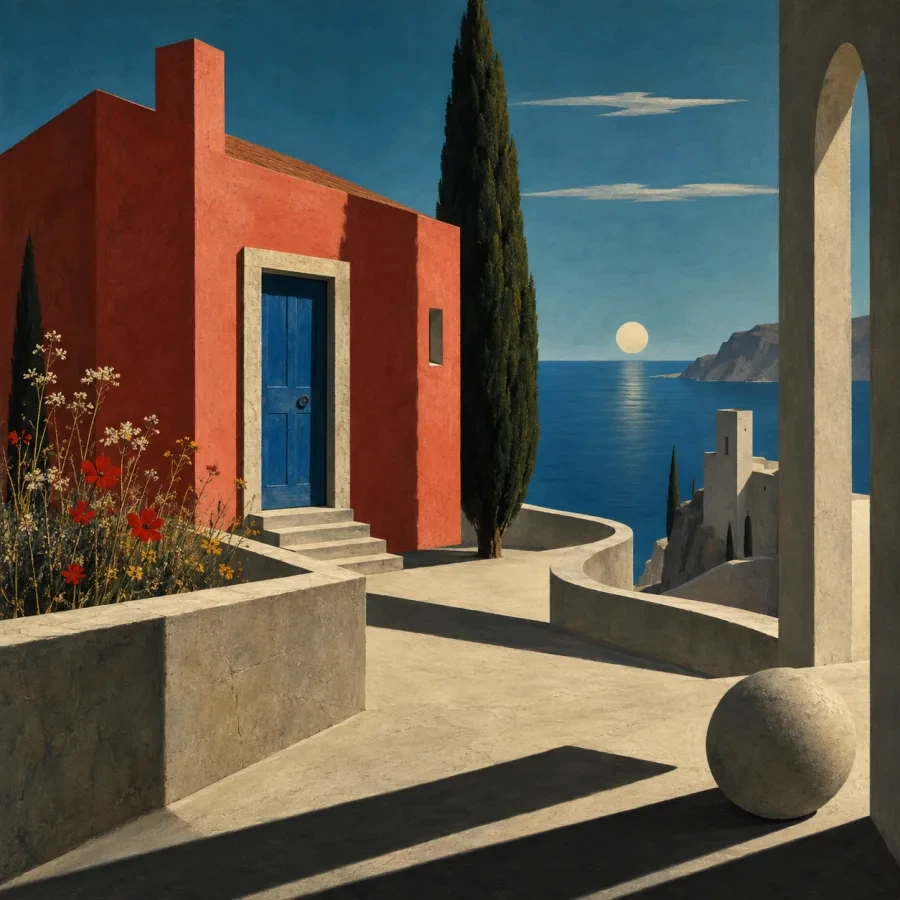
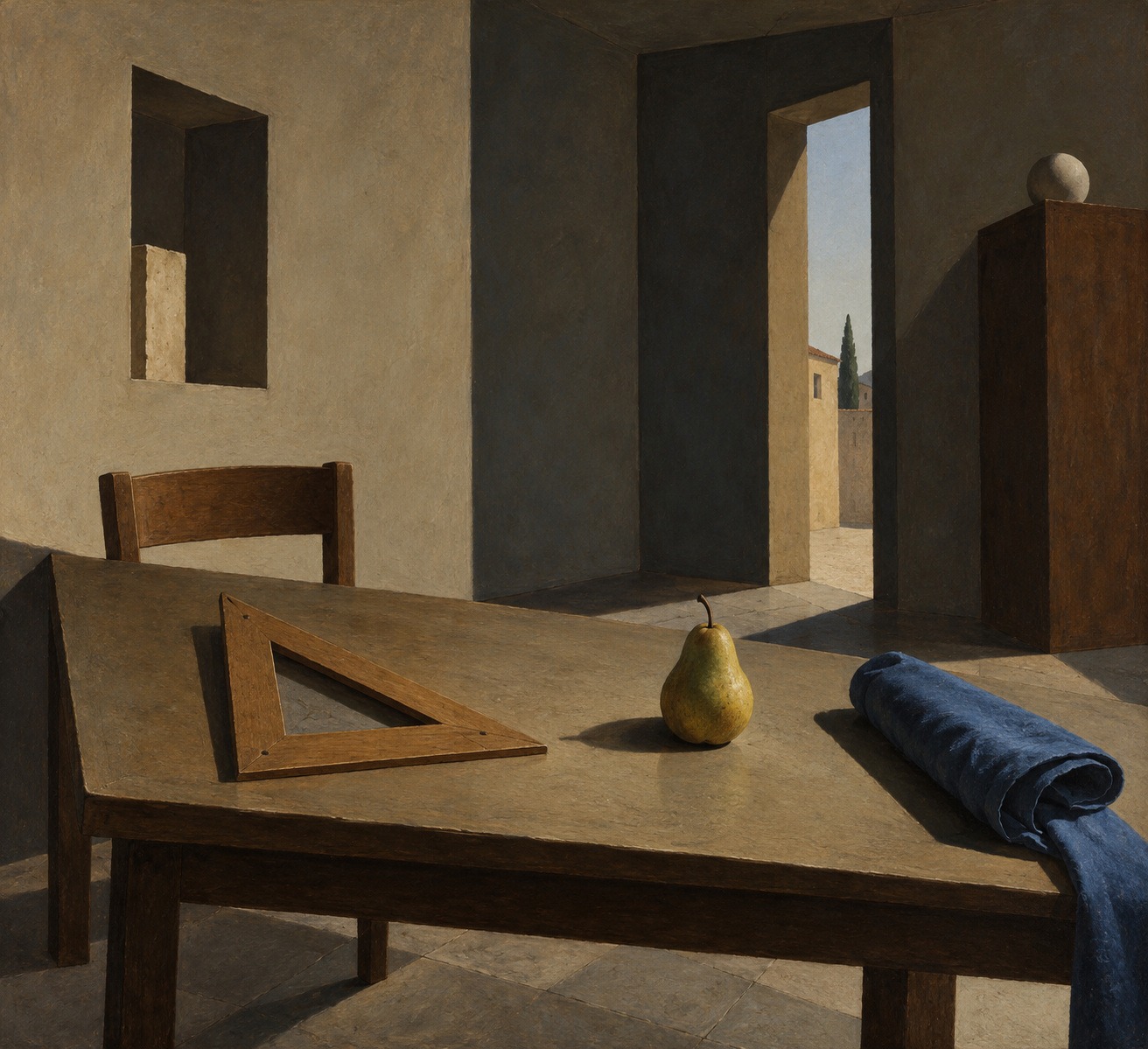
New square and interior studies accompany a retained titled collage, statue-filled plaza and coastal architectural scene. All are editorial interpretations rather than authenticated historical paintings.
Select an image for a closer look. Use the thumbnails, arrow keys or a swipe to compare examples. Zoom in to inspect details, or share the image that inspires you.


Creative toolbox · take this style further
Choose an input and a destination. Search sends your words to the chosen site; Copy & open puts them on your clipboard to paste there.
Create with AI
Turn your chosen input into an image prompt or a new creative direction.
ChatGPT
Copy your input and paste it into a ChatGPT conversation or image request.
Copy & open ChatGPT (new tab)Claude · Anthropic
Develop an image prompt or explore the style in a new Claude conversation.
Copy & open Claude · Anthropic (new tab)Midjourney
Paste your input into the Imagine bar on the Create page.
Copy & open Midjourney (new tab)Adobe Firefly
Copy your input, open Firefly, and paste it into the prompt field.
Copy & open Adobe Firefly (new tab)Leonardo.Ai
Copy your input, open Leonardo, and paste it into the generation field.
Copy & open Leonardo.Ai (new tab)Image search
Find visual references. Short, concrete keywords usually work best.
Lexica
Search AI images and prompts using your selected input.
Search with this input Lexica (new tab)Pexels
Search the photo and video library. Short keywords often work best.
Search with this input Pexels (new tab)Pixabay
Search photos, illustrations and other images.
Search with this input Pixabay (new tab)Unsplash
Search photographs using the style name or your own keywords.
Search with this input Unsplash (new tab)Wikimedia Commons
Search photographs, artworks and historical images. Check each file for its source and reuse terms.
Search with this input Wikimedia Commons (new tab)Art & research
Explore artists, collections and the ideas behind a style.
Wikipedia
Search for background reading. A style may not have its own article.
Search with this input Wikipedia (new tab)WikiArt
Copy your input into WikiArt’s search to explore artists and artworks.
Copy & open WikiArt (new tab)Europeana
Paste your keywords into the search to explore European museum, library and archive collections.
Copy & open Europeana (new tab)Inspiration
Discover portfolios and visual ideas from creative communities.
Instagram hashtags
Search a hashtag made from your input: spaces and punctuation are removed. Instagram may require sign-in.
Search with this input Instagram hashtags (new tab)ArtStation
Paste your input into artwork search for concept art, environments, characters and visual development.
Copy & open ArtStation (new tab)Behance
Paste your input into project search for illustration, design and visual storytelling.
Copy & open Behance (new tab)A closer look
Empty squares, enclosing interiors, long shadows, mannequin-like forms and unexpected objects can create an uneasy sense of order. The effect depends on relationships within space, not simply on adding a mysterious prop.
Historical meaning before a general mood
MoMA situates the Metaphysical School around de Chirico’s earlier work and his collaboration with Carrà and Alberto Savinio in 1917. Its account also notes the influence of de Chirico’s metaphysical period on later Surrealism. The terms are related historically, but they are not interchangeable labels for every dreamlike painting.
MoMA’s discussion of metaphysical still life includes work by de Chirico, Carrà and Morandi and emphasizes geometric organization and an apparently suspended world. This helps widen the subject beyond the familiar empty plaza. An ordinary bottle or drafting tool can become unsettling when its setting and relationships no longer behave as expected.
Make order slightly unreliable
Begin with an intelligible space: a square, a room or a platform. Establish its main planes and a clear large-scale arrangement. Then introduce one or two deliberate disturbances, such as a sharply tilted floor, an unexpectedly large object or a view that seems to belong to another spatial system.
The disturbance works because much of the scene remains convincing. If every line and object is arbitrary, the viewer has no stable expectation to question. Compare a regular version with a subtly altered one. The second should feel strange for a reason that can be traced through the composition, even if its narrative remains unresolved.
Objects and intervals
Choose objects with distinct associations and give them enough space to be noticed. A glove beside a classical fragment, a measuring tool beside a soft form, or an indoor object exposed in a public square can prompt questions without supplying a single answer. For an original study, invent a new relationship rather than reconstructing a famous arrangement.
Empty intervals help slow the image. A distant opening, a long shadow or an unexplained boundary can imply an event without showing it. Keep detail selective and surfaces relatively quiet where stillness is the aim. A crowd of symbolic objects can turn an ambiguous painting into a puzzle with too many competing clues.
Dates and versions matter
The Uffizi’s Metaphysical Composition is dated 1950–1960 and described as a later version of de Chirico’s 1914 Love Song. That distinction matters: a later repetition should not be captioned as the original early work. Collection records can also qualify attribution or dating, so preserve their wording when discussing a particular object.
The examples here are contemporary generated interpretations. They are not de Chirico or Carrà paintings and do not establish historical provenance. Their purpose is to make spatial and compositional ideas visible. For direct study of movement works, follow the museum records and compare the specific date, medium and context of each example.
A practical approach to prompting
Specify the setting, a limited group of objects, the direction of light and one controlled spatial inconsistency. Muted ochre, dusty red, green-gray or pale blue can support the atmosphere, but no fixed palette is compulsory. Let the composition establish the uncertainty before adding surface effects.
Review the result for both coherence and intentional disruption. A malformed doorway may simply be a generation error; an ordinary doorway placed in an unexpected relationship can be a meaningful pictorial choice. Ask what remains stable, what has shifted and how the interval between them affects the scene. Mystery is strongest when the painting gives us something precise to remain uncertain about.
About this guide
This AI-authored AOI guide appears under Penny Wraiter, AOI’s editorial persona. Sources support the historical context; exercises, prompts and poetry are original editorial interpretations. Image captions distinguish generated studies from documented works.
A small poetic detour
Original words from the AOI studio.
Poetry
The square is empty after noon.
A shadow lengthens without sound.
A doorway offers further space;
a spool waits on the level ground.
We know these things, yet not this meeting,
not why the quiet seems arranged.
One ordinary object stays,
and all its neighbors feel estranged.
The prompt workshop
Original creative exercises. These prompts create new illustrations, not documentary evidence.
An ordinary square, one uncertainty
Paint an original metaphysical-inspired empty square with a pale arcade, a small red spool and a long afternoon shadow. Keep the architecture mostly coherent but let one distant opening imply a different depth. Quiet ochre and green-gray, no copied artwork.
Interior without an answer
Create an original still interior with a wooden drafting triangle, a pear and a rolled blue cloth on a tilted table. A narrow doorway shows pale daylight. Controlled spatial ambiguity, quiet surfaces and no labels or signature.
A displaced object
Imagine a plain indoor chair standing alone on a broad coastal platform beneath a blank wall. Long coherent shadows, a distant red building and a subtle uncertainty of scale. Contemporary interpretation, not a historical painting.
A smile from the studio
Jokes
The empty square booked a meeting. Only the shadow arrived, and it stayed longer than expected.