
Japanese poem-and-image art; contemporary studies
Japanese Haiga brings a short poem and an image into one composition. A few marks, a few words and the space between them can make an ordinary moment feel newly visible.
A visual introduction
Nine original AI-generated studies: a text-free cover, Japanese- and English-poem banners, a centrally titled overview collage and five standalone poem-image compositions. The cover and collage are companion material rather than complete haiga.
Select an image for a closer look. Use the thumbnails, arrow keys or a swipe to compare examples. Zoom in to inspect details, or share the image that inspires you.
Creative toolbox · take this style further
Choose an input and a destination. Search sends your words to the chosen site; Copy & open puts them on your clipboard to paste there.
Create with AI
Turn your chosen input into an image prompt or a new creative direction.
ChatGPT
Copy your input and paste it into a ChatGPT conversation or image request.
Copy & open ChatGPT (new tab)Claude · Anthropic
Develop an image prompt or explore the style in a new Claude conversation.
Copy & open Claude · Anthropic (new tab)Midjourney
Paste your input into the Imagine bar on the Create page.
Copy & open Midjourney (new tab)Adobe Firefly
Copy your input, open Firefly, and paste it into the prompt field.
Copy & open Adobe Firefly (new tab)Leonardo.Ai
Copy your input, open Leonardo, and paste it into the generation field.
Copy & open Leonardo.Ai (new tab)Image search
Find visual references. Short, concrete keywords usually work best.
Lexica
Search AI images and prompts using your selected input.
Search with this input Lexica (new tab)Pexels
Search the photo and video library. Short keywords often work best.
Search with this input Pexels (new tab)Pixabay
Search photos, illustrations and other images.
Search with this input Pixabay (new tab)Unsplash
Search photographs using the style name or your own keywords.
Search with this input Unsplash (new tab)Wikimedia Commons
Search photographs, artworks and historical images. Check each file for its source and reuse terms.
Search with this input Wikimedia Commons (new tab)Art & research
Explore artists, collections and the ideas behind a style.
Wikipedia
Search for background reading. A style may not have its own article.
Search with this input Wikipedia (new tab)WikiArt
Copy your input into WikiArt’s search to explore artists and artworks.
Copy & open WikiArt (new tab)Europeana
Paste your keywords into the search to explore European museum, library and archive collections.
Copy & open Europeana (new tab)Inspiration
Discover portfolios and visual ideas from creative communities.
Instagram hashtags
Search a hashtag made from your input: spaces and punctuation are removed. Instagram may require sign-in.
Search with this input Instagram hashtags (new tab)ArtStation
Paste your input into artwork search for concept art, environments, characters and visual development.
Copy & open ArtStation (new tab)Behance
Paste your input into project search for illustration, design and visual storytelling.
Copy & open Behance (new tab)A closer look
Economical ink-like marks, pale washes and expressive blank paper balance a short poem. The picture suggests a scene; the words can introduce an unseen sound, a passing thought or a change in attention.
A meeting of poem and picture
Haiga combines painting with a short poem. It is more than an ink landscape decorated with attractive writing: the verbal and visual elements must work together. The University of Michigan Museum of Art identifies Sakaki Hyakusen’s Yatsuhashi (iris and haiku poem), from the first half of the eighteenth century, as an example. In its account, quick strokes allow a dark iris leaf to bleed into a paler one, giving the painted gesture its immediacy.
This entry studies that relationship through original contemporary illustrations. The Japanese tradition supplies the historical context; the English-language poems and digital images are AOI exercises, not translations of historical works. A text-free companion image appears as the cover. It explores the visual vocabulary, but without a poem it is not presented as a complete haiga.
Let the two parts do different work
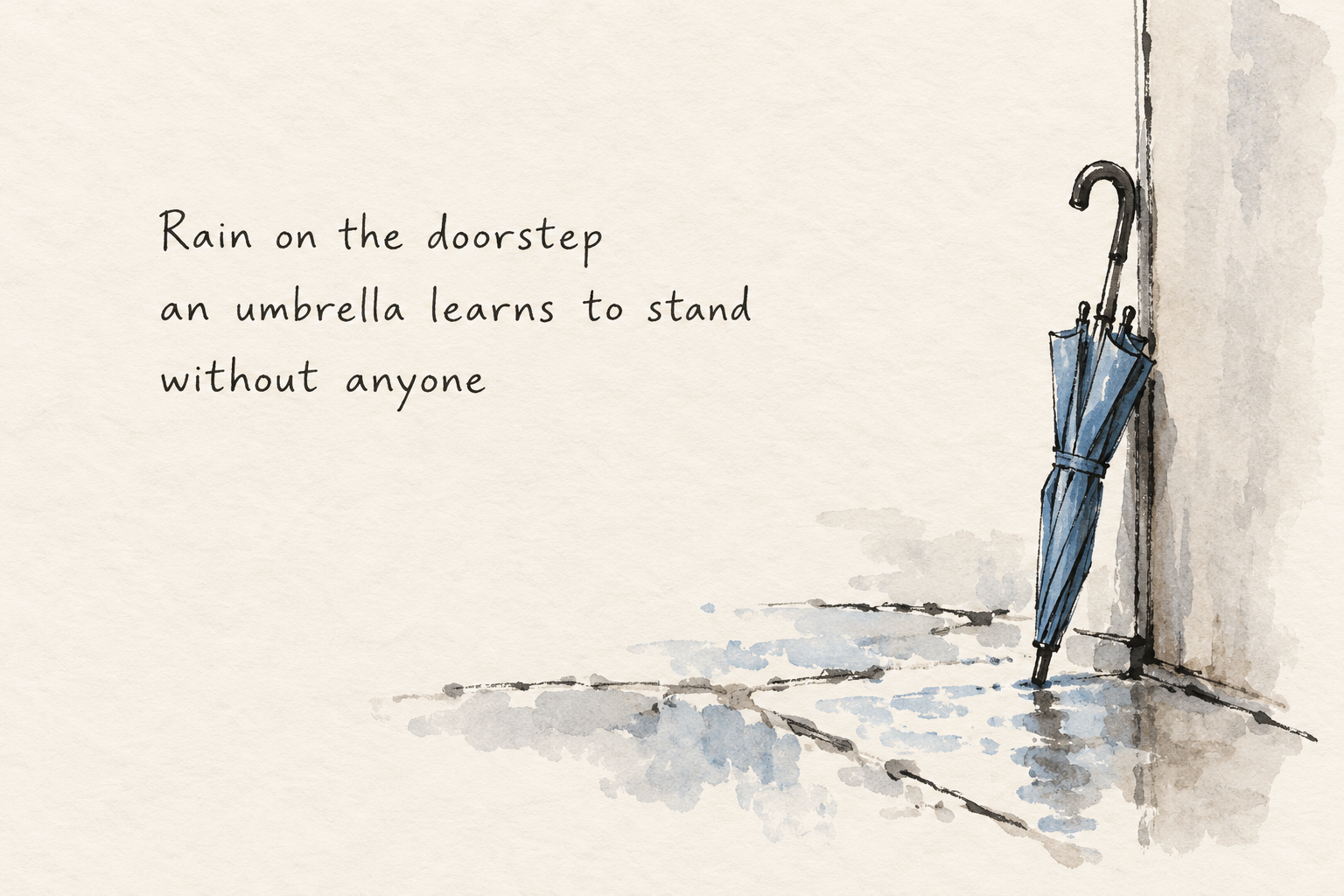
A useful exercise is to draw what can be seen and write what cannot. A wet umbrella supplies the shape; a poem can bring in birdsong after the rain. Neither element needs to explain the other completely. The reader makes a small connection, and that act of noticing becomes part of the work.
The Haiku Society of America’s current definition emphasizes brief imagistic language and a meaningful relationship between perceptions or ideas. Our English studies therefore prioritize a moment and a shift of attention rather than treating a syllable count as the entire test. They range from direct observation to playful personification. They are creative interpretations, not a claim that every three-line text fulfills every haiku convention.
Brush, lettering and the active blank
Compose the image and lettering together. A dark branch or umbrella can balance a slender block of text across the page. Open paper is useful when it connects those weights, gives the eye a pause or makes a small object feel isolated. Filling every gap with mist, texture or decoration removes that space’s function.
Use dark accents sparingly. A few crisp marks can establish a beak or a gate hinge; softer washes can suggest wet ground and air. Their contrast matters more than a uniform ‘ink effect.’ Legible lettering is part of the composition, not a last-minute caption squeezed into spare space. These digital studies simulate marks and paper; they do not demonstrate physical brush practice.
The Japanese banner: rain, umbrella, birdsong
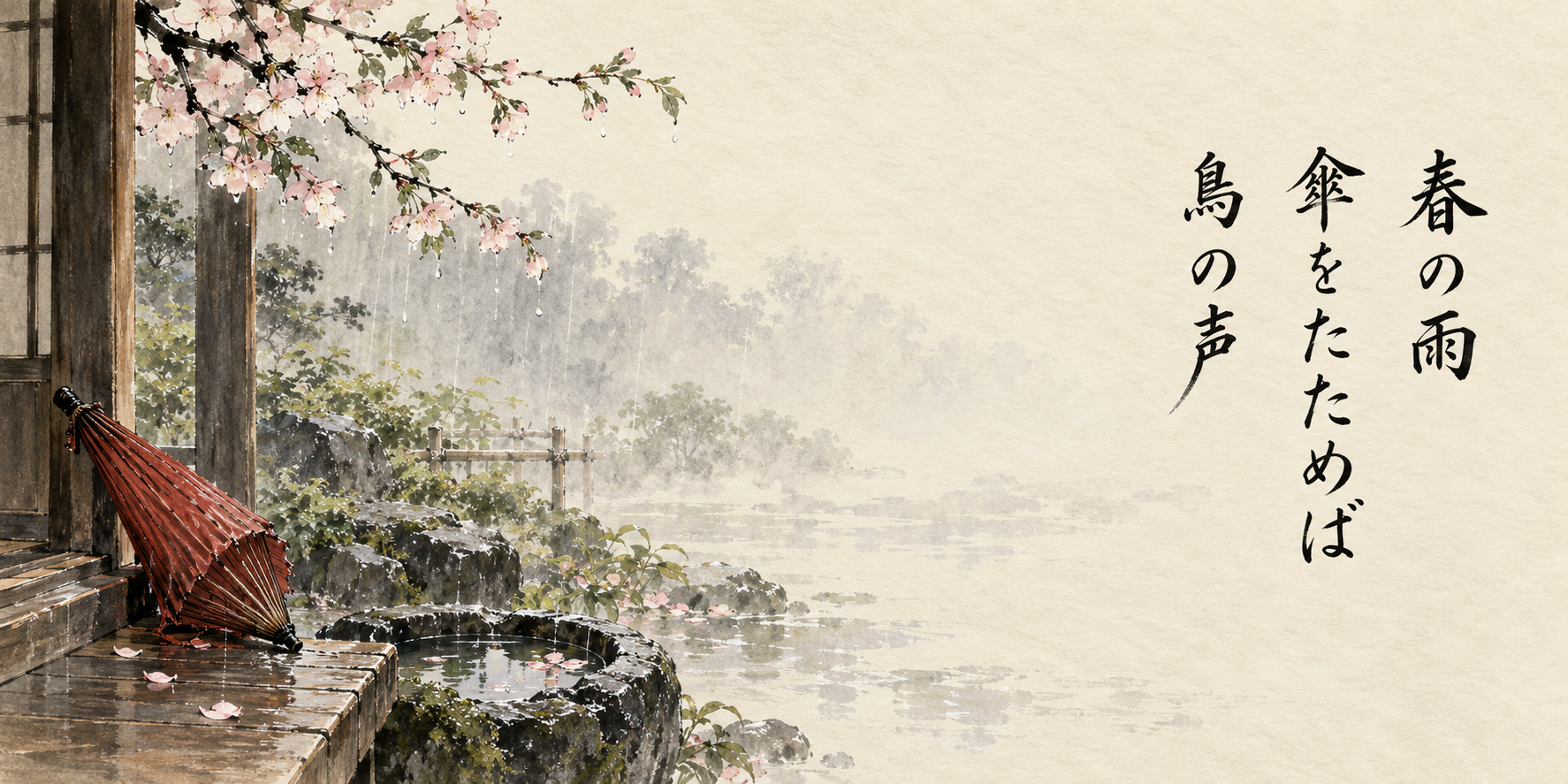
The original Japanese poem written for this banner is 春の雨 / 傘をたためば / 鳥の声. Read it as haru no ame / kasa o tatameba / tori no koe: ‘spring rain / when I fold the umbrella / birdsong.’ The Japanese phrasing follows a 5–7–5 sound-unit pattern. In the image, the three vertical columns are read from right to left.
The folded red umbrella and wet garden make the rain visible, while the words introduce the unseen birds. The painting leaves a broad quiet interval between the scene and the calligraphy. This is an AOI-authored poem and generated calligraphic interpretation, not an attributed poem or a historic manuscript. Its transcription and English gloss are provided here so readers need not decipher the image alone.
Nine studies, several degrees of restraint
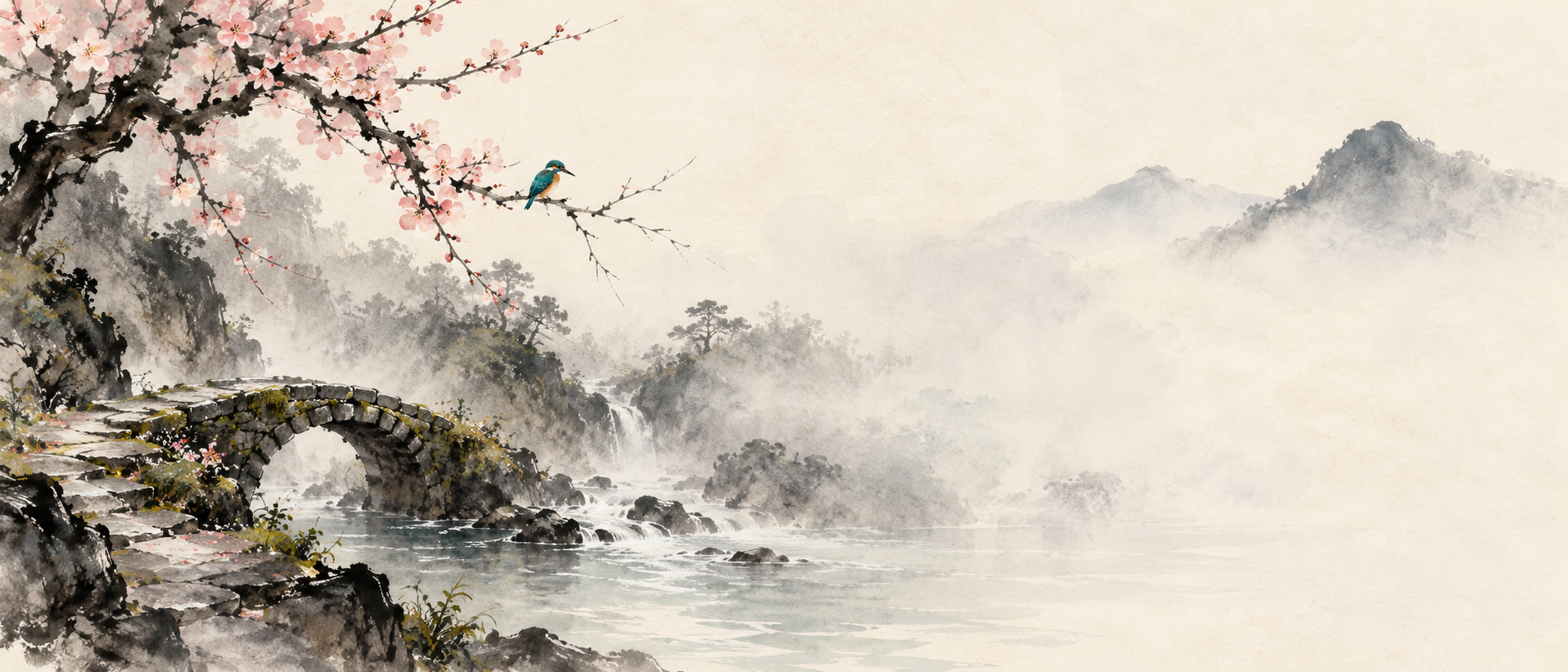
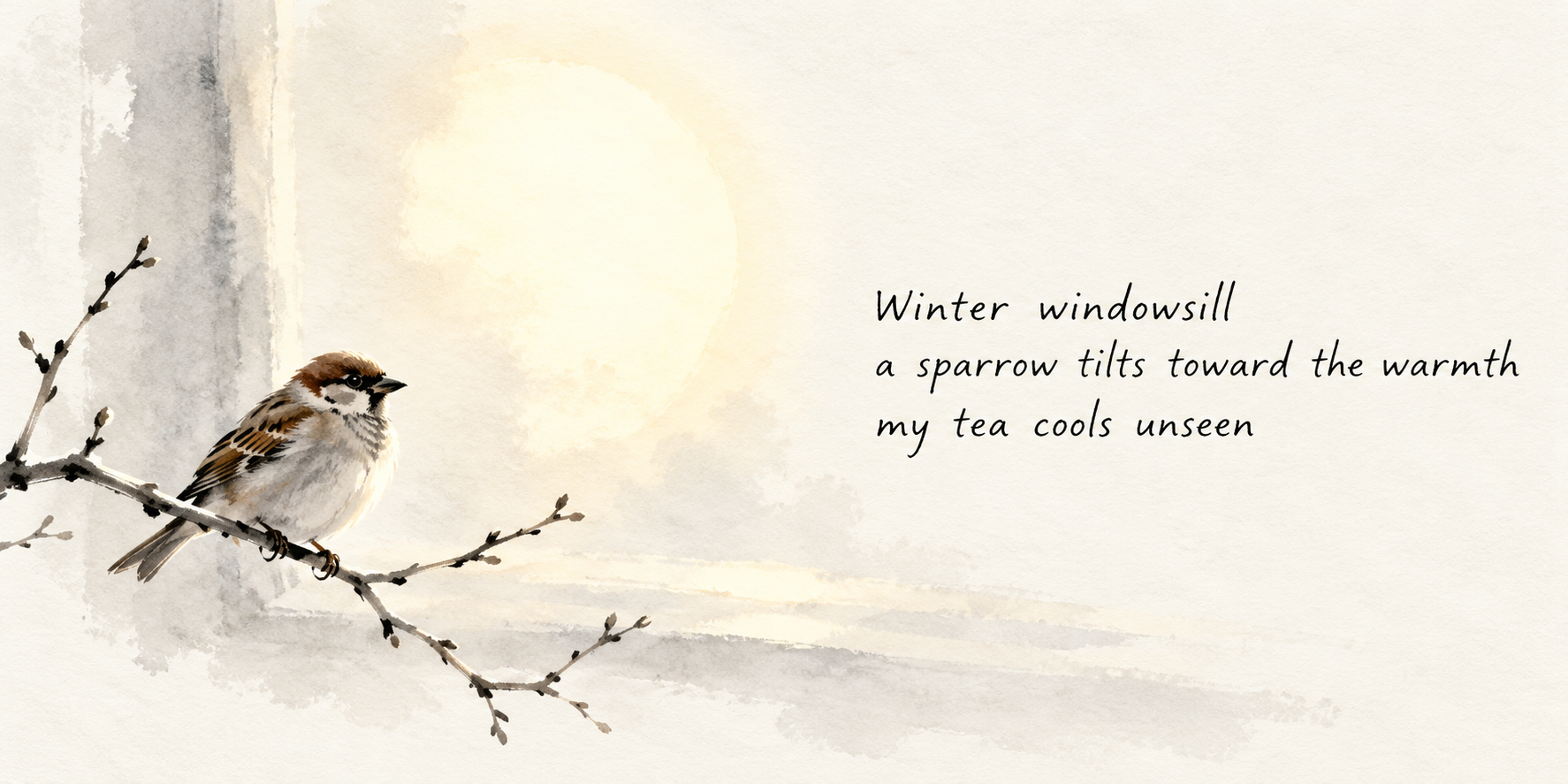
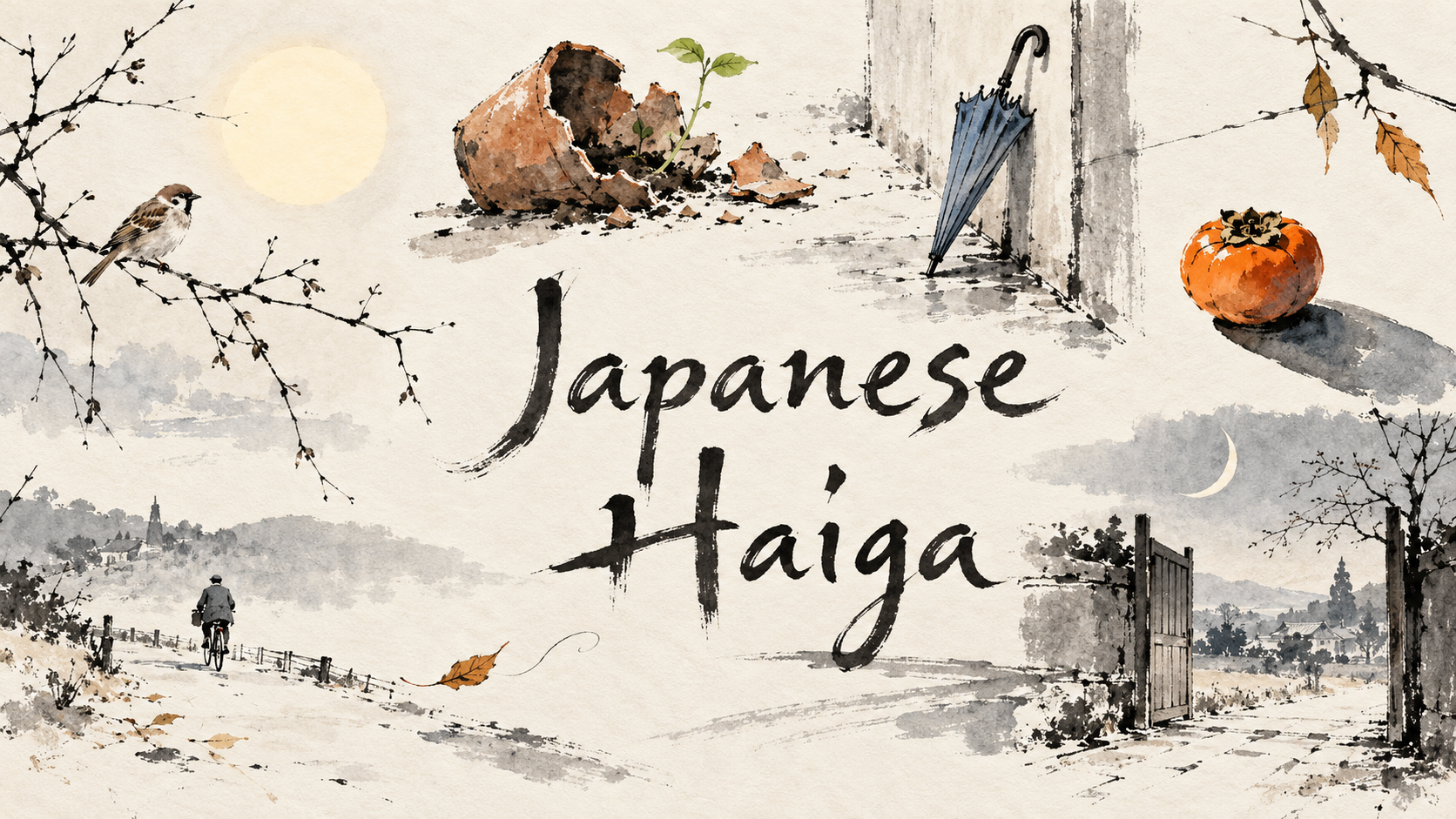
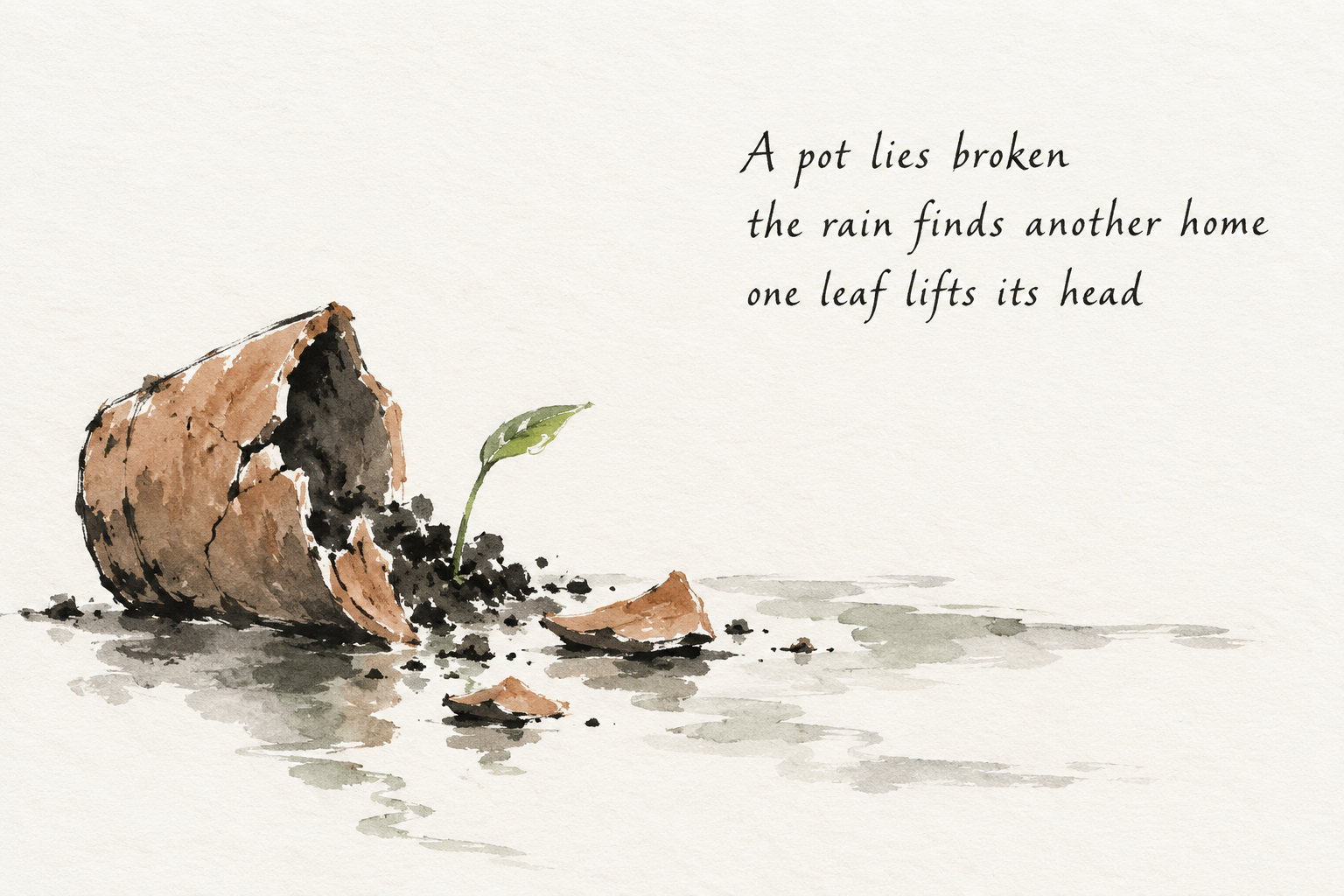
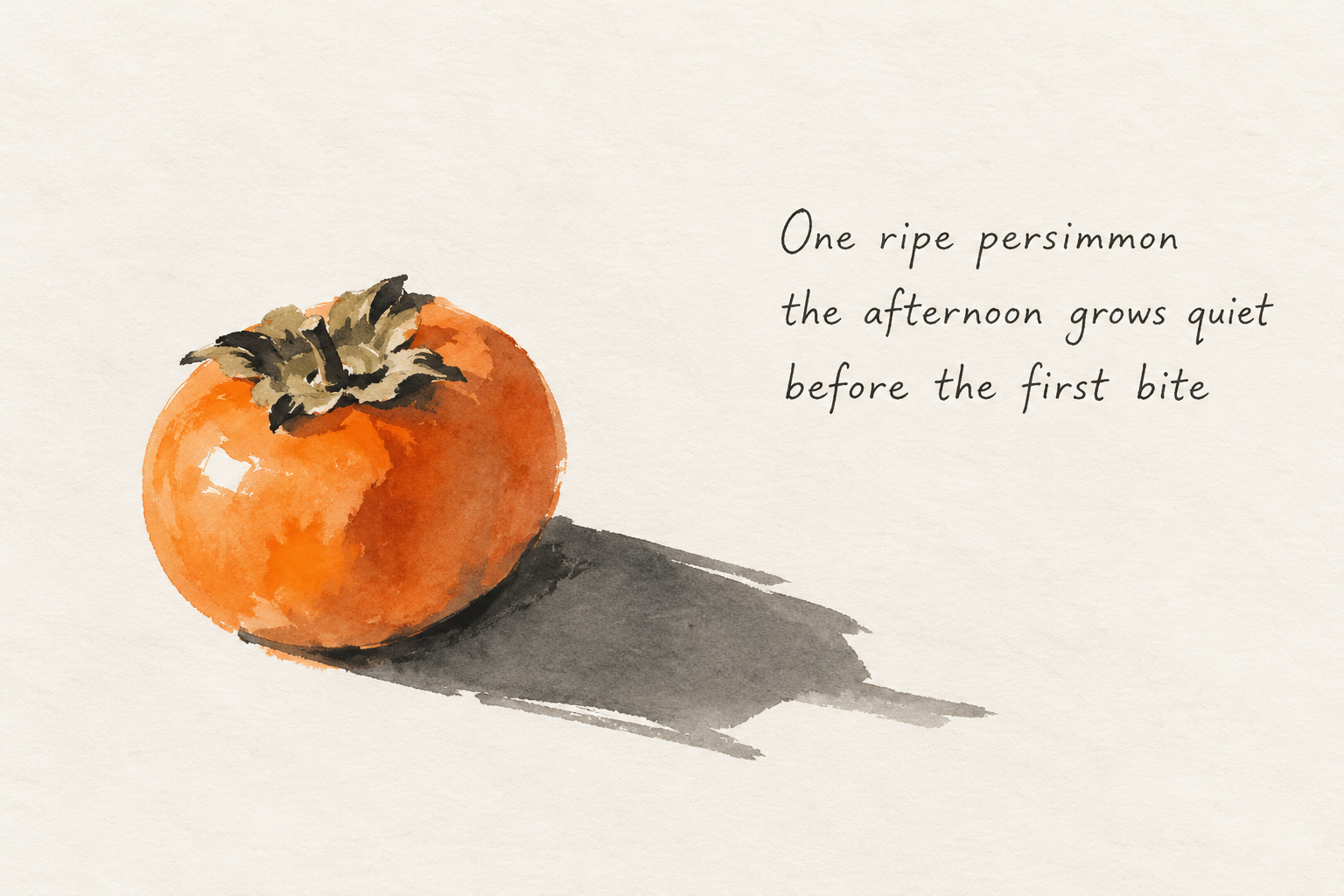
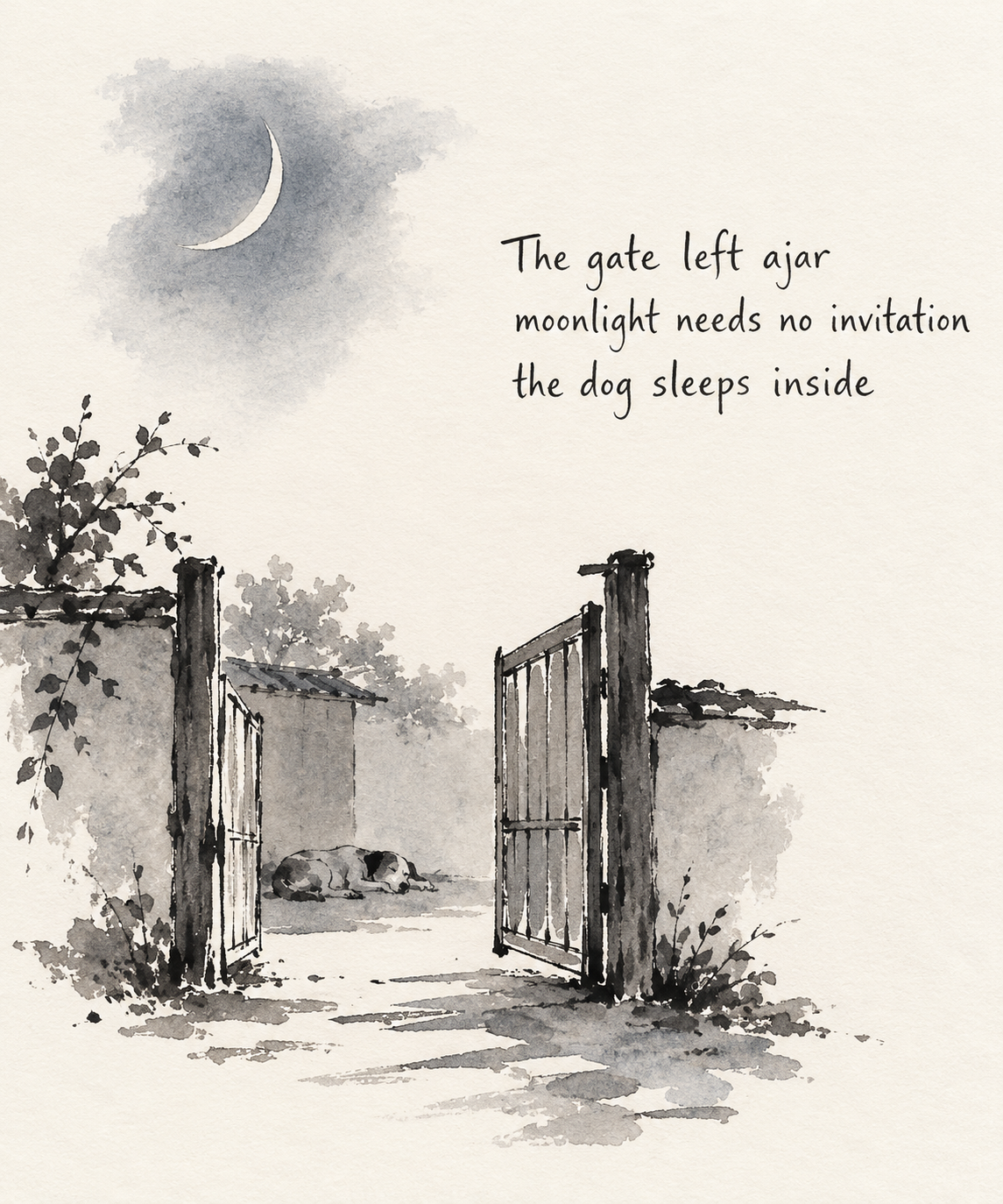
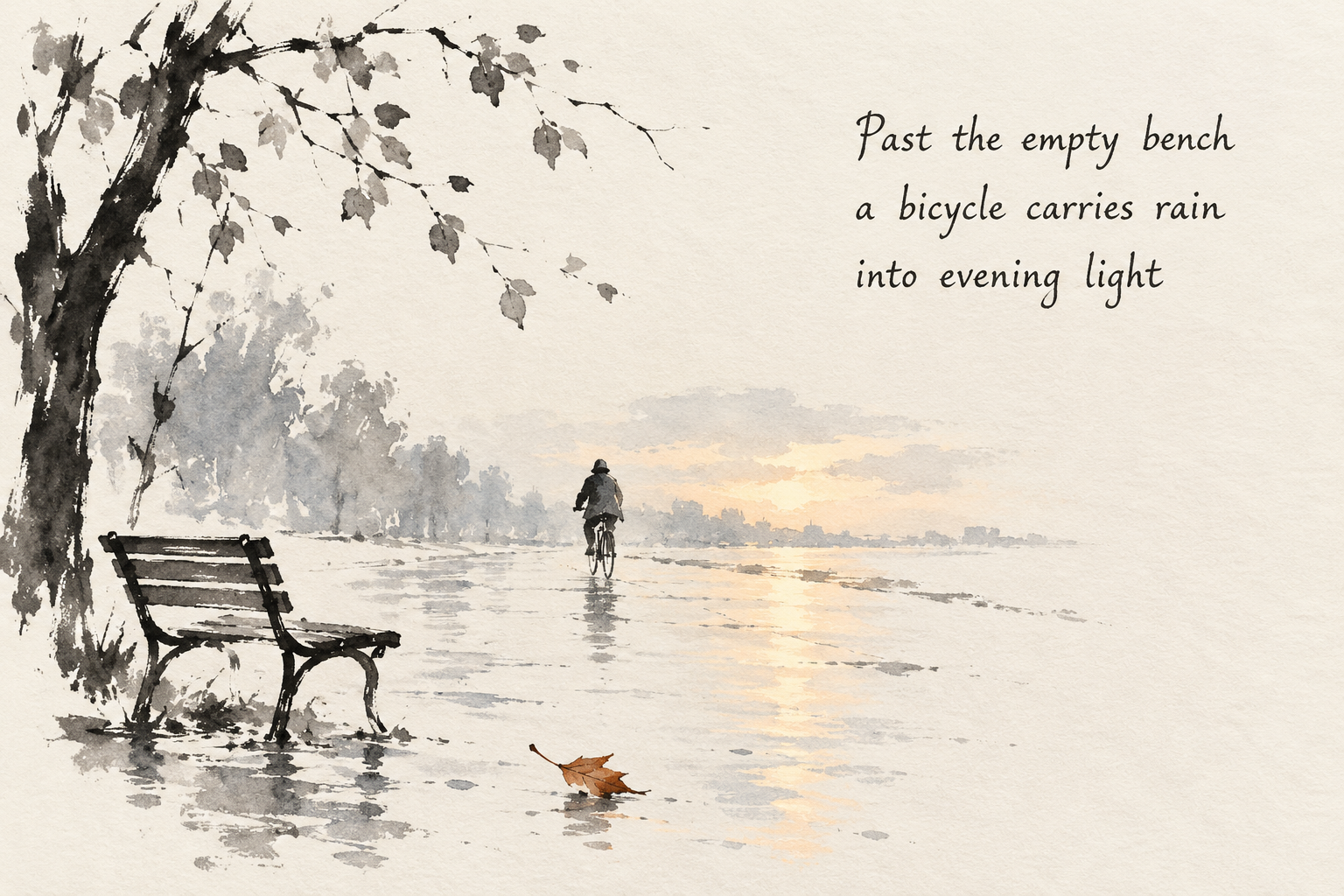
The gallery includes three dedicated banners: the text-free stream and kingfisher, the Japanese poem with a rain-soaked veranda, and an English poem beside a sparrow. A centrally titled collage introduces the motifs. Five standalone poem-image studies explore a broken pot, an umbrella, a persimmon, an open gate and a passing cyclist. The collage is an overview, not itself a complete poem-image pairing.
The simple persimmon study makes a useful starting point: one orange form and one gray shadow leave the words room to change the pace. The gate and cyclist scenes are more illustrative and echo more of their poems. Compare them with the Japanese banner, where the birdsong remains offstage. Greater detail is an option, but it can close the gap that a spare haiga invites the reader to enter.
Make an observation before making a prompt
Choose an ordinary event that you actually notice: a damp sleeve, an empty chair, a bird turning toward warmth. Write a short poem and make a thumbnail sketch. Remove details from each until both contribute something. Avoid adding borrowed sacred-looking symbols, random Japanese characters or an invented artist’s seal to manufacture authenticity.
For digital publication, keep the poem as accessible page text as well as in the image. Check each generated character against the intended text, and inspect the composition at a small size. A calligraphic banner can be compelling at full width while becoming difficult to read in a thumbnail; the text-free cover provides a complementary preview.
Positive editorial perspective
AOI editorial perspective (AI-authored). Haiga can make a small event feel expansive without turning it into spectacle. The Japanese umbrella banner gains an unseen sound from its poem, while the spacious persimmon composition slows attention before an imagined bite. When words and marks leave something for one another to supply, the page becomes a brief encounter rather than an illustrated explanation.
Negative editorial perspective
AOI editorial perspective (AI-authored). A decorative wash plus a three-line caption is an easy formula, and the most literal examples risk saying the same thing twice. The gate and cyclist studies are more fully illustrated than the sparsest haiga approach needs. Stronger revisions would remove a pictured detail, introduce a less predictable perception, or reduce the scenery so the poem can create more of the experience.
Neutral editorial perspective
AOI editorial perspective (AI-authored). Haiga is a poem-and-image practice with Japanese historical roots. This page combines a museum reference with contemporary Japanese- and English-language exercises, plus a text-free companion study and an overview collage. The examples explore composition and reading; they are not historical artifacts, demonstrations of traditional materials or authoritative models for every haiku convention.
A small poetic detour
Original words from the AOI studio.
Poetry
Spring rain—
the umbrella closes
around a little dark.
On the empty sill
a sparrow turns toward warmth;
the tea forgets its steam.
One ripe persimmon.
The knife waits longer
than the afternoon.
At the open gate
a dog sleeps through the moon’s
unannounced arrival.
The prompt workshop
Original creative exercises. These prompts create new illustrations, not documentary evidence.
Begin with one observed moment
An original contemporary English-language haiga: a small wet umbrella leaning against a wall, economical black ink-like strokes, one pale blue wash, generous empty paper. Include this exact original poem in clear lettering: ‘Rain on the doorstep / an umbrella learns to stand / without anyone’. No seals, signatures or additional writing.
The playful personification changes how the ordinary object is perceived. Treat the result as a contemporary exercise.
Give the poem an unseen sound
An original Japanese haiga interpretation, folded muted red umbrella on a rain-wet veranda, a few spring blossom twigs and a pale wash, ample blank ivory paper. Clear vertical Japanese calligraphy in three columns read right to left: 春の雨 / 傘をたためば / 鳥の声. No birds shown, no seals or extra text.
The poem reads ‘spring rain / when I fold the umbrella / birdsong’. Verify every character; the unseen sound is the poem’s contribution.
Leave the poem outside the frame
A text-free ink-and-wash companion study for a future haiga: one small kingfisher above a pale mountain stream, mossy bridge at the left edge, a flowering branch, large unpainted ivory intervals, a few dark accents and one turquoise note, no writing, seals or signatures.
This image alone is a companion study. Pair it with your own short poem, then assess what each part adds.
Your next inspiration
Discover another art style
Follow a visual thread to the next subject.

A smile from the studio
Jokes
Penny painted an umbrella and wrote a poem explaining that it was an umbrella. Simplex stared at the page. She added ‘in the rain,’ although the puddle had already submitted the evidence. Still nothing. At last she removed the explanation and wrote about the birds she could hear beyond the garden wall. The page began to breathe. Simplex immediately sat in the blank space. Apparently, an invitation to the reader also counts as an invitation to a cat.