
Photographic technique and visual interpretation
Understand infrared photography, near-infrared versus thermal imaging, filters and false color, with practical guidance and original AOI visual studies.
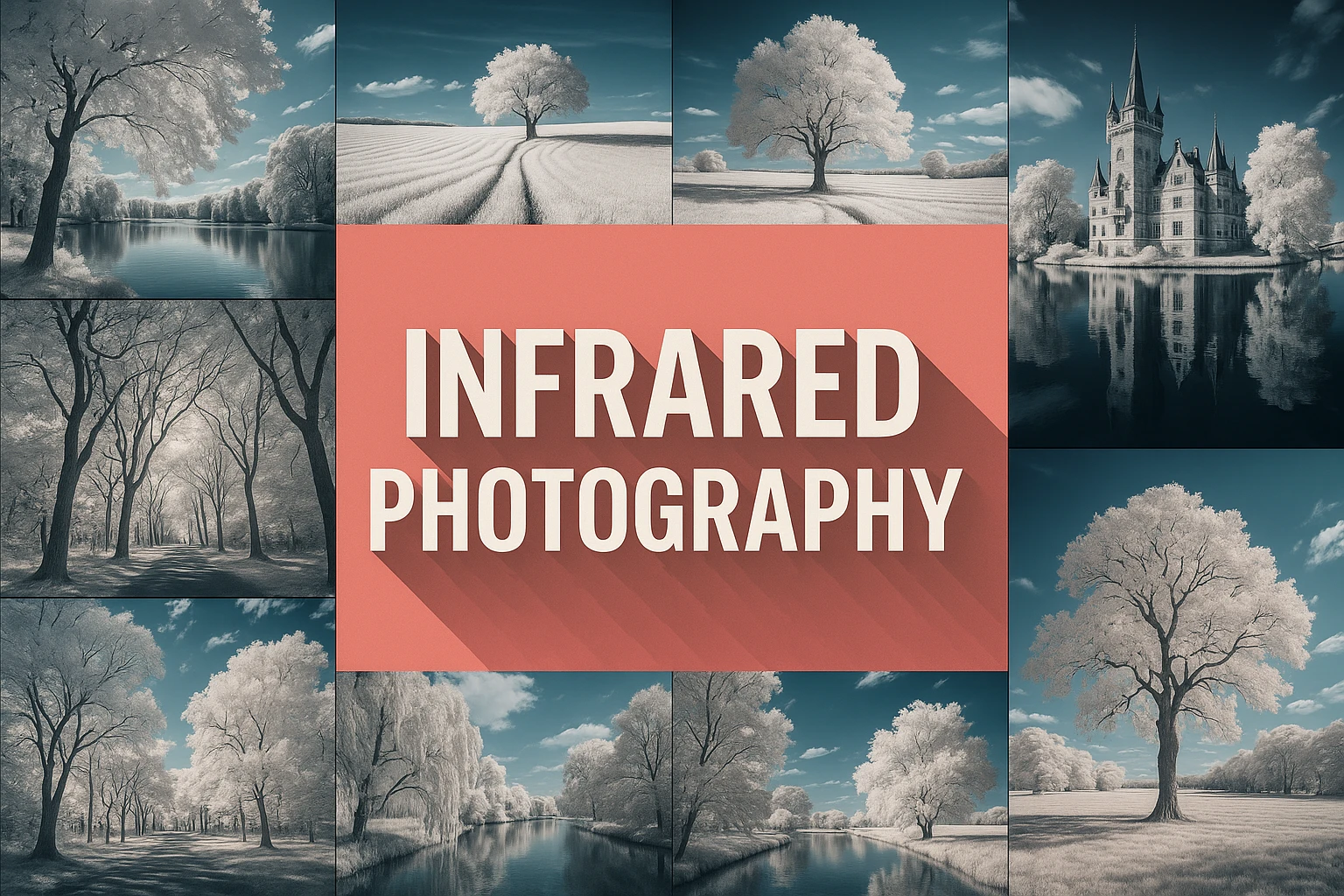
A visual introduction
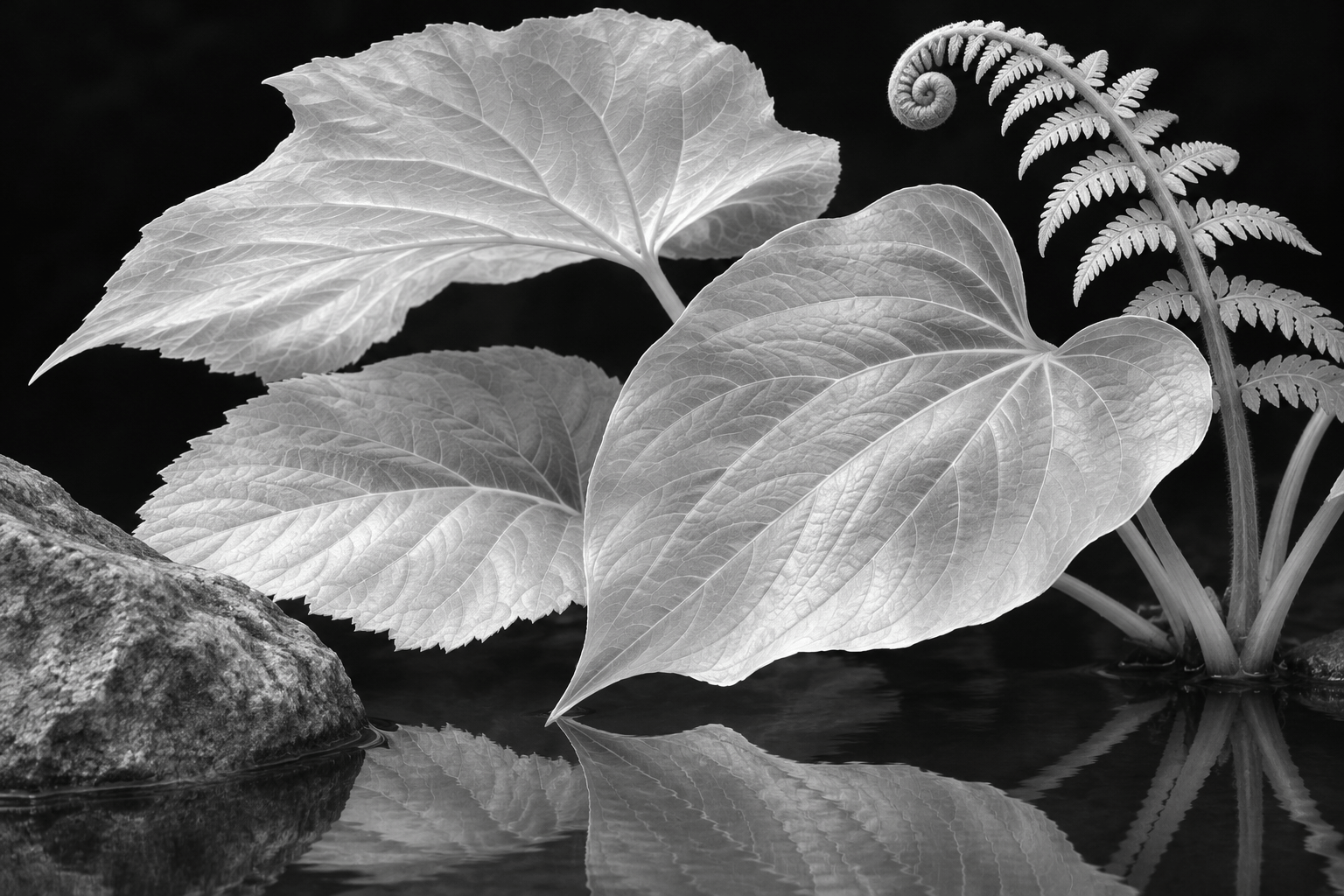
Four new AI-generated studies join the retained titled collage. They illustrate composition and infrared-inspired tonal or color relationships; none is a real infrared exposure, thermal measurement or plant-health assessment.
Select an image for a closer look. Use the thumbnails, arrow keys or a swipe to compare examples. Zoom in to inspect details, or share the image that inspires you.
Creative toolbox · take this style further
Choose an input and a destination. Search sends your words to the chosen site; Copy & open puts them on your clipboard to paste there.
Create with AI
Turn your chosen input into an image prompt or a new creative direction.
ChatGPT
Copy your input and paste it into a ChatGPT conversation or image request.
Copy & open ChatGPT (new tab)Claude · Anthropic
Develop an image prompt or explore the style in a new Claude conversation.
Copy & open Claude · Anthropic (new tab)Midjourney
Paste your input into the Imagine bar on the Create page.
Copy & open Midjourney (new tab)Adobe Firefly
Copy your input, open Firefly, and paste it into the prompt field.
Copy & open Adobe Firefly (new tab)Leonardo.Ai
Copy your input, open Leonardo, and paste it into the generation field.
Copy & open Leonardo.Ai (new tab)Image search
Find visual references. Short, concrete keywords usually work best.
Lexica
Search AI images and prompts using your selected input.
Search with this input Lexica (new tab)Pexels
Search the photo and video library. Short keywords often work best.
Search with this input Pexels (new tab)Pixabay
Search photos, illustrations and other images.
Search with this input Pixabay (new tab)Unsplash
Search photographs using the style name or your own keywords.
Search with this input Unsplash (new tab)Wikimedia Commons
Search photographs, artworks and historical images. Check each file for its source and reuse terms.
Search with this input Wikimedia Commons (new tab)Art & research
Explore artists, collections and the ideas behind a style.
Wikipedia
Search for background reading. A style may not have its own article.
Search with this input Wikipedia (new tab)WikiArt
Copy your input into WikiArt’s search to explore artists and artworks.
Copy & open WikiArt (new tab)Europeana
Paste your keywords into the search to explore European museum, library and archive collections.
Copy & open Europeana (new tab)Inspiration
Discover portfolios and visual ideas from creative communities.
Instagram hashtags
Search a hashtag made from your input: spaces and punctuation are removed. Instagram may require sign-in.
Search with this input Instagram hashtags (new tab)ArtStation
Paste your input into artwork search for concept art, environments, characters and visual development.
Copy & open ArtStation (new tab)Behance
Paste your input into project search for illustration, design and visual storytelling.
Copy & open Behance (new tab)A closer look
Pale textured foliage, dark water and deep skies can reorganize a familiar scene. Monochrome emphasizes material contrast; false color assigns visible hues to recorded information rather than revealing colors seen by the unaided eye.
A different record of a familiar place
Infrared photography is a family of capture techniques, not one fixed palette. This entry focuses on near-infrared photographic practice: using suitable film or a sensor and filtering to record light beyond ordinary visible red. A tree, bridge or pool may then acquire an unfamiliar tonal relationship even though its geometry has not changed.
Keep three things separate: the light recorded, the equipment’s response and the way the resulting information is displayed. A white tree in a monochrome image is not necessarily snowy, and a red tree in a false-color image is not necessarily red to the eye. The unfamiliar appearance becomes more interesting when the photograph still has a clear subject and composition.
Reflected light is different from a heat image
NASA distinguishes reflected near-infrared observations from the longer-wavelength thermal infrared used to study emitted energy. The familiar pale-foliage landscape generally concerns reflected illumination; it is not a map of which tree or stone is hottest. William Herschel’s 1800 experiment detected radiation beyond visible red, but that discovery should not be confused with the invention of a particular photographic style. [1]
NASA’s near-infrared overview explains that vegetation reflects, transmits and absorbs wavelengths differently, and that measured spectra can reveal information unavailable to ordinary vision. That supports the distinction between materials, not a universal rule that every leaf must appear pure white. Species, condition, illumination and capture choices all matter. A decorative rendering is not a calibrated vegetation measurement. [2]
For an image-maker, start with relationships you can organize: foliage against sky, masonry against leaves, or a bright canopy beside dark water. Preserve enough intermediate tone to describe the material. An image made entirely from clipped white foliage and featureless black surroundings loses the very differences that make the technique compelling.
The capture system determines the possibilities
An infrared-pass filter on a lens does not make every camera equally sensitive to infrared. HOYA’s R72 documentation emphasizes compatibility with the camera’s internal filtering and notes that exposure compensation varies with conditions. Consult the transmission information and the camera’s specifications rather than treating a product name as a complete exposure recipe. [3]
Film is equally specific. ILFORD describes SFX 200 as a black-and-white film with extended red sensitivity up to 740 nanometers. Its data sheet discusses deep-red filtering, potentially long exposures, lens-dependent focus differences and exposure tests. That makes it a useful documented example, but its handling and sensitivity should not be generalized to every infrared-sensitive film. [4]
Nikon’s account of Chris Baker’s practice describes the move from a lens filter to a converted camera. It also discusses lens hot spots, focus considerations and custom white balance. A hot spot is an optical image defect, not proof that the center of the scene is physically hotter. Check the actual camera, lens and filter together before relying on a familiar visible-light setup. [5]
Keep a record of the equipment and processing with each test. Photograph a stable composition with foliage, a neutral structure and shadow, then compare the results at the same viewing size. Inspect sharpness, bright leaf texture and any central haze. Change one variable at a time so the comparison answers a useful question.
Monochrome and false color ask different questions
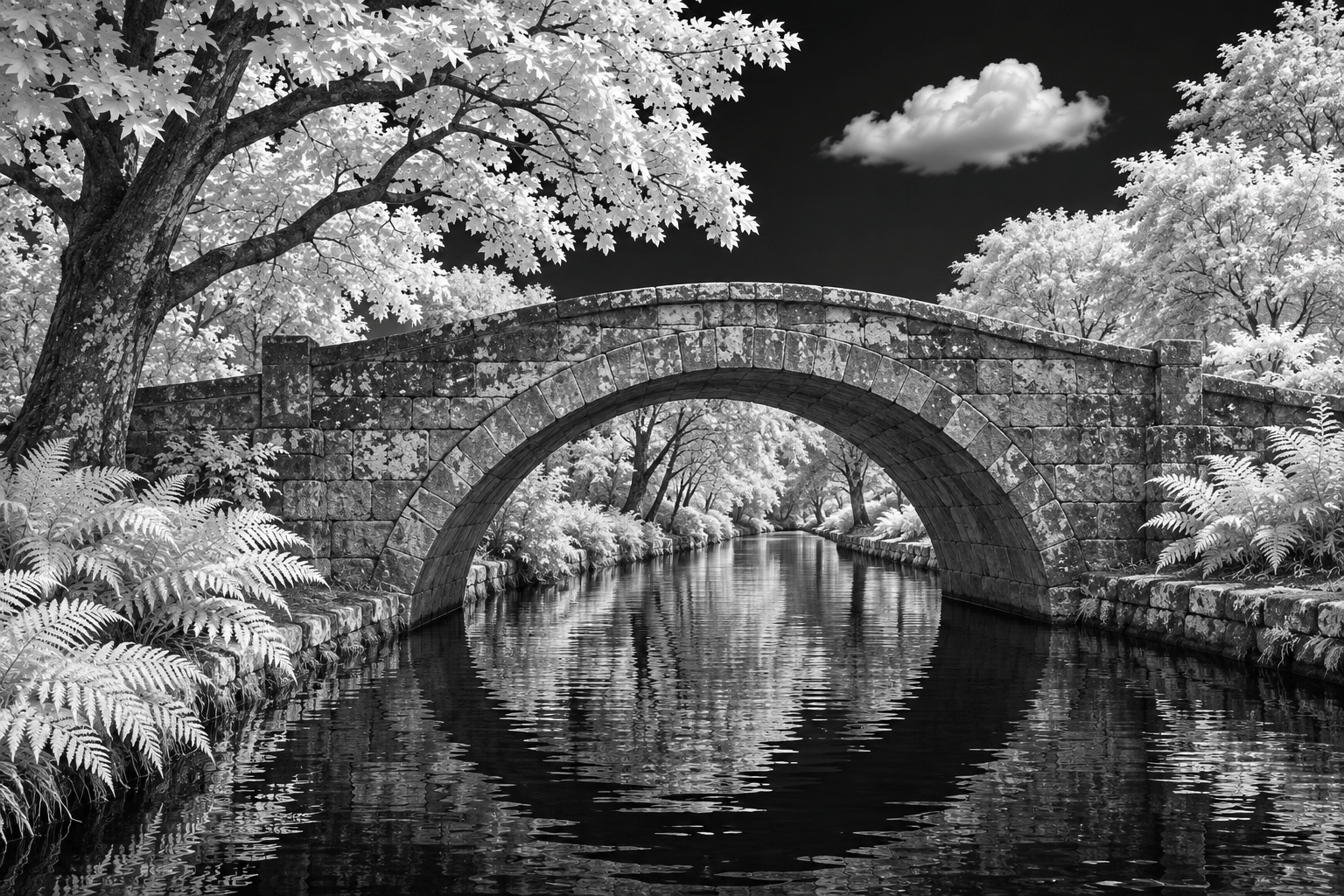
Monochrome turns attention toward value, shape and texture. A stone arch can occupy the middle tones between bright foliage and darker water, giving the eye a route through the image. Do not make the sky as dark as possible merely because you can; decide whether its contrast helps the subject.
False color is a display choice, not a claim that infrared has a secret visible hue. Baker describes channel swapping and further color adjustments in his own workflow, with results that depend on the filter and processing. His documented boardwalk and dandelion photographs show that the subject can range from broad landscape to close detail. Follow the Nikon source for the actual camera images. [5]
For an artistic interpretation, keep a consistent palette rule: for example, assign warm hues to foliage while leaving architecture relatively neutral. This can give an unfamiliar scene an internal logic. For scientific communication, a pleasing palette is insufficient; the band mapping, calibration and interpretation need to be documented.
Read the AOI gallery as visual studies
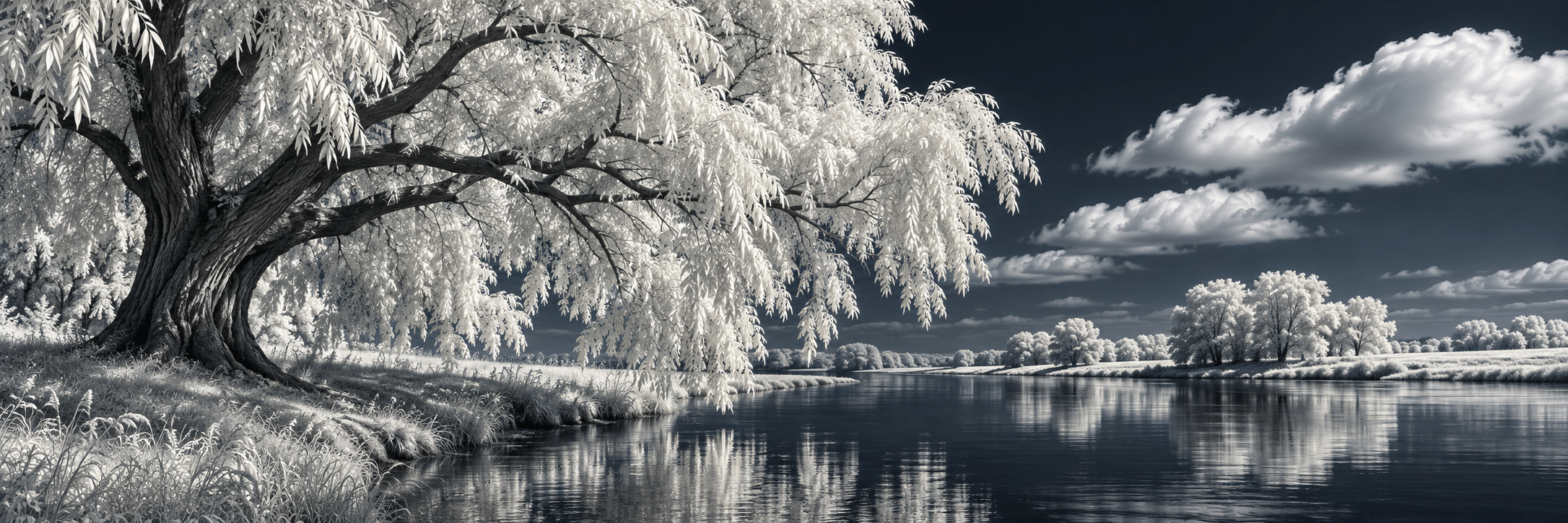
The Willow and the Dark River, the new banner, places a large textured canopy against quiet water and sky. Branches and dark bark hold the pale leaves together. Stone, Leaf and Water introduces an architectural middle value: the bridge remains legible without competing with every leaf.
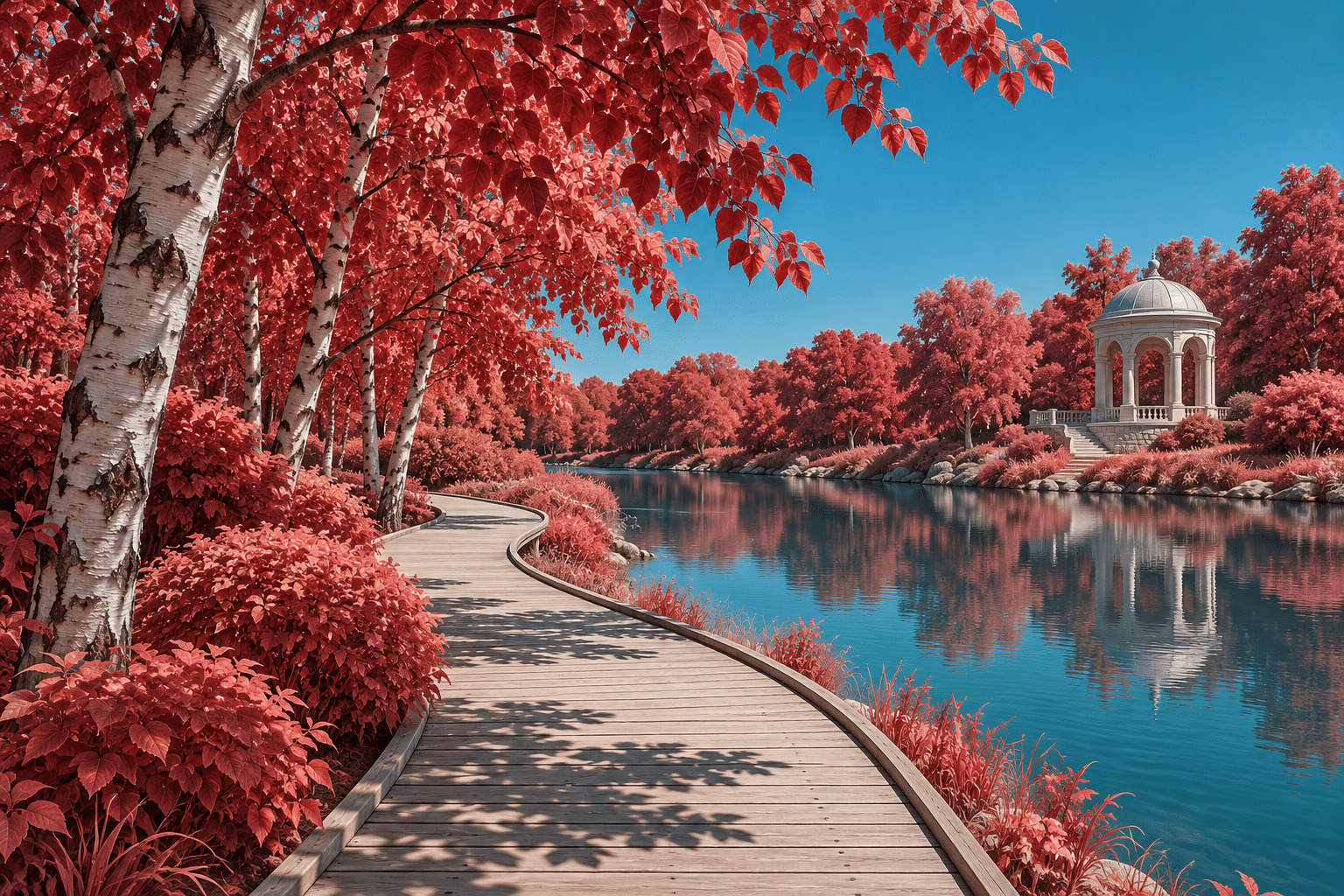
A Garden in Assigned Color uses coral and crimson foliage beside cyan-blue water and a curved boardwalk. Its daytime lighting keeps the unusual palette distinct from an ordinary warm sunset. The image demonstrates a consistent artistic assignment of color, not a measured spectral transformation of a real location.
Silver Leaves, Quiet Pool narrows the view to veins, a fern curl, stone and reflection. It shows why a close subject can be as effective as a panoramic landscape. The retained collage supplies a broader visual introduction with its complete central title. All gallery images are generated interpretations, not camera exposures or evidence about plant health.
A useful comparison exercise
Choose one quiet scene and decide what the unusual rendering should reveal: a branching structure, a material contrast or a route through space. With appropriate photographic equipment, retain a visible-light reference from the same viewpoint and document the capture setup. Compare the resulting structures as well as the colors.
For a generated study, describe those visual relationships directly: pale detailed leaves, a middle-gray bridge, dark reflective water and restrained highlights. Do not attach invented camera settings or measured wavelengths to the result. A photograph records a particular exposure; an AI illustration proposes an appearance. Keeping that distinction clear lets both be discussed on their own terms.
A small poetic detour
Original words from the AOI studio.
Poetry
The leaf keeps all its branching lines;
the river holds a darker sky.
A different measure of the light
lets an old familiar place go by.
No winter settled on the tree,
no hidden fire warmed the stone.
The world has more to offer sight
than any single view has shown.
The prompt workshop
Original creative exercises. These prompts create new illustrations, not documentary evidence.
Pale canopy, preserved texture
Create an original monochrome infrared-inspired river scene. A willow’s pale summer leaves retain fine texture against dark water and a deep sky. Use coherent branches, subtle reflections and a quiet asymmetric composition. No snow or thermal overlays. Present this as an AI illustration, not an actual exposure.
A garden in assigned color
Create an original false-color infrared-inspired garden with coral-red foliage, cyan-blue water, a neutral stone pavilion and a curved wooden boardwalk. Use clear daytime light and a consistent palette rule. No temperature scale or claimed scientific band mapping; this is an artistic interpretation.
Material contrast at close range
Compose an intimate monochrome infrared-inspired study of three broad leaves, a fern curl and a rough stone beside dark water. Preserve vein detail, subtle midtones and coherent reflections. Avoid white clipping, frost and glowing outlines. Original AI visual study, not a plant-health measurement.
Your next inspiration
Discover another art style
Follow a visual thread to the next subject.
People & works to explore
References discussed in this article. Consult the sources below for context.
Artists and practitioners
Chris Baker — documented infrared photographer featured by Nikon
Paintings and other works
Chris Baker, Bald Cypress Boardwalk at Wheeler Wildlife Refuge — camera and conversion documented by Nikon
Chris Baker, Dandelion in Madison, Alabama — close-up infrared example documented by Nikon
A smile from the studio
Jokes
The tree saw its infrared portrait and asked whether winter had arrived. The photographer checked the filter before the forecast.
Sources and further exploration
[1] NASA — Infrared Waves; Herschel’s discovery and thermal-infrared context
[2] NASA — Reflected Near-Infrared Waves; vegetation and measured spectral response
[3] HOYA — R72 Infrared; filter behavior, camera compatibility and exposure variability
[4] ILFORD — SFX 200 technical data sheet; extended-red film and practical testing