Photographic technique
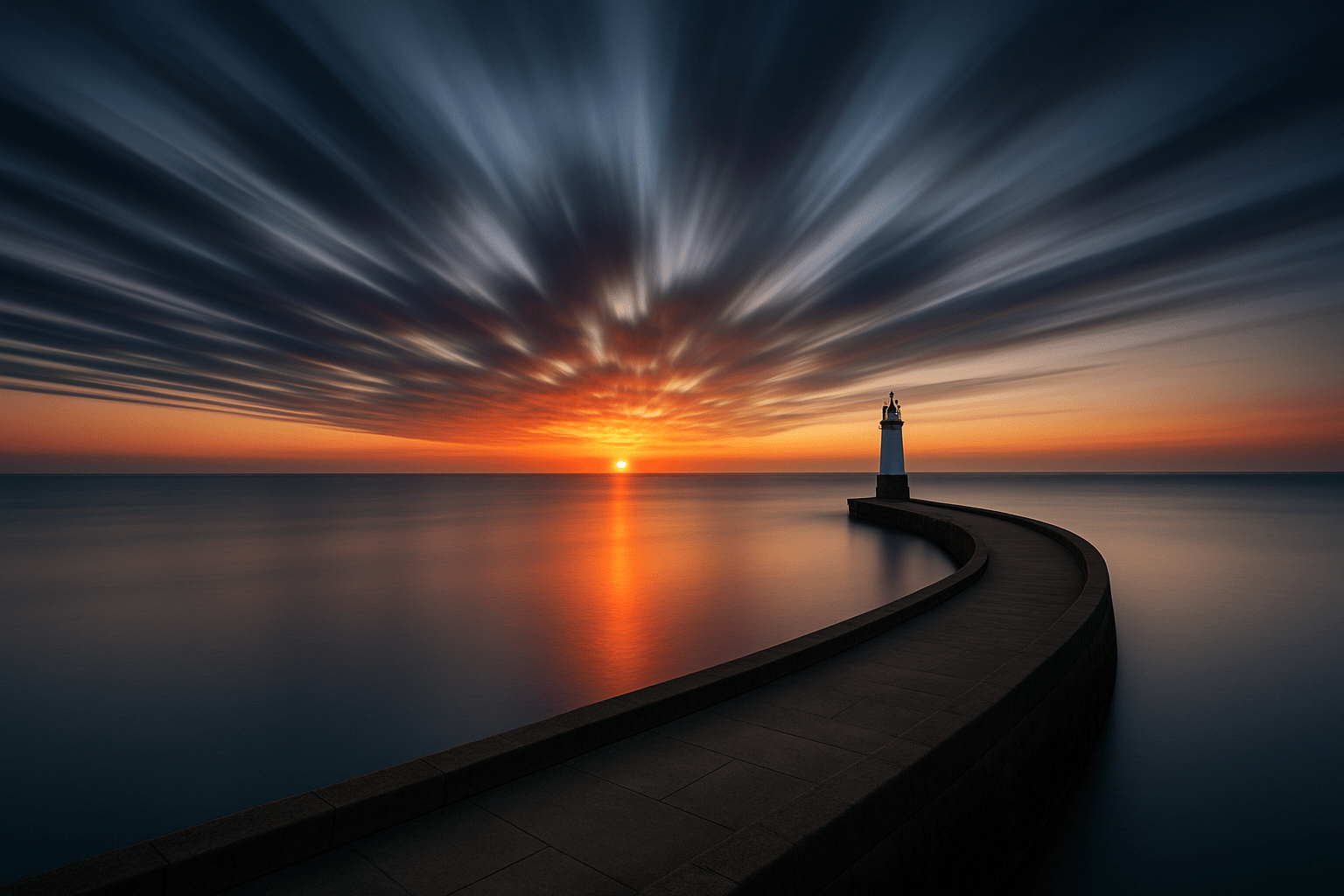
Long exposure turns duration into a visible compositional element: moving water softens, lights draw paths and still objects become anchors.
A closer look
Begin with one motion and one stable reference.
Understanding the subject
A long exposure records light over an extended interval rather than isolating a short instant. Its visual effect depends on movement during that interval: a stationary wall may stay defined while passing traffic becomes a luminous trail. Longer is not automatically better. Exposure, camera stability and the speed of the subject interact, so an exact shutter time cannot guarantee the same result in every scene.
AOI looking and making workshop
Begin with one motion and one stable reference. On a shoreline, use a rock as the reference and let the water describe movement around it. Check highlights before adding more exposure, because a bright lamp can dominate a night composition. Compare several durations to decide whether you want traces, recognizable movement or near abstraction. For a generated interpretation, specify which elements remain sharp and which blur; otherwise the whole image may become soft. Let the direction of movement guide the viewer through the frame.
The prompt workshop
Original creative exercises. These prompts create new illustrations, not documentary evidence.
Rock and tide
Create a long-exposure-inspired coastal image: one sharply defined dark rock surrounded by softly streaked pale water, low horizon and restrained dawn color. Keep rock texture clear and the water’s motion directional.
Night crossing
Create a city-night illustration with curved vehicle light trails passing a crisp stone bridge, controlled warm lamps and deep blue surroundings. Preserve readable architecture and avoid clipping the entire roadway to white.
Time as a ribbon
Create an abstract photographic interpretation of moving lanterns tracing thin amber ribbons around a still blue chair. Keep the chair sharp and the background dark, with deliberate gaps between the light paths.
Your next inspiration
Discover another art style
Follow a visual thread to the next subject.