
Historical landscape-painting tradition
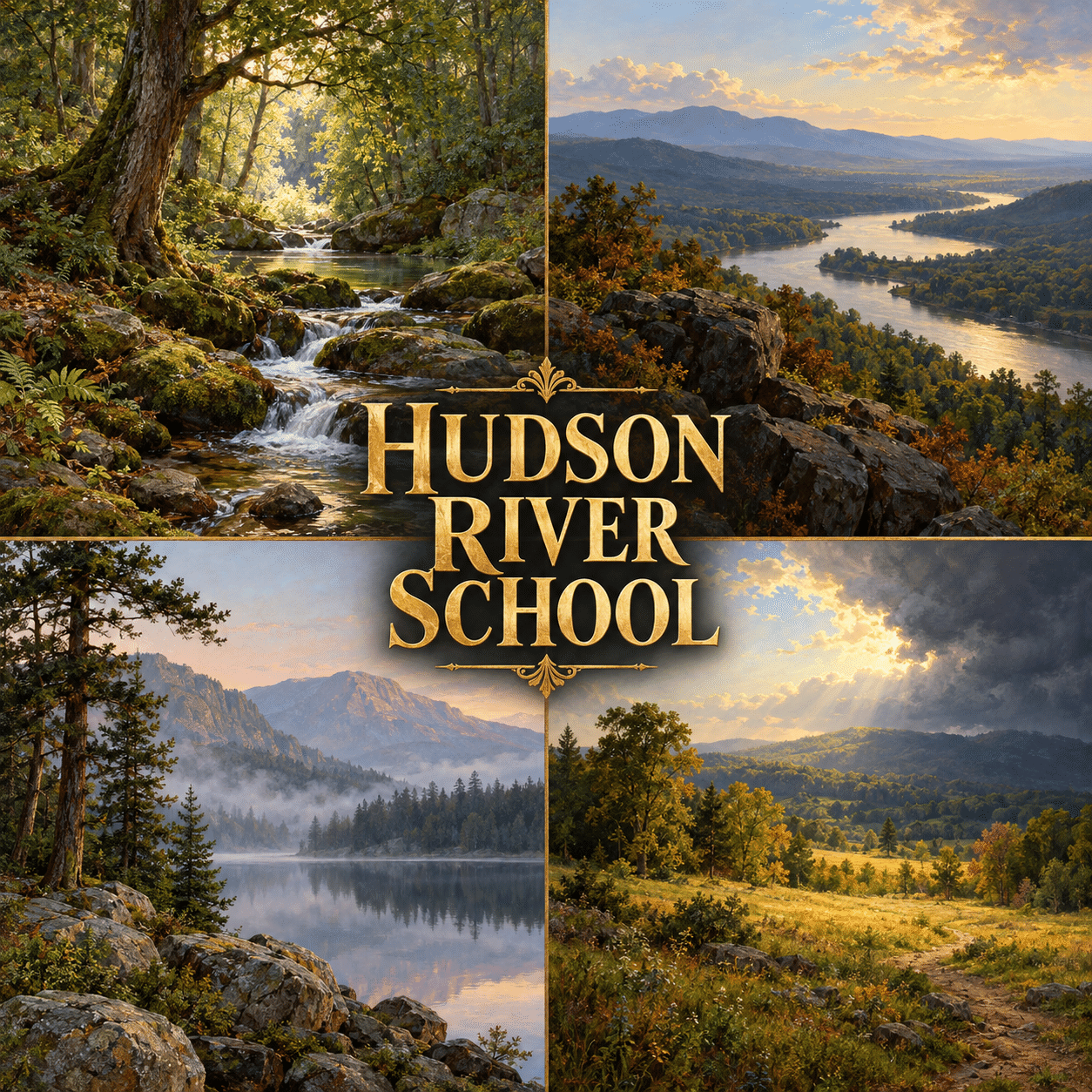
The Hudson River School combined close natural observation with carefully composed landscapes. Explore foreground detail, luminous distance, changing weather and the ideas carried by seemingly natural views.
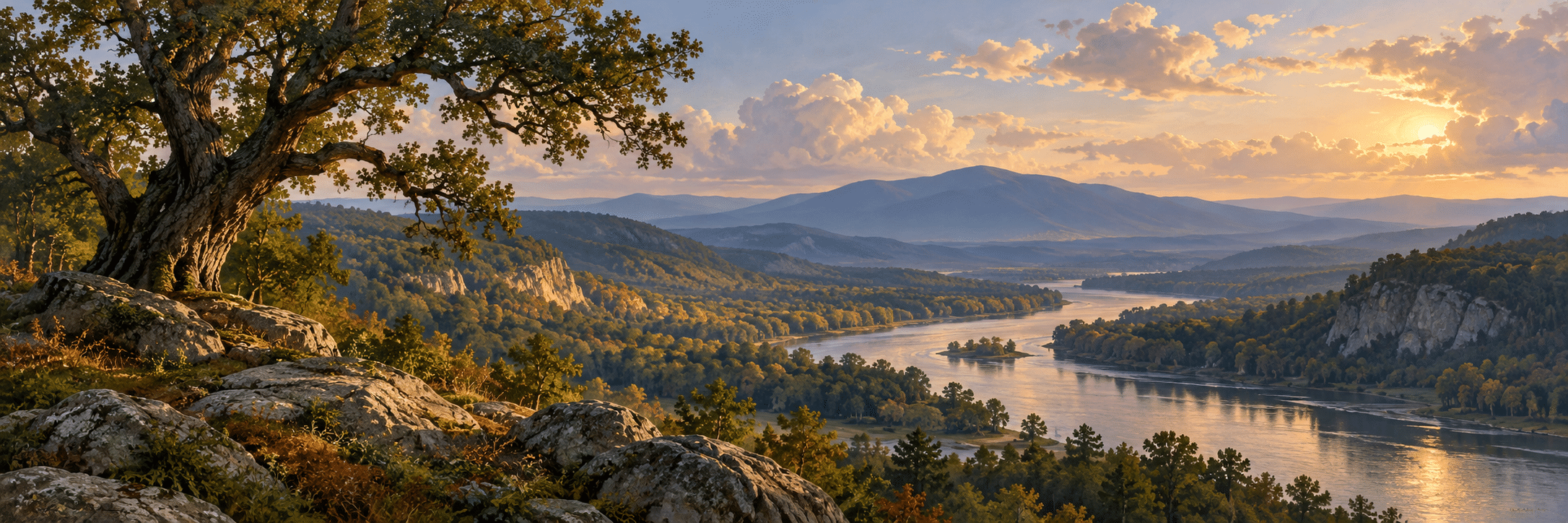
A visual introduction
Select an image for a closer look. Use the thumbnails, arrow keys or a swipe to compare examples. Zoom in to inspect details, or share the image that inspires you.


Creative toolbox · take this style further
Choose an input and a destination. Search sends your words to the chosen site; Copy & open puts them on your clipboard to paste there.
Create with AI
Turn your chosen input into an image prompt or a new creative direction.
ChatGPT
Copy your input and paste it into a ChatGPT conversation or image request.
Copy & open ChatGPT (new tab)Claude · Anthropic
Develop an image prompt or explore the style in a new Claude conversation.
Copy & open Claude · Anthropic (new tab)Midjourney
Paste your input into the Imagine bar on the Create page.
Copy & open Midjourney (new tab)Adobe Firefly
Copy your input, open Firefly, and paste it into the prompt field.
Copy & open Adobe Firefly (new tab)Leonardo.Ai
Copy your input, open Leonardo, and paste it into the generation field.
Copy & open Leonardo.Ai (new tab)Image search
Find visual references. Short, concrete keywords usually work best.
Lexica
Search AI images and prompts using your selected input.
Search with this input Lexica (new tab)Pexels
Search the photo and video library. Short keywords often work best.
Search with this input Pexels (new tab)Pixabay
Search photos, illustrations and other images.
Search with this input Pixabay (new tab)Unsplash
Search photographs using the style name or your own keywords.
Search with this input Unsplash (new tab)Wikimedia Commons
Search photographs, artworks and historical images. Check each file for its source and reuse terms.
Search with this input Wikimedia Commons (new tab)Art & research
Explore artists, collections and the ideas behind a style.
Wikipedia
Search for background reading. A style may not have its own article.
Search with this input Wikipedia (new tab)WikiArt
Copy your input into WikiArt’s search to explore artists and artworks.
Copy & open WikiArt (new tab)Europeana
Paste your keywords into the search to explore European museum, library and archive collections.
Copy & open Europeana (new tab)Inspiration
Discover portfolios and visual ideas from creative communities.
Instagram hashtags
Search a hashtag made from your input: spaces and punctuation are removed. Instagram may require sign-in.
Search with this input Instagram hashtags (new tab)ArtStation
Paste your input into artwork search for concept art, environments, characters and visual development.
Copy & open ArtStation (new tab)Behance
Paste your input into project search for illustration, design and visual storytelling.
Copy & open Behance (new tab)A closer look
Articulated foregrounds; layered recession; carefully framed vistas; atmospheric light; contrasts between intimate detail and expansive scale; trees, water and paths guiding attention through a composed landscape.
A network of painters rather than a classroom
The Hudson River School names a nineteenth-century American landscape-painting tradition associated with New York-based artists and the influence of Thomas Cole. The Metropolitan Museum explains that the group coalesced around the middle of the century and shared institutions, social connections and artistic concerns. The name does not refer to a single formal school building or fixed curriculum.
Cole, Asher B. Durand, Frederic Edwin Church and Albert Bierstadt offer important points of entry, but their work differs in scale, subject and ambition. The tradition extends beyond views of the Hudson itself. Treat the label as a historical connection among practices, not a requirement that every painting contain the same river bend and sunset.
Observation becomes composition
A convincing landscape can give a tree, rock or patch of ground a particular character while arranging the whole scene for an expressive purpose. The Met describes an idealized naturalism in the school’s production. Close attention and pictorial construction are therefore partners rather than opposites.
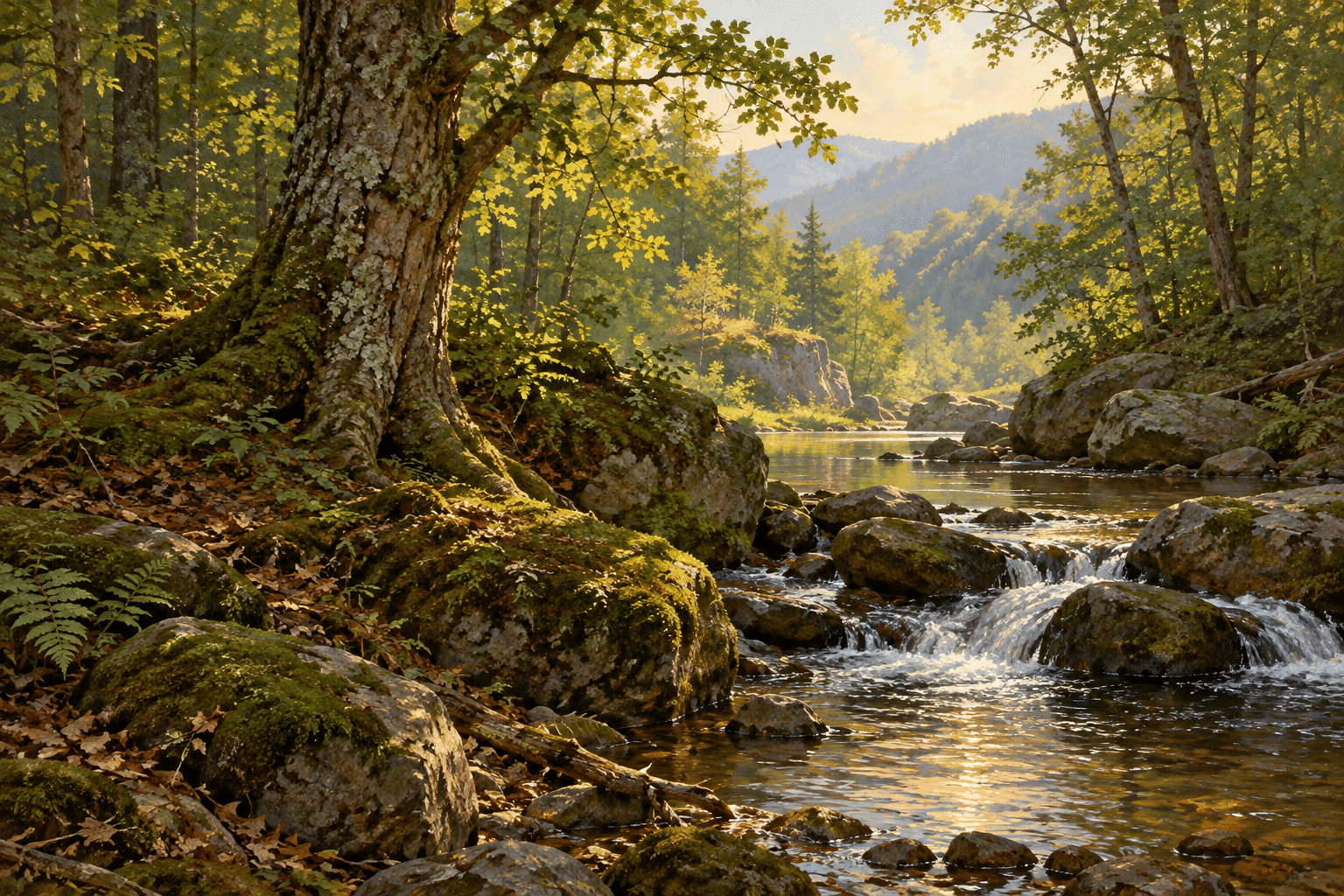
Begin an original study with a clear route for the eye. A dark foreground tree may frame a luminous opening; a stream can connect near rocks to distant hills; a small path can establish scale and invite imagined movement. Avoid filling every zone with equal detail. The foreground can reward close looking while the distance gains breadth through simpler shapes and softer contrasts.
Light organizes the experience
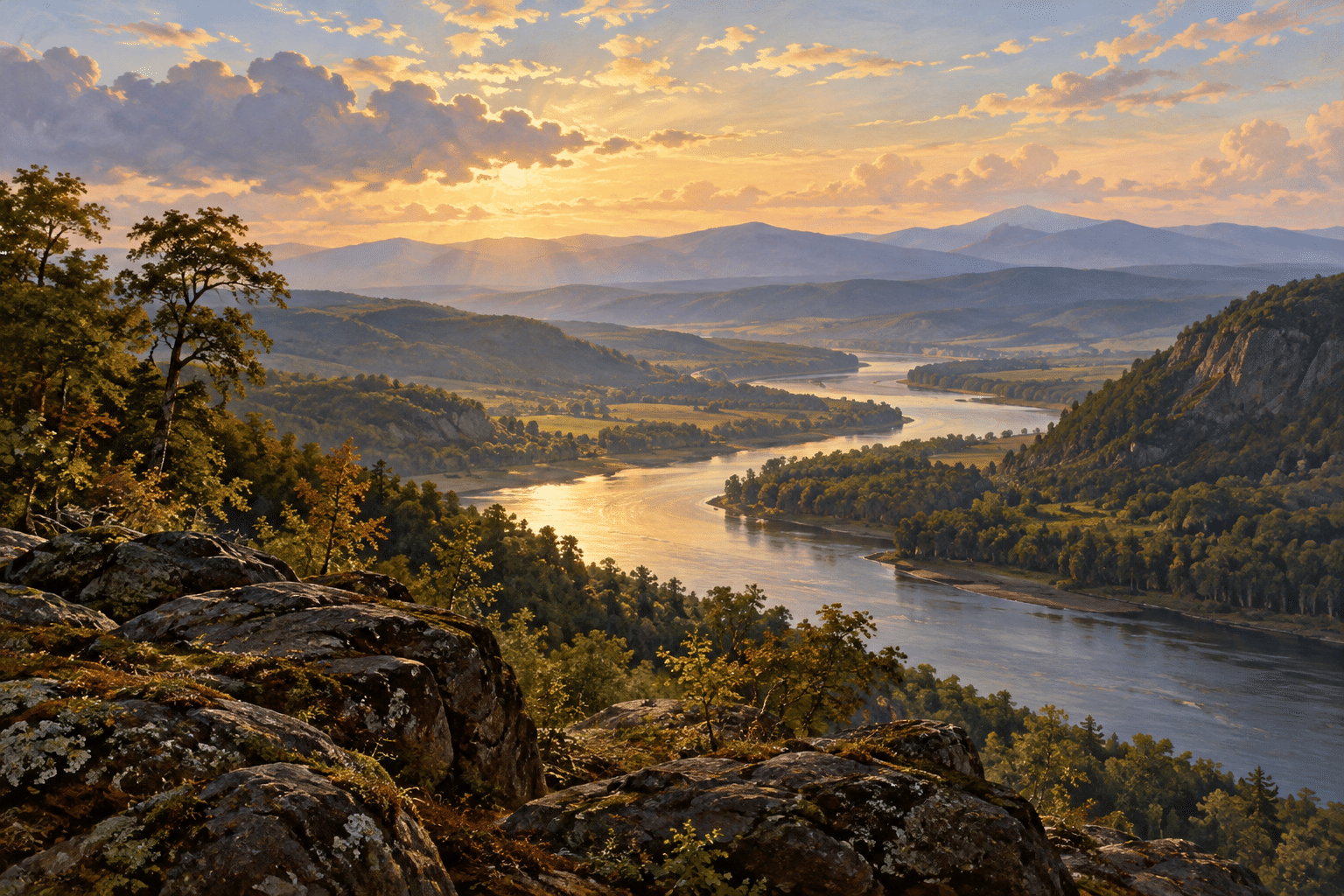
Light can reveal a valley gradually, divide a scene between shadow and illumination or hold a quiet stretch of water beneath an expansive sky. Its role is structural as well as atmospheric. Decide which region receives the brightest value and how that emphasis connects with the rest of the composition.
A dramatic sky needs a landscape capable of supporting it. If every cloud glows and every ridge is sharply outlined, the picture loses hierarchy. In a quieter study, small differences in temperature and value may be enough. Useful palettes include warm earth near the viewer, varied greens in the middle distance and cooler, less saturated distant forms, adjusted to the actual lighting idea.
A view can be deliberately made
Olana, Frederic Church’s home landscape, makes the relationship between observation and design especially tangible. The historic site describes his shaping of woodlands, roads, meadows and a lake to create successive views. The visitor’s movement through the grounds becomes part of the composition.
This offers a practical lesson for a new image: a convincing view is not necessarily an unedited transcription. Framing and selection influence what appears natural. Consider which signs of habitation or work the picture includes, minimizes or leaves outside its boundaries. A sweeping landscape can be beautiful while still inviting questions about the viewpoint and values it presents.
Variety within a landscape study
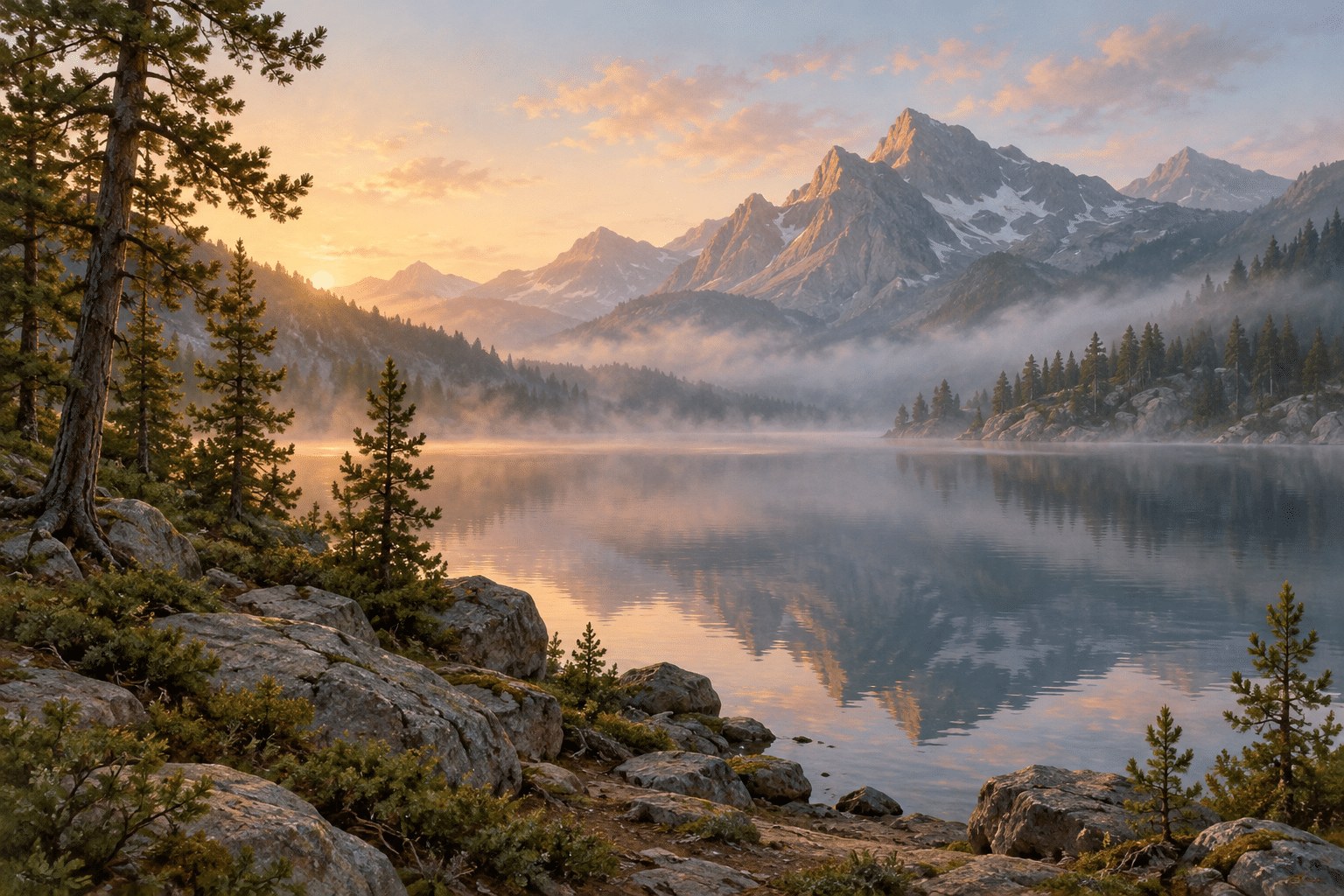
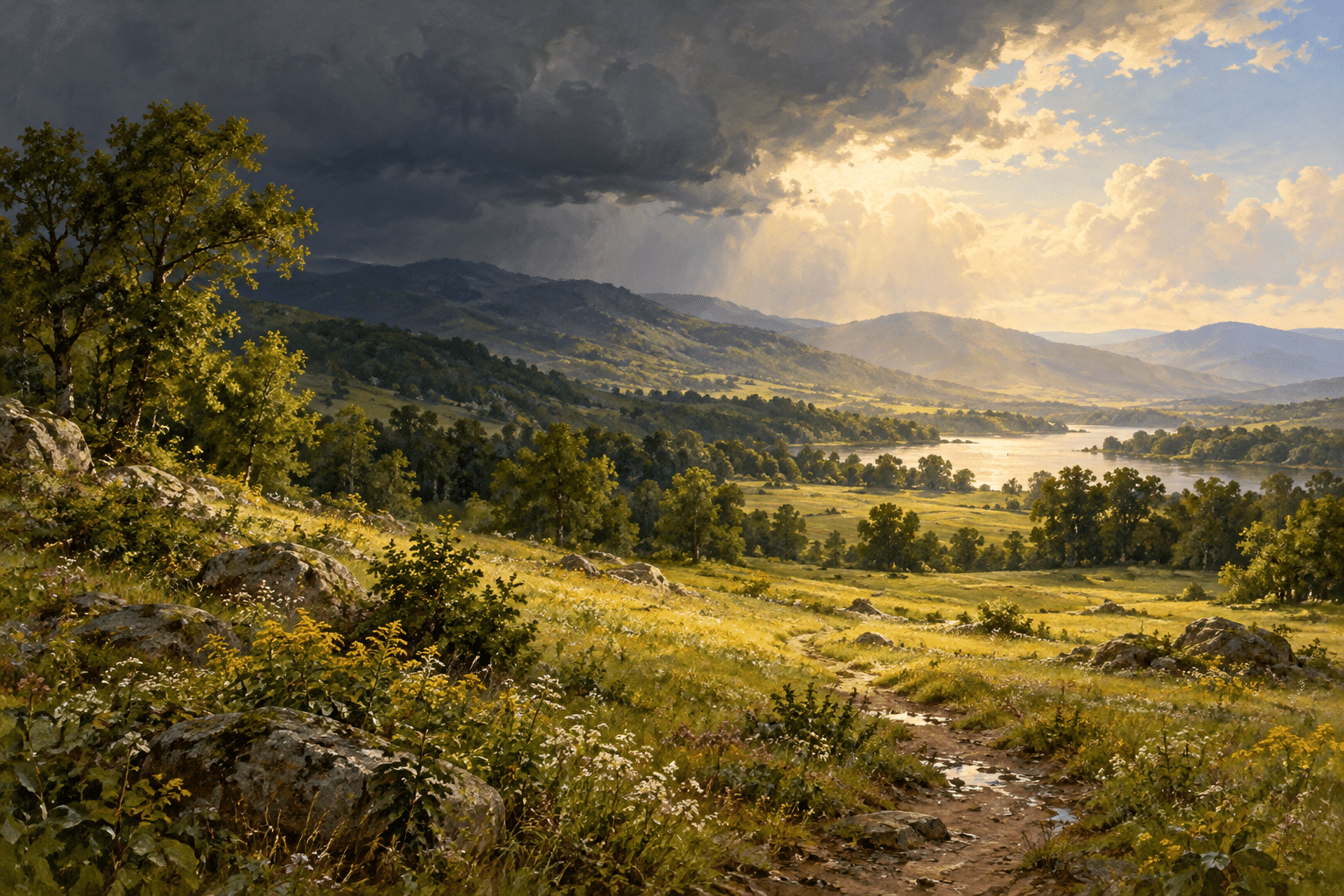
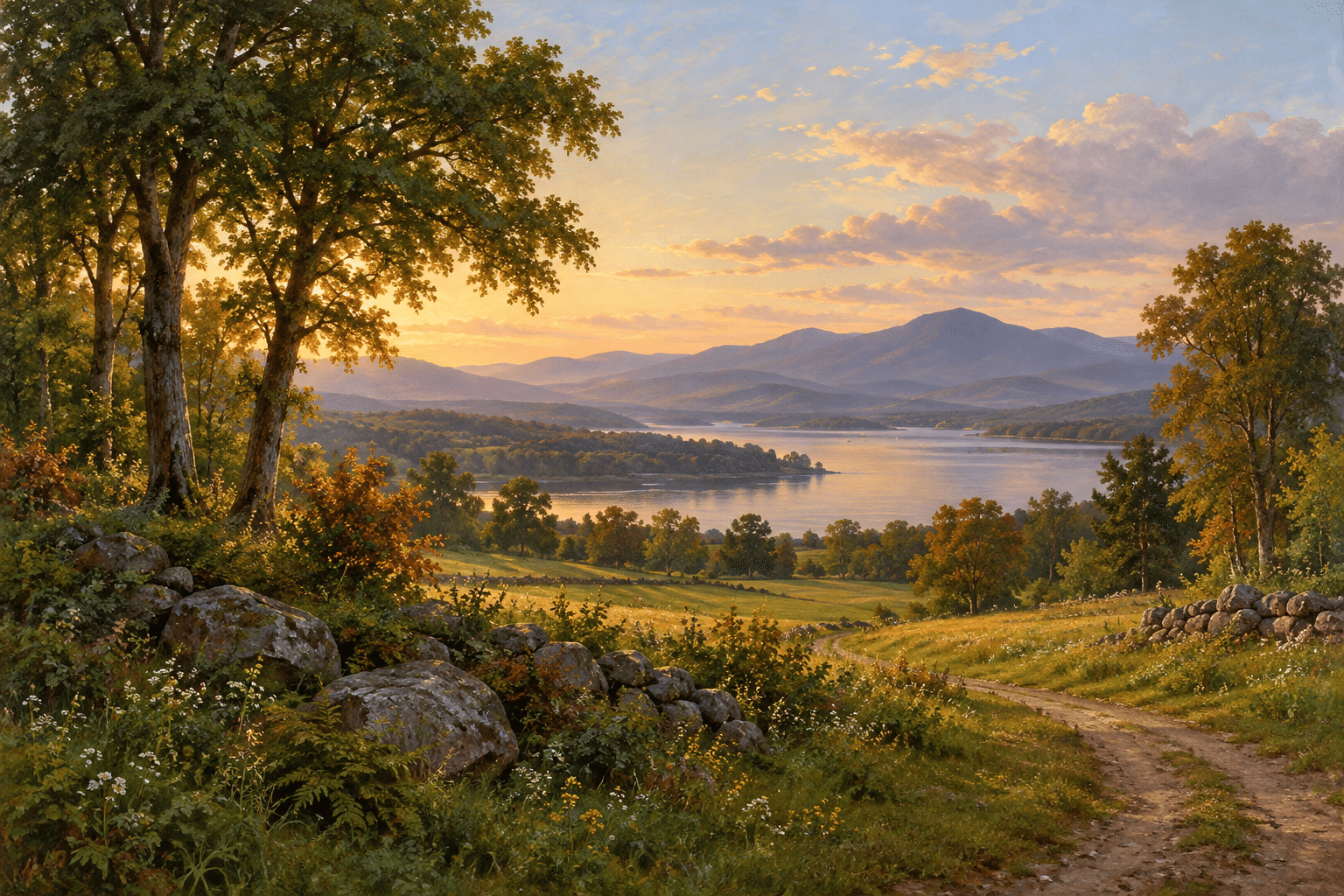
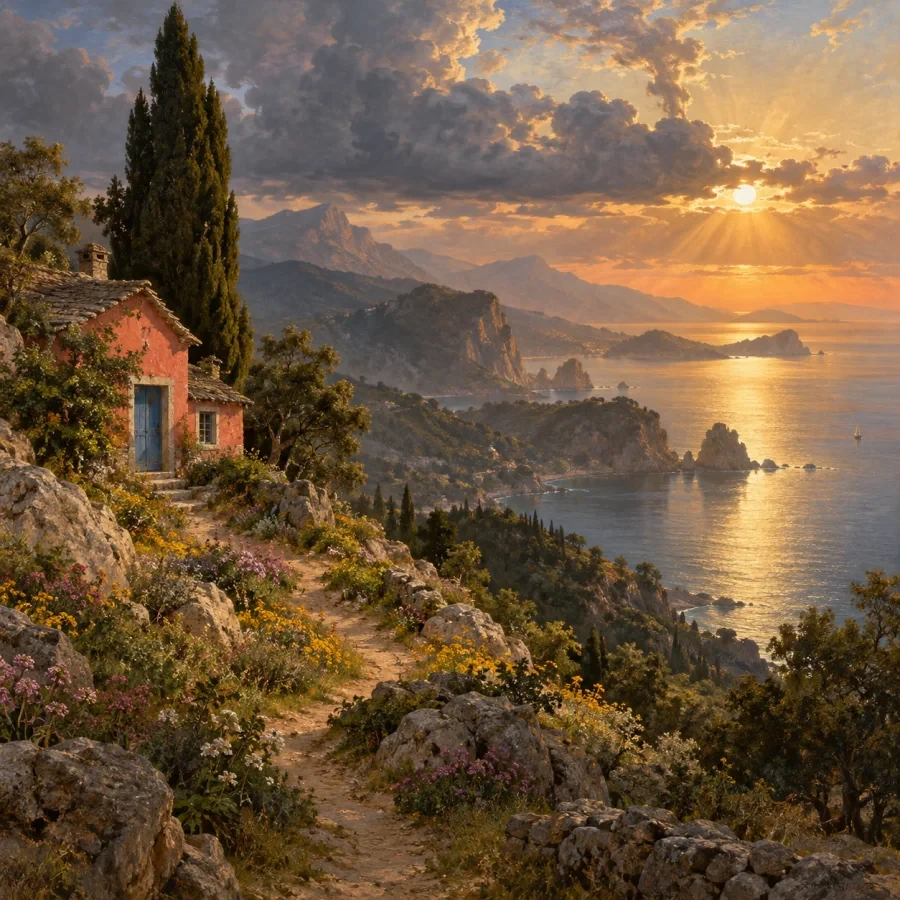
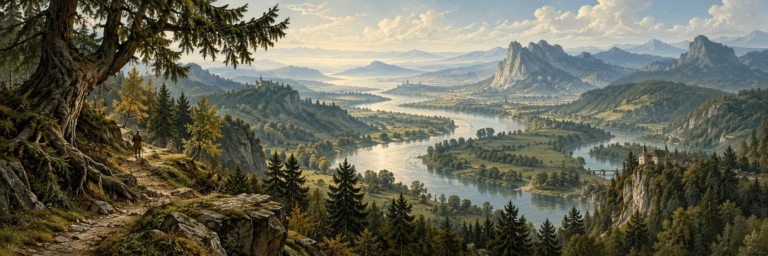
The new AI-generated gallery includes an intimate woodland, a broad river valley, a mountain lake, a changing-weather scene and a cultivated landscape. These are original interpretations of compositional principles, not records of actual locations, copies of named paintings or reconstructions of nineteenth-century conditions. They should not be used as geographical evidence.
Prompt with the viewing position, foreground anchor, route into depth and lighting situation. Specify whether the intended experience is intimate, expansive or unsettled. Avoid relying on “majestic masterpiece” as a substitute for decisions. A modest woodland opening can demonstrate the tradition’s attention to nature as effectively as an enormous panorama.
Positive editorial assessment — AI-authored
The strongest Hudson River School landscapes unite detailed attention with a persuasive sense of scale. They can make a small foreground feature feel connected to a much larger world. Carefully organized light gives the viewer a route through that world and time to explore its changing distances.
Critical editorial assessment — AI-authored
Modern imitation often substitutes oversized mountains, glowing skies and excessive sharpness for meaningful composition. Idealized views can also seem neutral when they are highly selective. Improve an interpretation by clarifying its viewpoint, moderating spectacle and considering what human relationships to the land the image reveals or omits.
Neutral editorial assessment — AI-authored
The Hudson River School is a historical landscape tradition with varied artists and subjects. Its principles are useful for studying depth, atmosphere and visual framing. Understanding particular paintings also requires their historical contexts and purposes, beyond admiration for scenic beauty alone.
A small poetic detour
Original words from the AOI studio.
Poetry
A branch frames more than it conceals;
a river gathers distant blue.
The foreground stone is small, but feels
like something we could hold and view.
A path decides where we might go;
the light selects a farther shore.
The painted distance asks us slow,
and leaves a little room for more.
The prompt workshop
Original creative exercises. These prompts create new illustrations, not documentary evidence.
An intimate opening
Original landscape painting informed by nineteenth-century American naturalism: a shaded woodland stream, one carefully observed foreground tree and a small luminous opening beyond. Varied greens and warm earth, selective detail and coherent daylight, no copied painting or real-location claim.
A valley in layers
Original broad river-valley painting with dark foreground rocks, a winding river guiding the eye through wooded slopes and cool distant hills, controlled luminous sky and clear depth. Avoid exaggerated fantasy mountains, signatures and historical provenance claims.
A made landscape
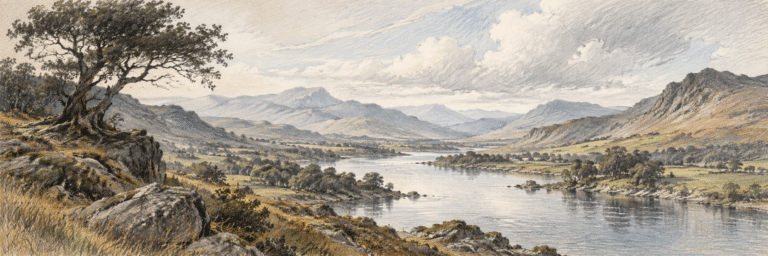
Original painted view across a meadow toward a quiet lake, a curved path and grouped native-looking trees framing distant hills, subtle evidence of cultivation and calm late-afternoon light. A contemporary AI interpretation, not a documented historic site.
Your next inspiration
Discover another art style
Follow a visual thread to the next subject.
Landscape Drawing: Framing Space with Line and Tone
Explore drawing as a way to structure landscape.
A smile from the studio
Jokes
The distant mountain requested sharper detail. The foreground rock explained that atmosphere had already assigned the roles.