
Music and internet visual culture
A voice pitched up until it glitters suggests an odd brief for a sleeve designer. What does that sound look like in a still image? HexD starts with an underground music scene. These visual studies answer with clipped whites, stepped silhouettes and tiny echoes of a central emblem.
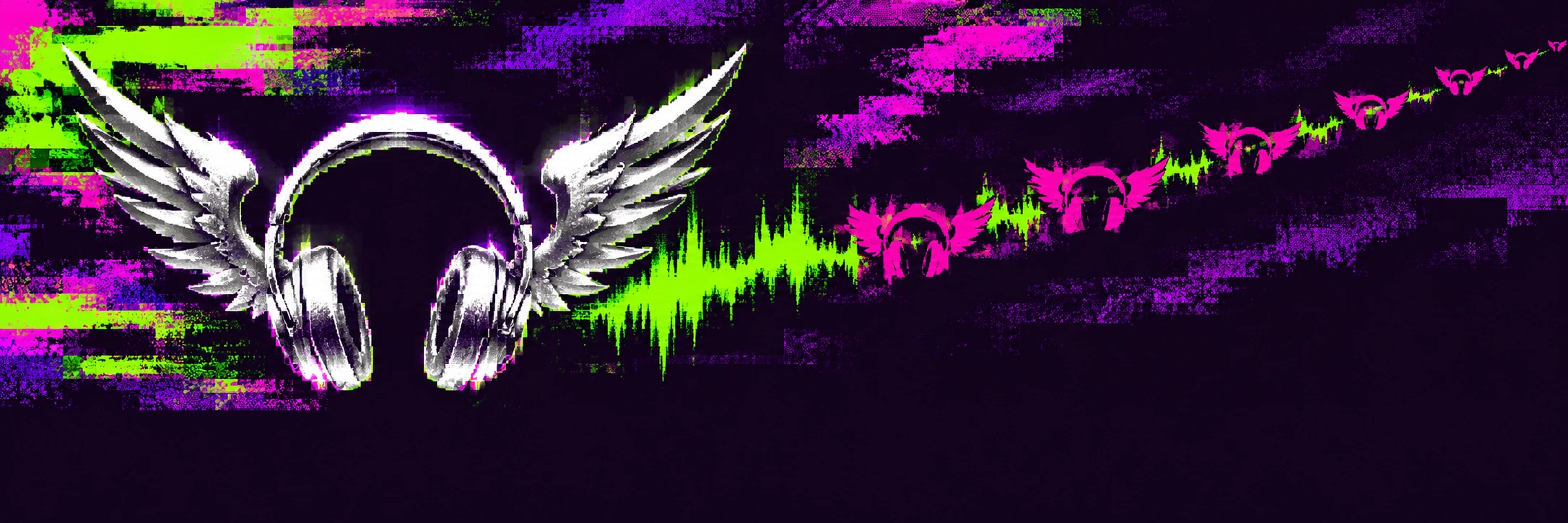
A visual introduction
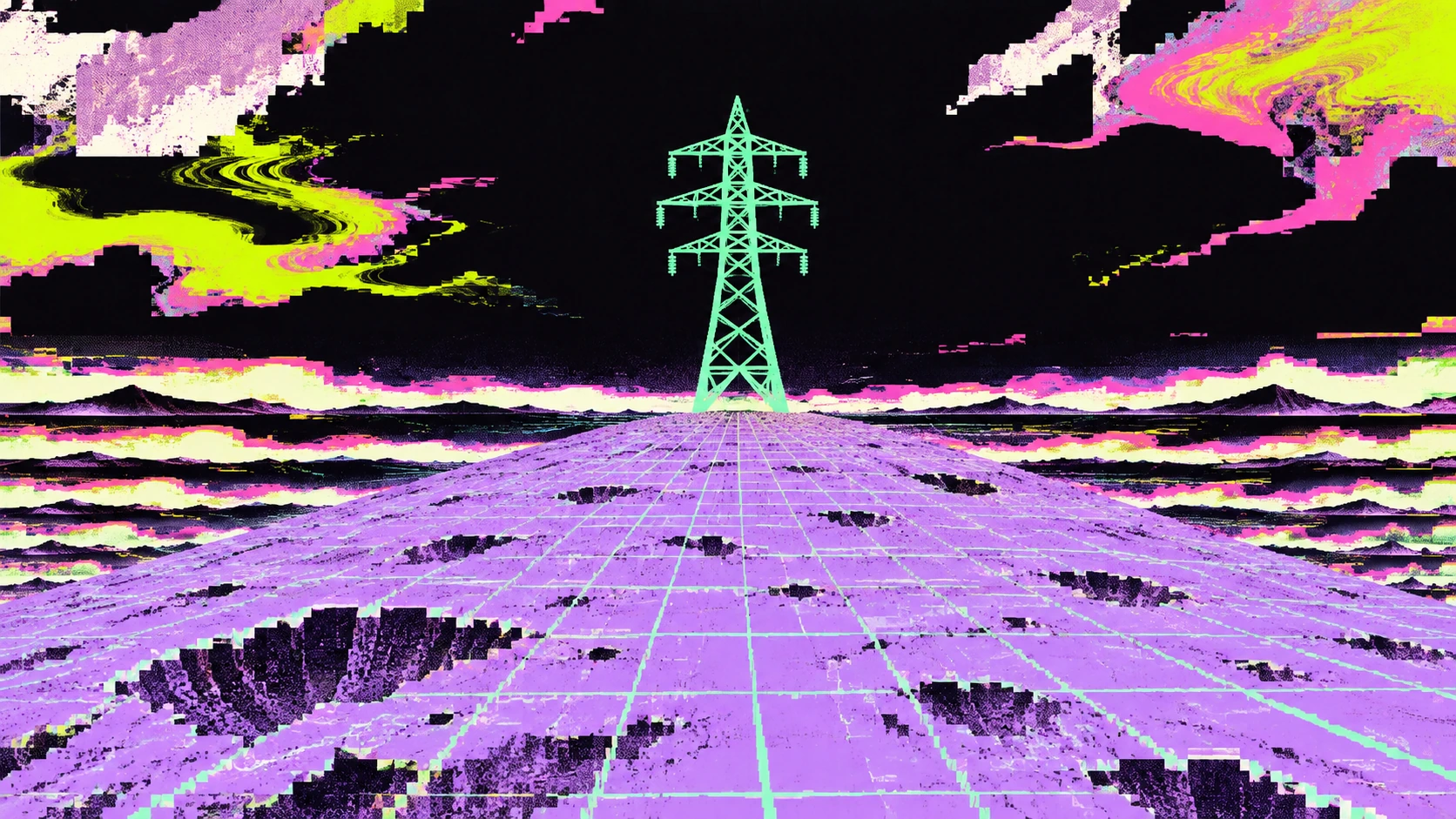
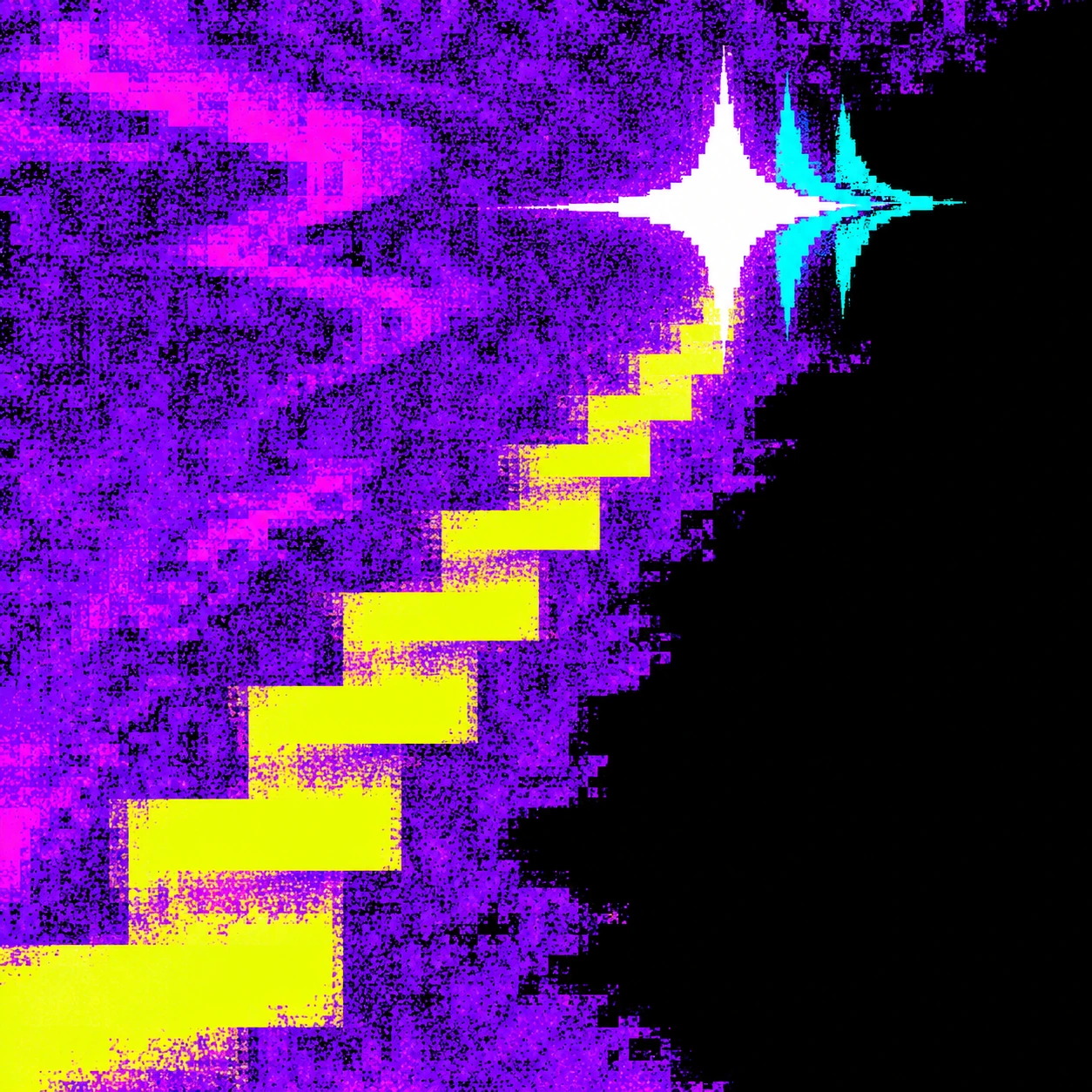
Seven original AI-generated studies translate musical distortion into still images, from a sleeve-sized emblem to a portrait, landscape and graphic score.
Select an image for a closer look. Use the thumbnails, arrow keys or a swipe to compare examples. Zoom in to inspect details, or share the image that inspires you.


Creative toolbox · take this style further
Choose an input and a destination. Search sends your words to the chosen site; Copy & open puts them on your clipboard to paste there.
Create with AI
Turn your chosen input into an image prompt or a new creative direction.
ChatGPT
Copy your input and paste it into a ChatGPT conversation or image request.
Copy & open ChatGPT (new tab)Claude · Anthropic
Develop an image prompt or explore the style in a new Claude conversation.
Copy & open Claude · Anthropic (new tab)Midjourney
Paste your input into the Imagine bar on the Create page.
Copy & open Midjourney (new tab)Adobe Firefly
Copy your input, open Firefly, and paste it into the prompt field.
Copy & open Adobe Firefly (new tab)Leonardo.Ai
Copy your input, open Leonardo, and paste it into the generation field.
Copy & open Leonardo.Ai (new tab)Image search
Find visual references. Short, concrete keywords usually work best.
Lexica
Search AI images and prompts using your selected input.
Search with this input Lexica (new tab)Pexels
Search the photo and video library. Short keywords often work best.
Search with this input Pexels (new tab)Pixabay
Search photos, illustrations and other images.
Search with this input Pixabay (new tab)Unsplash
Search photographs using the style name or your own keywords.
Search with this input Unsplash (new tab)Wikimedia Commons
Search photographs, artworks and historical images. Check each file for its source and reuse terms.
Search with this input Wikimedia Commons (new tab)Art & research
Explore artists, collections and the ideas behind a style.
Wikipedia
Search for background reading. A style may not have its own article.
Search with this input Wikipedia (new tab)WikiArt
Copy your input into WikiArt’s search to explore artists and artworks.
Copy & open WikiArt (new tab)Europeana
Paste your keywords into the search to explore European museum, library and archive collections.
Copy & open Europeana (new tab)Inspiration
Discover portfolios and visual ideas from creative communities.
Instagram hashtags
Search a hashtag made from your input: spaces and punctuation are removed. Instagram may require sign-in.
Search with this input Instagram hashtags (new tab)ArtStation
Paste your input into artwork search for concept art, environments, characters and visual development.
Copy & open ArtStation (new tab)Behance
Paste your input into project search for illustration, design and visual storytelling.
Copy & open Behance (new tab)A closer look
Choose an image with a clear contour. Push a few bright areas into flat white, reduce selected edges to pixel steps and displace a sliver of color sideways. A comparatively quiet patch lets the eye find the original signal again.
Listen before drawing
The music gives the name a context. In a 2021 Bandcamp Daily interview, Dismiss Yourself founder sticki recalled an online audience clustering around releases including Rare RCB hexD.mp3. The profile describes sped-up voices, hard beats, bright effects and distorted processing. It connects the name to hexcastcrew and describes the 2020 Surge Compilation Vol. 1 as a gathering point. The label archive lets a reader hear the recordings and see the accompanying artwork directly.
There is considerable room between the sound of a release and what an artist chooses for its sleeve. This gallery makes that translation explicit. A cutout repeated three times might correspond to an echo, while one clipped patch of white might suggest a note driven beyond its comfortable range. These are compositional choices made for the studies. A release’s own artwork remains the best source for how its makers pictured that particular sound.
Translate one audible event
Pick a few seconds from a track and listen for a single event. Does a syllable repeat, does a high sound cut across a dense passage, or does a beat suddenly leave a little hole? Draw the timing with three shapes on scrap paper. Give the longest sound the largest area and save the sharpest edge for the attack.
Work from an original emblem, photograph or drawing. Make a clean copy, a coarse copy and a narrow displaced strip. Hold the eye or the center of the emblem in register while the margins start to slip. A butterfly can keep its body perfectly still while three clipped wing edges imply an impossibly quick flutter.
Pixels, clipping and the useful pause
At a small working resolution, shallow diagonals break into long runs of square steps. Enlarge a selected contour with nearest-neighbor sampling to make those steps visible. On another layer, push two adjacent highlights towards white until their boundary disappears. The first process changes the shape of an edge, the second changes the available tonal information. Try them separately before combining them.
In audio, bit depth and sample rate are different quantities. In print the corresponding choices might be the number of tonal steps and the size of a repeated mark. The parallel is a way to think while drawing. A picture cannot tell you the settings that produced a track.
The sleeve in the listener’s hand
Reduce the cover to the size of a music player icon. A white outline can rescue the emblem in a busy passage. If the whole icon turns into a pale square, restore a dark interval around the focal shape. For a wide banner, repeat the smallest motif along the horizontal axis and give it somewhere to stop.
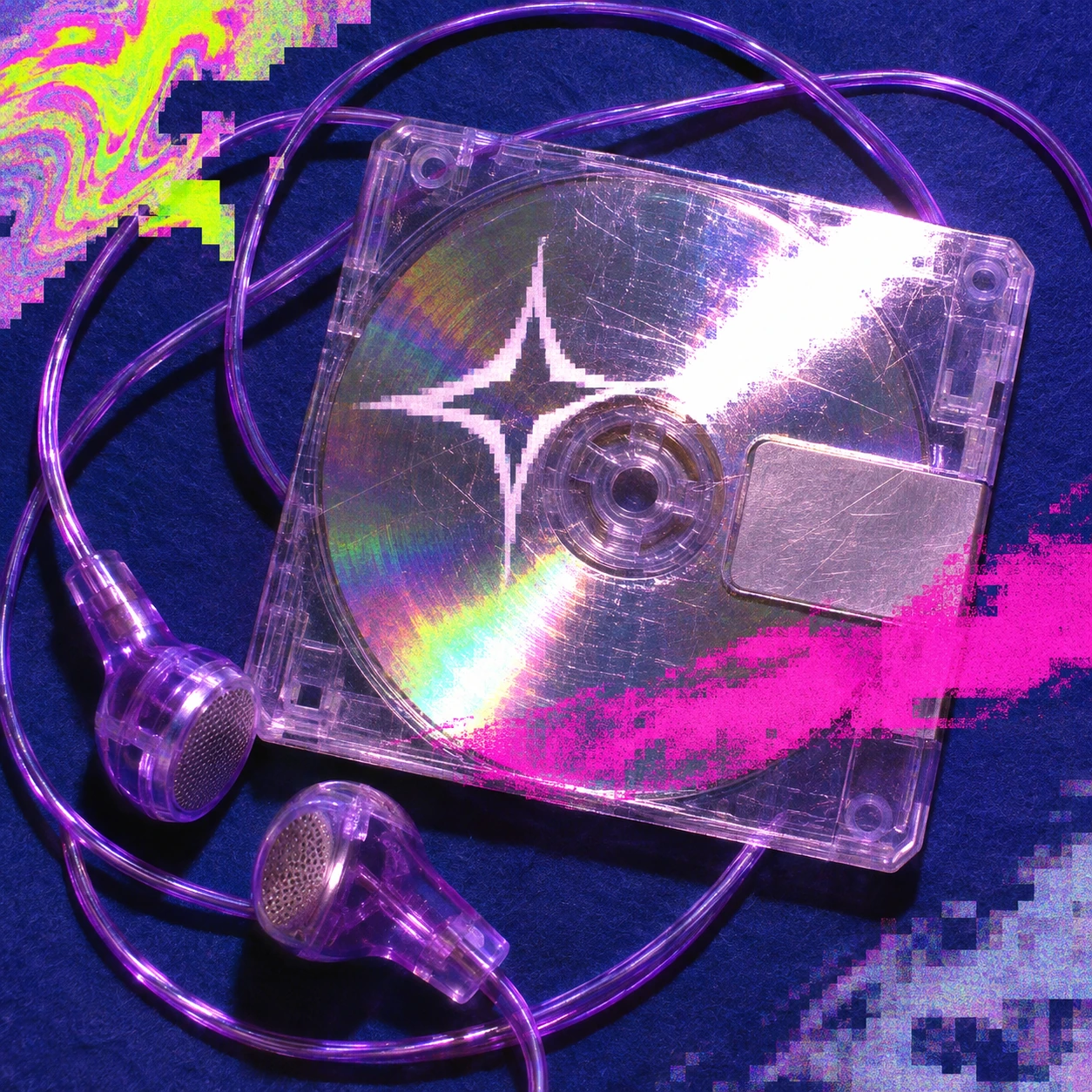
A visual experiment can be quieter than its source material. A scratched disc on a table can carry the idea through one blown reflection and an abrupt band of lost color. On a release page, keep artist names, track information and credits readable outside the heavily treated picture. Viewers can then follow the image back to the people who made the music.
Positive editorial review (AI-authored)
A clipped highlight and a repeated edge make duration visible. The viewer can reconstruct an imaginary before and after from a single still. A recognizable earbud or face also gives the distortion a material to work against.
Negative editorial review (AI-authored)
Blanket degradation makes every square centimetre equally busy. It can also flatten a whole music scene into a repeatable neon effect. Listening to one track and choosing a particular interruption produces a more responsive sleeve.
Neutral editorial review (AI-authored)
These images are visual interpretations of a music-associated aesthetic. Their use ranges from sleeve art to event banners and avatars. Color, grain and sticker-like marks remain flexible. The original release and its credits supply the relevant historical reference.
A small poetic detour
Original words from the AOI studio.
Poetry
A silver note climbs out of range.
The screen keeps four white corners of it.
Three pink ghosts arrive behind,
each smaller than the sound before.
Then black, just long enough to hear
the little click that starts the loop.
The prompt workshop
Original creative exercises. These prompts create new illustrations, not documentary evidence.
Give a cursor an echo
Create a HexD-inspired square cover around an original green butterfly cursor. Keep the body sharp. Repeat one wing edge three times in cyan and pink against a deep berry field, with a black pause beside it.
Draw the pitched-up portrait
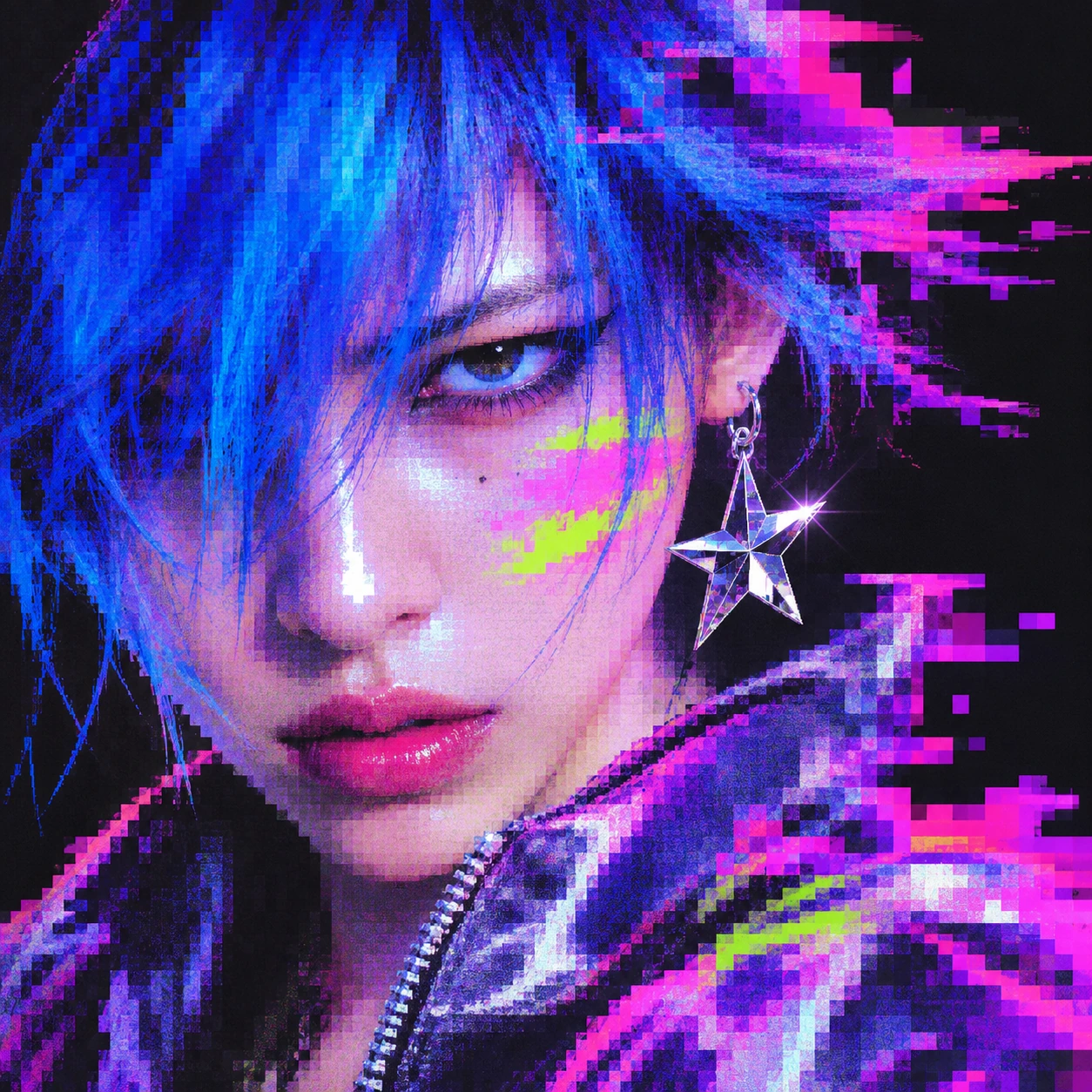
Make a tight original portrait with blue fringe and a silver earring. Keep one eye intact while the cheek highlight clips to white and the hair breaks into pink stair-steps. Preserve a dark outer silhouette at thumbnail size.
Score an image with silence
Design a mostly quiet desktop still life of a scratched disc and coiled earbuds. Introduce one narrow strip of displaced magenta and one flat white reflection. Place them as carefully as two beats separated by a rest.
Your next inspiration
Discover another art style
Follow a visual thread to the next subject.


A smile from the studio
Jokes
The producer asked me to make the cover sound louder. I sent back exactly the same sleeve with a black square around it. “That did it,” she said. “What plug-in was that?” “Margin.”