
Photographic practice · applied colour and interpretation
A hand-coloured photograph combines a photographic image with colour applied by hand. The photograph supplies one structure; the colourist makes further decisions about emphasis, plausibility and mood. This is a practice across different photographic supports, not a single historical movement. Understanding that division of labour makes it more interesting—and more useful for AI art—than a generic vintage filter.
A visual introduction
Original AI-generated visual exercises. Historical works and artists are identified separately in the text and sources.
Select an image for a closer look. Use the arrow keys or gallery controls to compare the illustrations.
Creative toolbox · take this style further
Choose an input and a destination. Search sends your words to the chosen site; Copy & open puts them on your clipboard to paste there.
More tools
Additional destinations selected for this article.
ChatGPT
Copy your input and paste it into a ChatGPT conversation or image request.
Copy & open ChatGPT (new tab)Claude · Anthropic
Develop an image prompt or explore the style in a new Claude conversation.
Copy & open Claude · Anthropic (new tab)Midjourney
Paste your input into the Imagine bar on the Create page.
Copy & open Midjourney (new tab)Adobe Firefly
Copy your input, open Firefly, and paste it into the prompt field.
Copy & open Adobe Firefly (new tab)Leonardo.Ai
Copy your input, open Leonardo, and paste it into the generation field.
Copy & open Leonardo.Ai (new tab)Lexica
Search AI images and prompts using your selected input.
Search with this input Lexica (new tab)Pexels
Search the photo and video library. Short keywords often work best.
Search with this input Pexels (new tab)Pixabay
Search photos, illustrations and other images.
Search with this input Pixabay (new tab)Unsplash
Search photographs using the style name or your own keywords.
Search with this input Unsplash (new tab)Wikipedia
Search for background reading. A style may not have its own article.
Search with this input Wikipedia (new tab)WikiArt
Copy your input into WikiArt’s search to explore artists and artworks.
Copy & open WikiArt (new tab)Instagram hashtags
Search a hashtag made from your input: spaces and punctuation are removed. Instagram may require sign-in.
Search with this input Instagram hashtags (new tab)A closer look
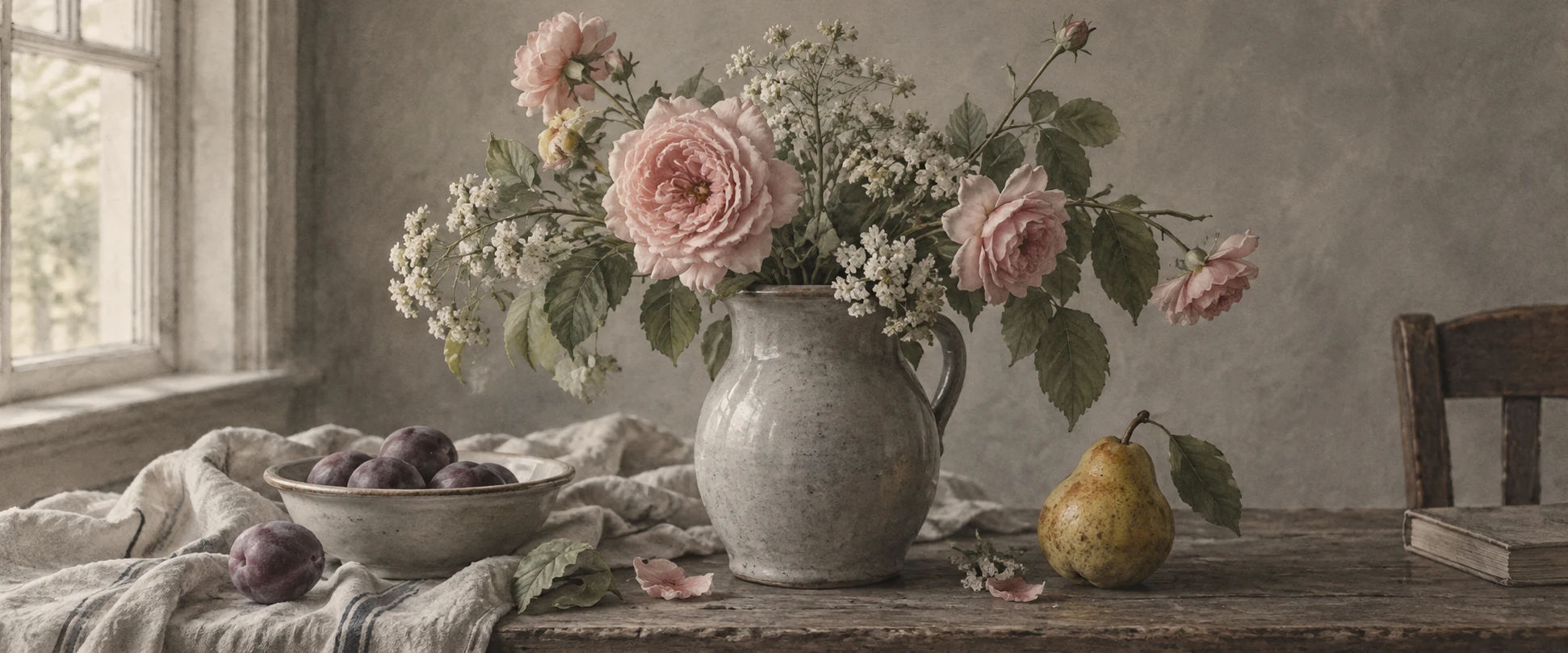
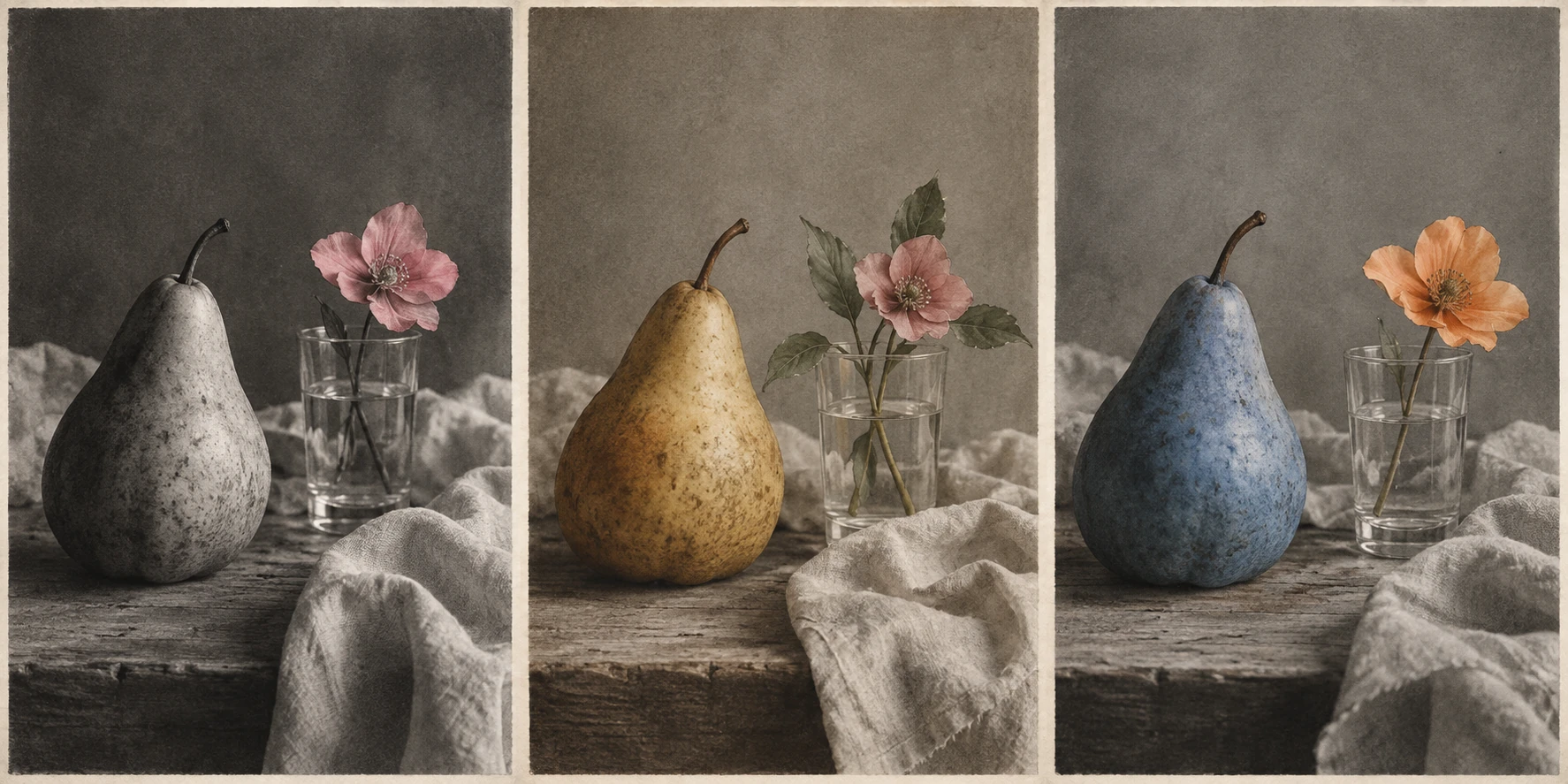
The generated still-life banner keeps a monochrome tonal foundation visible beneath restrained pink, green and ochre accents. The collage varies the colour decisions across related subjects. These are invented AI studies, not restored family photographs, museum objects or evidence of historical colours.
Two kinds of making in one image
A photograph can describe a face, garment or room without recording its colours in the way a modern viewer expects. Applying colour afterwards adds another act of interpretation. A small blush can direct attention toward a face; a painted uniform can make rank or display more conspicuous. The crucial question is not simply whether the picture looks realistic, but which parts of its appearance came from the photographic image and which were supplied later.
The National Science and Media Museum documents a hand-coloured cavalry officer portrait from about 1860, with accents on uniform, embroidery, sash and ring. This is a collodion positive on glass, commonly called an ambrotype. Colouring cost extra. Hand-colouring therefore belongs neither exclusively to paper nor exclusively to informal domestic craft: in this example it was an additional commercial service. [1]
The labour hidden inside the finished colour
The Met's record for an anonymous Japanese Performer in Bugaku-style Costume, from the 1880s, describes a painstaking trade: a highly skilled colourist might complete only two or three prints in a twelve-hour working day. Read that as the museum's account of this context, not a universal production rate. The finished print conceals a substantial investment of attention. [2]
That same record complicates the idea of photographic truth. The museum identifies a female model wearing costume associated with a court performance traditionally undertaken by men, and suggests that the picture was probably made for the tourist trade. Its persuasive detail does not make the staging an unmediated report. Added colour and carefully arranged subject matter can cooperate in producing an expectation. [2]
Felice Beato's Woman with Tea Set Playing the Koto, dated about 1860 by the Met, offers another documented example: an albumen silver print from a glass negative with applied colour. Retain that material description when discussing it. Reducing the work to an attractive Japanese vintage aesthetic throws away the information that explains its construction. [3]
Hand-colouring is not the same as early colour photography
Autochrome provides a useful comparison. Commercially introduced in 1907, it used a screen of dyed starch grains and a photographic emulsion to produce colour transparencies. The National Science and Media Museum explains the grains' role as tiny colour filters. This is a different image-making mechanism from choosing colours and applying them to a finished monochrome photograph. A dreamy palette alone cannot identify either process. [4]
For creative work, keep three operations distinct. A uniform tint shifts the whole image toward one hue. Selective colouring assigns colour to particular regions. A digital colourisation reconstructs or imagines colour through software. These descriptions concern what was done; none, by itself, guarantees the historical truth of the resulting hues. Where the physical medium matters, use the catalogue's specific terminology rather than treating every warm picture as sepia and every pastel picture as hand-coloured.
Look for the conversation between tone and pigment
Our banner is an illustration of a design principle: the underlying light and shade should remain legible. Look at the vase, the folds of cloth and the fruit's rounded form. Colour can rest lightly on that tonal structure instead of repainting every surface into a uniformly saturated modern photograph. The most persuasive area may be a place where colour stops before the viewer expects it to.
This restraint is an artistic option, not a rule that all historical examples obey. A bold, extensively painted photograph can belong to the practice as readily as a delicately tinted one. The task is to describe the specific relationship you see. Is the photographic detail clearly visible? Has colour emphasised a feature, softened it or replaced much of its modelling? Does an edge feel brushed, masked or smoothly photographic?
The collage makes the colourist's choice conspicuous. A blue pear is no less deliberate than a yellow one; it simply refuses the promise of natural appearance. Compare how your reading changes when the same general subject receives a sparse accent, a restrained plausible palette or an openly imaginative one. Colour can be an argument. It need not pretend to be a recovered fact.
Usability in AI art generation
This is a useful visual direction for editorial illustration, invented keepsakes, book imagery and speculative archives. Prompt for a monochrome photographic foundation, selective translucent colour and a named support such as matte paper. Specify what remains neutral. Without that last instruction, a model may deliver a fully coloured contemporary photograph with a distressed border and consider its historical obligations discharged.
AI can rapidly explore where colour should attract attention. Generate a subdued base and compare several limited palettes, or work from an image you own using separate masks or layers in an editor. Keep geometry and tonal structure stable when comparison matters. If the generative tool changes a face, lettering or an object along with its colour, the result is a reinterpretation, even when the changes are pleasing.
The major limitation is evidential. A monochrome image generally does not supply enough information to establish the original hue of every surface. A model's plausible red dress is a proposal, not a discovery. For a real historical photograph, separate colours supported by independent evidence from those chosen for atmosphere. Keep the original scan and publish the intervention as a colourised interpretation; do not replace the source silently.
There is also a credit question. Preserve the known photographer's attribution, credit the colourist when identified, and describe your own digital contribution. If the colourist is unknown, say so rather than inventing a name or assuming the photographer did every stage. For wholly generated work, an honest caption can be simple: “AI-generated image inspired by hand-coloured photography.” Neither the machine nor the caption has to impersonate a conservator.
A small exercise in deliberate uncertainty
Choose one invented still life and allow colour on only two objects. Make one version plausibly coloured and another knowingly implausible. Then write a caption explaining the choice without using the word authentic. The exercise reveals how much storytelling has been assigned to pigment. A photograph may begin the sentence; the colourist is allowed to change its ending.
A small poetic detour
Original words from the AOI studio.
Poetry
The camera keeps the shade.
A brush suggests the rose.
Memory negotiates.
The prompt workshop
Original creative exercises. These prompts create new illustrations, not documentary evidence.
Starting point: one coloured detail
AI-generated image inspired by hand-coloured photography, monochrome still life of flowers and folded cloth, only one rose receives a delicate pink wash, photographic shading remains visible, matte paper, no fake date or signature.
Original AOI exercise; a generated image is not historical or documentary evidence.
Richer composition: a restrained palette
Invented still life with pear, vase and linen, monochrome photographic foundation, translucent ochre on fruit and pale sage on leaves, neutral background and visible wash boundaries, quiet window light, no saturated colour-photo finish.
Original AOI exercise; a generated image is not historical or documentary evidence.
Experiment: colour as interpretation
Three digital hand-colouring studies of the same invented still life, preserve object positions and grey tonal structure, vary only the pear between muted yellow, pale blue and uncoloured grey, no labels, clearly an imaginative exercise.
Original AOI exercise; a generated image is not historical or documentary evidence.