
Photographic processes · direct light, contact and material
Cameraless photography is a family of ways to make photographic images without a camera. Objects, light and chemical actions can become the image-making tools. Photograms, luminograms and chemigrams do not all look alike, and a blue botanical silhouette is only one possibility. This guide connects documented examples with close-looking exercises and explains where generative AI can help—and where resemblance stops short of a physical photograph.
A visual introduction
Original AI-generated visual exercises. Historical works and artists are identified separately in the text and sources.
Select an image for a closer look. Use the arrow keys or gallery controls to compare the illustrations.
Creative toolbox · take this style further
Choose an input and a destination. Search sends your words to the chosen site; Copy & open puts them on your clipboard to paste there.
More tools
Additional destinations selected for this article.
ChatGPT
Copy your input and paste it into a ChatGPT conversation or image request.
Copy & open ChatGPT (new tab)Claude · Anthropic
Develop an image prompt or explore the style in a new Claude conversation.
Copy & open Claude · Anthropic (new tab)Midjourney
Paste your input into the Imagine bar on the Create page.
Copy & open Midjourney (new tab)Adobe Firefly
Copy your input, open Firefly, and paste it into the prompt field.
Copy & open Adobe Firefly (new tab)Leonardo.Ai
Copy your input, open Leonardo, and paste it into the generation field.
Copy & open Leonardo.Ai (new tab)Lexica
Search AI images and prompts using your selected input.
Search with this input Lexica (new tab)Pexels
Search the photo and video library. Short keywords often work best.
Search with this input Pexels (new tab)Pixabay
Search photos, illustrations and other images.
Search with this input Pixabay (new tab)Unsplash
Search photographs using the style name or your own keywords.
Search with this input Unsplash (new tab)Wikipedia
Search for background reading. A style may not have its own article.
Search with this input Wikipedia (new tab)WikiArt
Copy your input into WikiArt’s search to explore artists and artworks.
Copy & open WikiArt (new tab)Instagram hashtags
Search a hashtag made from your input: spaces and punctuation are removed. Instagram may require sign-in.
Search with this input Instagram hashtags (new tab)A closer look
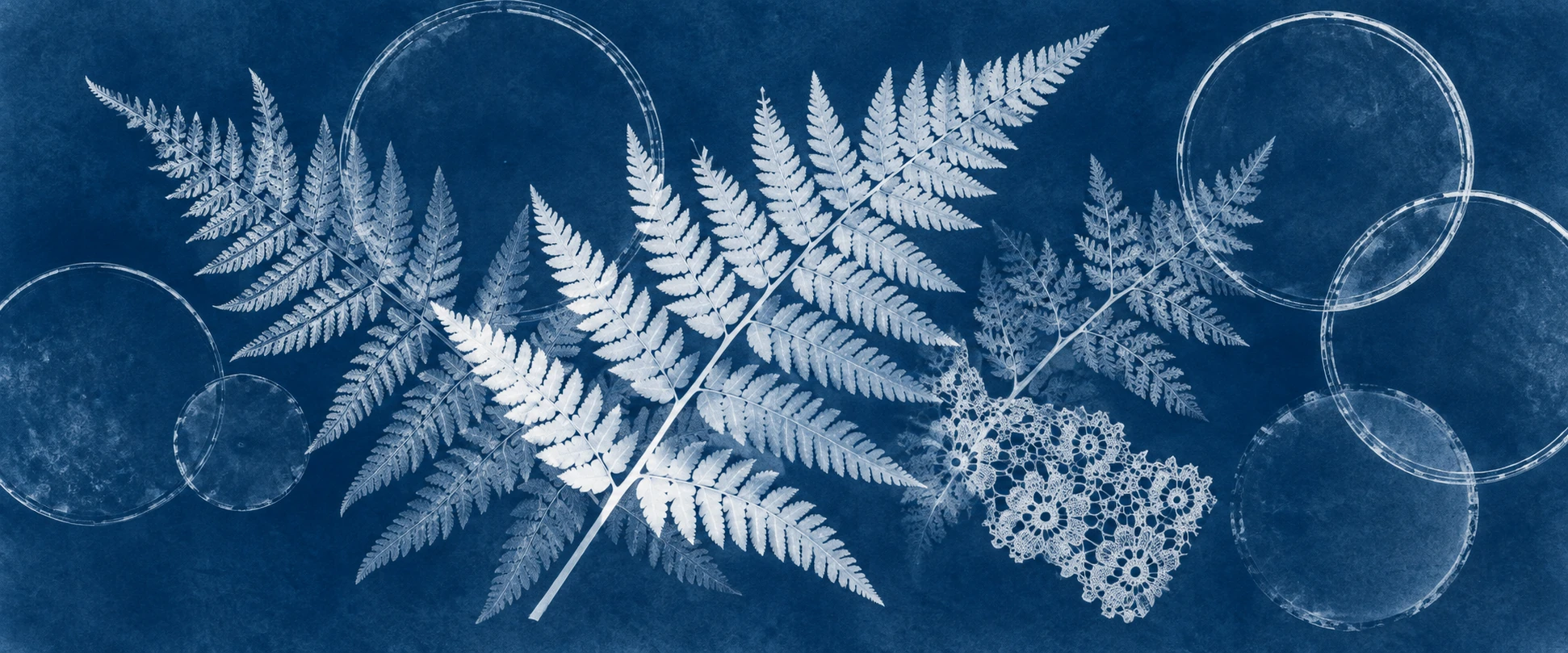
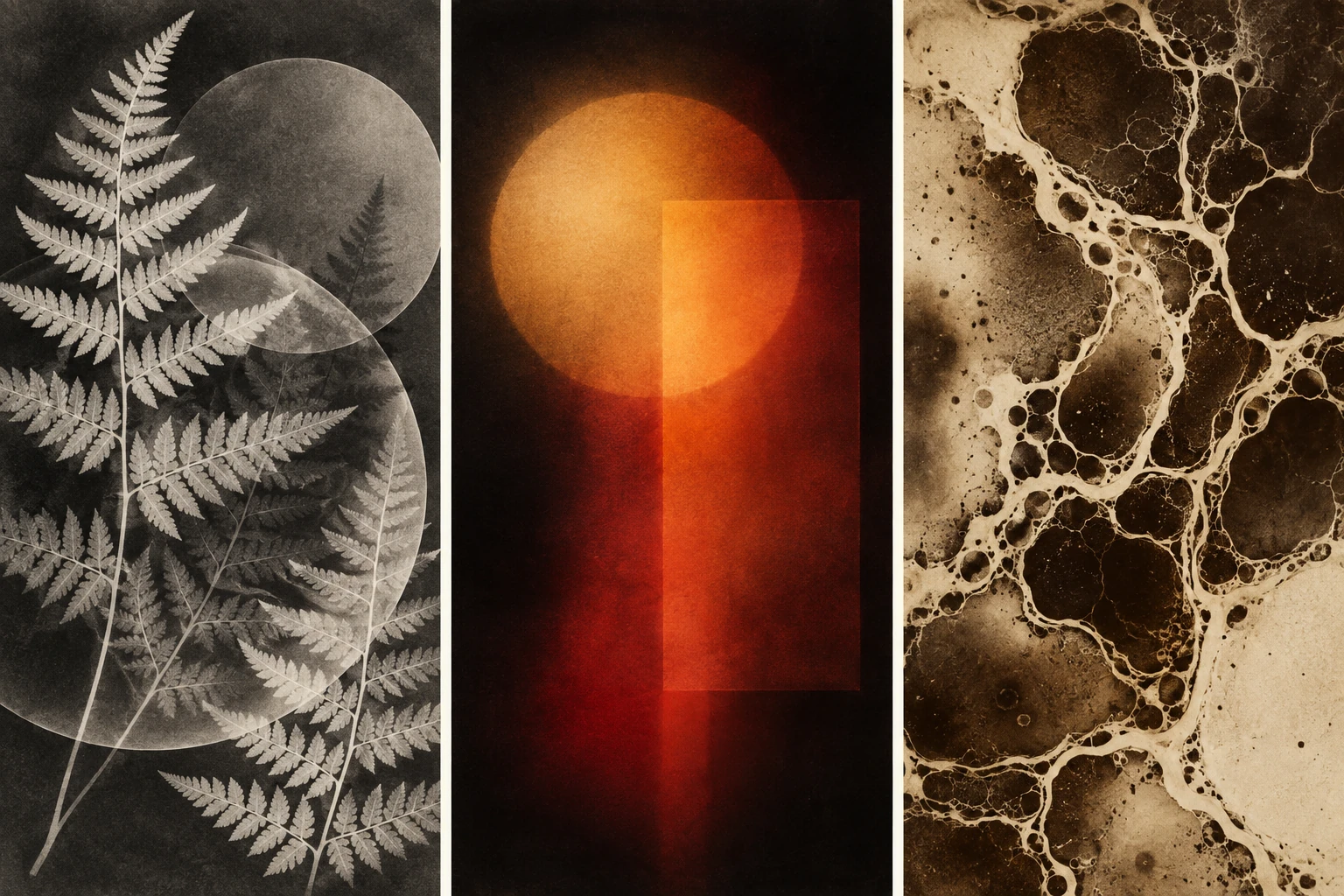
Our generated banner uses pale botanical silhouettes, translucent rings and a blue ground. The comparison collage separates three imagined appearances: contact silhouettes, luminous abstract fields and branching chemical-looking marks. All are AI-generated interpretations, not photographic exposures or reproductions of the historical works discussed below.
A process family, not a blue filter
Cameraless photography makes the relationship between a sensitive surface and its surroundings unusually direct. The V&A distinguishes photograms, radiographs, luminograms and chemigrams. In a photogram, objects interrupt light reaching photographic material; in a luminogram, shaped light itself builds the composition. A chemigram develops through direct material and chemical intervention. These related approaches should not be collapsed into one decorative preset. [1]
For this guide, begin with a practical question: what made the mark? A plant-shaped trace, a glowing field and a branching boundary ask for different explanations. Their resemblance to drawing or painting does not automatically make them drawings or paintings. Conversely, an AI picture of a white fern is not a photogram merely because no camera was used to generate it. The relevant distinction is the image's making, not the absence of a familiar piece of equipment.
A book made from algae, not photographs of algae
Anna Atkins's Photographs of British Algae: Cyanotype Impressions appeared in instalments from 1843. The Metropolitan Museum describes how she exposed wet specimens directly on sensitised paper, using algae she collected or received from other scientists. Her naming followed William Harvey's previously unillustrated 1841 manual. The object joins scientific classification, specimen exchange and page design: the plant helped produce its own image. [2]
There is a useful surprise here. Cyanotype names a photographic process, not a guarantee that no camera was involved. The V&A documents its later use for proofing snapshot negatives. Contact printing from a camera negative and placing an actual leaf on the surface are different routes to a blue print. Ask about the route before assigning the category. Blue alone is an unreliable witness. [3]
Three less obvious encounters with the medium
Susan Derges has placed photographic paper beneath flowing water at night, letting the environment participate in exposure. Garry Fabian Miller has directed light through glass vessels and shaped paper. Pierre Cordier's chemigrams use materials such as wax or varnish alongside photographic chemistry. These examples move well beyond the familiar arrangement of leaves on a sheet. [1]
The MoMA collection supplies another productive pairing: William Henry Fox Talbot's Lace, 1845, and Man Ray's Rayograph, 1922. The shared database term does not erase their different historical settings. Compare the works as arrangements of visibility, spacing and material, rather than imagining that the earlier experiment simply waited for an avant-garde artist to improve it. [4]
Curtis Moffat worked with Man Ray in the early 1920s while also developing portraiture and colour still lifes. The V&A's account of his working methods is a reminder that an artist can move among photographic approaches. A body of work need not obey the same neat categories as a navigation menu. [5]
Read the edges before naming the objects
In our banner, the most useful comparison is between a solid pale silhouette and a ring through which the ground seems to remain visible. Ask whether an edge is crisp, soft or doubled. Then look at overlap: does one form cancel another, or do their tonal values seem to accumulate? These observations describe the illustration. They are not measurements of a real exposure.
The collage changes the visual problem. At left, recognisable forms pull the eye toward imagined objects. In the middle, the eye must work with illumination and proportion without that reassurance. At right, it follows wandering boundaries. Try describing each panel without naming a subject: dense, interrupted, diffuse, branching, enclosed. This vocabulary becomes much more useful than asking a generator for something vaguely experimental.
Notice the empty areas too. A photogram-inspired composition can become unreadable when every square centimetre contains another novelty. Leave a region quiet enough to make a narrow stem or a small transparent interval matter. The blank part of the image is doing work. It has simply declined to attend the meeting about it.
Usability in AI art generation
AI is useful here as a composition sketchbook. It can propose overlapping silhouettes, restrained tonal families, edge contrasts and light-field arrangements. State which appearance you want: a contact-photogram-inspired study, a luminogram-inspired abstraction or a chemigram-inspired texture. Naming the visual mechanism is more informative than piling several process names into one prompt and hoping the machine has completed a darkroom apprenticeship.
Its limitation is fundamental: a generated silhouette is not evidence that a particular object touched or hovered above photographic paper. Nor does an invented chemical-looking boundary document a reaction. Generated exposure irregularities may look convincing while being physically inconsistent. Use the output to explore a design, not to establish material history, specimen identity, scale or experimental results.
For a hybrid workflow, make and digitise your own physical study, retain the unedited scan, then use a separate copy for digital variation. Record which version is a scan and which contains generated additions. If exact outlines matter—for a botanical comparison, for instance—do not trust a generative revision to preserve them. Compare against the source at full size and keep uncertain details out of documentary claims.
The strongest exercise is a controlled one: choose three forms, one ground and one kind of edge relationship. Change only their spacing across a series. Judge the intervals rather than the quantity of spectacular effects. Label the result as an AI-generated study inspired by a process. A precise caption gives the experiment room to be imaginative without borrowing evidence it does not possess.
Where to go next
Follow the museum records to actual works, then return to the illustrations with more demanding questions. What can a screen show about the surface, and what does the catalogue have to tell you? Which qualities belong to the arrangement, and which belong to the material event? The camera has left the room. Photography's questions have not.
A small poetic detour
Original words from the AOI studio.
Poetry
Light meets a leaf.
The leaf keeps its silence;
the paper answers.
The prompt workshop
Original creative exercises. These prompts create new illustrations, not documentary evidence.
Starting point: three forms
AI-generated photogram-inspired composition, three pale leaf silhouettes on a dark ground, varying edge softness, generous empty intervals, flat image plane, no perspective shadows, no text.
Original AOI exercise; a generated image is not historical or documentary evidence.
Richer composition: translucent overlap
Original cameraless-photography-inspired digital study: opaque lace and two translucent glass-ring impressions overlap, silver-grey tones, subtle contact-like edges, asymmetrical balance, no claim to a physical exposure.
Original AOI exercise; a generated image is not historical or documentary evidence.
Experiment: light without an object
Luminogram-inspired AI abstraction, one amber circle and one soft red rectangle emerging from darkness, compare their scale and separation, no recognisable objects, no lettering or imitation artist signature.
Original AOI exercise; a generated image is not historical or documentary evidence.
People & works to explore
References discussed in this article. Consult the sources below for context.