Photographic process · transferred image, applied colour and glass
A photographic crystoleum combines a transferred photographic image, applied colour and glass. Often encountered as a small framed object, it belongs to the meeting of photography and decorative image-making. Its appearance depends on layers and viewing conditions, not simply an old-fashioned palette. Here is how the process works, what the sources reveal and how to use the idea thoughtfully in AI art.
A visual introduction
Original AI-generated visual exercises. Historical works and artists are identified separately in the text and sources.
Select an image for a closer look. Use the arrow keys or gallery controls to compare the illustrations.
Creative toolbox · take this style further
Choose an input and a destination. Search sends your words to the chosen site; Copy & open puts them on your clipboard to paste there.
More tools
Additional destinations selected for this article.
ChatGPT
Copy your input and paste it into a ChatGPT conversation or image request.
Copy & open ChatGPT (new tab)Claude · Anthropic
Develop an image prompt or explore the style in a new Claude conversation.
Copy & open Claude · Anthropic (new tab)Midjourney
Paste your input into the Imagine bar on the Create page.
Copy & open Midjourney (new tab)Adobe Firefly
Copy your input, open Firefly, and paste it into the prompt field.
Copy & open Adobe Firefly (new tab)Leonardo.Ai
Copy your input, open Leonardo, and paste it into the generation field.
Copy & open Leonardo.Ai (new tab)Lexica
Search AI images and prompts using your selected input.
Search with this input Lexica (new tab)Pexels
Search the photo and video library. Short keywords often work best.
Search with this input Pexels (new tab)Pixabay
Search photos, illustrations and other images.
Search with this input Pixabay (new tab)Unsplash
Search photographs using the style name or your own keywords.
Search with this input Unsplash (new tab)Wikipedia
Search for background reading. A style may not have its own article.
Search with this input Wikipedia (new tab)WikiArt
Copy your input into WikiArt’s search to explore artists and artworks.
Copy & open WikiArt (new tab)Instagram hashtags
Search a hashtag made from your input: spaces and punctuation are removed. Instagram may require sign-in.
Search with this input Instagram hashtags (new tab)A closer look
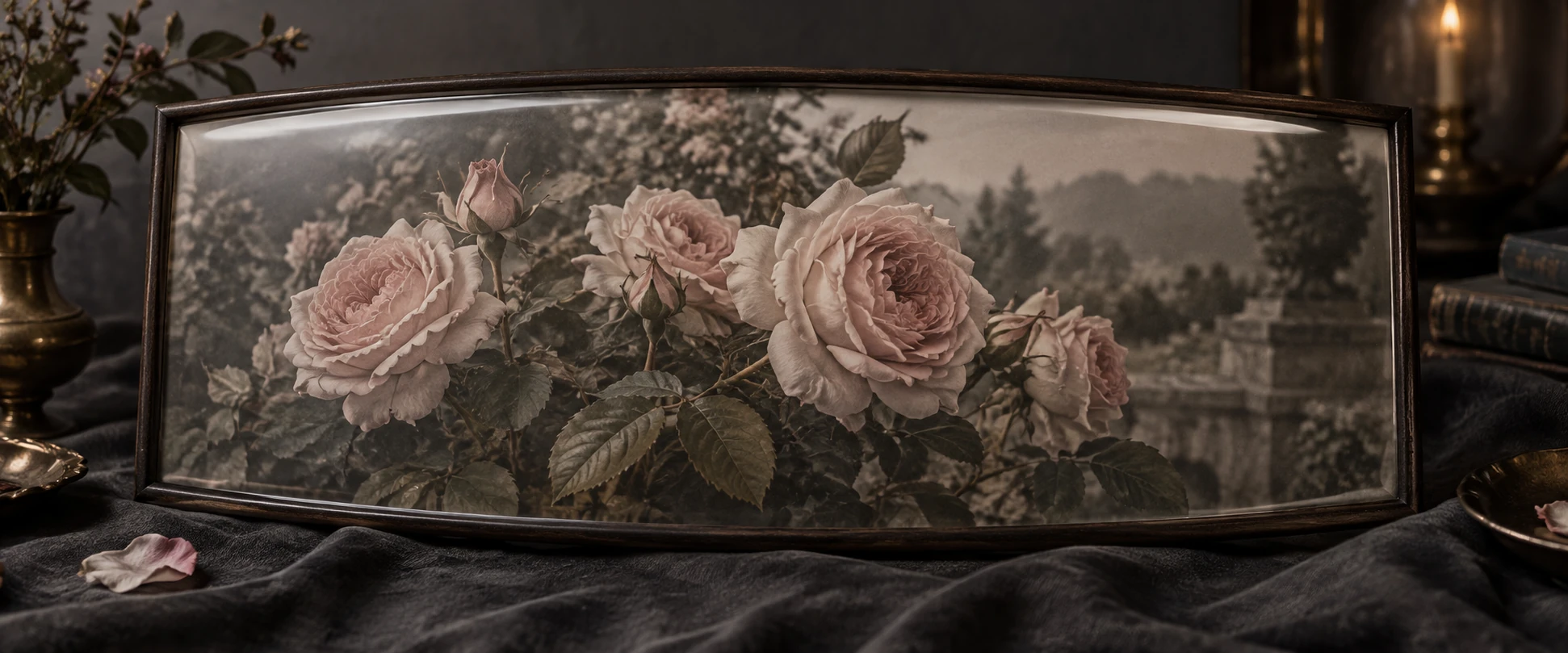
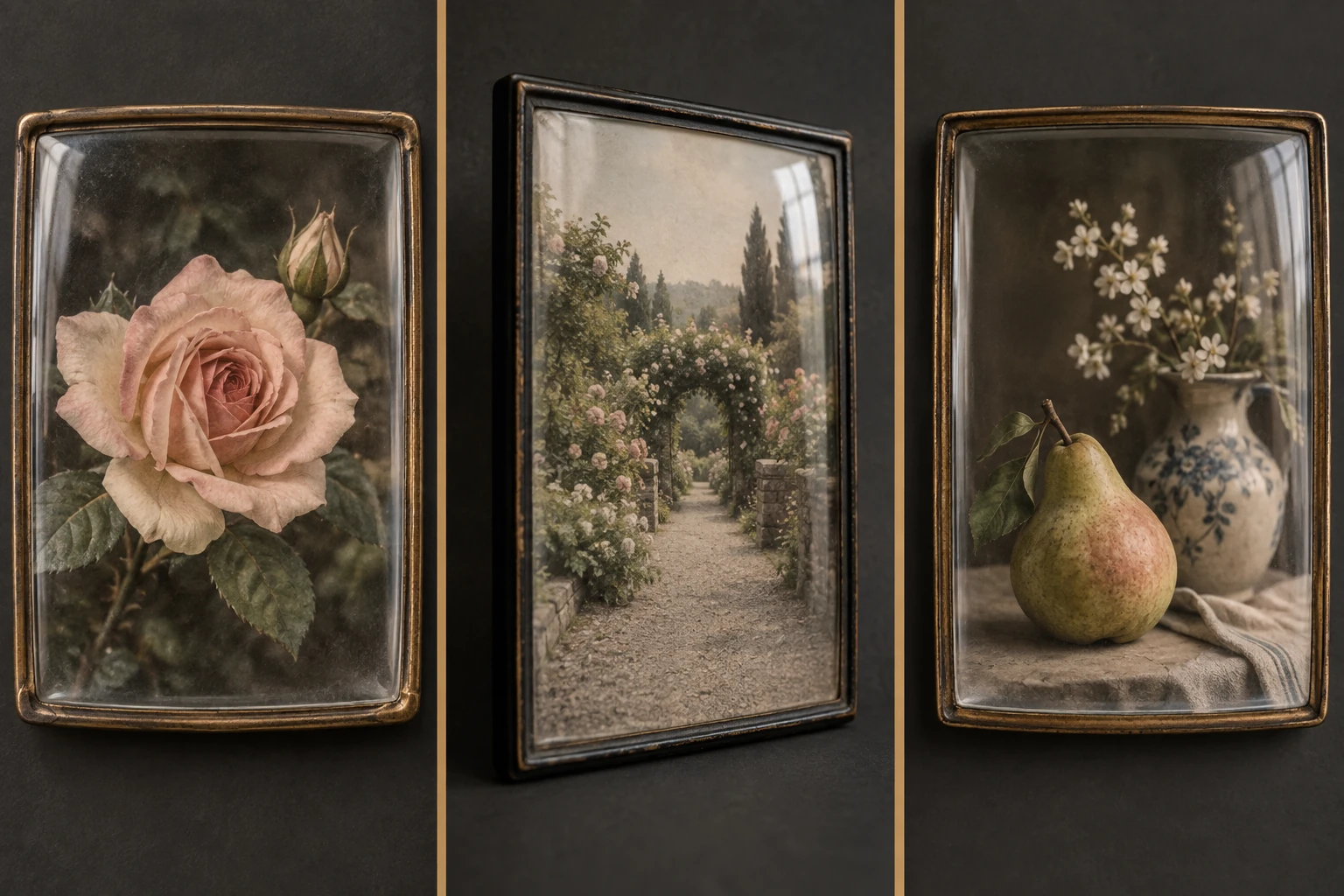
Our AI-generated banner imagines a softly coloured flower photograph beneath curved glass in a dark frame. The collage varies subject and viewing angle across three invented objects. These images interpret surface, reflection and colour; they are not photographs of antiques, reproductions of museum specimens or accurate construction diagrams.
First, remove the imaginary crystals
The name can lead an image generator in entirely the wrong direction. A crystoleum is not a photograph covered in gemstones, a crystalline abstraction or a stained-glass window. In the photographic process described by the Library of Congress, an albumen print is attached image-side toward curved glass, its paper support is removed, and the image is made translucent. Colour and backing complete an object intended to be viewed through the glass. [1]
That physical sequence matters. A photograph already exists before the transfer and colouring. This differs from simply exposing a photographic plate in a camera. It also differs from placing an ordinary opaque print behind a protective window: the reduced support and layered colour are part of how the finished image works. For an art database, “photographic process” is a more accurate label than a movement with a founder and manifesto.
What sits behind the glass
The Library of Congress describes detailed colour applied behind the transferred image, followed by a second curved glass carrying broader colour areas and a white backing. It dates use of the process from the 1880s through the 1910s. This is a useful description of a historical arrangement, not a guarantee that every object bearing the name has precisely that construction. [1]
Te Papa's thesaurus-based definition is broader: it includes transferred photographic prints, usually albumen, or oil paintings; the remaining image may be made translucent with oil or wax and further painted. That difference in scope is worth retaining. This guide focuses on photographic crystoleums, while acknowledging that the term can appear in a wider image-transfer vocabulary. [2]
The Australian Institute for the Conservation of Cultural Material reports an examined example made with a waxed albumen print beneath curved glass and another painted curved sheet. It is a helpful corrective to the idea that one online recipe defines every surviving specimen. Real objects are entitled to be more complicated than our filing systems. [3]
Three details that reward a second look
First, the colour need not occupy the same layer as every photographic detail. In the two-glass arrangement, fine detail and broad painted areas are distributed through a small physical stack. Second, the final white backing contributes to the presentation; it is not merely spare packaging. Third, the visible glass belongs to the image's optical experience as well as its protection. These observations follow from the construction described by the Library of Congress. [1]
Do not turn those facts into a claim that every example must look dramatically three-dimensional. A small online photograph can flatten the layering, hide reflections or exaggerate them. Frame, lighting and angle can dominate what you see. Where construction or identification matters, a catalogue and a conservator's examination are better evidence than visual confidence acquired from a thumbnail.
The AICCM workshop account also discusses interactions between deteriorating glass and photographic materials. That is why this guide treats the assembly as an explanation, not instructions for dismantling an antique. An attractive surface effect and a sound physical object are different questions. Existing glass, image and backing should be understood together. [3]
How to look at a layered image
Start with the picture itself. Is there continuous photographic modelling in the petals, face or fabric? Where does colour seem to sit lightly over that detail, and where does it become more opaque? Then attend to the object: the curve, the frame and the reflected light. Try to keep the image's depicted light separate from the highlight on the glass in front of it.
Our banner uses that distinction as a visual exercise. The roses have their own shading; the glass catches a separate, restrained reflection. A successful illustration makes those two systems coexist without turning the photograph into a luminous screen. Too much glare obliterates the subject; too little material information makes the object look like any other framed print.
In the collage, the change of angle is as important as the change of subject. Look at how much of the image remains readable and how the edge of the glass is suggested. These are editorial interpretations of material appearance. They cannot establish the internal structure of a real crystoleum, and the generated frames should not be used as dating evidence.
Usability in AI art generation
Crystoleum is particularly useful as a concept for object-based illustration: imagined keepsakes, a fictional collector's room, a book-cover still life or a study of images seen through reflective surfaces. Decide first whether you want the coloured picture alone or the whole framed object. A prompt that fails to distinguish them may produce a scene containing glass ornaments instead of a photographic object.
For the full object, describe a photographic tonal foundation beneath restrained applied colour, a subtly curved clear glass face, a modest frame and one coherent reflection. Name the invented subject inside the image. Exclude crystal facets, stained-glass leading and luminous display screens if they appear as unwanted substitutions. These are practical steering choices, not a claim that a model understands historic glasswork.
The limitation is structural. A generator can imitate visible depth, sheen and colour relationships; it does not transfer an albumen image or construct a translucent photographic layer. Nor is an AI exploded view reliable evidence of the object's assembly. Use verified diagrams or conservation documentation when you need to explain real layers. Reserve generated imagery for clearly labelled interpretation and design exploration.
A useful hybrid experiment starts with a photograph you own. Keep its tonal structure, develop a separate colour layer and explore how a modest reflected highlight changes the presentation. Retain the unaltered source and describe the result as a digital crystoleum-inspired study. If generating a wholly fictional antique, avoid invented maker's marks, dates or museum labels that could be mistaken for provenance.
Evaluate the result by asking whether its materials agree with one another. Does the glass reflect the same environment as the frame? Is the photograph still legible? Does the colour feel applied rather than emitted? A quieter answer is often more convincing than a spectacular one. The point is the negotiation between image and object, not how many optical effects can be persuaded to occupy a rectangle.
A precise name leaves room for invention
Crystoleum rewards the small difference between “looks like” and “was made by”. Its history gives artists a rich visual problem: photographic detail seen through colour, backing and glass. AI can explore that problem imaginatively. Keep the material claim honest, and the imaginative part becomes stronger rather than smaller.
A small poetic detour
Original words from the AOI studio.
Poetry
A rose behind glass,
colour behind the rose—
light reads both sides.
The prompt workshop
Original creative exercises. These prompts create new illustrations, not documentary evidence.
Starting point: a readable glass object
AI-generated crystoleum-inspired framed object, invented rose still life with monochrome photographic modelling beneath restrained applied colour, subtly curved clear glass, slim dark frame, one soft reflection, no crystals or glowing screen.
Original AOI exercise; a generated image is not historical or documentary evidence.
Richer composition: image and room
Imagined crystoleum-like garden photograph on a quiet writing desk, softly painted green and rose colour, photographic detail visible, modest curved-glass highlight coherent with window light, tactile frame and cloth, no maker mark or historical date.
Original AOI exercise; a generated image is not historical or documentary evidence.
Experiment: change only the viewing angle
Digital material study of one imagined crystoleum-like fruit photograph, front view and slight oblique view, retain the same image and muted colour, examine glass reflection and frame depth, not an exploded construction diagram.
Original AOI exercise; a generated image is not historical or documentary evidence.
People & works to explore
References discussed in this article. Consult the sources below for context.
Paintings and other works
Examined waxed albumen crystoleum — discussed in the AICCM workshop account; maker and title not supplied [3]