
Ancient Greek art · painting and decorated pottery
This guide concerns ancient Greek painting, especially the surviving evidence of painted pottery and the limits of what that evidence can tell us. It is not a survey of all later Greek art. Vase decoration offers a rich record of figures, narratives and pictorial decisions, but its survival should not make us confuse one durable medium with the full range of ancient painting.
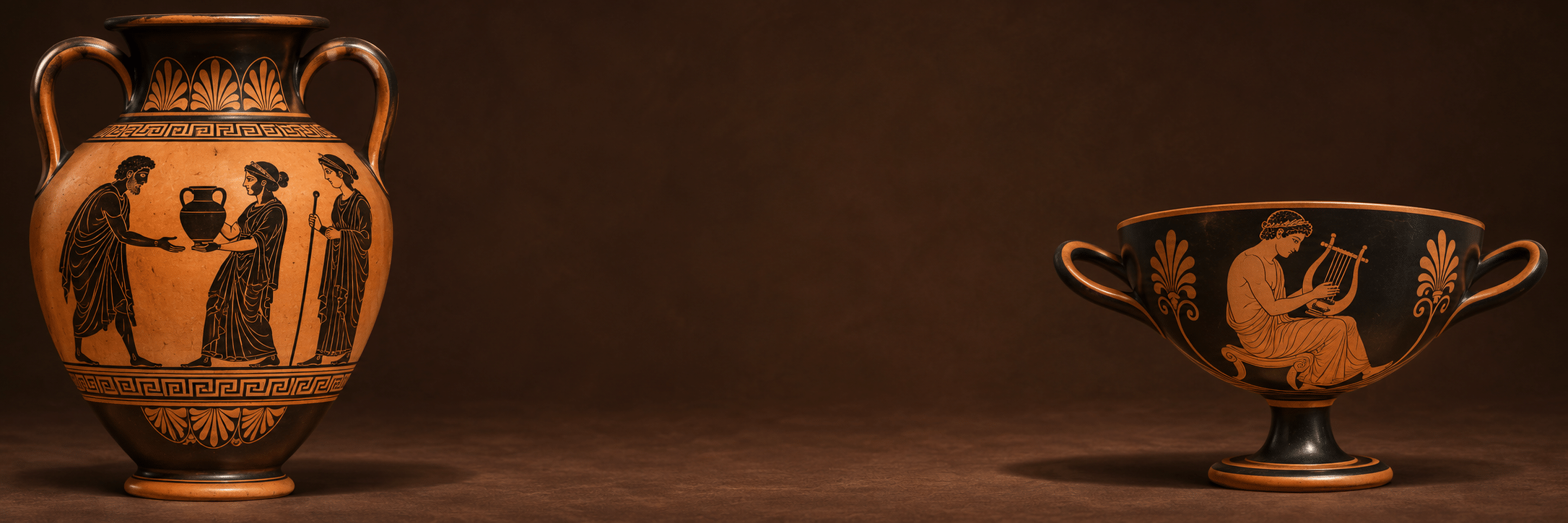
A visual introduction
Select an image for a closer look. Use the thumbnails, arrow keys or a swipe to compare examples. Zoom in to inspect details, or share the image that inspires you.
Creative toolbox · take this style further
Choose an input and a destination. Search sends your words to the chosen site; Copy & open puts them on your clipboard to paste there.
Create with AI
Turn your chosen input into an image prompt or a new creative direction.
ChatGPT
Copy your input and paste it into a ChatGPT conversation or image request.
Copy & open ChatGPT (new tab)Claude · Anthropic
Develop an image prompt or explore the style in a new Claude conversation.
Copy & open Claude · Anthropic (new tab)Midjourney
Paste your input into the Imagine bar on the Create page.
Copy & open Midjourney (new tab)Adobe Firefly
Copy your input, open Firefly, and paste it into the prompt field.
Copy & open Adobe Firefly (new tab)Leonardo.Ai
Copy your input, open Leonardo, and paste it into the generation field.
Copy & open Leonardo.Ai (new tab)Image search
Find visual references. Short, concrete keywords usually work best.
Lexica
Search AI images and prompts using your selected input.
Search with this input Lexica (new tab)Pexels
Search the photo and video library. Short keywords often work best.
Search with this input Pexels (new tab)Pixabay
Search photos, illustrations and other images.
Search with this input Pixabay (new tab)Unsplash
Search photographs using the style name or your own keywords.
Search with this input Unsplash (new tab)Wikimedia Commons
Search photographs, artworks and historical images. Check each file for its source and reuse terms.
Search with this input Wikimedia Commons (new tab)Art & research
Explore artists, collections and the ideas behind a style.
Wikipedia
Search for background reading. A style may not have its own article.
Search with this input Wikipedia (new tab)WikiArt
Copy your input into WikiArt’s search to explore artists and artworks.
Copy & open WikiArt (new tab)Europeana
Paste your keywords into the search to explore European museum, library and archive collections.
Copy & open Europeana (new tab)Inspiration
Discover portfolios and visual ideas from creative communities.
Instagram hashtags
Search a hashtag made from your input: spaces and punctuation are removed. Instagram may require sign-in.
Search with this input Instagram hashtags (new tab)ArtStation
Paste your input into artwork search for concept art, environments, characters and visual development.
Copy & open ArtStation (new tab)Behance
Paste your input into project search for illustration, design and visual storytelling.
Copy & open Behance (new tab)A closer look
Read contour, gesture, overlap and the relationship between an image and its vessel. Black-figure and red-figure techniques organise colour and detail differently; neither is simply a modern flat illustration placed on a pot.
Start with the surviving object
Ancient painting existed in forms whose survival is uneven. A decorated ceramic vessel is valuable evidence, but it was also an object with a shape, a use and a viewing situation. Its handles, shoulder and curved surface affect the image. A photograph that flattens one side can hide how a scene unfolds as the vessel turns.
The Metropolitan Museum's Greek Vase Painting publication provides a broader context for examining these objects. Use object records to distinguish date, place, technique and attribution. A painter's modern scholarly name may identify a recognisable body of work without preserving the person's ancient name. [2]
Black-figure and red-figure
In black-figure painting, dark figures stand against the clay-coloured ground, with incised details cutting through the dark surface. Red-figure reverses the broad arrangement: figures retain the clay colour against a dark background, and brush-drawn lines describe internal details. The Met's technical account explains their relationship to the ceramic process. [1]
For visual analysis, compare what those methods make easy to articulate. Incision can produce a crisp internal pattern; brush lines can vary in weight and describe a different range of bodily detail. Neither technique is a shorthand for artistic quality. The composition and its handling remain specific to each object.
Bodies tell stories through relationships
Before identifying a myth, examine how figures act towards one another. A turned head, a reaching arm or an overlapping shield can establish attention and conflict. Repetition creates rhythm, while a change in direction can mark a decisive figure. An image may remain narratively clear even when its setting is sparse.
Do not assign an identity solely from a generic attribute in a generated image. Historical interpretation needs the documented object and its context. For an original exercise, invent an ordinary activity with clear gestures rather than claiming to reconstruct a particular lost painting.
A particular object: the Shoemaker Vase
The Ashmolean’s Shoemaker Vase, a black-figure pelike attributed to the Eucharides Painter, was made in Athens around 500–470 BC and found on Rhodes. Its workshop scene shows a shoemaker cutting a sole around a customer’s foot. The museum notes that craft scenes are relatively unusual in this pottery. A specific object therefore complicates an expectation that every scene must show a god or hero. [3]
Compare the scale of the customer, the craftsman’s bent posture and the onlooker’s direction of attention. These relationships make an activity readable within a restricted field. Our newly imagined vessels use ordinary actions as exercises in gesture, without claiming to reconstruct this object or its historical workshop.
The vessel is part of the composition
Try drawing the same group on a broad bowl and a tall narrow jar. The available field changes how bodies can stand, bend or overlap. Borders can separate zones and frame the action, but they should respond to the object rather than behave as a decorative sticker around a rectangular picture.
Think about viewing distance too. A bold silhouette may read across a room, while a small gesture rewards close inspection. The balance between these scales is a useful lesson for contemporary illustration even when no ancient motif is copied.
Avoid the familiar shortcuts
Ancient Greek painting is not adequately represented by white columns, blue sea and a generic profile. Nor can vase painting stand for all periods and places of Greek visual culture. Keep distinctions between ancient, Byzantine, modern and contemporary subjects explicit when following related articles.
For a creative study, choose one technique, one object form and one simple action. Preserve readable contours and a controlled ground. Label the result as a contemporary interpretation. That makes it possible to learn from the pictorial construction without presenting a synthetic image as an archaeological find.
What the new images demonstrate
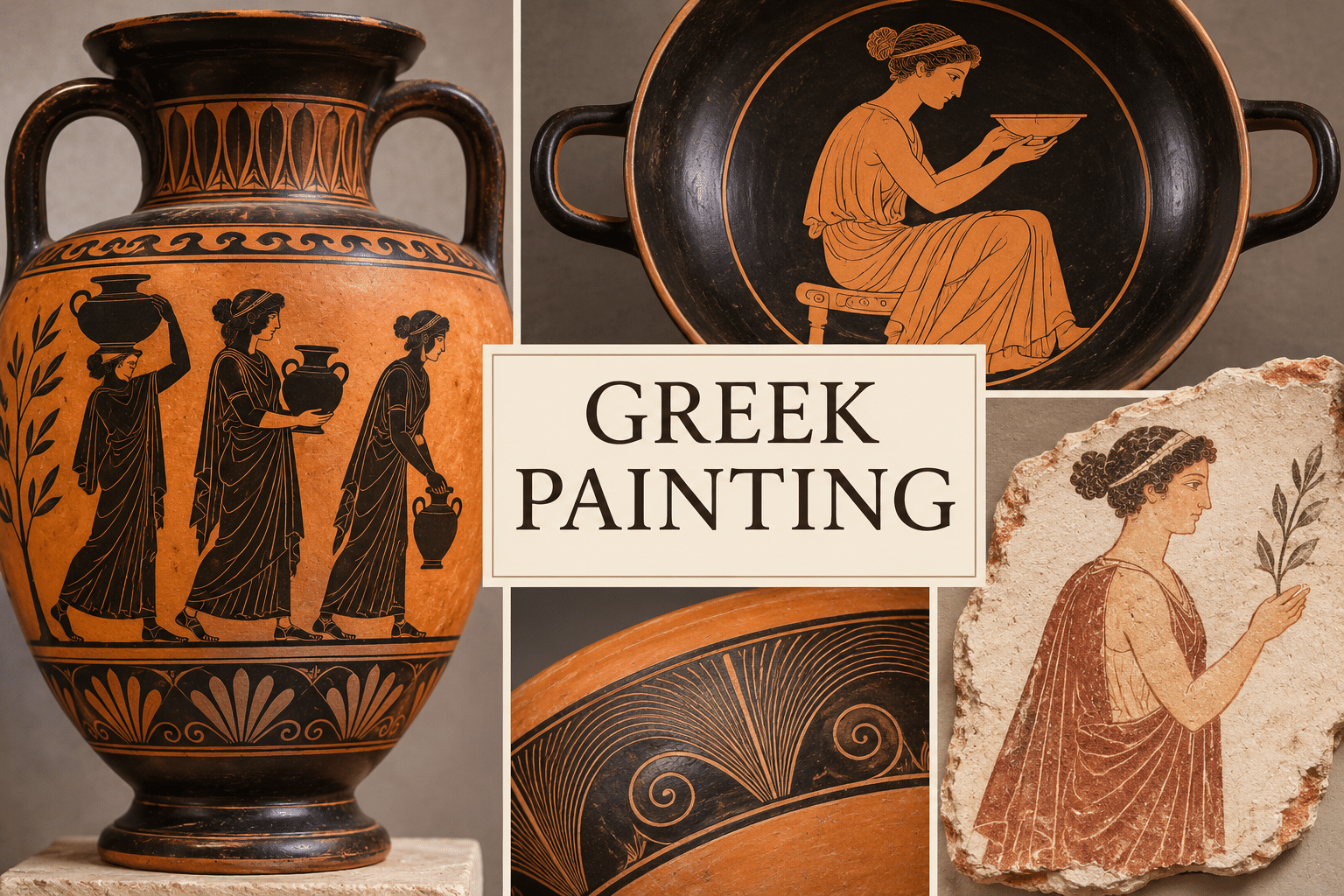
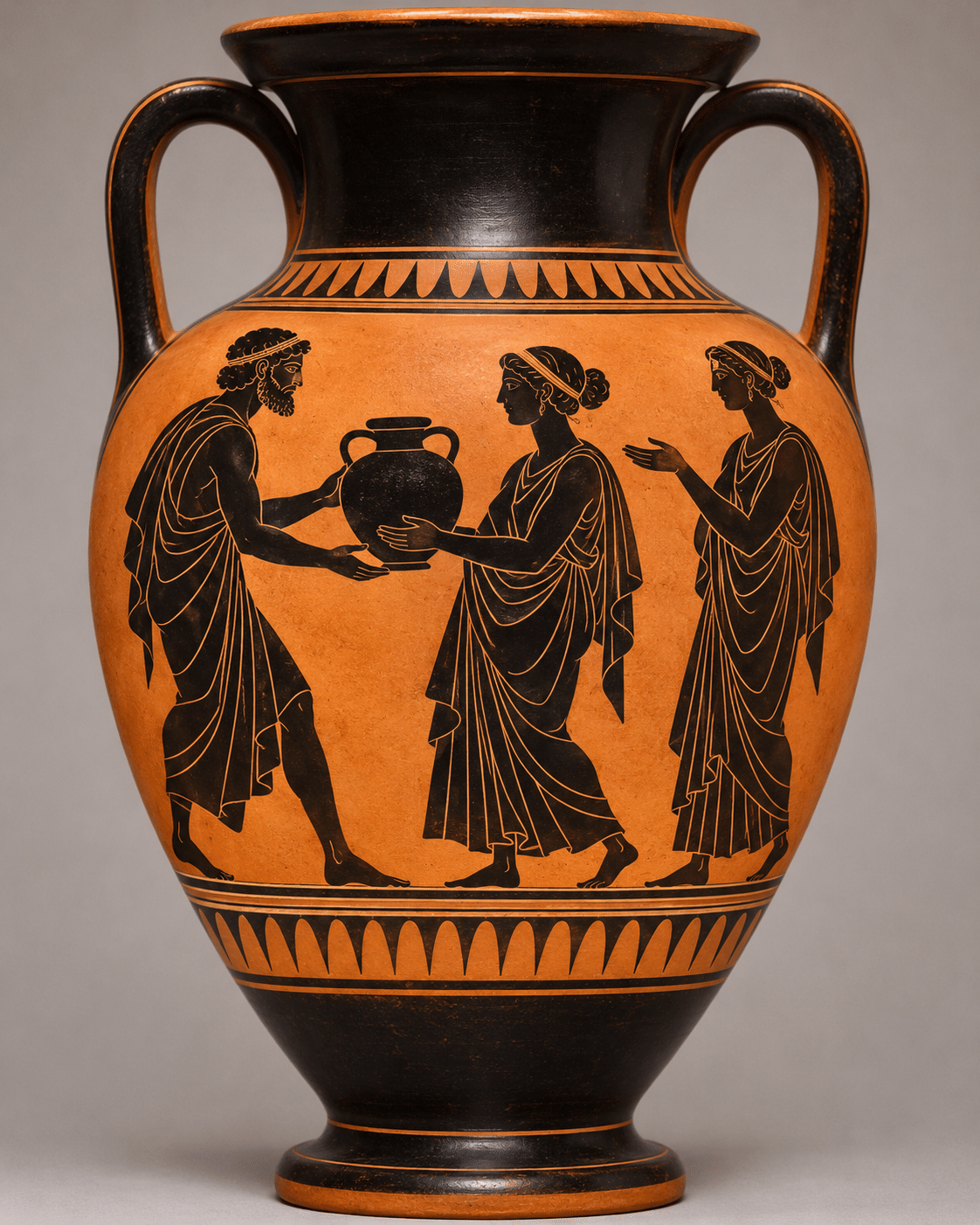
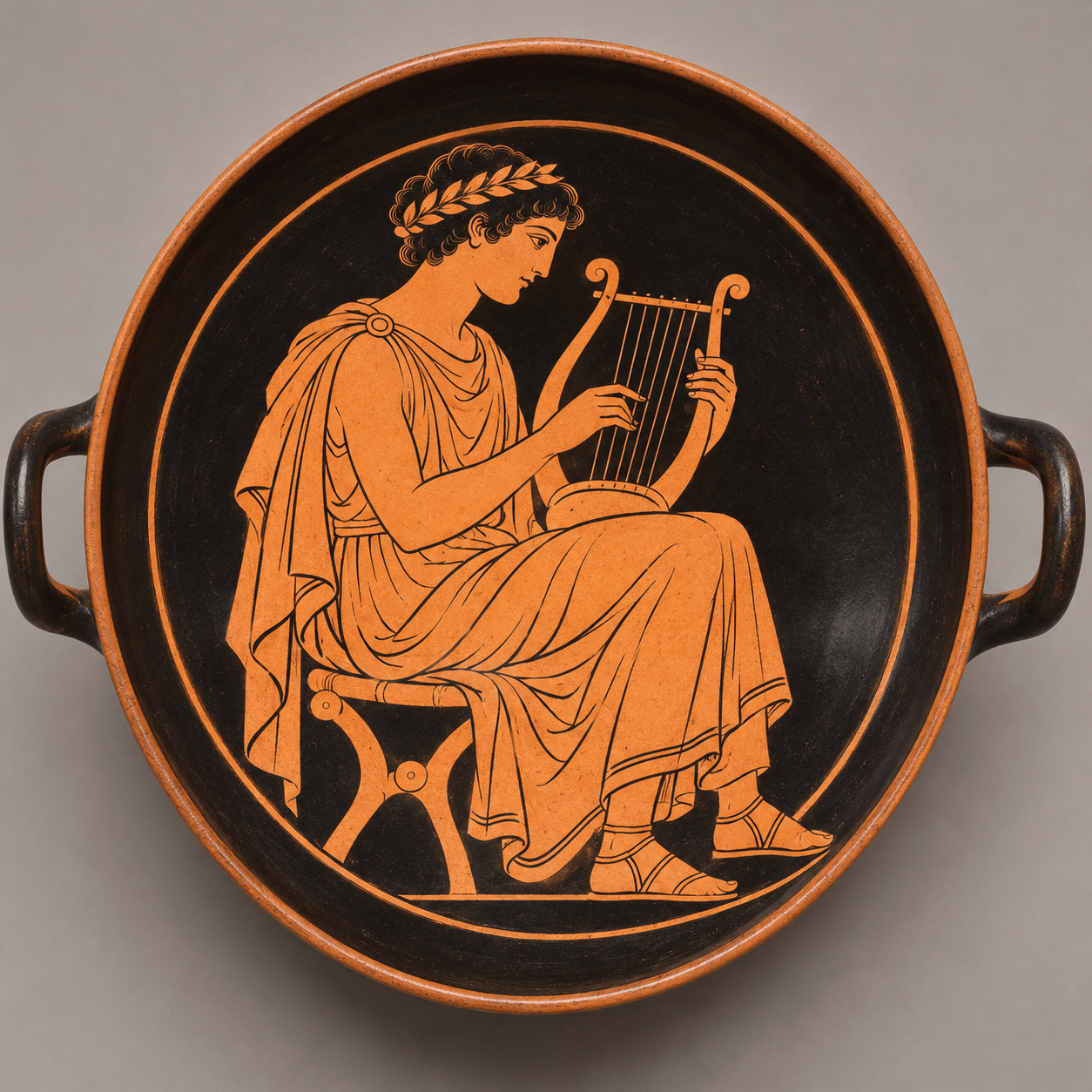
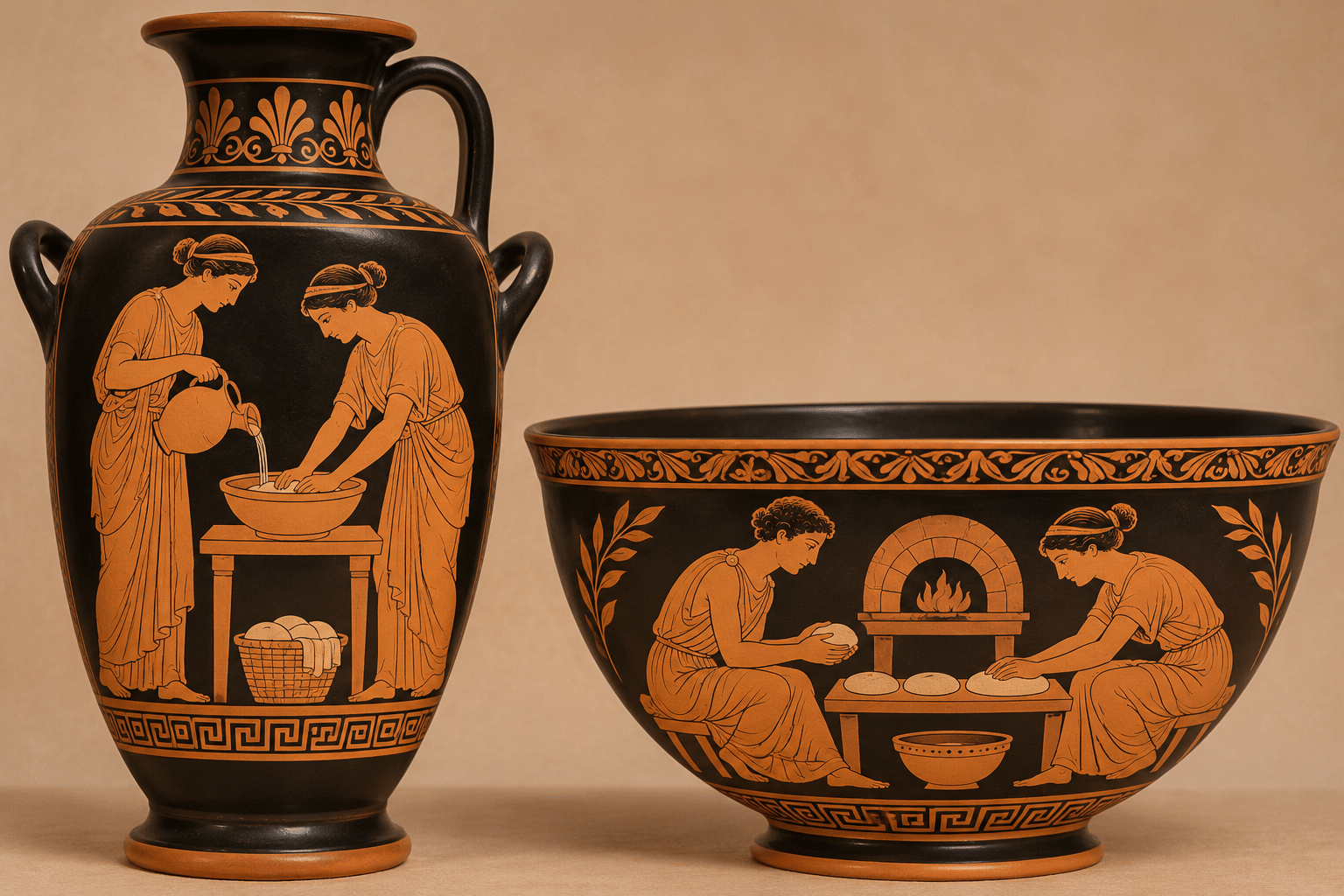
The first example uses dark silhouettes and incised-looking detail for an exchange of a water jar. The second keeps a seated musician clay-coloured against a black circular field. The third adapts scenes of food preparation to a tall jar and a broad bowl. These are independent generated designs, not replicas, archaeological records or demonstrations of actual fired ceramic chemistry.
The collage includes an imagined plaster fragment to acknowledge that decorated pottery is not the whole subject of painting. Its invented fragment must not be cited as surviving ancient evidence. For historical technique and dating, return to the museum publications rather than reading the photographic appearance of a synthetic object as proof.
A small poetic detour
Original words from the AOI studio.
Poetry
Around the clay, a hand extends;
a second hand receives its weight.
The turning vessel keeps the pause
between an offer and its fate.
A little line becomes a sleeve,
a curve contains a listening face.
We turn the bowl to follow them;
the story travels with its space.
The prompt workshop
Original creative exercises. These prompts create new illustrations, not documentary evidence.
Gesture on a curved surface
Design an original contemporary ceramic-decoration study of three people passing a water jar. Clear profile gestures, controlled overlaps and a curved vessel surface. Use a black-figure-inspired silhouette method; do not claim an authentic ancient object.
Reverse the figure and ground
Create a paired original vase-decoration study of the same simple athletic pose: dark silhouette on clay colour and clay-coloured figure on dark ground. Make the different treatment of internal lines visible.
Shape changes the story
Design two original decorated vessels, a broad bowl and a tall jar, each showing a small group preparing a meal. Adapt the figures to each curved field instead of pasting a rectangular illustration onto the surface.
A smile from the studio
Jokes
The painted musician asked for a larger stage. The potter offered a wider bowl.