
Artist study · American narrative painting
Grandma Moses built richly populated scenes of work, seasons and community life. Their organization deserves as much attention as their charm.
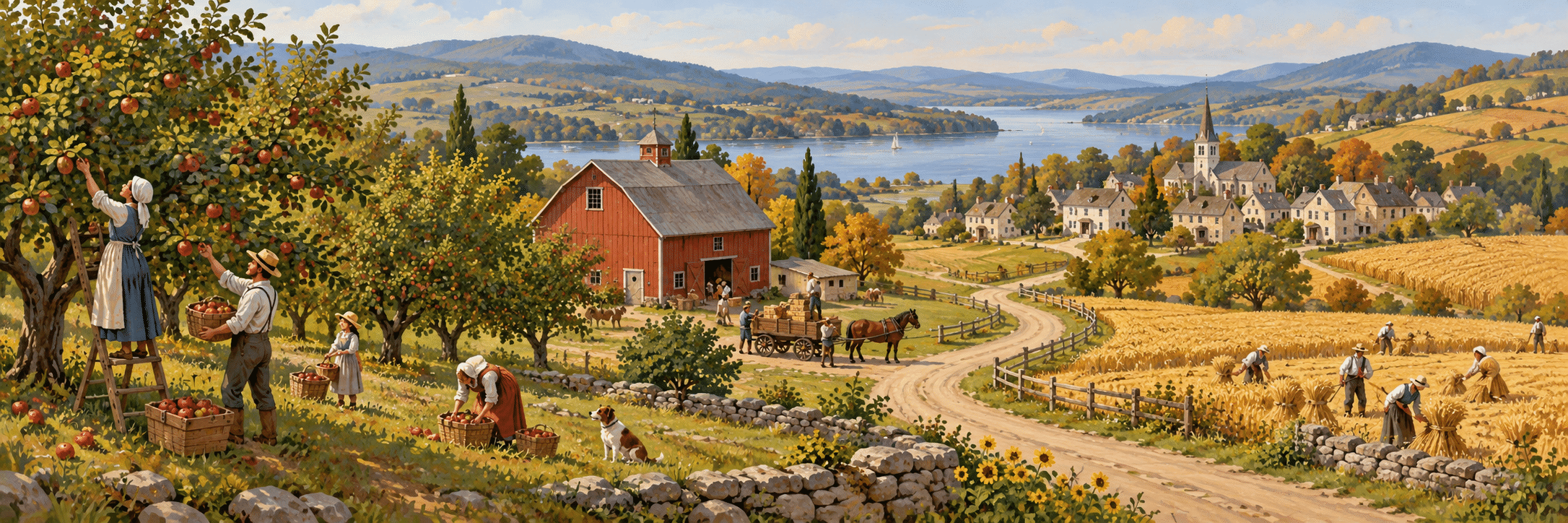
A visual introduction
Select an image for a closer look. Use the thumbnails, arrow keys or a swipe to compare examples. Zoom in to inspect details, or share the image that inspires you.



Creative toolbox · take this style further
Choose an input and a destination. Search sends your words to the chosen site; Copy & open puts them on your clipboard to paste there.
Create with AI
Turn your chosen input into an image prompt or a new creative direction.
ChatGPT
Copy your input and paste it into a ChatGPT conversation or image request.
Copy & open ChatGPT (new tab)Claude · Anthropic
Develop an image prompt or explore the style in a new Claude conversation.
Copy & open Claude · Anthropic (new tab)Midjourney
Paste your input into the Imagine bar on the Create page.
Copy & open Midjourney (new tab)Adobe Firefly
Copy your input, open Firefly, and paste it into the prompt field.
Copy & open Adobe Firefly (new tab)Leonardo.Ai
Copy your input, open Leonardo, and paste it into the generation field.
Copy & open Leonardo.Ai (new tab)Image search
Find visual references. Short, concrete keywords usually work best.
Lexica
Search AI images and prompts using your selected input.
Search with this input Lexica (new tab)Pexels
Search the photo and video library. Short keywords often work best.
Search with this input Pexels (new tab)Pixabay
Search photos, illustrations and other images.
Search with this input Pixabay (new tab)Unsplash
Search photographs using the style name or your own keywords.
Search with this input Unsplash (new tab)Wikimedia Commons
Search photographs, artworks and historical images. Check each file for its source and reuse terms.
Search with this input Wikimedia Commons (new tab)Art & research
Explore artists, collections and the ideas behind a style.
Wikipedia
Search for background reading. A style may not have its own article.
Search with this input Wikipedia (new tab)WikiArt
Copy your input into WikiArt’s search to explore artists and artworks.
Copy & open WikiArt (new tab)Europeana
Paste your keywords into the search to explore European museum, library and archive collections.
Copy & open Europeana (new tab)Inspiration
Discover portfolios and visual ideas from creative communities.
Instagram hashtags
Search a hashtag made from your input: spaces and punctuation are removed. Instagram may require sign-in.
Search with this input Instagram hashtags (new tab)ArtStation
Paste your input into artwork search for concept art, environments, characters and visual development.
Copy & open ArtStation (new tab)Behance
Paste your input into project search for illustration, design and visual storytelling.
Copy & open Behance (new tab)A closer look
For an original narrative landscape, begin with the routes that connect people: a path, a road, a fence opening or a line of washing.
Understanding the subject
Anna Mary Robertson Moses, known as Grandma Moses, became widely recognized for painting later in life. The Smithsonian’s account emphasizes her sustained artistic work and the everyday activities represented in it. Her paintings should not be dismissed as effortless nostalgia or treated as proof that self-taught artists share one appearance. Individual scenes can be examined for how many small actions fit within a larger, readable landscape.
A long life of work and observation
Anna Mary Robertson Moses lived from 1860 to 1961. The Smithsonian records her upbringing in upstate New York and years of farm and household work, including a period in Virginia. [1] Those experiences provide context for her subjects without reducing every painted scene to a literal record of a particular day.
SAAM’s exhibition A Good Day’s Work emphasizes the combination of creativity, labour and memory. Moses began painting in earnest in her late seventies, and Otto Kallir presented her first solo exhibition in 1940. [2] The familiar late-success story is part of the biography, but it should lead viewers toward the work rather than substitute for looking at it.
Many actions, one landscape
A narrative landscape can contain several centres of interest. The challenge is to make them belong to one place. Look at how roads, fences, fields and building groups divide the surface, then follow the small activities distributed among them. A path can carry the eye from a foreground task to a distant gathering.
For a contemporary exercise, plan the large areas before the figures. Decide where the ground opens, where buildings cluster and where a route changes direction. Small incidents become meaningful when their positions explain relationships: a person carries something toward a barn, another waits at a gate, a group works beside a tree.
Do not confuse abundant detail with random detail. Each activity needs enough space to be read, while quieter fields or stretches of snow give the whole picture room to breathe. A lively scene can remain calm in its overall organization.
Season as a compositional structure
Season changes more than the colour of leaves. Snow can join separate fields into a broad pale area, making roads and people stand out. Autumn can divide the land into warm patches. Spring can open a contrast between new growth, dark soil and pale buildings.
Use those changes to organize a new picture rather than adding seasonal decoration at the end. Establish the largest light and dark areas first. Then place smaller accents where they help connect activities. Repeating one red coat in several distant groups may guide the eye, but identical figures everywhere weaken the sense of individual tasks.
Memory, invention and reception
SAAM describes Moses’s paintings as combinations of observation and personal memory, and examines the tension between her popular fame and dismissive critical reception. [2] That context encourages a more attentive reading than the assumption that a welcoming image must be simple or unconsidered.
A remembered landscape need not operate like a photograph. Scale, spacing and viewpoint can serve narrative clarity. The useful question is how those decisions organize the story. Calling an unusual perspective a mistake without examining its effect can miss the picture’s priorities.
At the same time, affection does not make an image a complete social history. Ask what kinds of labour appear, who participates and what remains outside the frame. A contemporary interpretation can preserve the interest in shared activity while choosing a different place, period or set of experiences.
AOI looking and making workshop
For an original narrative landscape, begin with the routes that connect people: a path, a road, a fence opening or a line of washing. Place small groups around specific tasks rather than distributing figures randomly. Use changes in color and density to distinguish fields, buildings and gatherings. Let the overall view remain clear even when there is much to discover. A contemporary neighborhood can support the same kind of patient visual storytelling. The pleasure comes from relationships among activities, not simply from making everything quaint or uniformly cheerful.
Five new narrative landscapes
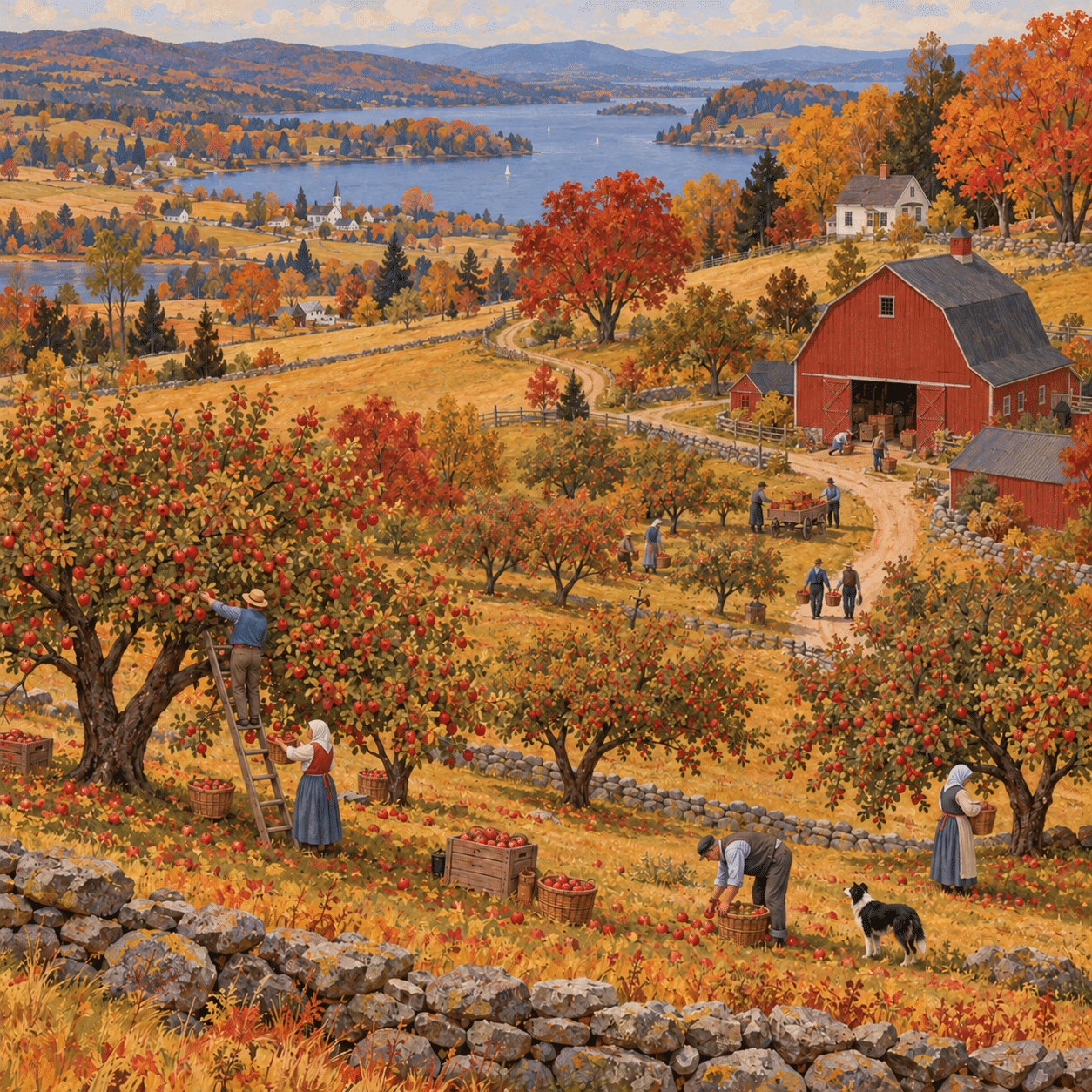
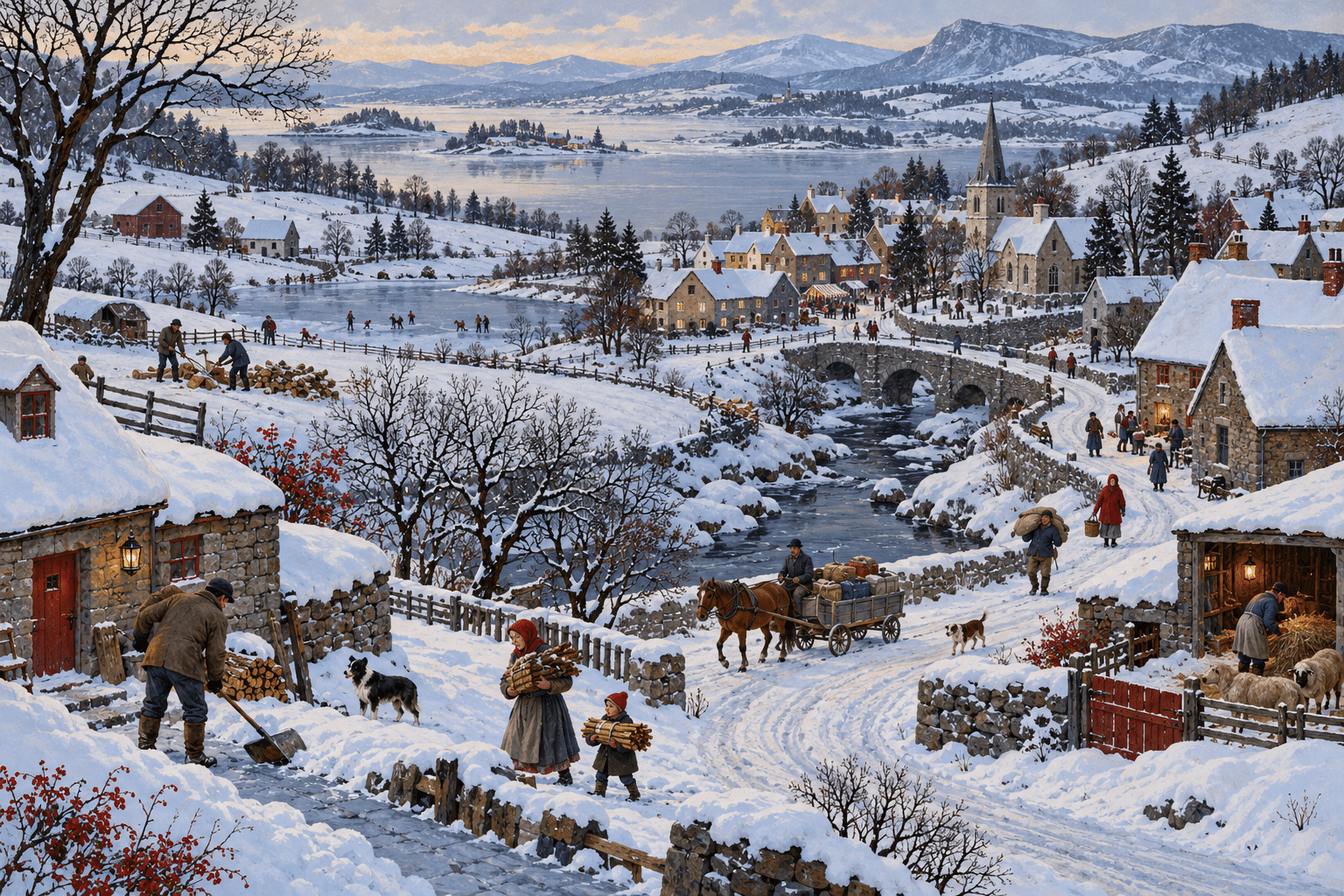
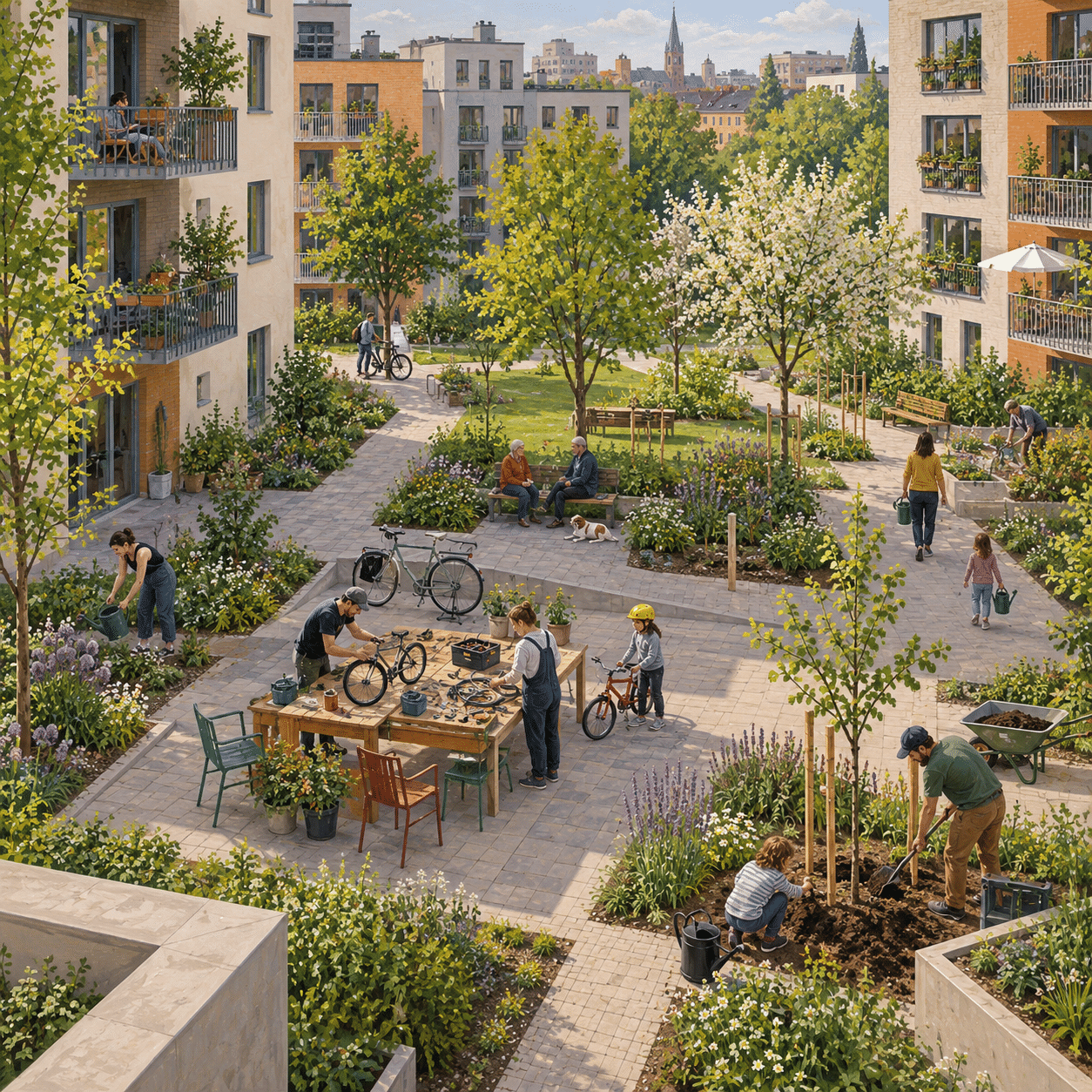
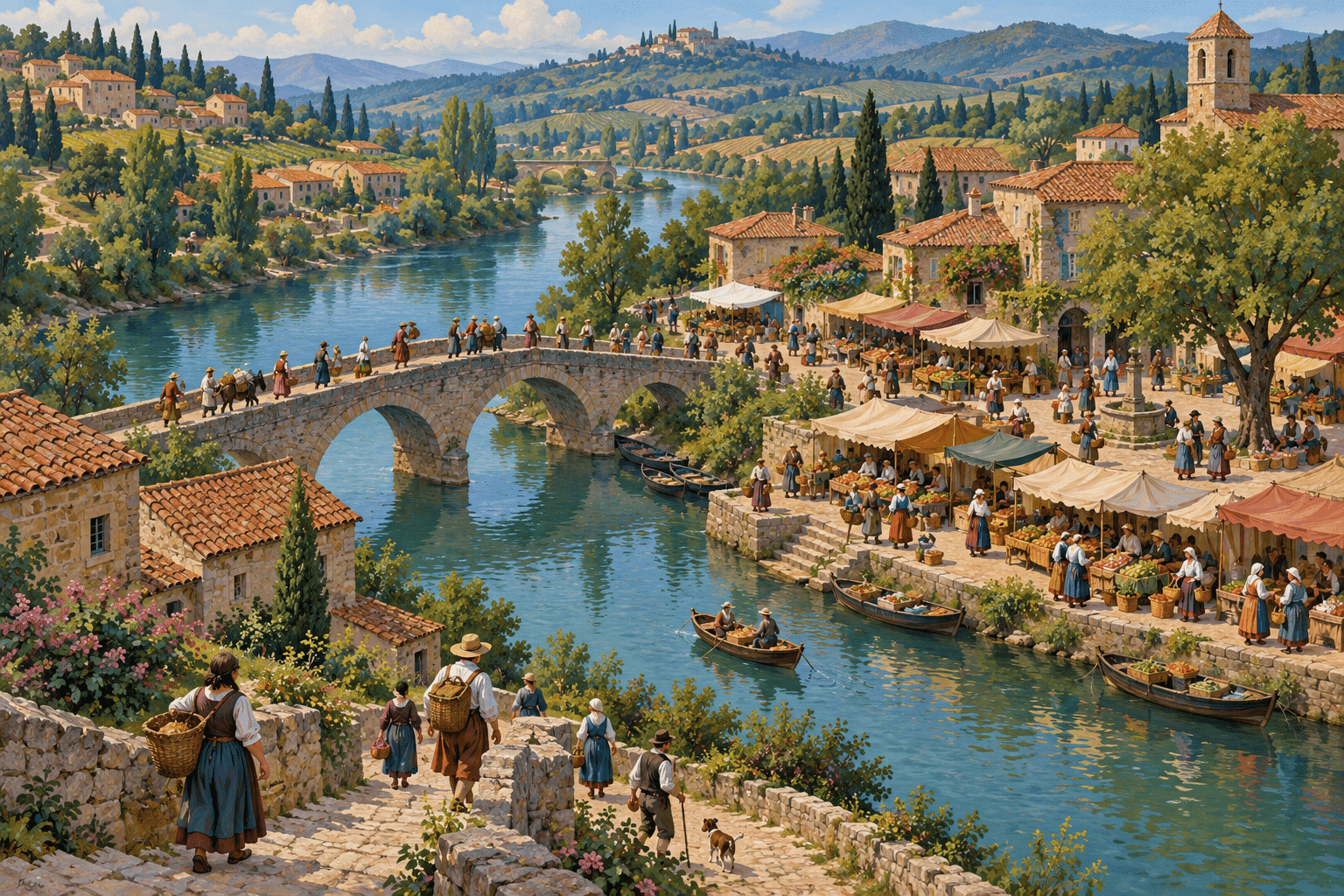
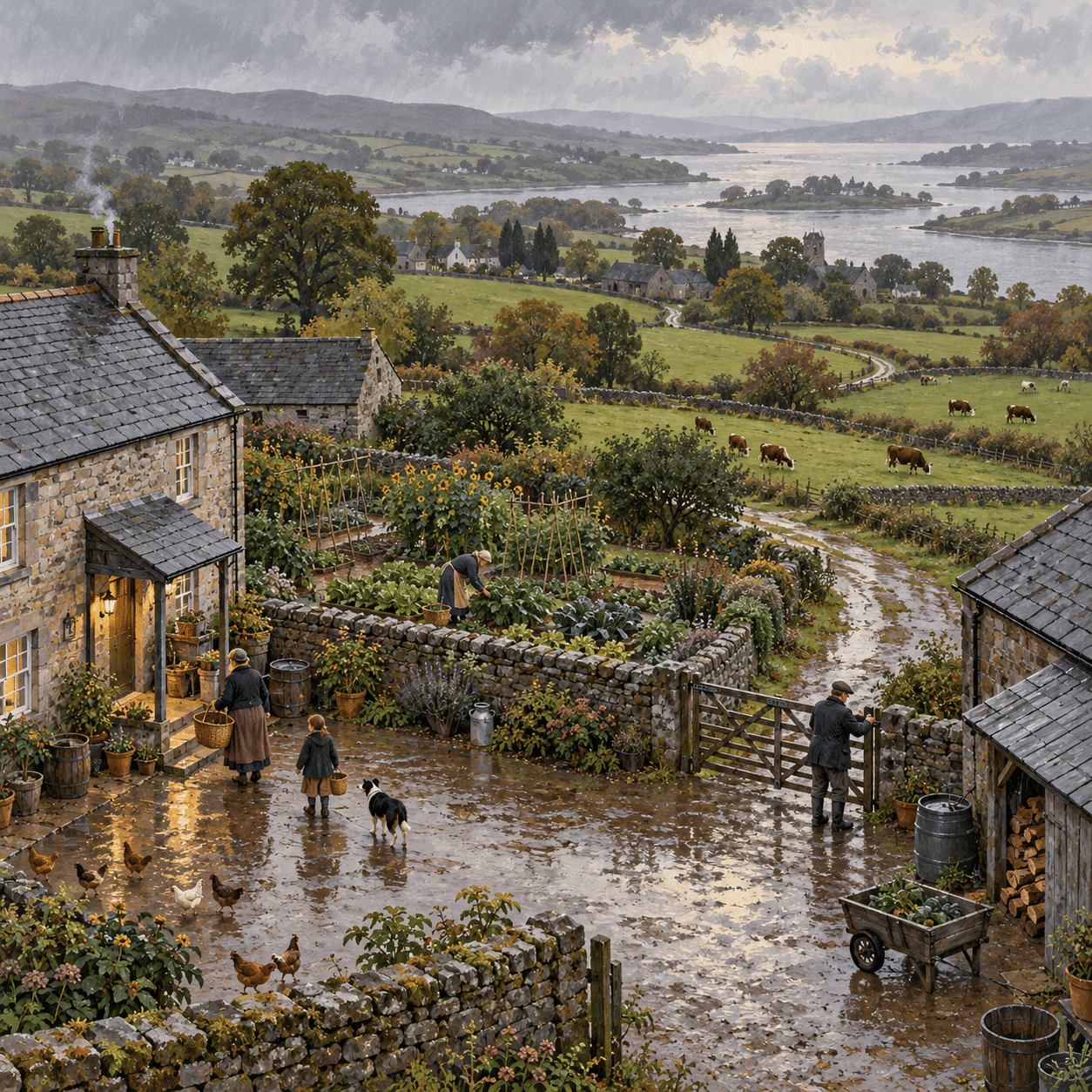
The orchard study follows neighbours gathering apples across a hillside. The winter scene connects snow clearing and carrying supplies along a village road. A present-day courtyard replaces historical rural scenery with bicycle repair and tree planting. A riverside market groups arrivals, stalls and conversation. A rainy farmyard follows the small practical movements of carrying baskets and tending a garden.
These are original AI-generated narrative-landscape exercises, not paintings by Grandma Moses, reconstructions of lost works or images from her biography. The banner introduces a fictional harvest landscape, and the centrally titled collage compares several settings. Their variety tests whether the compositional lesson survives beyond one nostalgic subject.
A prompt should describe the relationships
Name the place, the shared activity and the routes connecting people. Specify an elevated viewpoint if it helps the scene read, and reserve areas of open ground. Choose a limited seasonal palette with a few accents instead of requiring every object to be equally bright.
During review, check the small stories individually. A ladder should reach the tree it serves; a wheelbarrow should rest on the ground; people carrying an object should agree about its position. Then step back and check the overall pattern. Accurate tiny details cannot rescue an unclear landscape structure.
Avoid using the artist’s name as a shortcut for childishness or deliberate incompetence. A useful study asks how the picture distributes attention, how it handles many activities and how it makes a place memorable. Those are demanding compositional tasks.
Positive editorial assessment — AI-authored
The strongest lesson is the organization of many small human actions within a legible whole. Roads, open fields and clustered buildings can make a busy picture rewarding at several viewing distances. The approach gives ordinary work and shared routines substantial pictorial attention.
Critical editorial assessment — AI-authored
An imitation can become a collection of quaint cottages and interchangeable tiny figures. Nostalgia may conceal weak composition or flatten the complexity of rural life. Improve an exercise by giving each group a distinct task, clarifying the routes between them and allowing quieter areas to balance detail.
Neutral editorial assessment — AI-authored
This is an artist study with a contemporary making workshop, not a claim that all self-taught painting shares one style. Institutional sources support the biographical context. The new gallery explores narrative organization through invented scenes and is clearly separated from Moses’s own work.
A small poetic detour
Original words from the AOI studio.
Poetry
A road goes out beyond the gate,
a basket crosses through the square;
the orchard bends beneath its weight,
and little tasks are everywhere.
The field lies quiet, wide and pale,
the painted village keeps its day;
one winding path collects the tale
of hands that work along the way.
The prompt workshop
Original creative exercises. These prompts create new illustrations, not documentary evidence.
A day of shared work
Create an original narrative painting of neighbors gathering apples across a hillside orchard, small readable actions connected by paths, clear fields and a warm seasonal palette. Keep the whole landscape organized.
Winter community
Create an original wide painting of a fictional village clearing snow and carrying supplies, varied small groups and a clear road linking them. Use careful detail without turning every figure into the same pose.
A present-day story
Create an original panoramic painting of a community repairing bicycles and planting trees in a city courtyard, elevated viewpoint and many connected small actions. Make the modern setting explicit.
A smile from the studio
Jokes
The painter gave every villager a different task. The road complained that it was still doing all the connecting.