
Historical art movement
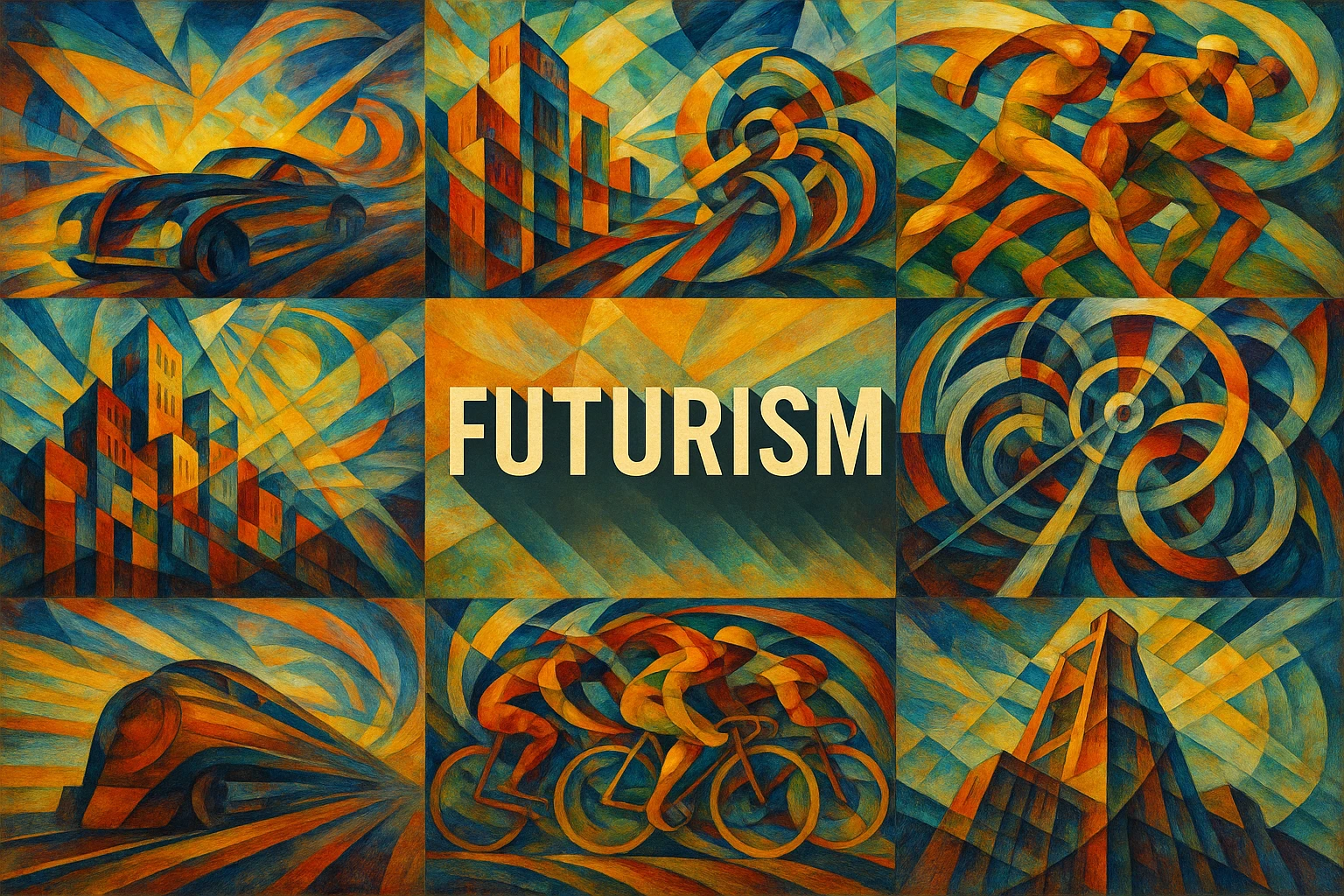
Futurism explored speed, energy and modern life, while carrying political and militarist associations that should not disappear from its history.
A closer look
Choose one moving subject and make its direction unmistakable.
Understanding the subject
Historical Futurism is associated with manifestos and artistic experiments concerning movement, machines and modernity. Its formal innovations cannot be separated entirely from the political and militarist positions expressed by parts of the movement. It is also distinct from any generic futuristic illustration. A contemporary study can examine repeated forms, directional forces and fractured movement without endorsing those historical positions or claiming that all participants worked identically.
AOI looking and making workshop
Choose one moving subject and make its direction unmistakable. Repeated contours, intersecting planes and changes in scale can suggest successive moments, but too many directions cancel one another. Keep a stable reference—a curb, a horizon or a stationary object—so movement can be perceived. For an original exercise, use an ordinary action such as cycling or wind passing through laundry. Avoid equating technological excitement with moral progress. Let the image explore how motion is organized rather than turning the subject into an uncritical celebration of force.
The prompt workshop
Original creative exercises. These prompts create new illustrations, not documentary evidence.
A bicycle in motion
Create an original dynamic painting of a cyclist passing a quiet wall, repeated wheel arcs and directional color planes. Keep one stable architectural reference and avoid militaristic imagery.
Wind across a courtyard
Create an original motion study of laundry moving in strong wind, overlapping fabric positions and a clear dominant diagonal. Use a restrained palette and a fixed courtyard structure.
Mechanical rhythm
Create an abstract contemporary image of turning gears represented through repeated arcs and intersecting planes, with a clear center of motion. Explore rhythm without propaganda symbols or historical attribution.
Your next inspiration
Discover another art style
Follow a visual thread to the next subject.
Sources and further exploration
Futurism | The Guggenheim Museums and Foundation
Umberto Boccioni. Unique Forms of Continuity in Space. 1913 (cast 1931 or 1934) | MoMA
Creative studies to try
Explore these collected prompts as creative interpretations. They are starting points for image-making, not reproductions of historical artworks or evidence about a tradition.
Visual cues: fractured planes, motion lines, simultaneous viewpoints; Repeated contours and mechanical speed
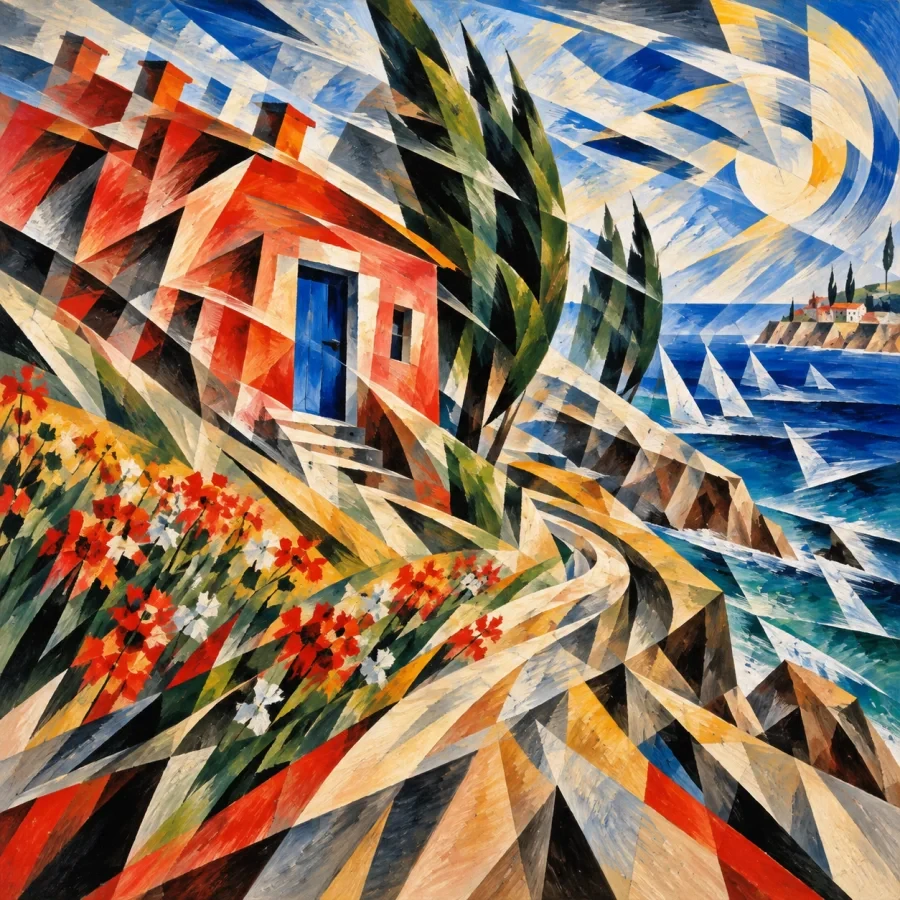
Study 1 — Futurism
Ultra-wide panoramic banner, a human hand and a sleek robotic hand reaching toward each other, fingertips almost touching, a bright luminous spark of intelligence between them, a subtle world map behind them with global data network lines, symbolizing human-AI collaboration and digital transformation, rendered in Futurism style, with advanced technology atmosphere, glowing interfaces, luminous data streams, cinematic depth, high quality, high detail, balanced composition, no text, no logo, no watermark, exact aspect ratio 1584:396
Prompt source: 1001 Art Styles. Select the text to copy, then adapt the subject and composition.
Study 2 — Futurism
Apply the following visual approach to my subject or project, preserving its core content and purpose. Use repeated silhouettes, forceful diagonals, fragmented planes, and sweeping lines of force to convey motion and the dynamism of modern machinery. Treat this as a contemporary interpretation, not a historical artifact. Adapt the composition to my subject. Do not add text unless my project calls for it.
Prompt source: Emergent Mind Style Atlas. Select the text to copy, then adapt the subject and composition.