
Visual interpretation · synthwave and imagined futures
Explore Futuresynth as an overlapping synthwave label and visual reference, with clear context, composition and palette guidance, prompts and contrasting AOI studies.
A visual introduction
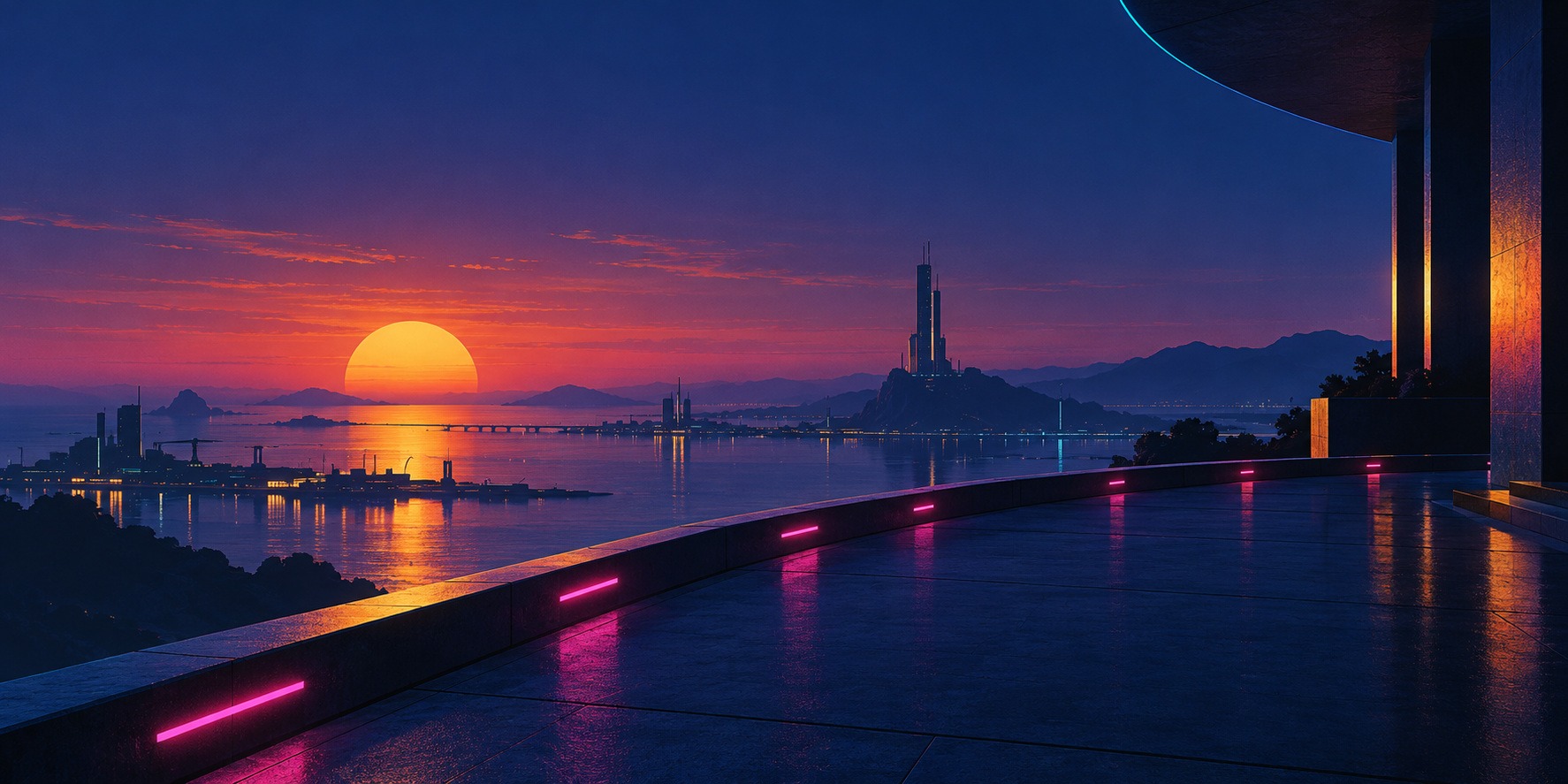
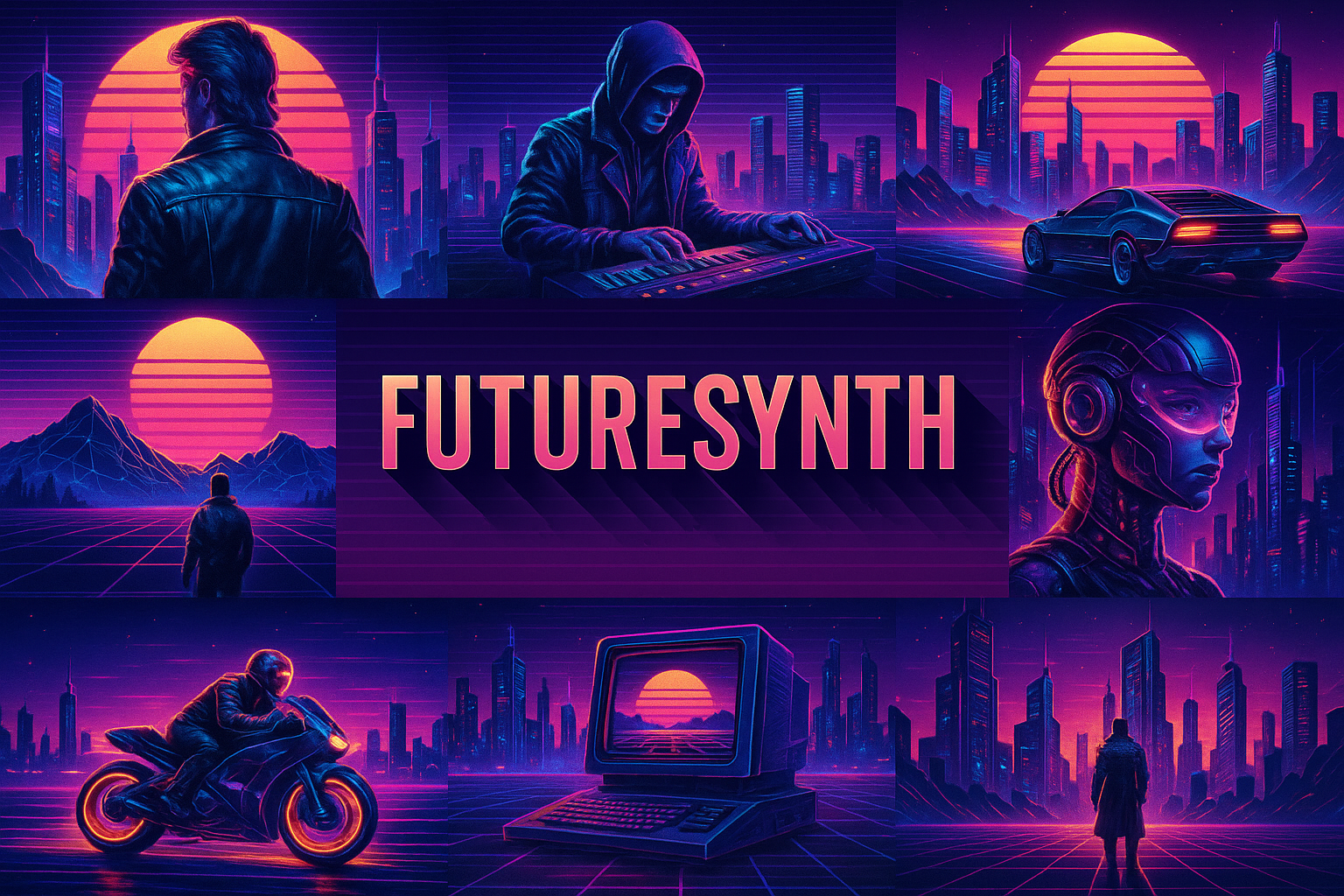
Three new standalone studies and a new banner explore a coastal platform, a quiet music room, abstract rhythm and a harbor panorama. The earlier centered-title collage and portrait collage remain for comparison. All are AOI illustrations, not historical documentation.
Select an image for a closer look. Use the thumbnails, arrow keys or a swipe to compare examples. Zoom in to inspect details, or share the image that inspires you.
Creative toolbox · take this style further
Choose an input and a destination. Search sends your words to the chosen site; Copy & open puts them on your clipboard to paste there.
Create with AI
Turn your chosen input into an image prompt or a new creative direction.
ChatGPT
Copy your input and paste it into a ChatGPT conversation or image request.
Copy & open ChatGPT (new tab)Claude · Anthropic
Develop an image prompt or explore the style in a new Claude conversation.
Copy & open Claude · Anthropic (new tab)Midjourney
Paste your input into the Imagine bar on the Create page.
Copy & open Midjourney (new tab)Adobe Firefly
Copy your input, open Firefly, and paste it into the prompt field.
Copy & open Adobe Firefly (new tab)Leonardo.Ai
Copy your input, open Leonardo, and paste it into the generation field.
Copy & open Leonardo.Ai (new tab)Image search
Find visual references. Short, concrete keywords usually work best.
Lexica
Search AI images and prompts using your selected input.
Search with this input Lexica (new tab)Pexels
Search the photo and video library. Short keywords often work best.
Search with this input Pexels (new tab)Pixabay
Search photos, illustrations and other images.
Search with this input Pixabay (new tab)Unsplash
Search photographs using the style name or your own keywords.
Search with this input Unsplash (new tab)Wikimedia Commons
Search photographs, artworks and historical images. Check each file for its source and reuse terms.
Search with this input Wikimedia Commons (new tab)Art & research
Explore artists, collections and the ideas behind a style.
Wikipedia
Search for background reading. A style may not have its own article.
Search with this input Wikipedia (new tab)WikiArt
Copy your input into WikiArt’s search to explore artists and artworks.
Copy & open WikiArt (new tab)Europeana
Paste your keywords into the search to explore European museum, library and archive collections.
Copy & open Europeana (new tab)Inspiration
Discover portfolios and visual ideas from creative communities.
Instagram hashtags
Search a hashtag made from your input: spaces and punctuation are removed. Instagram may require sign-in.
Search with this input Instagram hashtags (new tab)ArtStation
Paste your input into artwork search for concept art, environments, characters and visual development.
Copy & open ArtStation (new tab)Behance
Paste your input into project search for illustration, design and visual storytelling.
Copy & open Behance (new tab)A closer look
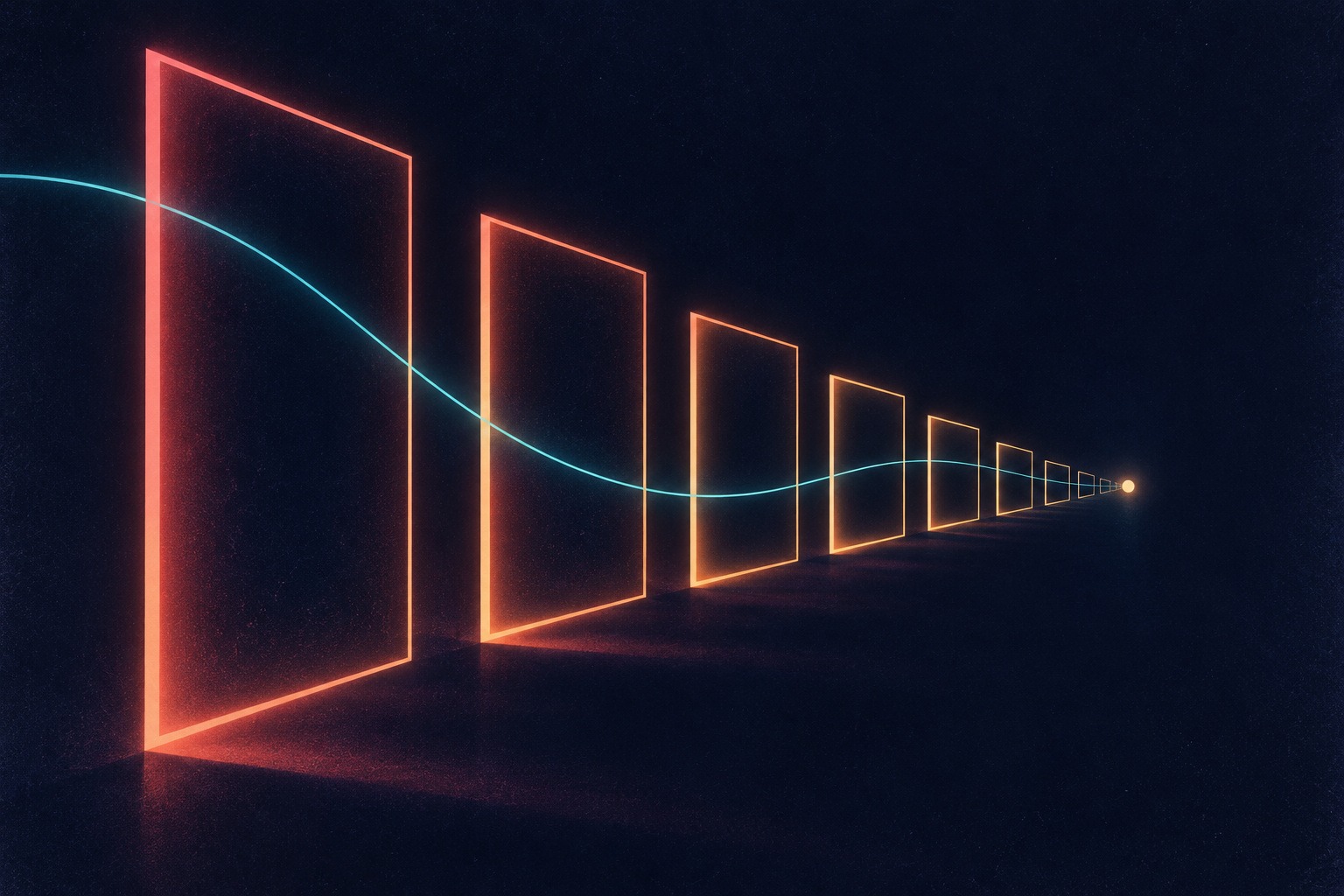
Geometric depth, repeated intervals and selective light create anticipation; dark fields give cyan, coral and amber accents room to carry the composition.
Futuresynth: a visual interpretation of an overlapping music label
Futuresynth is a term used in the orbit of synthwave and retrowave. Its boundaries are not consistent enough to treat it as a separate, formally established visual-art movement. Paul Ballam-Cross’s research on these music cultures notes that futuresynth, outrun and retrowave are sometimes used interchangeably with synthwave. RetroSynth Records also uses futuresynth among overlapping scene labels. [1, 2]
This AOI guide uses the name for a practical visual interpretation: imagined futures expressed through electronic rhythm, geometric space, selective luminous color and a sense of anticipation. That working definition is editorial, not a newly discovered historical school. AOI did not coin the word. The new illustrations are original studies made for this guide, while the broader cultural vocabulary belongs to many artists, designers, musicians and audiences.
Context without an invented founding story
Ballam-Cross examines how synthwave, chillwave and vaporwave construct nostalgia through sound, imagery and imagined memories. His synthwave discussion connects the visual culture with science-fiction cinema and games, while distinguishing it from adjacent genres. The useful lesson is that a future-looking image can also express a remembered or imagined past. This does not make every pink-and-blue image part of one coherent movement. [1]
The earlier AOI entry assigned a precise founding story, asserted a fixed fusion of musical genres and listed unrelated historical paintings as Futuresynth works. Those claims are not retained. This guide does not nominate a single inventor, universal tempo, mandatory instrument or definitive artist roster. For examples of the living music scene, NewRetroWave provides releases, interviews and visual material; specific artwork credits should be checked on the relevant release rather than inferred from a musician’s name. [3]
Visual grammar: depth, rhythm and a destination
Begin with a clear spatial proposition. A platform, corridor, coast or abstract sequence of frames can suggest somewhere the eye is traveling toward. Give that destination a reason to matter: an isolated light, a change in scale or a small interruption in the rhythm. Perspective is useful because it translates repetition into movement across a still image.
Build three layers: a dark foreground anchor, a readable middle-distance structure and a comparatively quiet background. Repeat a limited shape family, then vary the intervals. A rail of lights becomes more interesting when one gap or bend changes its rhythm. A field of unrelated decorative symbols offers fewer clues about where to look.
The connection with electronic music is an analogy for composition, not a claim that a certain hue represents a measurable sound. Repetition can suggest pulse, a luminous accent can suggest an attack, and a broad gradient can suggest sustained atmosphere. Use those comparisons to make choices while allowing the artwork to function without a soundtrack.
Palette and light: reserve brightness for a reason
A useful starting palette is midnight indigo, muted violet, a narrow cyan accent and a small amber or coral highlight. Suggested working swatches are #101733, #563664, #48C9D8 and #F2A85A. They are AOI design suggestions, not historical standards or measurements of every illustration. The palette can be warmer, quieter or nearly monochrome while keeping the same relationships.
Make glow selective. If every contour shines equally, objects lose weight and distance becomes difficult to read. Let a few edges carry light while broad surfaces remain subdued. Check a grayscale preview: the composition should still have a dominant value relationship. In a reflective scene, place reflections where the surface and light source support them rather than scattering bright streaks for atmosphere.
Three studies, three different problems
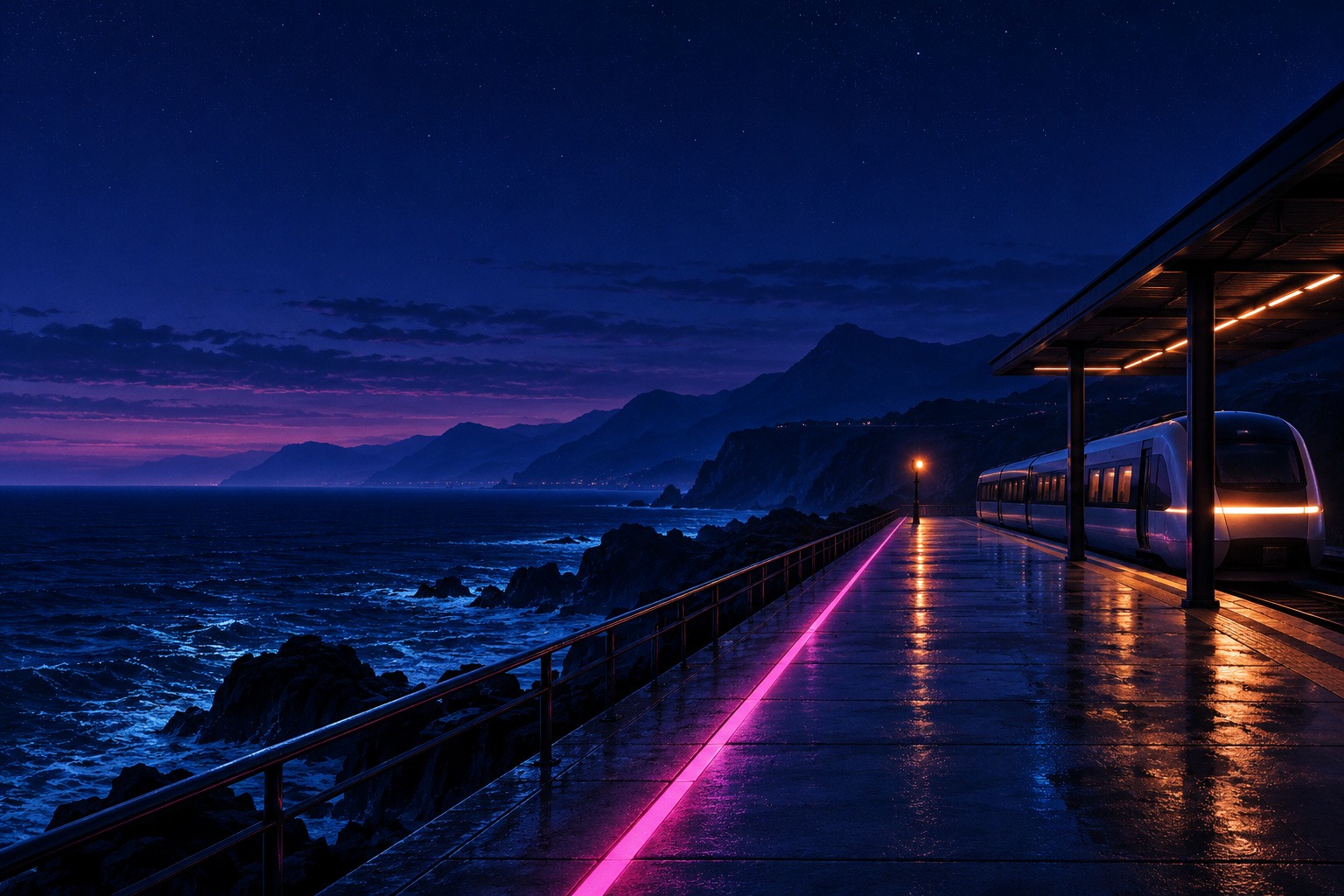
The coastal platform study combines a receding light strip, an empty platform and a compact train. Its broad dark sea and sky leave the warm beacon and narrow magenta line room to direct attention. The sense of futurity comes from simplified forms and lighting, with no need for a crowded city or flying vehicles.
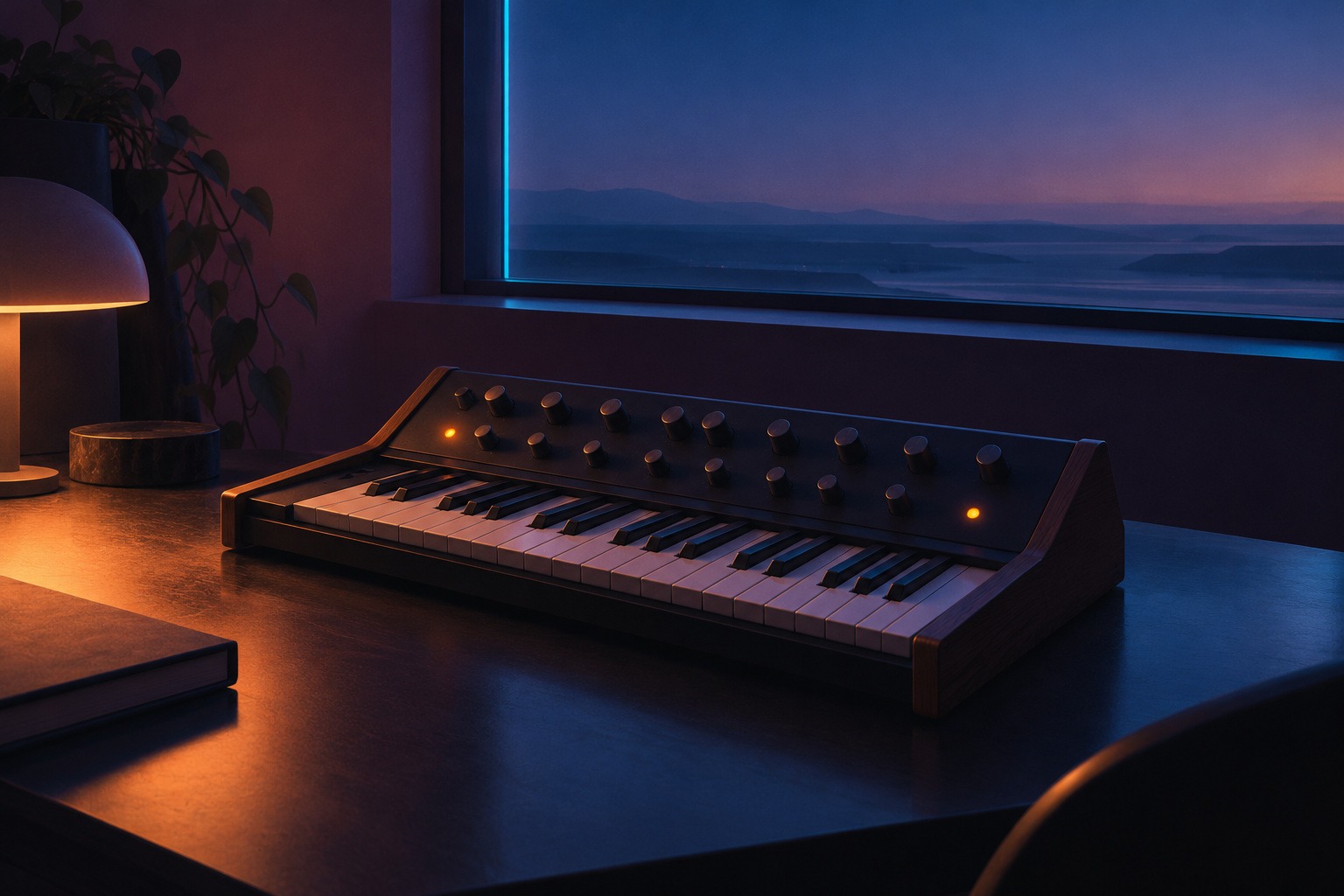
The studio study shifts to an intimate scale. A fictional synthesizer sits beneath a window between warm lamplight and cool evening tones. The instrument connects the image with music, but the real compositional problem is the balance of desk, window and shadow. It is a generated prop with simplified details, not documentation of an actual playable instrument or a particular manufacturer’s design.
The abstract signal study removes the recognizable scene. Receding rectangular frames and a curved cyan line create rhythm through scale and spacing. Its small bright endpoint provides a destination. This variation tests how much of the visual idea survives without a skyline, vehicle, performer or sunset.
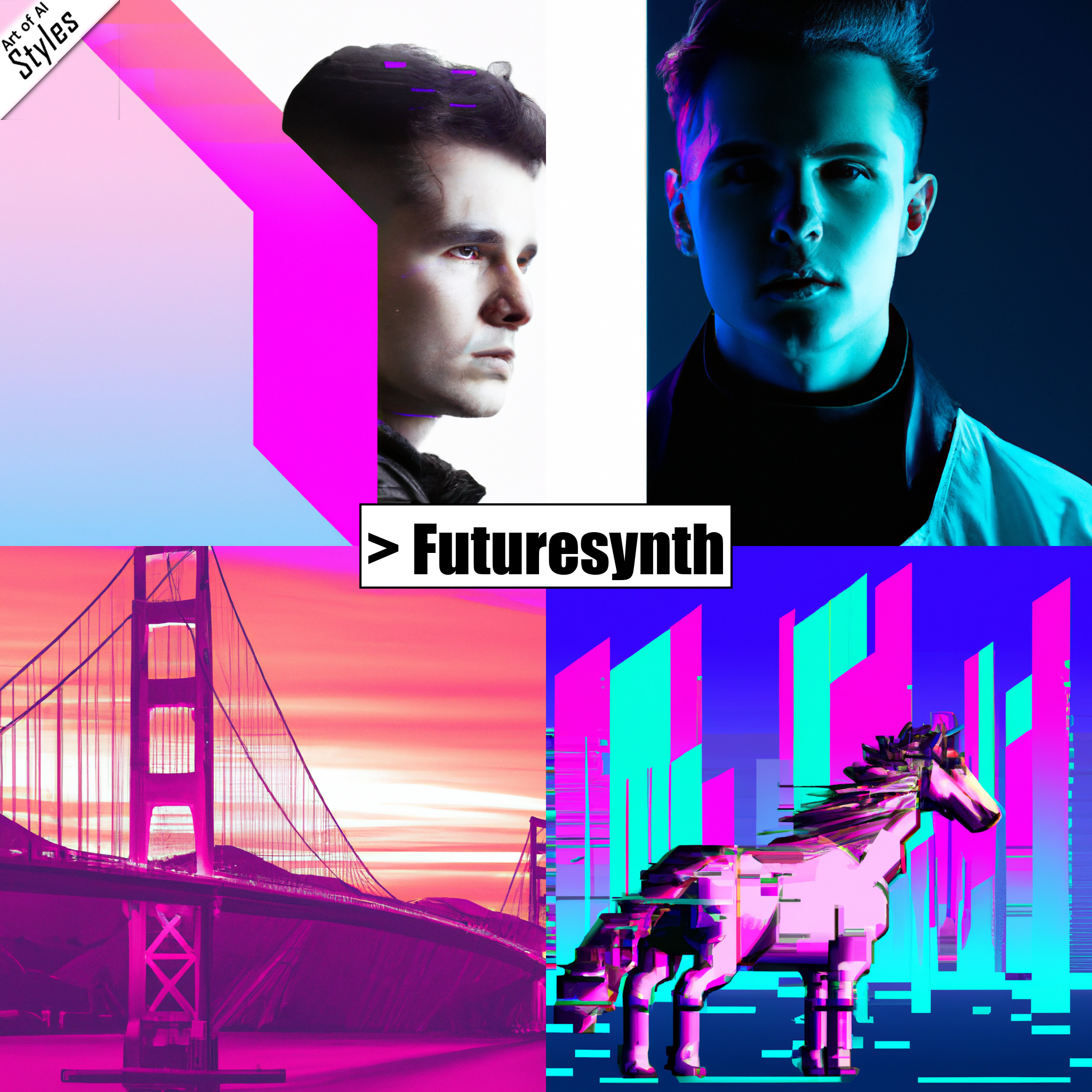
The new banner combines a harbor panorama with a curved observation terrace. The retained centered-title collage presents a more familiar collection of neon scenes and figures. An earlier portrait-and-bridge collage remains as an archive comparison. None of these images is an authenticated historical artwork or evidence for a musical origin story.
Related aesthetics and useful boundaries
Synthwave is the most direct neighboring reference in the sources used here. For this guide, Futuresynth emphasizes the visual problem of anticipation: how a scene or sequence points toward a destination. This is a local editorial emphasis, not a claim that the entire music scene recognizes a separate category. [1, 2]
Compare different intentions instead of treating labels as interchangeable filters. A nostalgic cover may foreground remembered objects; a speculative scene may foreground an unfamiliar environment; an abstract poster may communicate through spacing alone. Adding a neon grid to all three can erase those differences. If a project has a particular narrative, let that narrative determine which references belong.
Make a study that survives without its clichés
Write a brief with a subject, a spatial rule and a mood. For example: an empty station, one diagonal route, quiet expectation. Draw the large dark and light shapes first. Add one repeating structure and one controlled deviation. Choose a dominant cool field and a limited warm focal area, then test the result at thumbnail size before introducing texture.
Make a second version with the most obvious motif removed. Replace the sunset with a beacon, the sports car with a platform, or the skyline with abstract frames. If the picture loses all identity, its structure needs work. If the atmosphere remains legible, the image has a more flexible visual vocabulary.
For an album cover or poster, leave deliberate room for readable typography and test the crop. For motion work, animate a restrained change in light or spacing instead of moving every element. A loop should have a considered rhythm and an intentional return. Avoid presenting a generated still as an animated or interactive work unless that behavior has actually been created.
Prompt vocabulary and quality checks
Useful terms describe decisions: off-center destination, repeated intervals, dark foreground anchor, selective edge light, restrained cyan, small amber focal point, atmospheric gradient, clear silhouette and quiet negative space. Combine a few with a concrete subject. Long strings of genre labels often leave the model to supply a familiar visual cliché.
Inspect perspective, repeated structures, instrument details and reflections. Keep invented writing out of a scene unless you intend to replace it with designed typography. Ask whether the brightest area is also the most meaningful area. If not, reduce it or give the focal point a stronger shape. Retain a version without bloom or grain so that finishing effects do not conceal weak composition.
About the text, images and sources
This is an AI-authored AOI guide under Penny Wraiter, AOI’s editorial persona. Sources establish the use and cultural context of the term; the visual exercises, palettes, poem and new images are AOI interpretations. Four new AI-generated images extend the two preserved archive images. The exact generation requests are retained with the asset records. No claim is made that these pictures demonstrate a distinct historical school or reproduce a musician’s commissioned cover art.
A small poetic detour
Original words from the AOI studio.
Poetry
The platform keeps its quiet.
One light travels farther
than the train.
Across the water, windows
practice another tomorrow.
We borrow their color
and leave the skyline unfinished.
A line recedes,
a pulse becomes a distance.
The future waits
where the dark still has room.
The prompt workshop
Original creative exercises. These prompts create new illustrations, not documentary evidence.
A destination in the dark
Create an original retrofuturistic illustration of an empty coastal rail platform at night. Use one diagonal light strip toward a small amber beacon, dark indigo sea and sky, a compact fictional train and restrained cyan reflections. Keep perspective coherent and most surfaces quiet. No signage, brands, copied movie scene or obligatory sunset disc.
Bring the future indoors
Create an original quiet electronic-music-inspired interior: a fictional unbranded synthesizer on a desk under a wide blue-hour window, warm lamplight, muted plum walls and one narrow cyan reflection. Organize the scene through light and shadow rather than neon clutter. No text or manufacturer logos. Treat the instrument as a fictional prop, not a technical illustration.
Translate pulse into spacing
Create an original abstract composition of thin coral-to-amber rectangular frames receding across an indigo field. Let a single cyan curve cross the sequence and end near a small warm point. Keep generous empty space, clear scale progression and controlled edge glow. No city, vehicle, sun, text or decorative interface.
A smile from the studio
Jokes
The future arrived early. I asked it to wait until the final render finished.