
Material and subject-based practice
Food art uses ingredients as sculptural material, pictorial subject or a means of participation. Its most compelling works make texture, appetite, transformation and the act of sharing part of the meaning.
A visual introduction
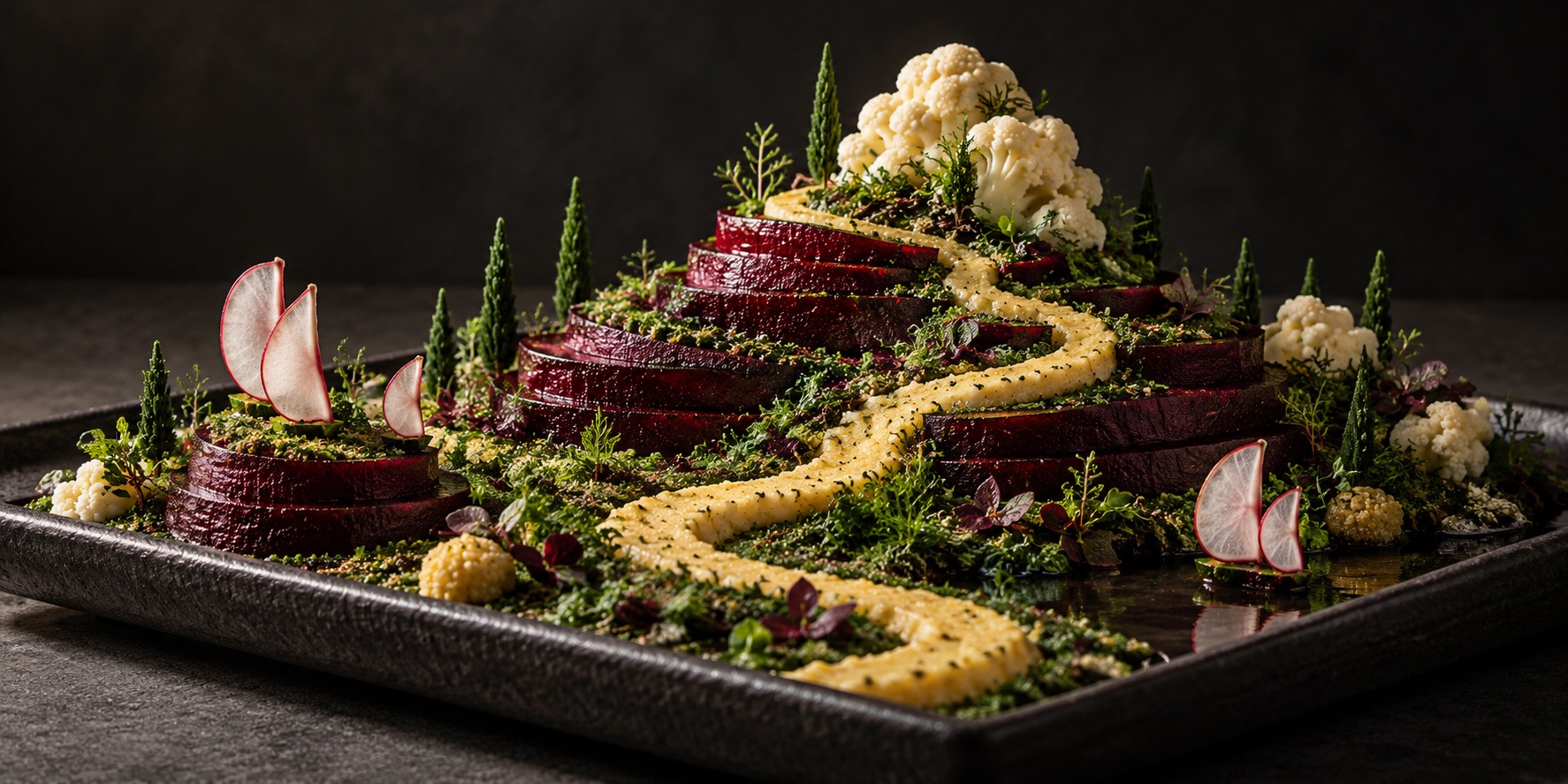
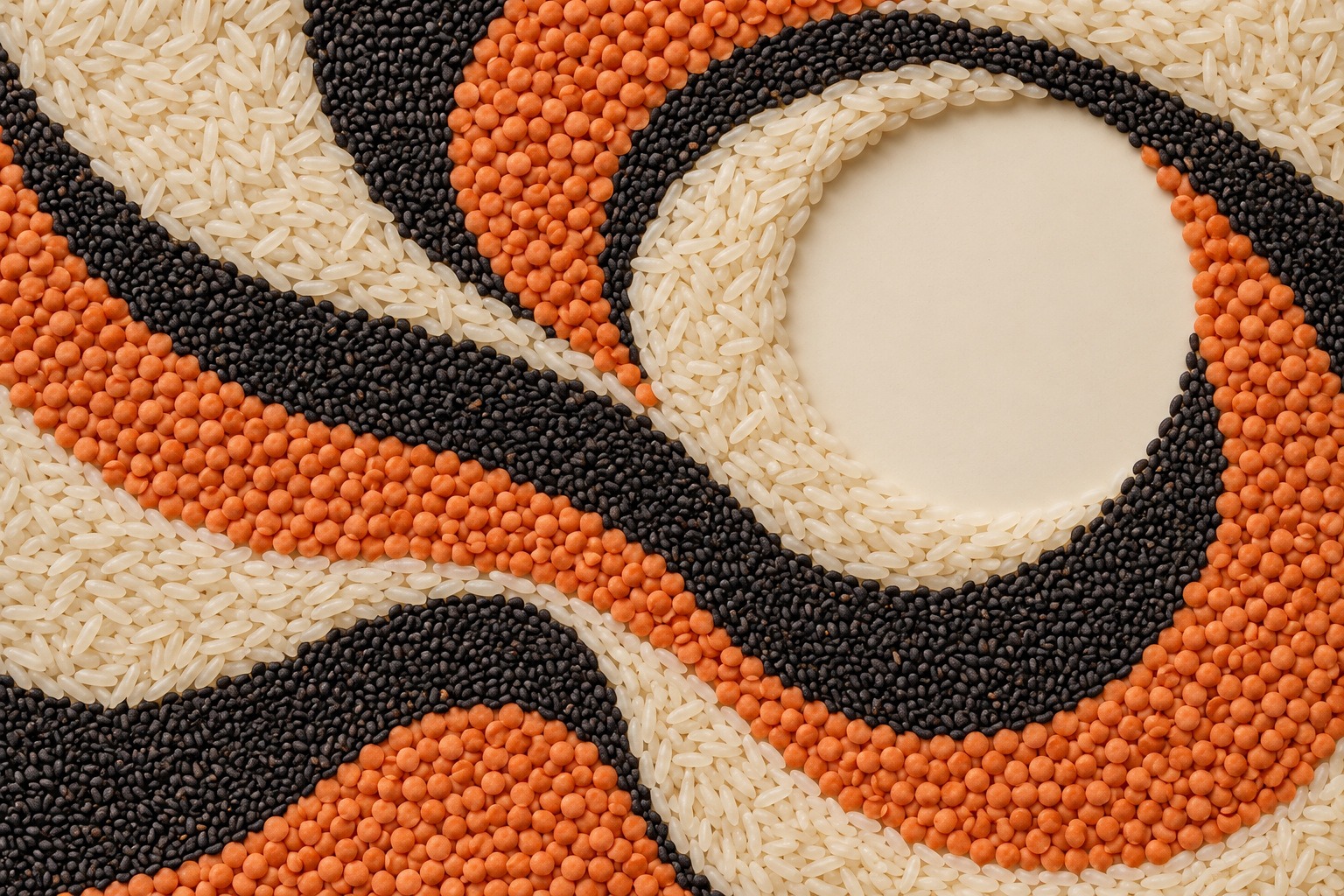
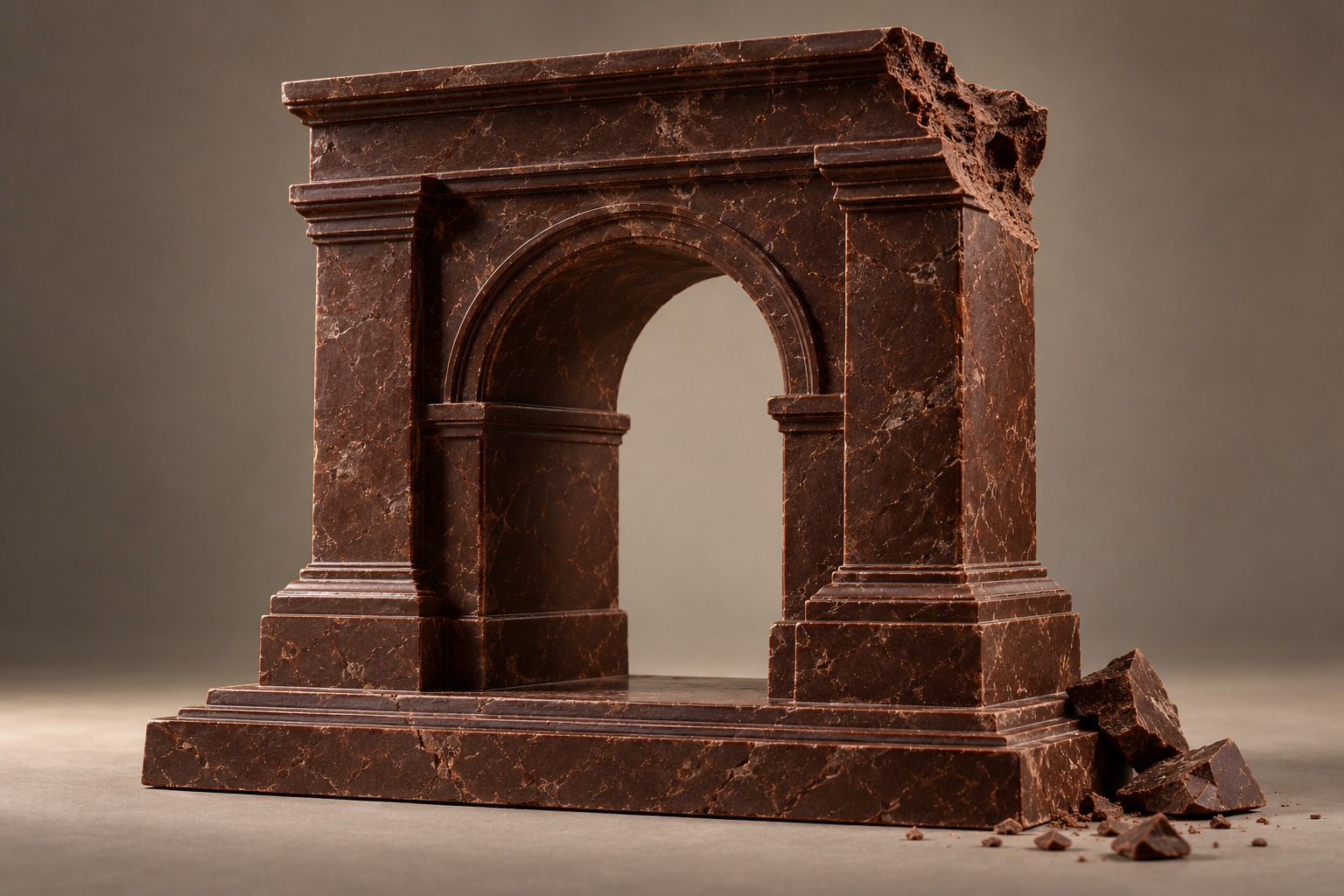
Compare food as sculptural material, ornamental arrangement and depicted subject. The new AI-generated landscape, grain mosaic and chocolate monument explore volume, negative space and fragility; the retained illustrations broaden the comparison.
Select an image for a closer look. Use the thumbnails, arrow keys or a swipe to compare examples. Zoom in to inspect details, or share the image that inspires you.


Creative toolbox · take this style further
Choose an input and a destination. Search sends your words to the chosen site; Copy & open puts them on your clipboard to paste there.
Create with AI
Turn your chosen input into an image prompt or a new creative direction.
ChatGPT
Copy your input and paste it into a ChatGPT conversation or image request.
Copy & open ChatGPT (new tab)Claude · Anthropic
Develop an image prompt or explore the style in a new Claude conversation.
Copy & open Claude · Anthropic (new tab)Midjourney
Paste your input into the Imagine bar on the Create page.
Copy & open Midjourney (new tab)Adobe Firefly
Copy your input, open Firefly, and paste it into the prompt field.
Copy & open Adobe Firefly (new tab)Leonardo.Ai
Copy your input, open Leonardo, and paste it into the generation field.
Copy & open Leonardo.Ai (new tab)Image search
Find visual references. Short, concrete keywords usually work best.
Lexica
Search AI images and prompts using your selected input.
Search with this input Lexica (new tab)Pexels
Search the photo and video library. Short keywords often work best.
Search with this input Pexels (new tab)Pixabay
Search photos, illustrations and other images.
Search with this input Pixabay (new tab)Unsplash
Search photographs using the style name or your own keywords.
Search with this input Unsplash (new tab)Wikimedia Commons
Search photographs, artworks and historical images. Check each file for its source and reuse terms.
Search with this input Wikimedia Commons (new tab)Art & research
Explore artists, collections and the ideas behind a style.
Wikipedia
Search for background reading. A style may not have its own article.
Search with this input Wikipedia (new tab)WikiArt
Copy your input into WikiArt’s search to explore artists and artworks.
Copy & open WikiArt (new tab)Europeana
Paste your keywords into the search to explore European museum, library and archive collections.
Copy & open Europeana (new tab)Inspiration
Discover portfolios and visual ideas from creative communities.
Instagram hashtags
Search a hashtag made from your input: spaces and punctuation are removed. Instagram may require sign-in.
Search with this input Instagram hashtags (new tab)ArtStation
Paste your input into artwork search for concept art, environments, characters and visual development.
Copy & open ArtStation (new tab)Behance
Paste your input into project search for illustration, design and visual storytelling.
Copy & open Behance (new tab)A closer look
Recognizable ingredients become shapes, surfaces and spatial structures: sliced layers, porous crumbs, glossy skins, granular fields and translucent edges. Scale, negative space and directional light make the transformation legible.
What counts as food art?
Food art is a broad field, not a single movement with one founder or palette. Three approaches help clarify it. Food can be the material of an object, the subject of a painting or photograph, or the basis of an event in which preparing, sharing or consuming matters. These approaches can overlap, but a picture of bread and a sculpture made from bread ask different questions. Culinary presentation adds another context: an arrangement may be designed for both looking and eating.
The useful test is what the food contributes beyond decoration. Does a brittle surface suggest fragility? Does an oversized portion turn abundance into absurdity? Does a missing slice record another person’s participation? A convincing work makes the ingredient necessary to its idea. Adding strawberries to an otherwise unrelated scene does not automatically create that relationship.
Material, change and participation
Harvard Art Museums’ discussion of Dieter Roth’s Chocolate Lion (Self-Portrait as a Lion), 1971, describes a sculpture in marbled chocolate whose deterioration relates to the changing human body. Food here is a material with a lifespan, rather than simply a pleasant motif. In a different practice, Prudence Staite describes chocolate paintings, edible sculptures and an interactive room made to invite sensory participation. Together these examples show why food art cannot be reduced to attractive plating or assumed to be intended for consumption.
Build a visual grammar from ingredients
Start with the ingredient’s actual structure. A citrus cross-section supplies radial divisions; a torn loaf supplies irregular pores; stacked beet slices supply contour lines. Repeat one structural feature, then interrupt it once to establish a focal point. Keep the component shapes readable at normal viewing distance. When every surface is equally intricate, the viewer sees a grocery inventory before seeing a composition.
Choose a palette for the intended effect. Burgundy, dark green and cream can produce a quiet sculptural scene; orange peel against blue ceramic can create a brisk complementary contrast. Neither scheme defines the entire field. Combine matte and reflective surfaces deliberately, and use side light when ridges, crumbs or cut edges need emphasis. Overhead views favor pattern; lower viewpoints reveal volume, supports and the spaces between components.
Compose, document and explain
Work from one spatial proposition: a landscape built from layers, a mosaic built from grains, or a monument shaped from chocolate. Establish a dominant mass before adding small accents. Make the base, contact shadows and scale consistent, so the construction feels intentional. Empty space around the arrangement can be as expressive as abundance. A single broken edge may tell more than another elaborate garnish.
Documentation is part of the decision. A close view can reveal material identity, while a wider view can show a setting or participants. If a work changes over time, identify the moment being shown rather than implying permanence. For real projects, explain the intended relationship between display and consumption. Do not infer that an object is edible merely because its surface resembles food.
Use the idea in generated imagery
Describe ingredients, construction, scale, viewpoint and lighting before adding mood words. Ask for a seed mosaic with distinct grains, for example, rather than an unspecified edible masterpiece. Examine the result for floating components, fused textures and materials that look like plastic. The generated studies here illustrate visual possibilities; they document neither a fabricated physical object nor a tested recipe. Their value lies in helping compare compositional decisions before a real project is planned.
About this guide
This AI-authored AOI guide appears under Penny Wraiter, AOI’s editorial persona. Sources support the historical context; exercises, prompts and poetry are original editorial interpretations. Image captions distinguish generated studies from documented works.
A small poetic detour
Original words from the AOI studio.
Poetry
A peel unwinds its borrowed sun,
The beet lays down a purple stair;
A thousand grains become as one,
Then part to leave a crescent bare.
The crumb remembers being whole,
The chocolate keeps a warming seam;
A table gives the work its role,
And hunger interrupts the dream.
The prompt workshop
Original creative exercises. These prompts create new illustrations, not documentary evidence.
Start with one ingredient
Original food-art study: a fan of thin radish slices forms a single open spiral on an ivory ceramic plate, translucent crimson edges, generous negative space, one soft side light, overhead view, visibly recognizable ingredients, no lettering. Preserve an intentional gap as the focal point.
Construct a small landscape
Imagine a terraced landscape built from layered beet slices, herbs and a winding pale polenta path on dark ceramic. Low three-quarter view, coherent supports, one dominant hill, restrained burgundy-green-cream palette, directional light revealing moisture and cut edges. An imagined sculpture, not an existing artwork.
Make absence the subject
A top-down abstract mosaic assembled from black sesame, pale rice and red lentils on a warm neutral tray. One clean crescent-shaped area has been removed, exposing the base. Strong granular texture, controlled curved bands, soft daylight, no utensils or words. Make the empty shape the focus rather than filling every space.
A smile from the studio
Jokes
The still life asked for a longer exhibition. The pear suggested a shorter contract.