
Historical movement
Figuration Libre brought exuberant figures and popular imagery into early-1980s French painting. Explore its comic rhythms, cultural openness and the compositional discipline behind apparently unruly scenes.
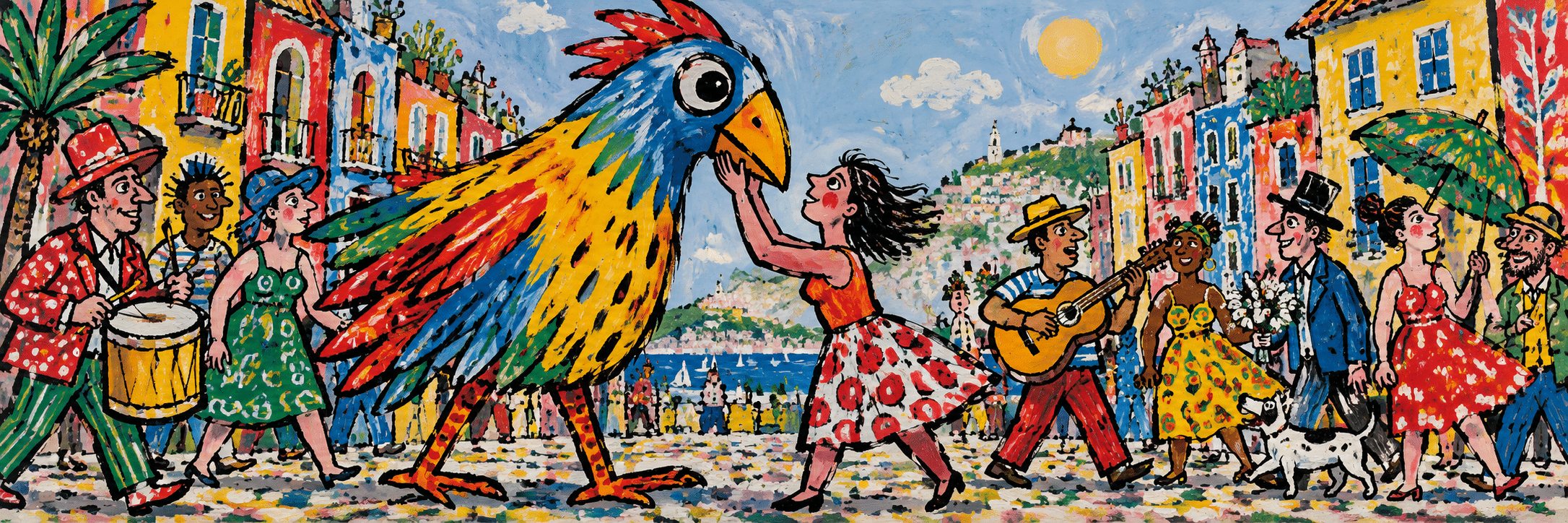
A visual introduction
Select an image for a closer look. Use the thumbnails, arrow keys or a swipe to compare examples. Zoom in to inspect details, or share the image that inspires you.
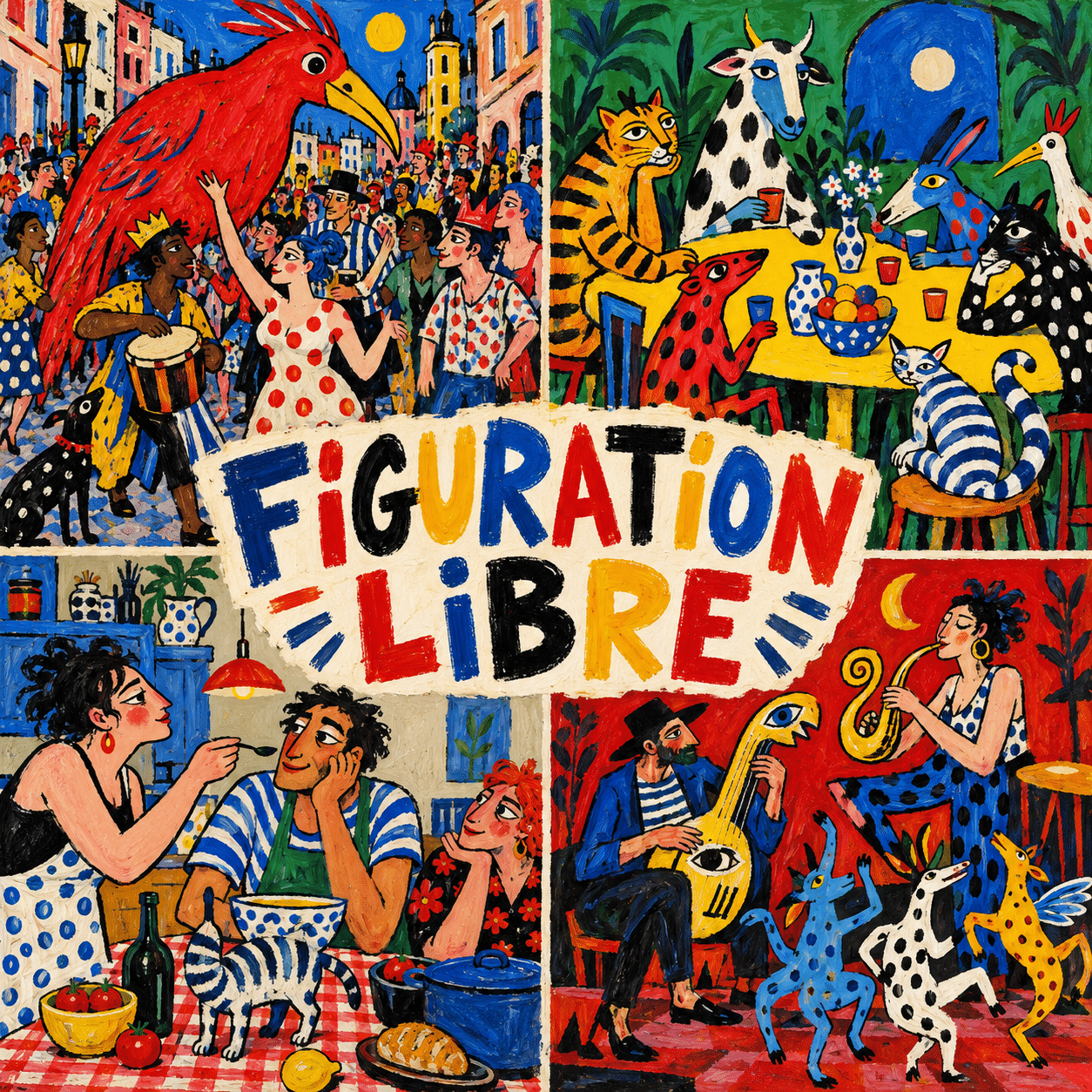
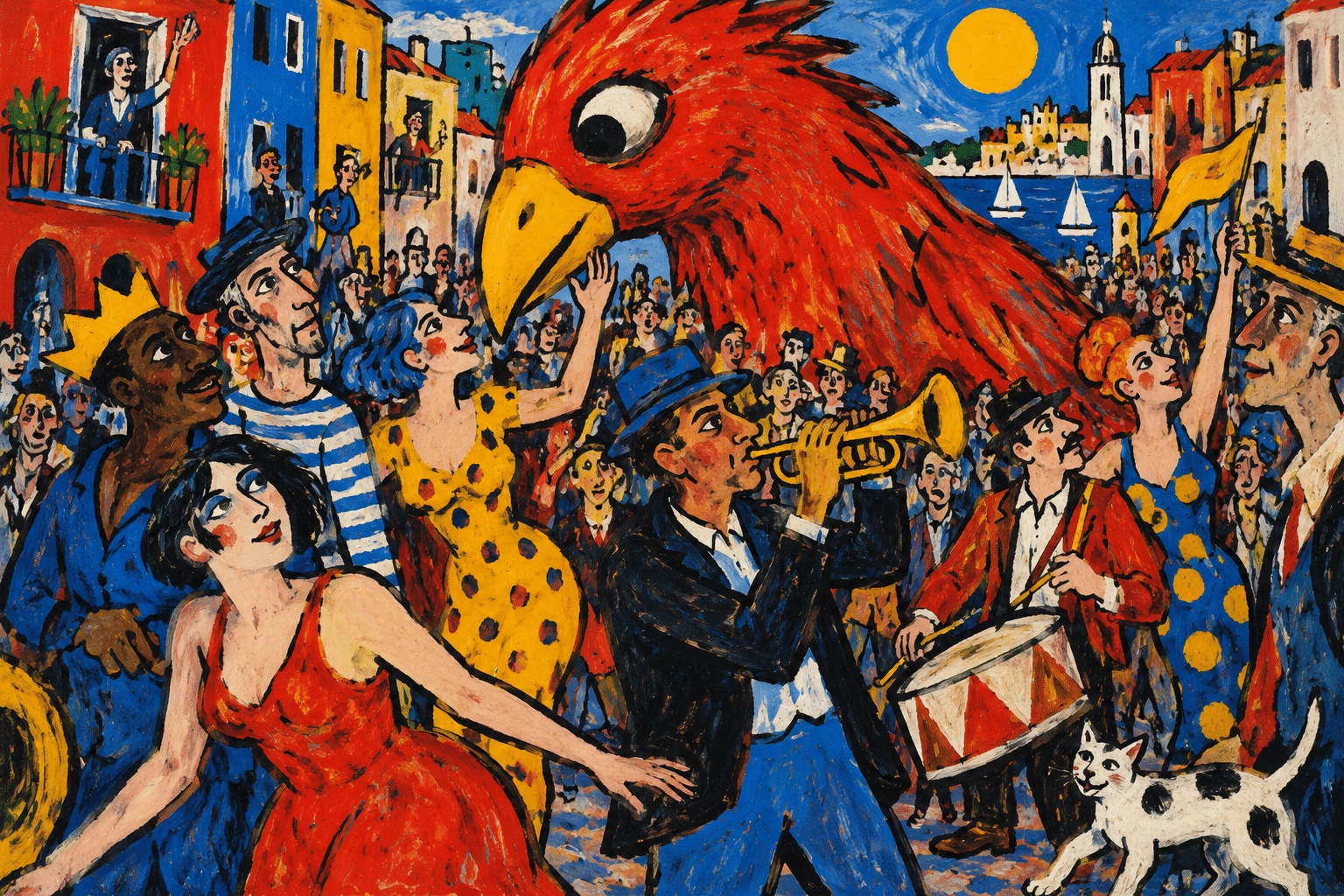
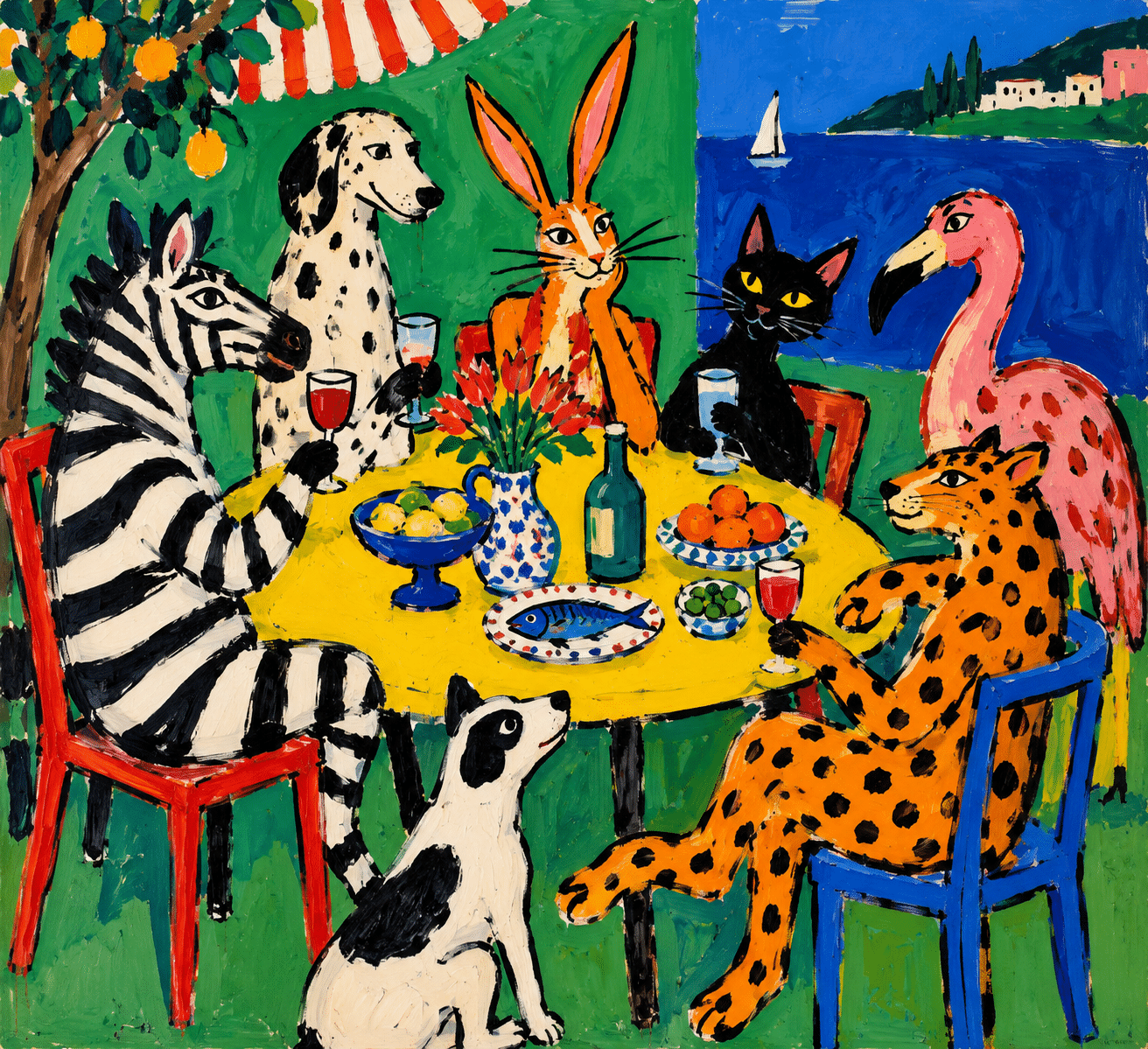


Creative toolbox · take this style further
Choose an input and a destination. Search sends your words to the chosen site; Copy & open puts them on your clipboard to paste there.
Create with AI
Turn your chosen input into an image prompt or a new creative direction.
ChatGPT
Copy your input and paste it into a ChatGPT conversation or image request.
Copy & open ChatGPT (new tab)Claude · Anthropic
Develop an image prompt or explore the style in a new Claude conversation.
Copy & open Claude · Anthropic (new tab)Midjourney
Paste your input into the Imagine bar on the Create page.
Copy & open Midjourney (new tab)Adobe Firefly
Copy your input, open Firefly, and paste it into the prompt field.
Copy & open Adobe Firefly (new tab)Leonardo.Ai
Copy your input, open Leonardo, and paste it into the generation field.
Copy & open Leonardo.Ai (new tab)Image search
Find visual references. Short, concrete keywords usually work best.
Lexica
Search AI images and prompts using your selected input.
Search with this input Lexica (new tab)Pexels
Search the photo and video library. Short keywords often work best.
Search with this input Pexels (new tab)Pixabay
Search photos, illustrations and other images.
Search with this input Pixabay (new tab)Unsplash
Search photographs using the style name or your own keywords.
Search with this input Unsplash (new tab)Wikimedia Commons
Search photographs, artworks and historical images. Check each file for its source and reuse terms.
Search with this input Wikimedia Commons (new tab)Art & research
Explore artists, collections and the ideas behind a style.
Wikipedia
Search for background reading. A style may not have its own article.
Search with this input Wikipedia (new tab)WikiArt
Copy your input into WikiArt’s search to explore artists and artworks.
Copy & open WikiArt (new tab)Europeana
Paste your keywords into the search to explore European museum, library and archive collections.
Copy & open Europeana (new tab)Inspiration
Discover portfolios and visual ideas from creative communities.
Instagram hashtags
Search a hashtag made from your input: spaces and punctuation are removed. Instagram may require sign-in.
Search with this input Instagram hashtags (new tab)ArtStation
Paste your input into artwork search for concept art, environments, characters and visual development.
Copy & open ArtStation (new tab)Behance
Paste your input into project search for illustration, design and visual storytelling.
Copy & open Behance (new tab)A closer look
Bold contours; intense colour; compressed pictorial space; animated figures and hybrid creatures; patterned surfaces; narrative collisions; deliberate movement between popular imagery and painterly invention.
Freedom to bring different images together
Figuration Libre emerged in France around 1981, with Robert Combas, Hervé Di Rosa, Rémi Blanchard and François Boisrond central to its early development. The Musée Paul Valéry’s historical account describes an energetic opening toward many forms of creation, with humour and provocation playing important roles. The term names a particular historical constellation, not every freely painted figure.
The same museum places the French painters in dialogue with international contemporaries including Keith Haring and Jean-Michel Basquiat. These encounters matter, but dialogue does not make distinct artists and scenes interchangeable. Avoid turning an international exchange into a single homogeneous movement or assigning every brightly coloured cartoon-like painting to Figuration Libre.
Popular culture becomes pictorial material
Comics, everyday images and playful invented worlds provide useful ways to understand the movement’s openness. Figures need not obey academic proportion, and a picture can move between the humorous, strange and confrontational. The Centre Pompidou’s account of Di Rosa emphasizes his recurring narrative universe and work across techniques rather than a narrowly fixed signature style.
For a new interpretation, invent characters whose gestures create a readable event. A crowded scene can still have a protagonist, an interruption and a direction of movement. Let recognizable objects collide in unexpected ways, but choose those collisions for their narrative effect. Randomly scattering monsters and symbols produces quantity without the energy of an actual encounter.
Contour gives exuberance a structure
A strong dark outline can hold saturated colours apart and make compressed forms legible. Repeated curves, teeth-like patterns or angular limbs create rhythm across the surface. Variations in line thickness can distinguish the central action from surrounding noise, even when the drawing feels deliberately rough.
Begin with a few large masses before filling the gaps. The most crowded area should have a reason to be crowded. Leave a quieter patch where the eye can recover, or repeat one colour to connect distant figures. Apparent spontaneity becomes more persuasive when the viewer can follow the painting rather than merely register that it contains many things.
Colour and space can refuse polite separation
Flat colour areas may sit beside visible brushwork, and figures may share a shallow stage with patterns that behave almost like characters. Warm and cool colours can establish visual hierarchy without realistic shading. A compressed room, street or imaginary landscape offers a strong setting for these interactions.
The approach differs from simply enlarging a polished comic panel. A painting can keep awkward edges, expressive repainting and incompatible scales. Those choices should feel purposeful. Uniform digital smoothness may remove useful friction, while excessive distress can become another decorative effect. Decide which passages need clarity and which should remain restless.
A contemporary gallery with distinct encounters
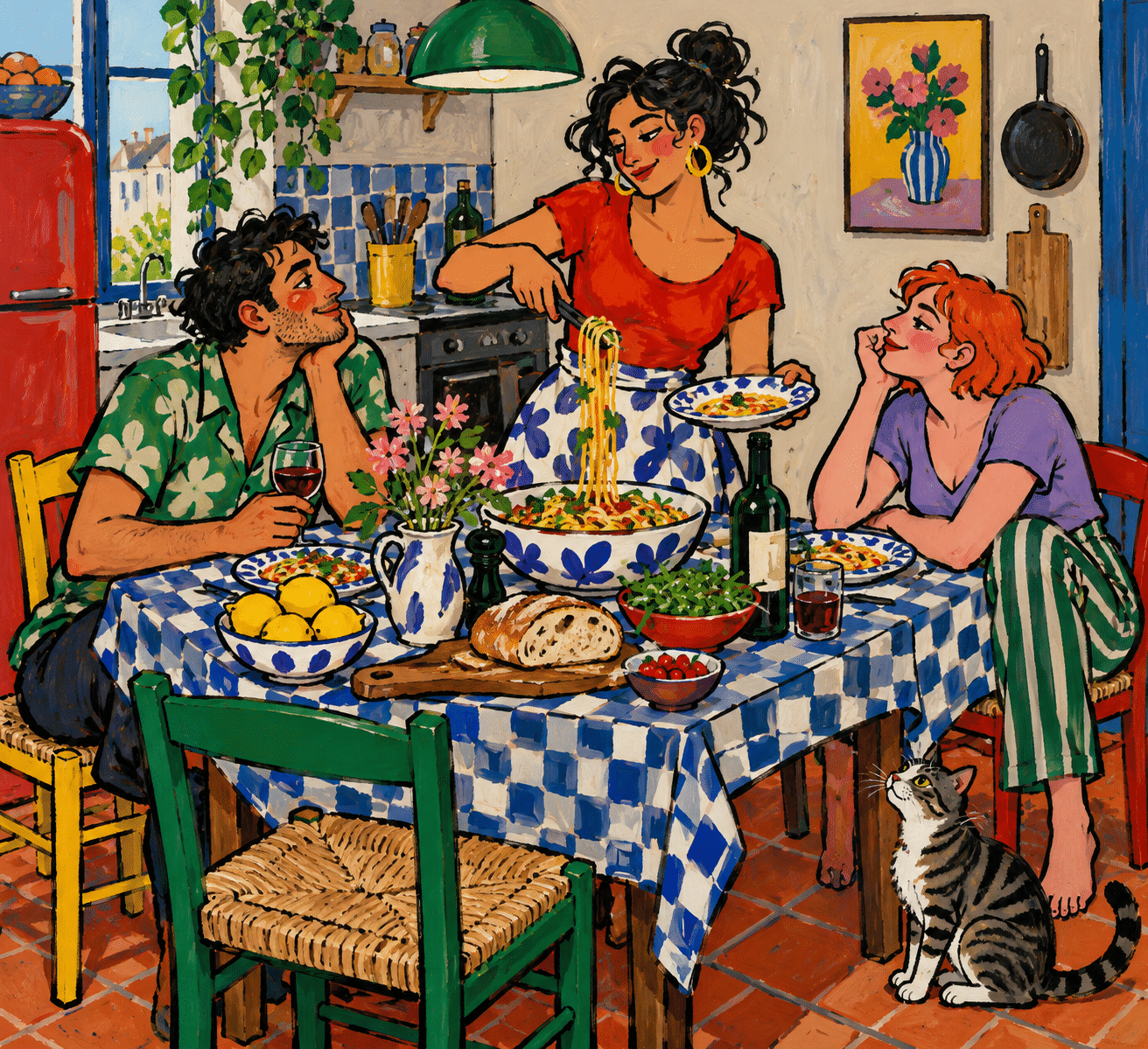
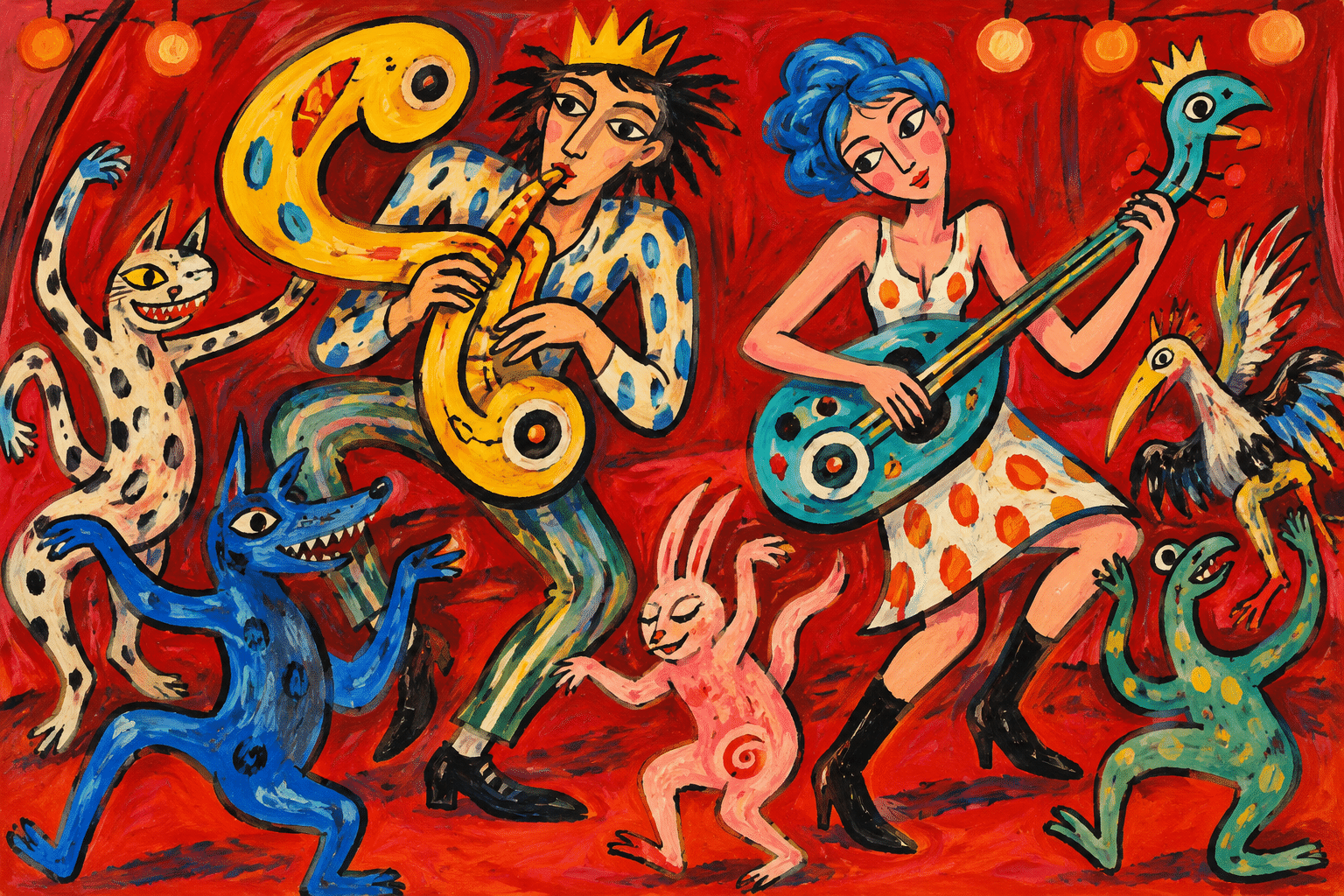
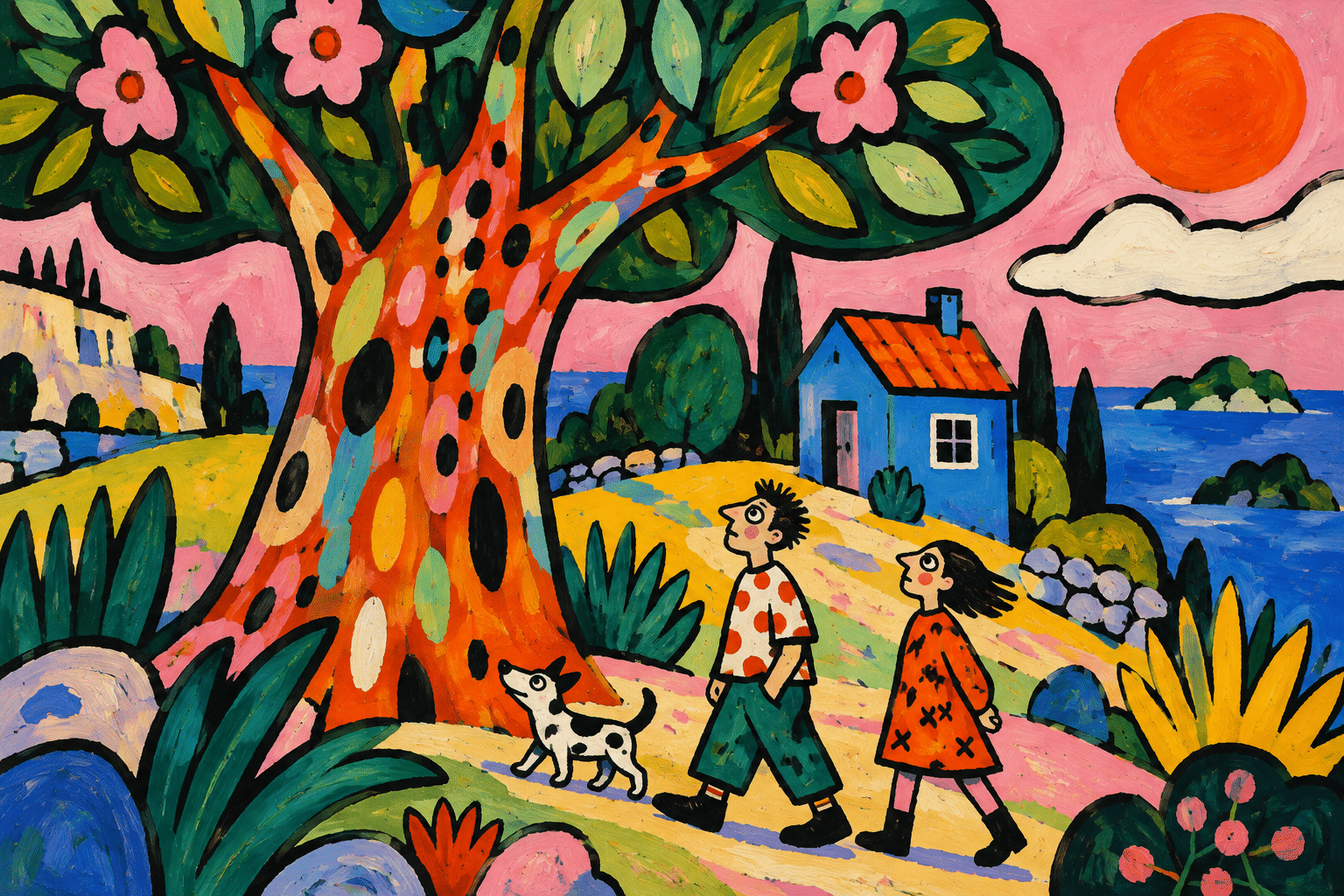
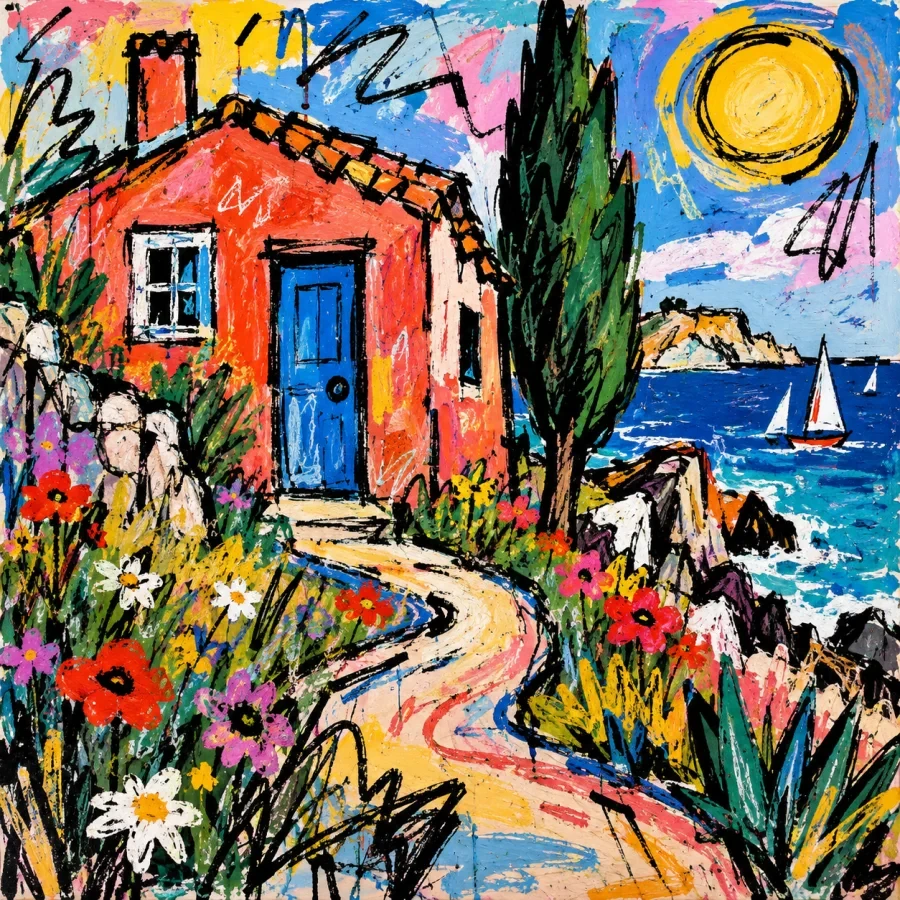
The new AI-generated studies include a street procession, an animal gathering, a domestic room, a musical encounter and a shallow imaginary landscape. Each uses original characters and compositions. They are educational interpretations of broad visual principles, not works by the historical artists, replicas of their recurring characters or evidence of a newly discovered period painting.
Prompt the action first: who meets whom, what interrupts the scene and where attention should travel. Then specify contour, palette, spatial compression and paint texture. Avoid asking only for “wild colourful art.” A clear narrative relationship makes the freedom productive and helps distinguish the five examples from variations of the same crowded surface.
Positive editorial assessment — AI-authored
Figuration Libre can make painting feel immediate, porous and full of life. Its strongest compositions turn popular imagery into personal invention, using contour and colour to connect unlikely participants. Humour can open the picture while painterly tension keeps it from becoming a disposable visual gag.
Critical editorial assessment — AI-authored
Imitations often equate freedom with indiscriminate clutter. Repeated cartoon faces, maximum saturation and uniformly loud detail can flatten the scene. Improve the image by giving one encounter priority, varying the rhythm and allowing awkwardness to serve expression rather than treating every accidental mark as valuable.
Neutral editorial assessment — AI-authored
Figuration Libre belongs to a specific early-1980s context and to a wider return of energetic figuration. Its principles are useful for narrative painting and expressive illustration, but the historical category should not replace attention to individual artists, works and international exchanges.
A small poetic detour
Original words from the AOI studio.
Poetry
The doorway opens like a shout;
a painted bird invents a street.
The yellow chair comes dancing out
on crooked, argumentative feet.
A heavy outline holds the day,
but leaves the colours room to run.
The picture has too much to say—
and finds a rhythm, one by one.
The prompt workshop
Original creative exercises. These prompts create new illustrations, not documentary evidence.
An unruly street encounter
Original energetic figurative painting of a small street procession interrupted by a giant friendly bird, bold dark contours, saturated red yellow and blue, compressed space and deliberately varied brushwork. Clear narrative hierarchy, original characters, no text or copied artwork.
A room full of personalities
Original expressive painting of three invented adults and a small striped animal in a crowded kitchen, asymmetrical gestures and patterned objects, strong outlines and flat colour with visible repainting. One main interaction and a quiet patch of wall, no lettering or artist imitation.
Rhythm becomes visible
Original figurative painting of two imaginary musicians and dancing hybrid creatures on a shallow stage, colour echoes and repeated curves conveying rhythm, dark contours and lively paint texture. Invented instruments are visibly fantastical, no famous characters or signatures.
Your next inspiration
Discover another art style
Follow a visual thread to the next subject.
Cartoon Drawing: Character, Exaggeration and Visual Timing
Compare cartoon drawing with its use in painting.
Dau al Set: Poetry, Strange Images and Barcelona’s Postwar Avant-garde
Explore another distinct collective and its imaginative imagery.
A smile from the studio
Jokes
The background applied for a speaking role. The figures agreed, provided it stopped interrupting every sentence.