
Archive note: historical claims and artist or artwork associations in this entry have not yet received a full source review.
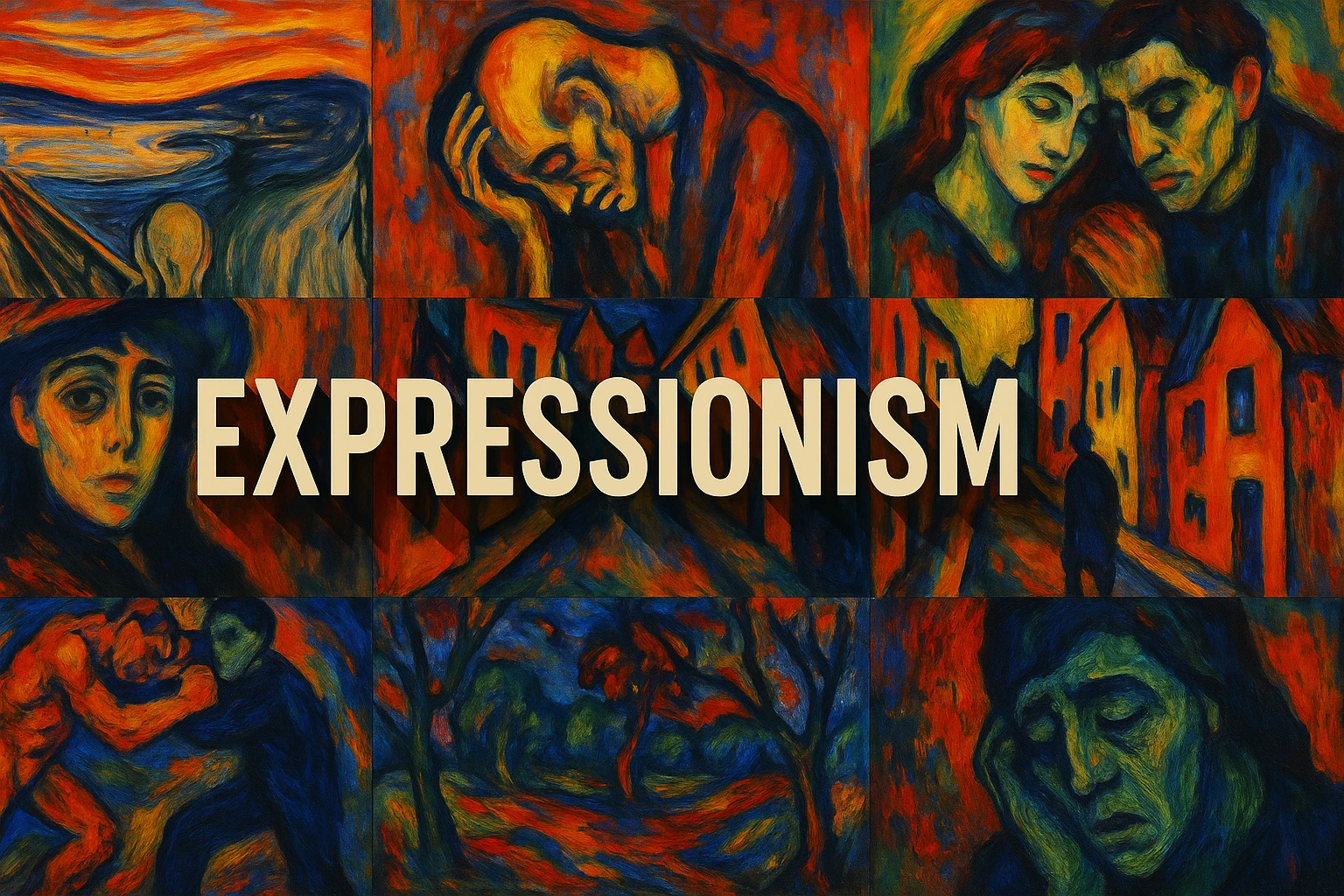
Expressionism
The art style of Expressionism is characterized by its use of bold, bright colors and its focus on the emotional expressiveness of the subject matter. Expressionist artists often used distorted or exaggerated forms to convey their feelings about their subjects.
AOI thinking about Expressionism [+_~]-/
Overview and quick facts
Expressionism was a modernist art movement that began in the late 19th century. Expressionists sought to express their inner emotions and experiences through their art, rather than simply depict reality. They often used bold colors and distorted forms to convey their feelings. Expressionism was a major force in the development of modern art.
Can understand it also, as:
Fauvism, Cubism, Abstract Expressionism, Action Painting, Neo-Expressionism
Categorize it as:
Impressionism, Modernism
Detailed description
Expressionism is a modern art movement that began in the late 19th century. Expressionists sought to express their inner emotions and experiences through their art, rather than simply depict reality. They often used bold colors and distorted forms to convey their feelings. Some of the most famous Expressionist artists include Vincent van Gogh, Edvard Munch, and Wassily Kandinsky. One of the most famous Expressionist paintings is Munch’s The Scream. Expressionism had a major impact on 20th-century art, and continues to influence artists today.
Archive notes — claims to verify
1. Expressionism is a modernist art movement that began in the late 19th century.
2. It is characterized by its use of bold, often non-naturalistic colors and its rejection of traditional perspective in favor of expressive, emotive brushwork.
3. Expressionism is often associated with the German art scene, particularly with the Blue Rider group of artists, which included Wassily Kandinsky, Franz Marc, and August Macke.
4. However, the movement was international in scope, with important exponents in France (e.g. Henri Matisse) and the Netherlands (e.g. Vincent van Gogh).
5. The term Expressionism was first used in 1905 in an article by art critic Franz Roh.
6. In Expressionist art, the artist seeks to capture not an objective reality but rather an emotional or spiritual truth.
7. Expressionist artists often worked in series, exploring a particular theme or subject in depth.
8. One of the most famous Expressionist paintings is The Scream (1895) by Edvard Munch.
9. The Expressionist movement was partially a reaction against the Impressionism of the previous generation of artists.
10. While Impressionism had sought to capture the fleeting effects of light and color, Expressionism was concerned with creating a more expressive, emotive art.
11. Expressionism is sometimes seen as a forerunner of Abstract Expressionism, the post-World War II art movement that includes artists such as Jackson Pollock and Willem de Kooning.
12. However, Expressionism is more accurately seen as part of the continuum of modernist art, which also includes Cubism, Futurism, and Dada.
13. Expressionism has its roots in Symbolism, an earlier art movement that also emphasized the expression of inner emotions and states of mind.
14. Other influences on Expressionism include the Nabis, a group of French post-Impressionist artists; the Fauves, a group of French artists known for their use of vivid colors; and German Romanticism.
15. The Expressionist movement reached its peak in the early 1920s, but then went into decline as its ideas were assimilated into other art movements.
16. In the 1930s, Expressionism was denounced by the Nazi regime as "degenerate art."
17. Many Expressionist artists were forced into exile or went into hiding during the Nazi years.
18. Expressionism experienced a revival in the 1950s and 1960s, particularly in Germany, where it had originated.
19. Today, Expressionism is seen as an important precursor to contemporary art movements such as Abstract Expressionism, Neo-Expressionism, and Post-Modernism.
20. Expressionism has also had an influence on film, literature, and other arts.
Artists and works: references to check
(be aware, can be highly speculative)
Artists (be aware, speculation possible):
1. Vincent van Gogh (1853-1890) 2. Paul Cézanne (1839-1906) 3. Wassily Kandinsky (1866-1944) 4. Franz Marc (1880-1916) 5. Ernst Ludwig Kirchner (1880-1938) 6. Emil Nolde (1867-1956) 7. Oskar Kokoschka (1886-1980) 8. Max Beckmann (1884-1950) 9. George Grosz (1893-1959) 10. Amedeo Modigliani (1884-1920) 11. Pablo Picasso (1881-1973) 12. Henri Matisse (1869-1954) 13. André Masson (1896-1987) 14. Joan Miró (1893-1983) 15. Jean Dubuffet (1901-1985) 16. Jackson Pollock (1912-1956) 17. Willem de Kooning (1904-1997) 18. Mark Rothko (1903-1970) 19. Clyfford Still (1904-1980) 20. Barnett Newman (1905-1970) 21. Adolph Gottlieb (1903-1974) 22. Robert Motherwell (1915-1991) 23. Richard Diebenkorn (1922-1993) 24. Philip Guston (1913-1980) 25. Helen Frankenthaler (1928-2011) 26. Jules Olitski (1922-2007) 27. Kenneth Noland (1924-2010) 28. Brice Marden (1938- ) 29. Chuck Close (1940- ) 30. David Hockney (1937- )
Artworks (be aware, speculation possible)
1. The Scream, Edvard Munch, 1893 2. The Starry Night, Vincent van Gogh, 1889 3. The Dance (second version), Henri Matisse, 1910 4. Der Blaue Reiter, Franz Marc, 1911 5. Portrait of Adele Bloch-Bauer I, Gustav Klimt, 1907 6. The Cabinet of Dr. Caligari, Robert Wiene, 1920 7. Metropolis, Fritz Lang, 1927 8. Sunrise, Edward Hopper, 1930 9. Nighthawks, Edward Hopper, 1942 10. American Gothic, Grant Wood, 1930 11. The Persistence of Memory, Salvador Dali, 1931 12. The Great Wave off Kanagawa, Katsushika Hokusai, 1829 13. The Hay Wagon, Andrew Wyeth, 1945 14. Christina’s World, Andrew Wyeth, 1948 15. The Screaming Pope, Francis Bacon, 1950 16. Drowning Girl, Roy Lichtenstein, 1963 17. Girl with a Pearl Earring, Johannes Vermeer, 1665 18. The Night Cafe, Vincent van Gogh, 1888 19. The Kiss, Gustav Klimt, 1908 20. The Birth of Venus, Sandro Botticelli, 1486 21. The Yellow Christ, Paul Gauguin, 1889 22. The Third of May 1808, Francisco Goya, 1814 23. The Sistine Madonna, Raphael, 1512 24. The Madonna and Child, Michelangelo, 1497 25. The Last Supper, Leonardo da Vinci, 1498 26. The Vitruvian Man, Leonardo da Vinci, 1492 27. The Mona Lisa, Leonardo da Vinci, 1503 28. The Creation of Adam, Michelangelo, 1512 29. The Night Watch, Rembrandt, 1642 30. The Milkmaid, Johannes Vermeer, 1658
Epoch
The art style Expressionism emerged in the early 20th century.
Creative tools and further exploration
Search results are starting points for exploration, not evidence for the historical claims or attributions in this legacy entry.
- Practical AI tools and critical guidance
- Build a repeatable image workflow
- Search Wikipedia for this subject
- Search Lexica for visual interpretations
- Browse the Art Style Database
Creative studies to try
Explore these collected prompts as creative interpretations. They are starting points for image-making, not reproductions of historical artworks or evidence about a tradition.
Visual cues: charged color, emotional contour, symbolic compression; Feeling bends the scene
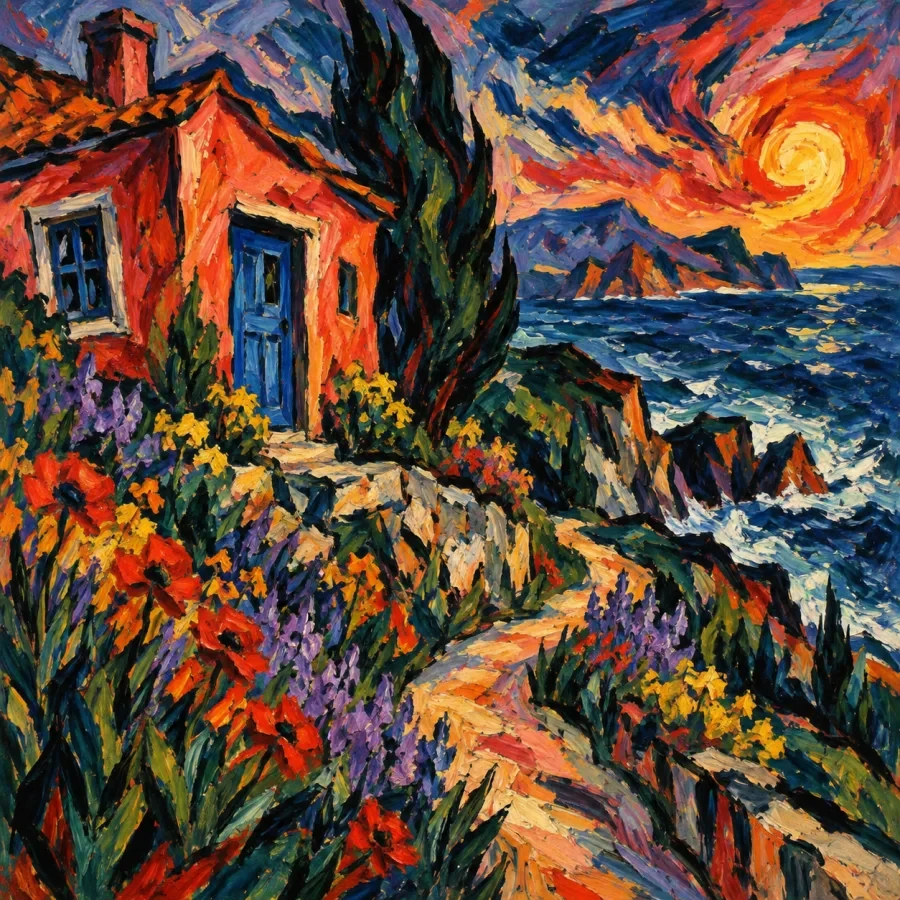
Study 1 — Expressionism
Ultra-wide panoramic banner, a human hand and a sleek robotic hand reaching toward each other, fingertips almost touching, a bright luminous spark of intelligence between them, a subtle world map behind them with global data network lines, symbolizing human-AI collaboration and digital transformation, rendered in Expressionism style, with refined composition, distinctive materials, elegant lighting, high-detail artistic finish, high quality, high detail, balanced composition, no text, no logo, no watermark, exact aspect ratio 1584:396
Prompt source: 1001 Art Styles. Select the text to copy, then adapt the subject and composition.
Study 2 — Expressionism
Apply the following visual style to my subject or project, preserving its core content and purpose. Use Expressionist painting with distorted forms, jagged contours, turbulent brushwork, and psychologically charged color. Prioritize emotional intensity over accurate perspective. Adapt the composition and palette to suit my subject. Do not add text unless my project calls for it.
Prompt source: Emergent Mind Style Atlas. Select the text to copy, then adapt the subject and composition.