
Cultural survey · art in Ecuador across places, materials and periods
A guide to art in Ecuador that distinguishes archaeological objects, Quito’s built heritage, toquilla weaving and modern practice, with sourced context and original studies.
A visual introduction
Compare the distinct AOI studies and the titled reference collage. Captions distinguish generated interpretations from documentary evidence.
Select an image for a closer look. Use the thumbnails, arrow keys or a swipe to compare examples. Zoom in to inspect details, or share the image that inspires you.
Creative toolbox · take this style further
Choose an input and a destination. Search sends your words to the chosen site; Copy & open puts them on your clipboard to paste there.
Create with AI
Turn your chosen input into an image prompt or a new creative direction.
ChatGPT
Copy your input and paste it into a ChatGPT conversation or image request.
Copy & open ChatGPT (new tab)Claude · Anthropic
Develop an image prompt or explore the style in a new Claude conversation.
Copy & open Claude · Anthropic (new tab)Midjourney
Paste your input into the Imagine bar on the Create page.
Copy & open Midjourney (new tab)Adobe Firefly
Copy your input, open Firefly, and paste it into the prompt field.
Copy & open Adobe Firefly (new tab)Leonardo.Ai
Copy your input, open Leonardo, and paste it into the generation field.
Copy & open Leonardo.Ai (new tab)Image search
Find visual references. Short, concrete keywords usually work best.
Lexica
Search AI images and prompts using your selected input.
Search with this input Lexica (new tab)Pexels
Search the photo and video library. Short keywords often work best.
Search with this input Pexels (new tab)Pixabay
Search photos, illustrations and other images.
Search with this input Pixabay (new tab)Unsplash
Search photographs using the style name or your own keywords.
Search with this input Unsplash (new tab)Wikimedia Commons
Search photographs, artworks and historical images. Check each file for its source and reuse terms.
Search with this input Wikimedia Commons (new tab)Art & research
Explore artists, collections and the ideas behind a style.
Wikipedia
Search for background reading. A style may not have its own article.
Search with this input Wikipedia (new tab)WikiArt
Copy your input into WikiArt’s search to explore artists and artworks.
Copy & open WikiArt (new tab)Europeana
Paste your keywords into the search to explore European museum, library and archive collections.
Copy & open Europeana (new tab)Inspiration
Discover portfolios and visual ideas from creative communities.
Instagram hashtags
Search a hashtag made from your input: spaces and punctuation are removed. Instagram may require sign-in.
Search with this input Instagram hashtags (new tab)ArtStation
Paste your input into artwork search for concept art, environments, characters and visual development.
Copy & open ArtStation (new tab)Behance
Paste your input into project search for illustration, design and visual storytelling.
Copy & open Behance (new tab)A closer look
There is no single Ecuadorian visual grammar. Study the material, place, maker and purpose of each work; compare architectural light, woven structure, ceramic form and modern abstraction without collapsing them into one style.
What this entry means by Ecuadorians
Ecuadorians names people, not an art movement or a uniform aesthetic. This entry is a starting point for exploring art in Ecuador through particular works, materials and institutions. A country label cannot explain an artwork’s form by itself. The useful questions are who made it, where and when it was made, what it was for, and how it relates to a specific community or artistic conversation.
The survey deliberately separates several contexts: an archaeological object, Quito’s built heritage, a living weaving practice and modern artistic collections. These are routes for further study, not an exhaustive account of Indigenous, Afro-Ecuadorian, urban, regional or diasporic practices. No single portrait, costume, landscape or color palette can stand for all of them.
Look at an object before inventing a tradition
The Metropolitan Museum’s Valdivia Female Figure provides a concrete early example. The museum identifies it as a ceramic work from Ecuador and dates it to the late third millennium BCE. Its modeled body, surface and coiffure can be studied closely through the record. Interpretations of an ancient object’s function should remain tied to the evidence and the museum’s qualifications. [1]
Calling such an object Ecuadorian describes its relationship to present-day geography; it does not make the modern nation its original political setting. Nor should its form become a generic pattern applied to every later artwork. The generated pottery in this page’s studio and collage is intentionally a simple invented contemporary object, not a reconstructed archaeological find.
Quito: architecture with a layered history
UNESCO’s account of the City of Quito describes its historic center and the artistic exchanges associated with its architecture and the Quito School. It identifies European influences alongside Indigenous contributions. This is a specific historical context for examining buildings, sculpture and decoration, rather than a timeless national look. [2]
Read the built environment with attention to labor, patronage and the unequal conditions of colonial society as well as to formal invention. A pleasing courtyard image alone cannot tell that history. For visual study, notice how openings, rooflines, walls and carved or painted surfaces organize a viewer’s movement through a place.
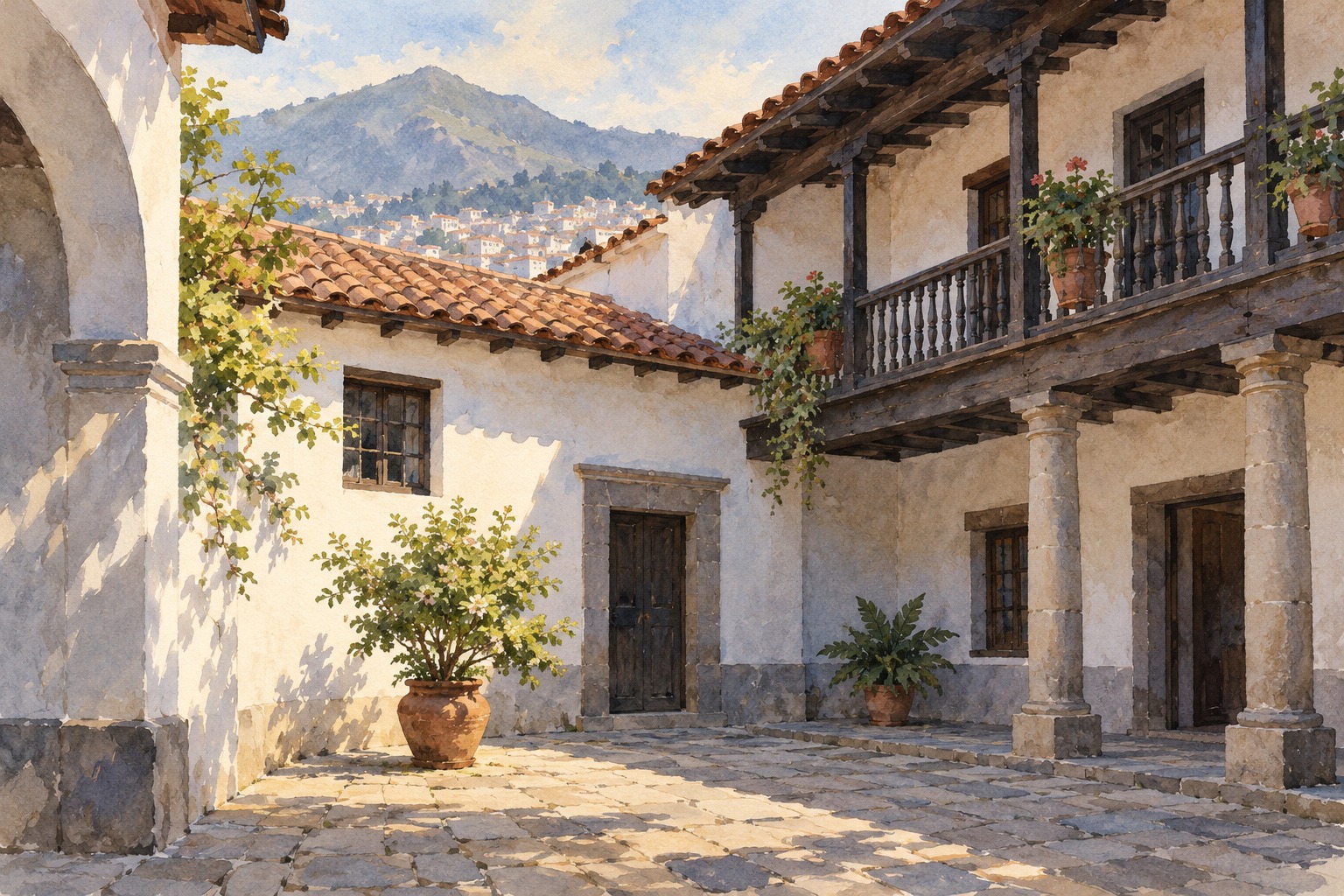
The courtyard example here is an invented watercolor inspired by architectural relationships associated with Quito. It is not a surveyed monument. Its pale wall, dark balcony and diagonal shadows create a particular compositional exercise; they should not be mistaken for a documentary record of a named building.
Toquilla weaving is knowledge as well as an object
UNESCO’s entry on traditional Ecuadorian toquilla straw-hat weaving emphasizes the skills and community transmission behind the finished hat. It discusses plant fibers, preparation, weaving and finishing, including the fine work associated with Pile. The heritage is the living practice and its bearers, not merely the outline of a fashionable accessory. [3]
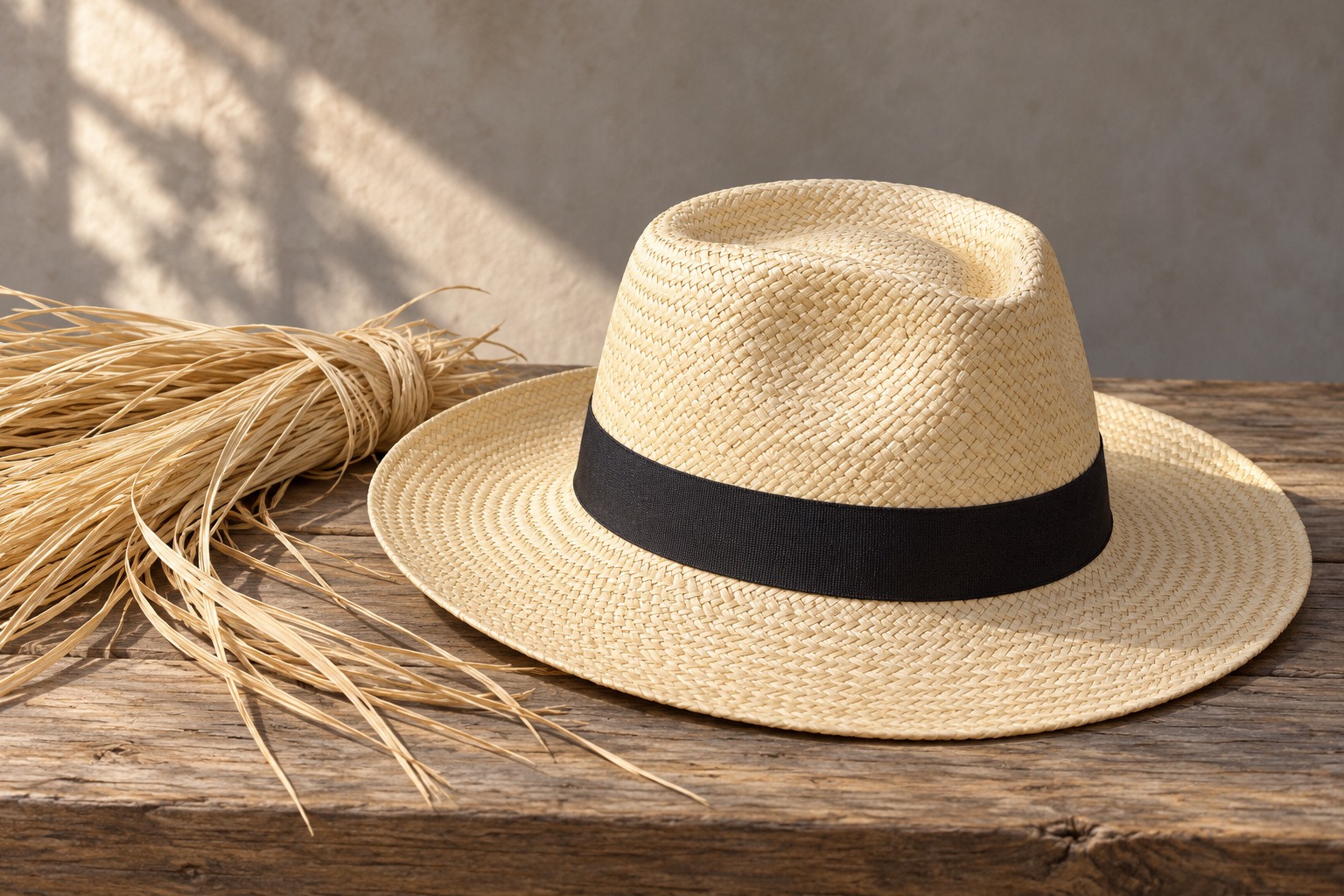
For close looking, compare the direction and scale of the weave, the transition from crown to brim, and the way light reveals structure. A generated image can suggest these relationships but cannot certify fiber, workmanship, place of manufacture or an authentic maker’s product. The still life is therefore labelled as a contemporary interpretation, and it should not be used as a technical weaving diagram.
Modern art exceeds a heritage postcard
The Casa de la Cultura Ecuatoriana’s museum overview describes collections that include nineteenth-century painting and modern approaches such as abstraction, collage and neofiguration. It names artists including Araceli Gilbert, Enrique Tábara and Luis Molinari. This institutional account offers a practical route beyond the assumption that art in Ecuador must depict traditional dress or mountains. [4]
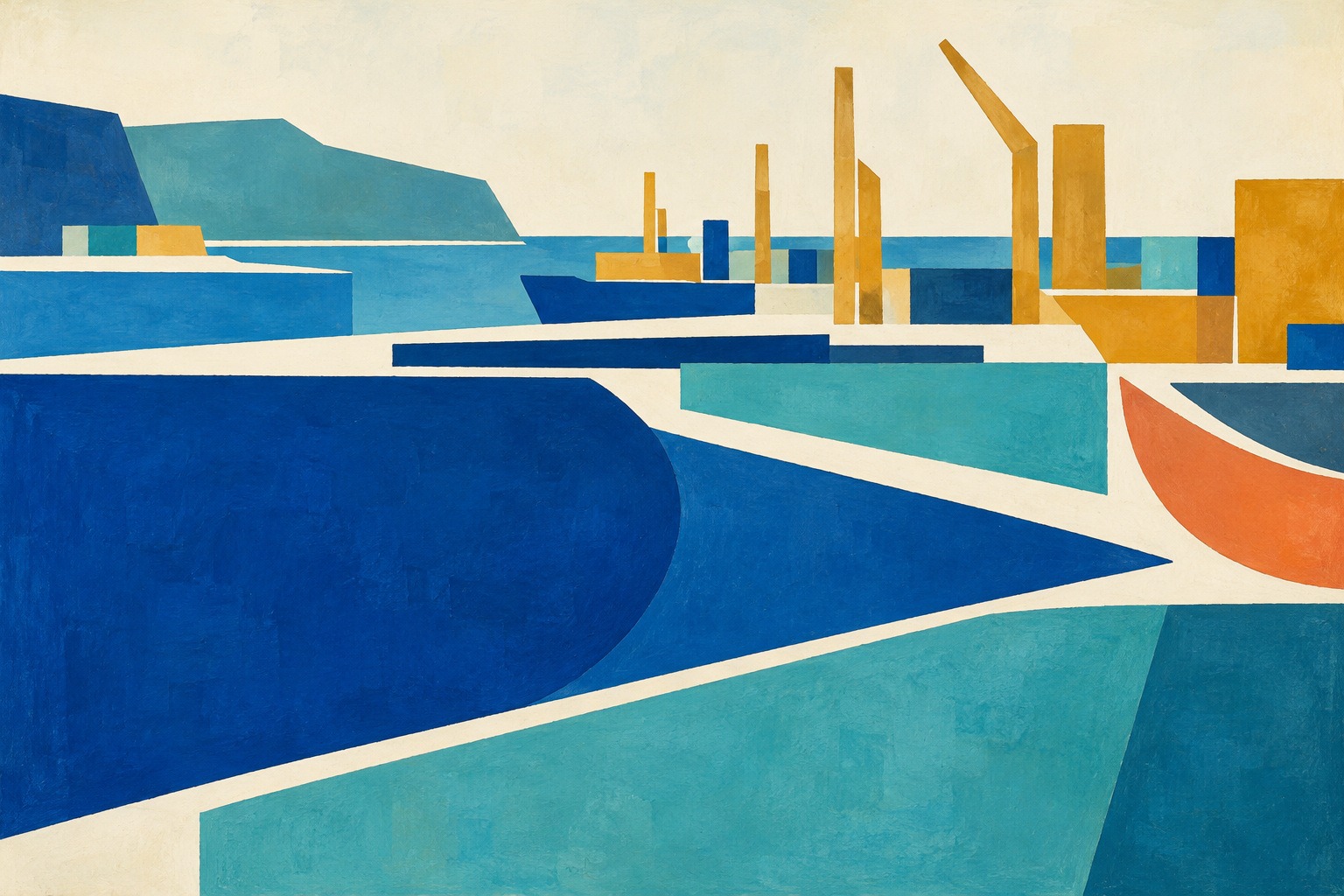
Follow individual artists and museum records to understand their actual choices. An abstract image is not evidence of an artist’s nationality, and a national label does not make distinct practices interchangeable. The port-inspired abstraction in this guide is an independent AOI exercise, not an imitation or attributed work by any of those artists.
Several visual grammars, chosen for a reason
An architectural study can use a large quiet wall to make a small balcony or doorway significant. Let light group the scene before adding every tile and stone. In the watercolor example, warm roof tones and cool shadows give the courtyard depth while the open floor keeps it readable.
A material study asks different questions. The straw-hat still life uses a limited range of ivory, amber and gray so that woven structure becomes the main event. Its quiet background separates the object from surrounding clutter. The task is to describe the material convincingly, not to add flags or decorative symbols to announce a country.
An abstract study can begin with the spacing of cranes, warehouses or water channels and transform those observations into planes. Blue, ochre and coral are the choices of this particular exercise, not an Ecuadorian palette. Compare the weight of shapes, the direction of edges and the size of unpainted-looking spaces before deciding whether the design needs additional detail.
How to use the five new images
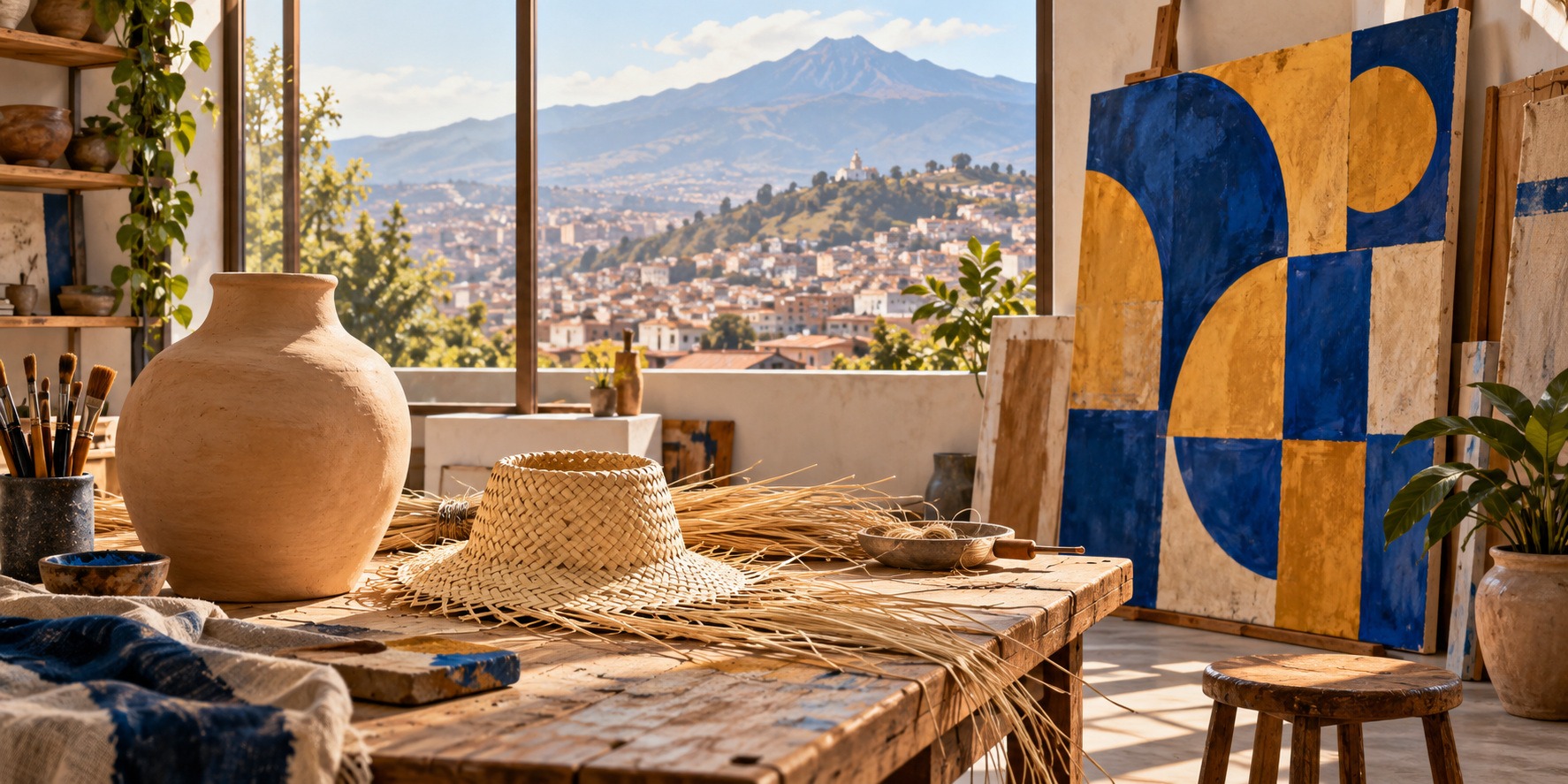
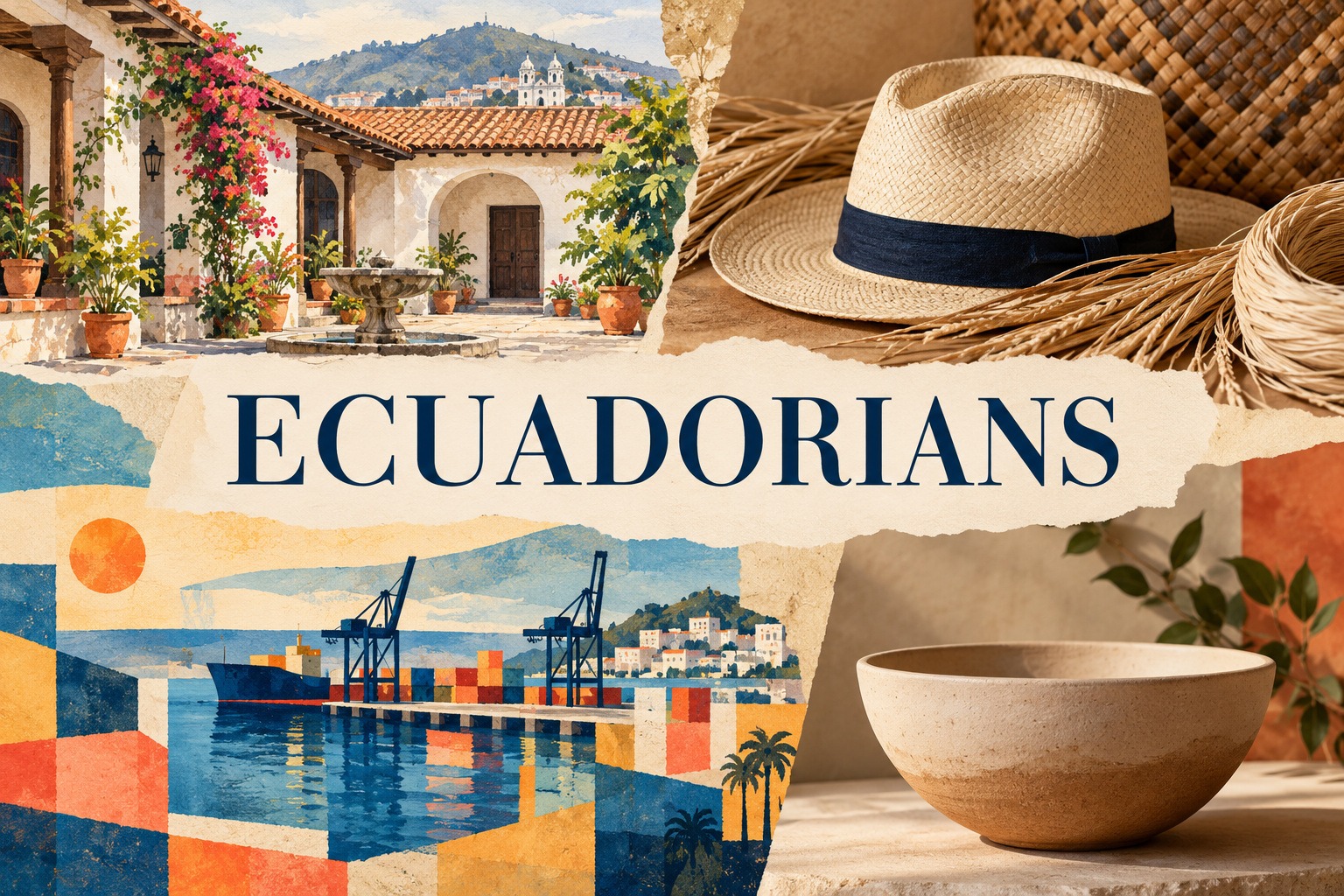
The studio banner brings several materials into an imagined contemporary workspace. It is a visual invitation to compare practices, not a claim that every maker combines them. The centrally titled collage gives a compact overview through architecture, woven fiber, geometry and a simple ceramic form.
The three standalone examples then isolate different problems: architectural light, material texture and abstract composition. Each is an AI-generated AOI illustration. None documents a real workshop, proves a cultural identity, or replaces looking at work made by Ecuadorian artists and craftspeople. Their captions make those limits explicit while explaining the formal choices worth examining.
A research-led exercise
Choose a documented object or work from an institutional source and record the maker when known, date, place, material and the source’s exact degree of certainty. Write three visual observations and one unanswered question. This keeps a useful boundary between what you see and what you infer.
Next, make an independent composition around one formal problem, such as courtyard shadow or woven rhythm. State that it is a contemporary interpretation. Avoid transferring sacred or community-specific motifs without understanding their context, and avoid invented maker biographies or museum labels. If the project needs authentic cultural knowledge or a real product, work with the relevant people and documented sources.
Useful vocabulary and common mistakes
A more productive prompt specifies subject, medium, place-related reference and visual decision: an invented Quito-inspired courtyard watercolor with large light walls, or a contemporary still life examining straw texture. The phrase Ecuadorian style alone provides little meaningful instruction.
The most common failure is substituting a picturesque stereotype for research. Another is presenting archaeological, colonial and contemporary forms as one unbroken decorative recipe. Keep their distinctions visible. A strong introductory guide creates paths toward specific artists, objects and communities rather than claiming to summarize a country in one image.
About this guide and its illustrations
This is an AI-authored AOI guide under Penny Wraiter, AOI’s editorial persona. The linked sources support the historical and technical context; the practical exercises, poem and new illustrations are AOI interpretations. Generated pictures are labelled as such and do not establish historical authorship, material authenticity or physical performance.
A small poetic detour
Original words from the AOI studio.
Poetry
The courtyard keeps a square of light.
The fiber turns, returns,
and finds another crossing.
Across the table, a blue plane
meets an ochre edge.
No single color names a country.
We begin with one object,
its maker, its place,
and leave the next page open
for another voice.
The prompt workshop
Original creative exercises. These prompts create new illustrations, not documentary evidence.
Study a courtyard through light
Create an invented contemporary Quito-inspired courtyard watercolor: pale plaster walls, terracotta roof, dark wooden balcony and one potted plant. Organize the picture with diagonal light and cool shadows. No people, lettering or claim that this is a specific historic monument.
Let material carry the image
Create a contemporary still life inspired by Ecuadorian toquilla straw-hat craft: one pale woven hat beside loose plant fiber, quiet gray table, warm side light and readable woven structure. Label it an interpretive illustration, not an authentic identified product or instructional process diagram.
Translate a port into geometry
Create an independent geometric painting prompted by a coastal port: blue water planes, ochre verticals, ivory channels and one coral curve. Balance asymmetry and empty space. No copied artist composition, national symbols or claim to represent a universal Ecuadorian aesthetic.
A smile from the studio
Jokes
The studio catalogue asked for one national color. The paint drawer requested a longer conversation.
Sources and further exploration
[2] UNESCO World Heritage, City of Quito. Historical architecture and the Quito School in context.