
Original AOI visual concept
Echoic Surrealism is an AOI-created visual proposal in which an imagined sound leaves changing material echoes in a believable space. A source, a sequence of altered returns and a final residue give the dream a readable structure.
An A⊕I –[-.+] creαt¡ve c⊕ncept, n⊕t αn estαbl¡she∂ h¡st⊕r¡cαl m⊕vement.
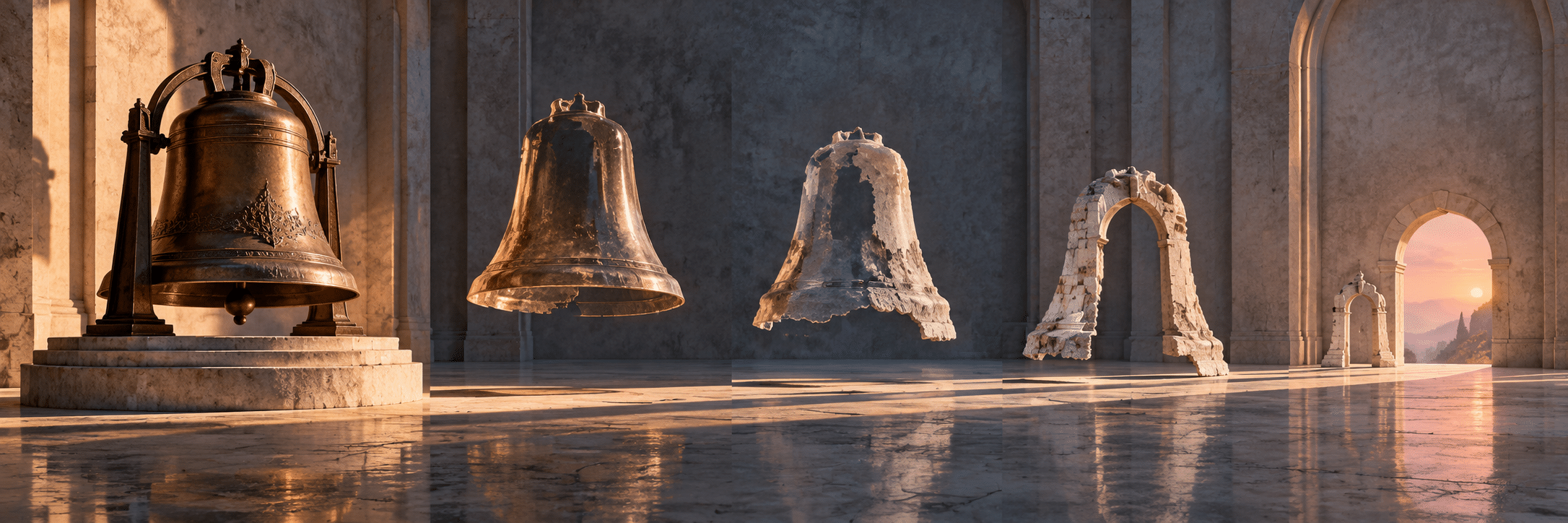
A visual introduction
Select an image for a closer look. Use the thumbnails, arrow keys or a swipe to compare examples. Zoom in to inspect details, or share the image that inspires you.

Creative toolbox · take this style further
Choose an input and a destination. Search sends your words to the chosen site; Copy & open puts them on your clipboard to paste there.
Create with AI
Turn your chosen input into an image prompt or a new creative direction.
ChatGPT
Copy your input and paste it into a ChatGPT conversation or image request.
Copy & open ChatGPT (new tab)Claude · Anthropic
Develop an image prompt or explore the style in a new Claude conversation.
Copy & open Claude · Anthropic (new tab)Midjourney
Paste your input into the Imagine bar on the Create page.
Copy & open Midjourney (new tab)Adobe Firefly
Copy your input, open Firefly, and paste it into the prompt field.
Copy & open Adobe Firefly (new tab)Leonardo.Ai
Copy your input, open Leonardo, and paste it into the generation field.
Copy & open Leonardo.Ai (new tab)Image search
Find visual references. Short, concrete keywords usually work best.
Lexica
Search AI images and prompts using your selected input.
Search with this input Lexica (new tab)Pexels
Search the photo and video library. Short keywords often work best.
Search with this input Pexels (new tab)Pixabay
Search photos, illustrations and other images.
Search with this input Pixabay (new tab)Unsplash
Search photographs using the style name or your own keywords.
Search with this input Unsplash (new tab)Wikimedia Commons
Search photographs, artworks and historical images. Check each file for its source and reuse terms.
Search with this input Wikimedia Commons (new tab)Art & research
Explore artists, collections and the ideas behind a style.
Wikipedia
Search for background reading. A style may not have its own article.
Search with this input Wikipedia (new tab)WikiArt
Copy your input into WikiArt’s search to explore artists and artworks.
Copy & open WikiArt (new tab)Europeana
Paste your keywords into the search to explore European museum, library and archive collections.
Copy & open Europeana (new tab)Inspiration
Discover portfolios and visual ideas from creative communities.
Instagram hashtags
Search a hashtag made from your input: spaces and punctuation are removed. Instagram may require sign-in.
Search with this input Instagram hashtags (new tab)ArtStation
Paste your input into artwork search for concept art, environments, characters and visual development.
Copy & open ArtStation (new tab)Behance
Paste your input into project search for illustration, design and visual storytelling.
Copy & open Behance (new tab)A closer look
One grounded source; a directional sequence of related forms; diminishing contrast or scale; a stable contour surviving changes of material; a final impossible residue; spacious silence around the sequence.
Definition: a sound returns as something else
In this AOI interpretation, Echoic Surrealism turns the idea of an echo into a rule for making images. A bell, a footstep, a closing book or another imagined sound begins a chain of visible returns. Each return preserves something recognizable from the source while changing its material, scale or place. The last echo leaves a small impossible consequence in an otherwise legible setting.
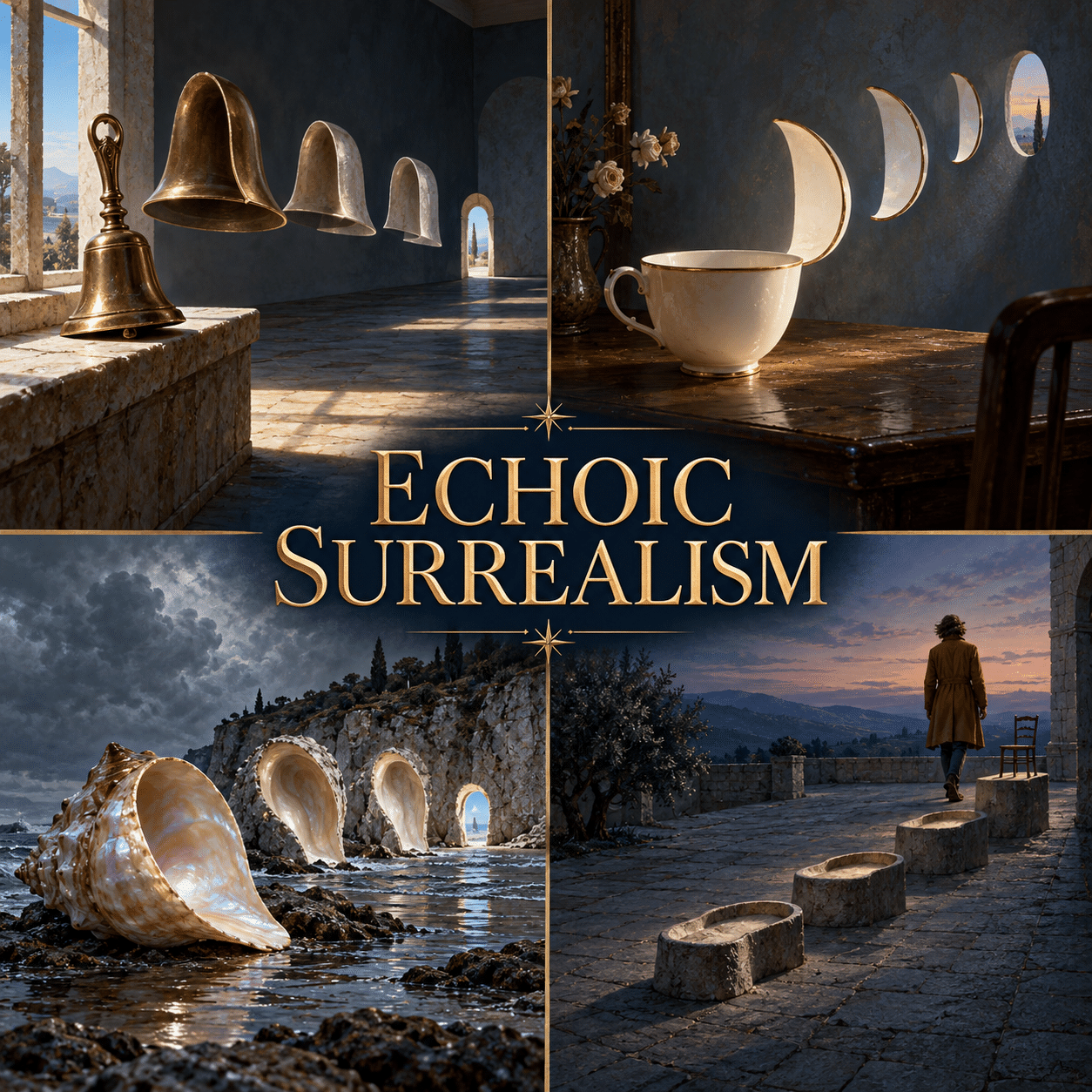
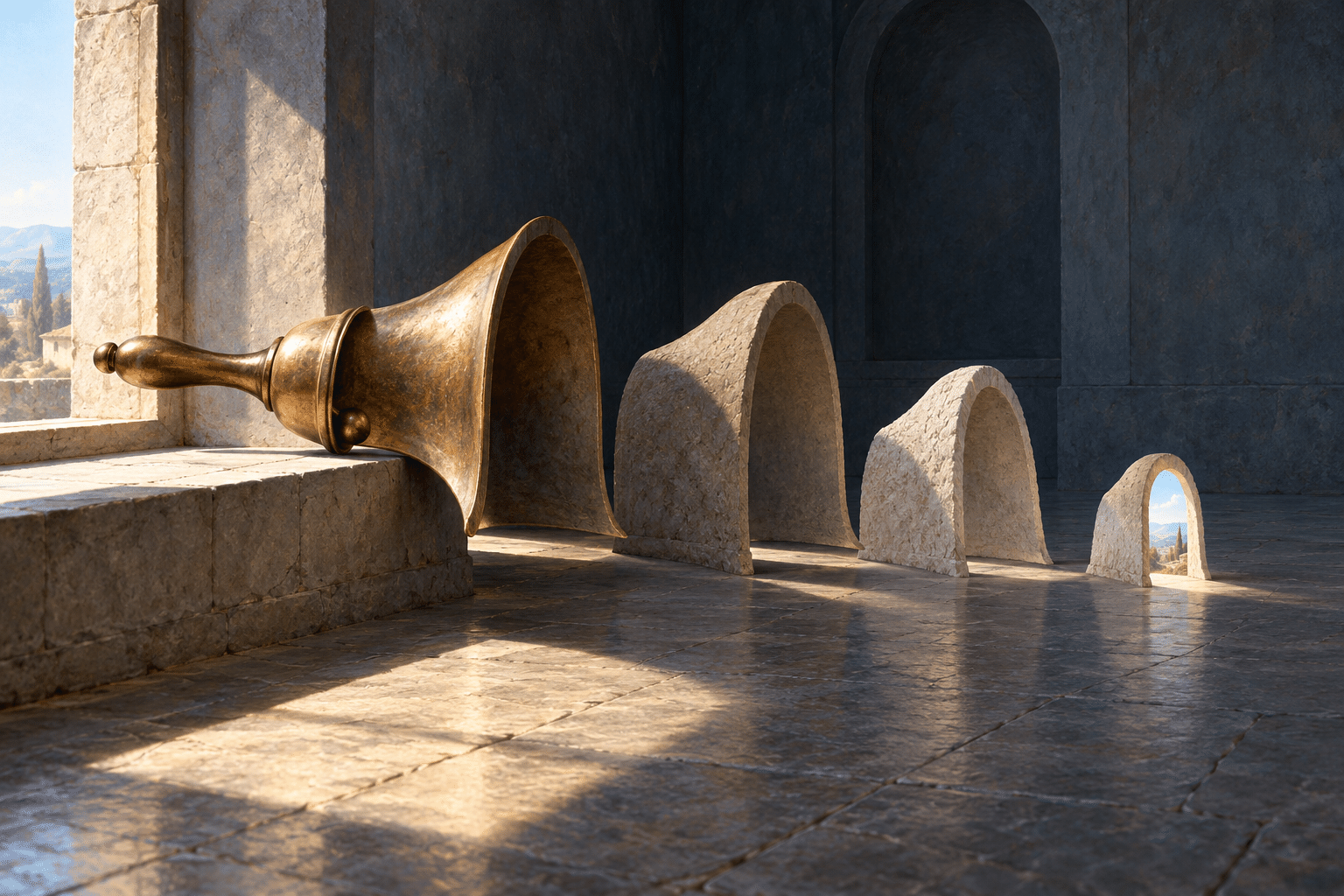
A painted bell might release a sequence of hollow bronze shapes that become stone arches; the final arch could remain as a tiny doorway in a distant wall. The image does not need to produce actual sound. Its subject is the passage from an event to its remembered, altered aftermath.
Provenance and the reason for the proposal
Echoic Surrealism is presented here as an AOI-created experimental art concept, developed into this explicit visual grammar in the present article. It is not documented here as an established historical movement. No founding date, independent school, roster of historical artists or claim of exclusive invention is asserted.
The proposal answers a practical creative problem: images about sound often stop at instruments, musical notes or generic glowing waves. Echoic Surrealism instead asks how a remembered event might reshape a room, landscape or ordinary object. Its point of difference is the legible transformation between returns, not simply the presence of dreamlike scenery.
A repeatable visual grammar
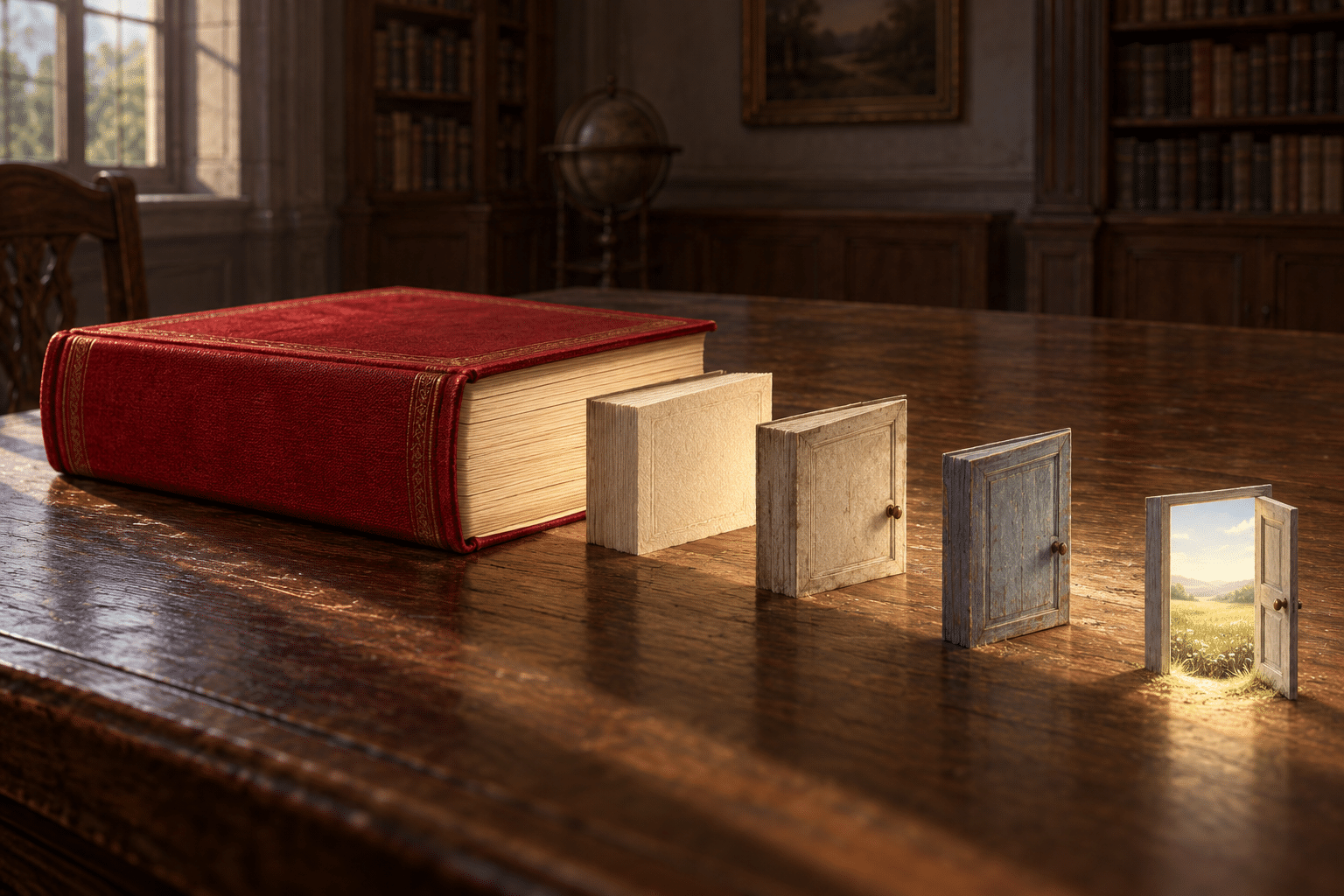
Start with one source that has physical weight and a clear position. Choose a recognizable feature to carry through the image: the bell’s flared lip, a shoe’s curved heel, or the rectangular opening of a book. This persistent feature lets the viewer trace the sequence even when its material changes.
Use three to five returns as a useful starting constraint. Give them a direction, vary the intervals, and reduce their visual force as they travel. Then introduce one decisive transformation: bronze becomes stone, a footprint rises into a stair, or a page edge becomes a doorway. Finish with a residue that rewards a second look. These are compositional rules for this proposal, not measurements of acoustic behavior.
Palette, light and the space between returns
A productive palette assigns warm material color to the source, cooler or less saturated color to the distant returns, and a quiet ground around both. Bronze, chalk white, slate blue and muted rose make one possible family. A monochrome drawing can work equally well if density and edge clarity carry the sequence.
Keep the main illumination coherent so the transformation remains the exceptional event. Shadows can anchor even an impossible object. Negative space acts as a pause between returns; filling every gap with mist, particles or ornaments removes that pause. A diagonal path creates travel, a curve can suggest return, and a circular path can make the residue seem trapped with its source.
Five ways to test the idea
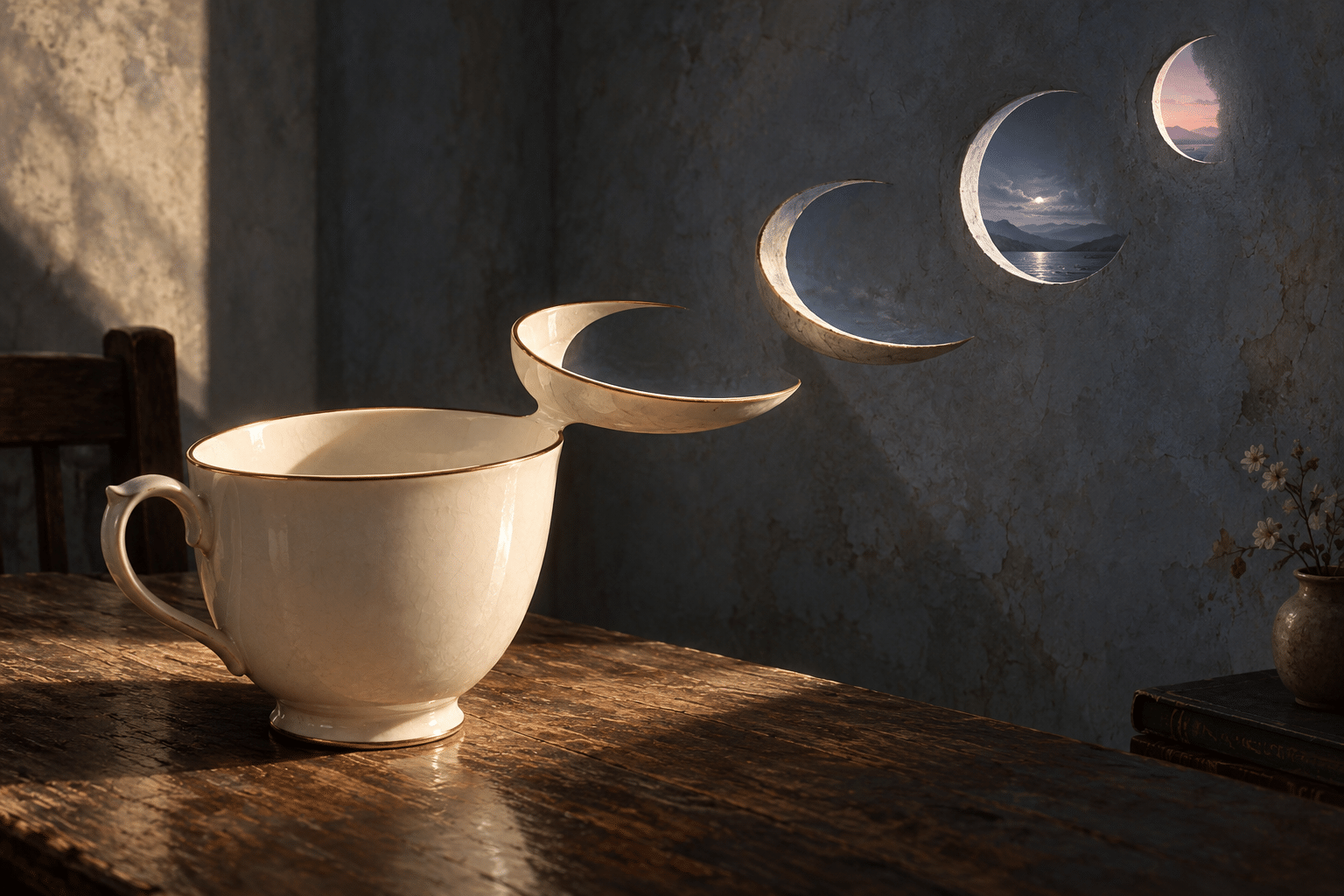
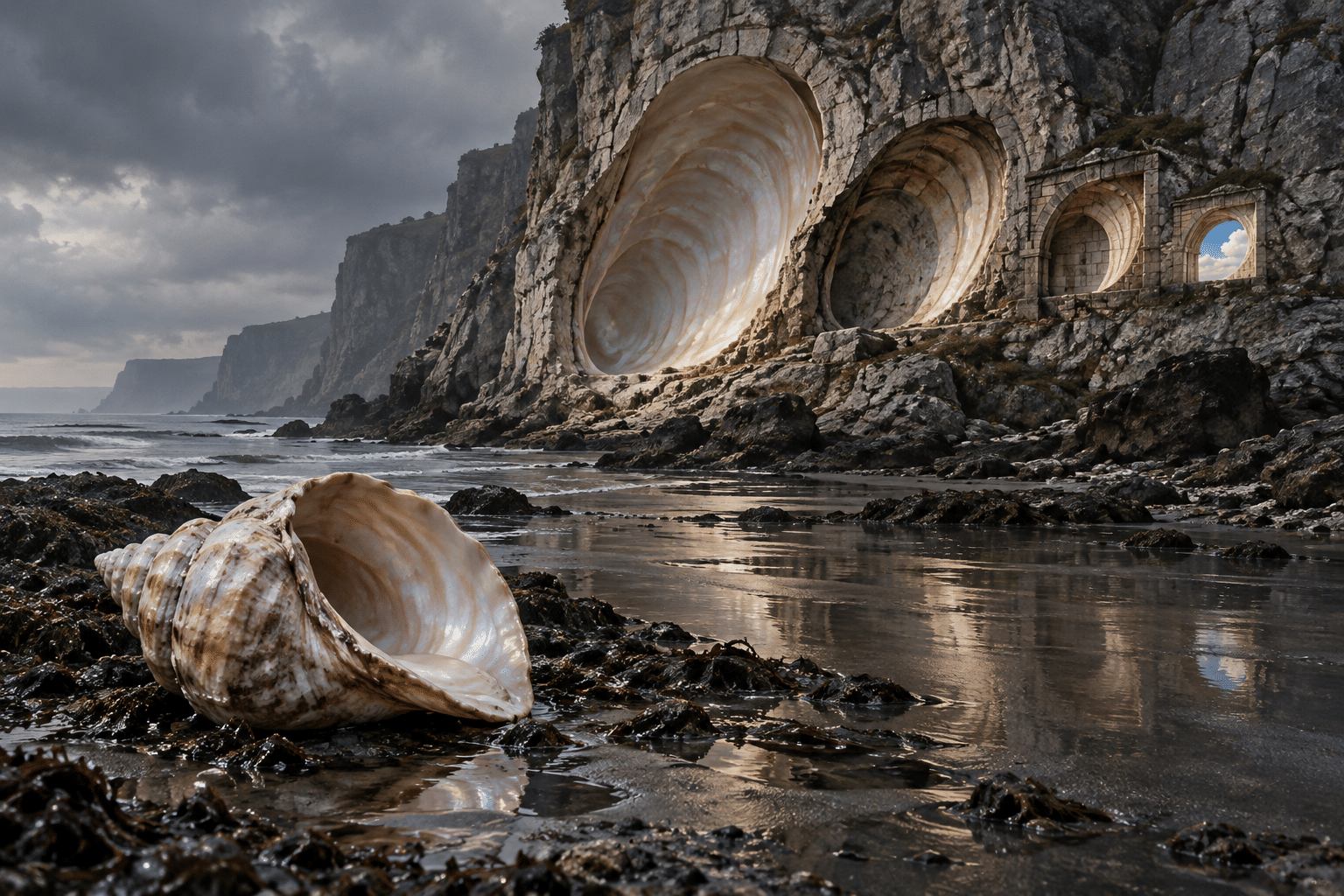
An architectural study can let the outline of a bell become freestanding arches. A small still life can let the rim of a porcelain cup detach and return as a succession of fragile ceramic crescents. A coastal image can translate the opening of a shell into progressively lighter openings through a cliff.
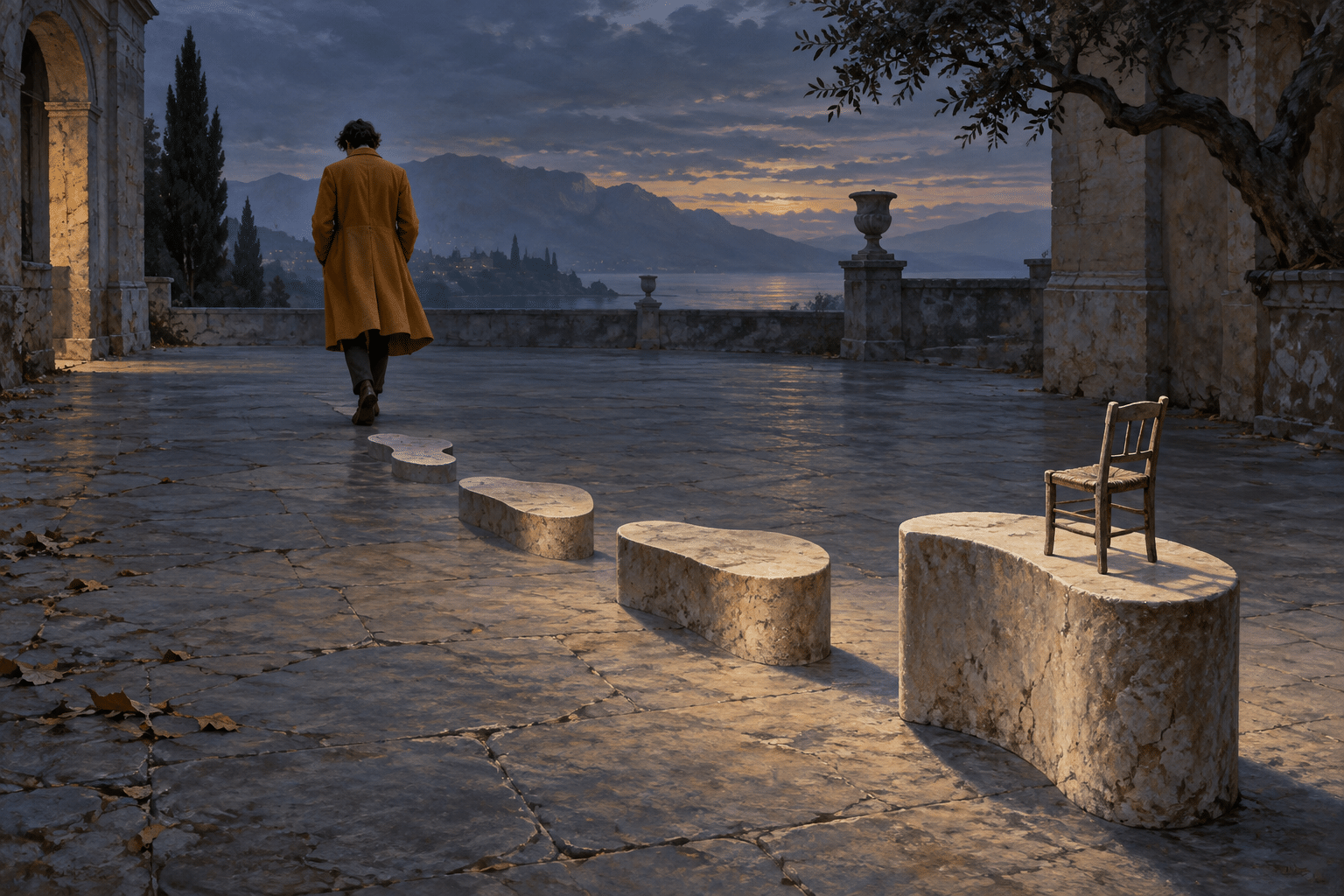
A figurative scene can follow a solitary adult’s footprints as they rise into steps that end at an empty chair. A library scene can turn the edges of a closing book into a receding passage of paper doors. Each test should retain its own focal point, scale and emotional situation. They are variations on a rule, not interchangeable images with a new object pasted into the same fog.
How it differs from neighboring approaches
Historical Surrealism supplies a broader context of unexpected associations and challenges to ordinary experience. The National Gallery of Art locates that movement in 1920s Paris; MoMA discusses its engagement with dreams and unconscious associations. These sources explain the historical context, not the origin or validation of this AOI proposal.
Echoic Surrealism uses a deliberately composed sequence, whereas a generic dreamscape need not. It also differs from a glitch aesthetic: broken pixels or corrupted signals are optional and do not define the concept. Describing a work as a metaphor for cross-sensory experience does not establish that its maker or viewer experiences synesthesia. Neither hallucinations nor a medical condition are required to make these pictures.
A practical image brief
Name the source, the carried contour, the path of returns and the final transformation before choosing decorative adjectives. For example: a shell on a shore; its opening repeated four times; each return farther into a limestone cliff; the last becomes a small window containing a different sky. Keep surrounding geography believable so the altered rule can be noticed.
After generation, inspect whether the returns remain connected to their source, whether at least one material transformation is clear, and whether the final residue can be found. If the result reads as several unrelated floating objects, simplify. The gallery is a set of AI-generated concept studies, not documentation of fabricated installations or historical artworks.
Positive editorial assessment — AI-authored
The concept gives repetition a narrative purpose. A recognizable contour makes change readable, while the diminishing sequence invites the viewer to slow down and follow an event through space. It can evoke absence or persistence without relying on written explanation inside the artwork.
Critical editorial assessment — AI-authored
The approach can become a decorative trail of duplicates. Fog and glow may conceal the absence of a meaningful transformation, and repeated rings alone can resemble familiar sound visualizers. Give the source a specific setting, make the change consequential, and allow the final residue to differ from the initial spectacle.
Neutral editorial assessment — AI-authored
Echoic Surrealism is a proposed design method for still images, animation and spatial concepts. Its defining test is the relationship between source, altered returns and residue. It offers a consistent prompt vocabulary, but an individual work still needs composition, emotional specificity and careful execution.
Pocket-sized facts
AOI-created visual proposal, not presented as a documented historical movement.
The proposed grammar connects a source, transformed returns and a final residue.
The imagery is a metaphor for sound and memory, not an acoustic simulation or medical claim.
A small poetic detour
Original words from the AOI studio.
Poetry
The bell is still. The room goes on.
A bronze curve loosens from the air;
it pales to stone, becomes a door,
and leaves a smaller doorway there.
No voice arrives to claim the last
light folded in that distant seam.
What happened once has changed its shape—
the room remembers how to dream.
The prompt workshop
Original creative exercises. These prompts create new illustrations, not documentary evidence.
A bell becomes architecture
Create an original Echoic Surrealist concept painting: a grounded bronze handbell on a stone sill, followed by four separated echoes of its flared outline across a quiet room. The echoes gradually change from bronze shells into pale stone arches; the last becomes a tiny real doorway in the far wall. One coherent side light, warm source and cool diminishing returns, clear empty intervals. No musical notes, lettering or generic particles.
Footsteps that stay behind
Create an original Echoic Surrealist scene of one fictional adult in a plain coat walking away across a believable dusk courtyard. Four visible footprints behind them rise successively into low stone steps, preserving the heel curve; the last step supports one empty chair. A restrained slate-and-ochre palette, coherent cast shadows, an intelligible path and generous silence between objects. No duplicated people or extra limbs.
A small sound, an impossible coast
Create an original Echoic Surrealist coastal painting with one shell in the foreground. Its curved opening returns four times along a limestone cliff, changing from pearly shell rims into architectural openings and diminishing in contrast. The final small opening contains a daylight sky different from the overcast coast. Believable shore textures, one readable transformation, controlled spatial depth, no text or sound-wave graphics.
Your next inspiration
Discover another art style
Follow a visual thread to the next subject.
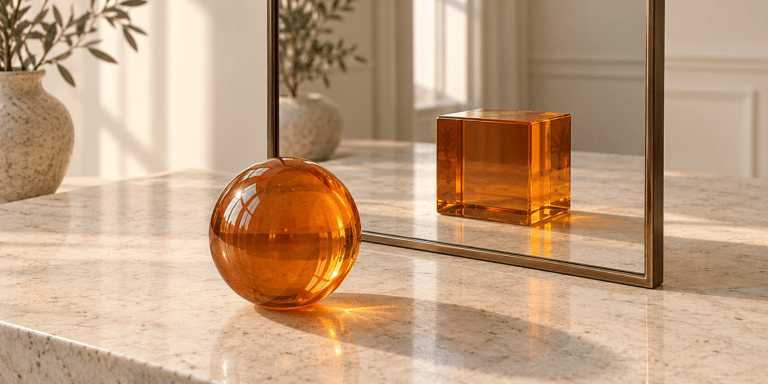
Cognition Warp Style: A Stable Scene with One Unstable Rule
Compare another AOI approach to changing one rule inside a stable scene.
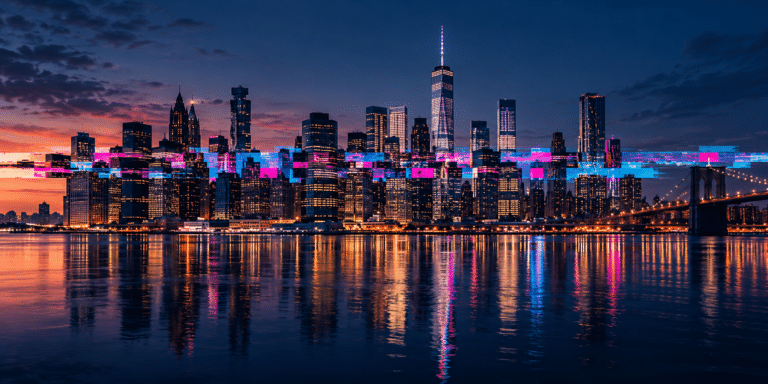
Glitch Art: When the Image Reveals Its System
Distinguish remembered visual returns from the appearance of signal disruption.
A smile from the studio
Jokes
The echo applied for a studio of its own. It was offered the next room, and the next room, and a considerably smaller next room.