
AOI experimental visual concept
Cognition Warp Style is an AOI visual concept that makes a familiar scene uncertain by altering one spatial rule while preserving enough ordinary structure to keep it legible. The subject is a designed perceptual puzzle, not an illustration of a medical condition or a claim about how a particular person thinks.
An A⊕I –[-.+] creαt¡ve c⊕ncept, n⊕t αn estαbl¡she∂ h¡st⊕r¡cαl m⊕vement.
A visual introduction
Seven new AI-generated studies explore scale, reflection, support and nested space. The retained earlier ornamental profile is a looser historical interpretation within the AOI collection. No image is a scientific or medical demonstration.
Select an image for a closer look. Use the thumbnails, arrow keys or a swipe to compare examples. Zoom in to inspect details, or share the image that inspires you.

Creative toolbox · take this style further
Choose an input and a destination. Search sends your words to the chosen site; Copy & open puts them on your clipboard to paste there.
Create with AI
Turn your chosen input into an image prompt or a new creative direction.
ChatGPT
Copy your input and paste it into a ChatGPT conversation or image request.
Copy & open ChatGPT (new tab)Claude · Anthropic
Develop an image prompt or explore the style in a new Claude conversation.
Copy & open Claude · Anthropic (new tab)Midjourney
Paste your input into the Imagine bar on the Create page.
Copy & open Midjourney (new tab)Adobe Firefly
Copy your input, open Firefly, and paste it into the prompt field.
Copy & open Adobe Firefly (new tab)Leonardo.Ai
Copy your input, open Leonardo, and paste it into the generation field.
Copy & open Leonardo.Ai (new tab)Image search
Find visual references. Short, concrete keywords usually work best.
Lexica
Search AI images and prompts using your selected input.
Search with this input Lexica (new tab)Pexels
Search the photo and video library. Short keywords often work best.
Search with this input Pexels (new tab)Pixabay
Search photos, illustrations and other images.
Search with this input Pixabay (new tab)Unsplash
Search photographs using the style name or your own keywords.
Search with this input Unsplash (new tab)Wikimedia Commons
Search photographs, artworks and historical images. Check each file for its source and reuse terms.
Search with this input Wikimedia Commons (new tab)Art & research
Explore artists, collections and the ideas behind a style.
Wikipedia
Search for background reading. A style may not have its own article.
Search with this input Wikipedia (new tab)WikiArt
Copy your input into WikiArt’s search to explore artists and artworks.
Copy & open WikiArt (new tab)Europeana
Paste your keywords into the search to explore European museum, library and archive collections.
Copy & open Europeana (new tab)Inspiration
Discover portfolios and visual ideas from creative communities.
Instagram hashtags
Search a hashtag made from your input: spaces and punctuation are removed. Instagram may require sign-in.
Search with this input Instagram hashtags (new tab)ArtStation
Paste your input into artwork search for concept art, environments, characters and visual development.
Copy & open ArtStation (new tab)Behance
Paste your input into project search for illustration, design and visual storytelling.
Copy & open Behance (new tab)A closer look
A recognisable room or object provides an anchor. Repeated edges, scale changes or impossible connections then introduce a controlled contradiction, supported by otherwise coherent light and materials.
Establish something the viewer can trust
Start with a familiar arrangement: a corridor, a table, a stair or a shelf. Give it a clear viewpoint and a few dependable scale cues. The viewer needs a working expectation before a distortion can challenge it. If the entire scene is undefined, there is little to reconsider.
This AOI formulation is a creative framework, not a documented historical movement. Its language of cognition refers to looking and interpretation. It does not diagnose confusion, reproduce a neurological experience or supply scientific evidence about perception.
Choose one rule to bend
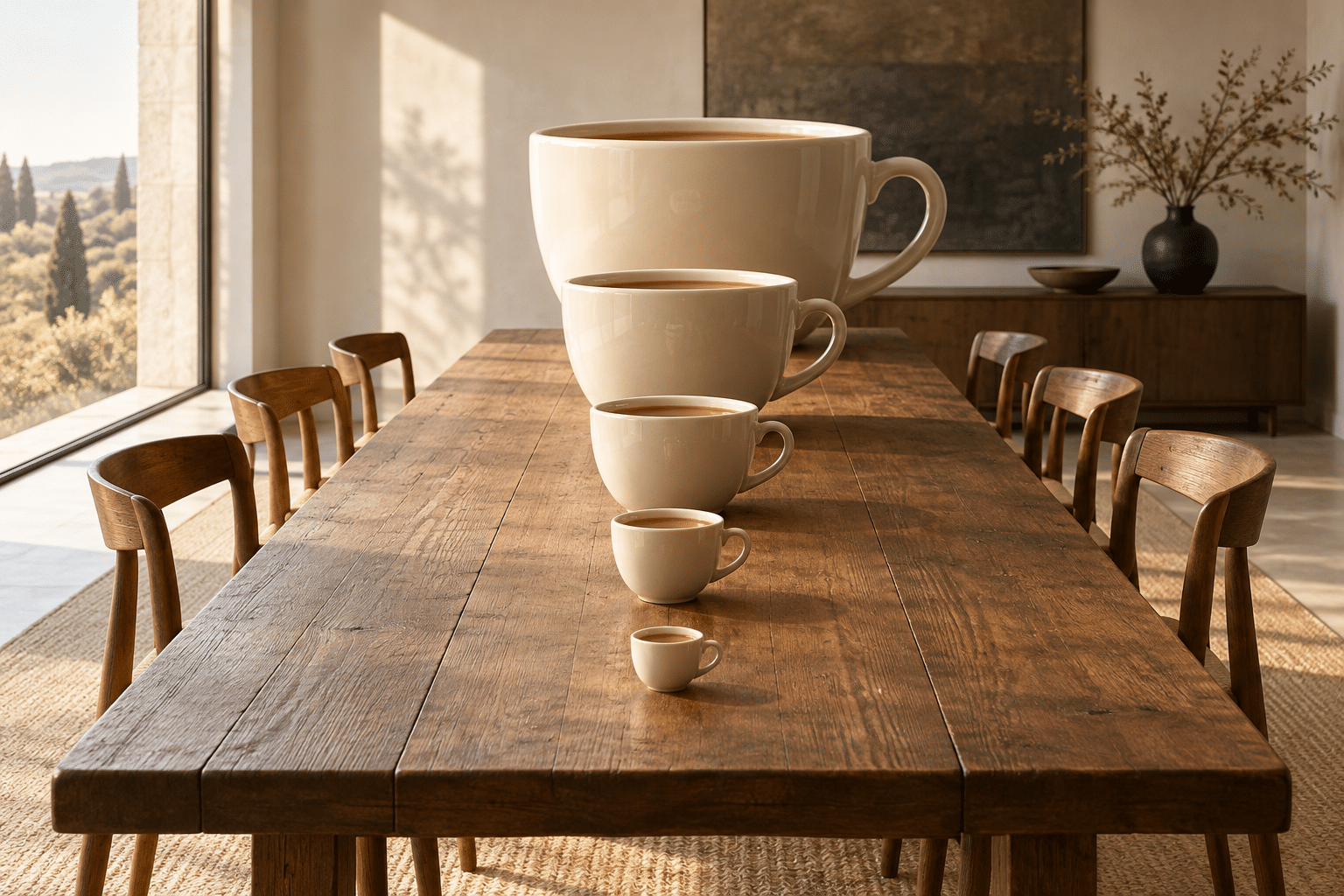
Possible rules include constant object size, continuous surfaces or consistent room depth. A corridor might grow wider with distance while its doors remain ordinary; a stair might reconnect to an earlier landing; a row of identical cups might change scale along an otherwise stable table. Pick one of these and develop it precisely.
Keep the surrounding rules consistent. A scale paradox becomes easier to discover when shadows still identify a shared light source and materials behave predictably. Random perspective errors can look superficially similar, but they do not offer a clear contradiction for the viewer to trace.
Control where the change happens
A gradual distortion can begin in a quiet region and become unmistakable near the focal point. Alternatively, a sharp boundary can separate ordinary space from the altered zone. Decide which experience you want: slow recognition or sudden interruption. Avoid scattering unrelated warps throughout the image.
Repeated forms are useful measuring devices. Their intervals let the viewer notice compression, expansion or misalignment. Preserve a few unaltered repetitions as a reference. Without that baseline, a warped pattern may simply look irregular.
Light and colour should help the reading
A restrained palette can keep attention on the spatial problem. Use an accent to mark a significant junction rather than colouring every distorted object differently. Soft atmospheric effects may support mood, but too much haze can conceal the exact connection that makes the concept work.
Check the composition in flat values and as a line drawing. The contradiction should remain understandable without decorative texture. If the puzzle depends entirely on a caption, improve the construction rather than adding more descriptive adjectives.
Distinguish the neighbouring concepts
Hyperdimensional Graffiti applies spatial contradiction to a traceable graphic stroke. Cognition Warp keeps a recognisable scene as its anchor. Dreamcore Fusion, as formulated elsewhere in this collection, concentrates on the atmosphere of familiarity disrupted by one impossible event. These proposals can overlap, but their primary design problems differ.
For a controlled exercise, make an ordinary corridor first, then a second version in which only the door scale changes with distance. Keep the camera, light and furnishings fixed. A successful revision makes the altered rule discoverable and gives that discovery a visual consequence, rather than merely making the room look badly drawn.
A contradiction needs a baseline
A visual puzzle becomes stronger when the viewer can explain both the ordinary expectation and the exception. In a room of repeated doorways, floor joints and ceiling beams can establish regular depth. Enlarging only the distant doorway then introduces a measurable disagreement. Without those stable cues, the image may suggest an unusually built room instead of a controlled paradox.
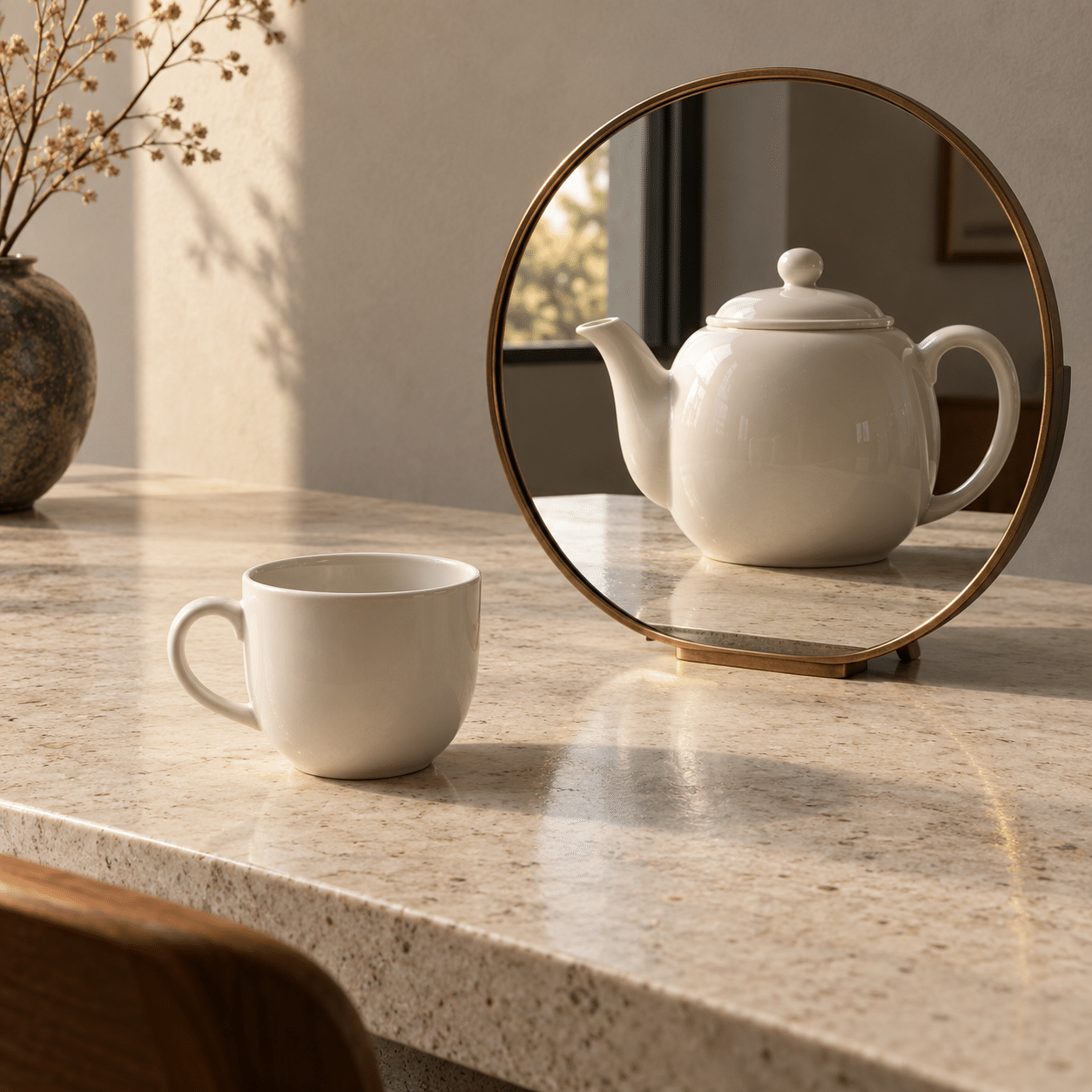
Not every composition needs an impossible object. A subtle mismatch between an object and its reflection can be enough. An ordinary cup might remain intact while its reflected handle appears on an incompatible side. The task is to make the relationship discoverable through the image itself. A caption can direct attention, but it should not supply a contradiction that the artwork fails to show.
Use a hierarchy of evidence
Place the most dependable cue near the viewer: a table edge, a repeated tile or a familiar object. Let the anomalous relationship develop farther into the scene. This creates a sequence of looking, testing and reconsidering. A contrasting accent can mark the point where the rule changes, but use it sparingly so it does not become an unrelated spectacle.
The palette can support this sequence. Quiet stone, pale timber and a single saturated object make spatial relationships easy to compare. A vivid palette is also possible if value and edge clarity remain organised. Color is a control variable here, not a fixed signature. The concept should survive a change from blue to warm gray.
A practical construction and revision method
Write the rule before designing the image: identical objects should remain the same physical size; a reflection should correspond to its object; a continuous surface should connect consistently. Establish an ordinary version, then alter one relationship. Compare both versions with attention to shadows, occlusion and repeated intervals. These are the clues that tell viewers what space they are seeing.
Generated images may introduce additional accidental distortions. Treat those as problems to review, not as automatic evidence of an innovative style. An extra limb, a broken chair or an arbitrary stair junction can distract from the intended question. Simplify the subject when precise construction matters. A row of vessels offers fewer unrelated failure points than a crowded city.
Where this proposal is useful
Cognition Warp can support book-cover concepts, editorial illustrations about uncertainty, exhibition studies and scenes that reward a second look. A single unresolved connection may make a strong still image. For an instructional diagram or an architectural proposal, the same ambiguity would be a liability unless it is explicitly the subject.
The new visual studies explore spatial expectation through familiar settings and objects. They are illustrative experiments, not validated perceptual tests. The older ornamental profile remains as part of the page’s visual history; its dense swirling texture is a looser interpretation than the present rule-based definition. Keeping that distinction visible is more useful than pretending all images demonstrate the same mechanism.
Five different questions in the new studies
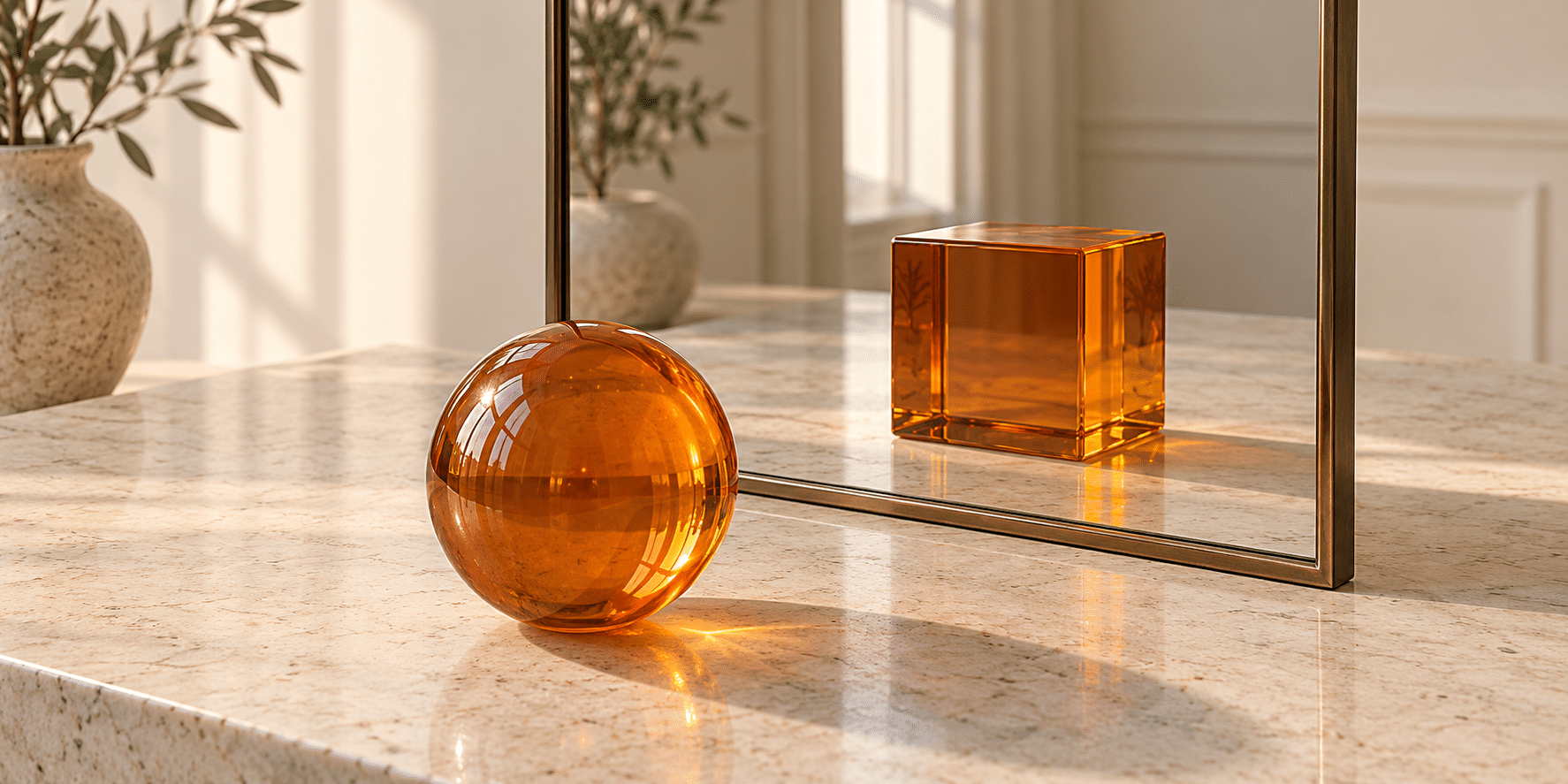
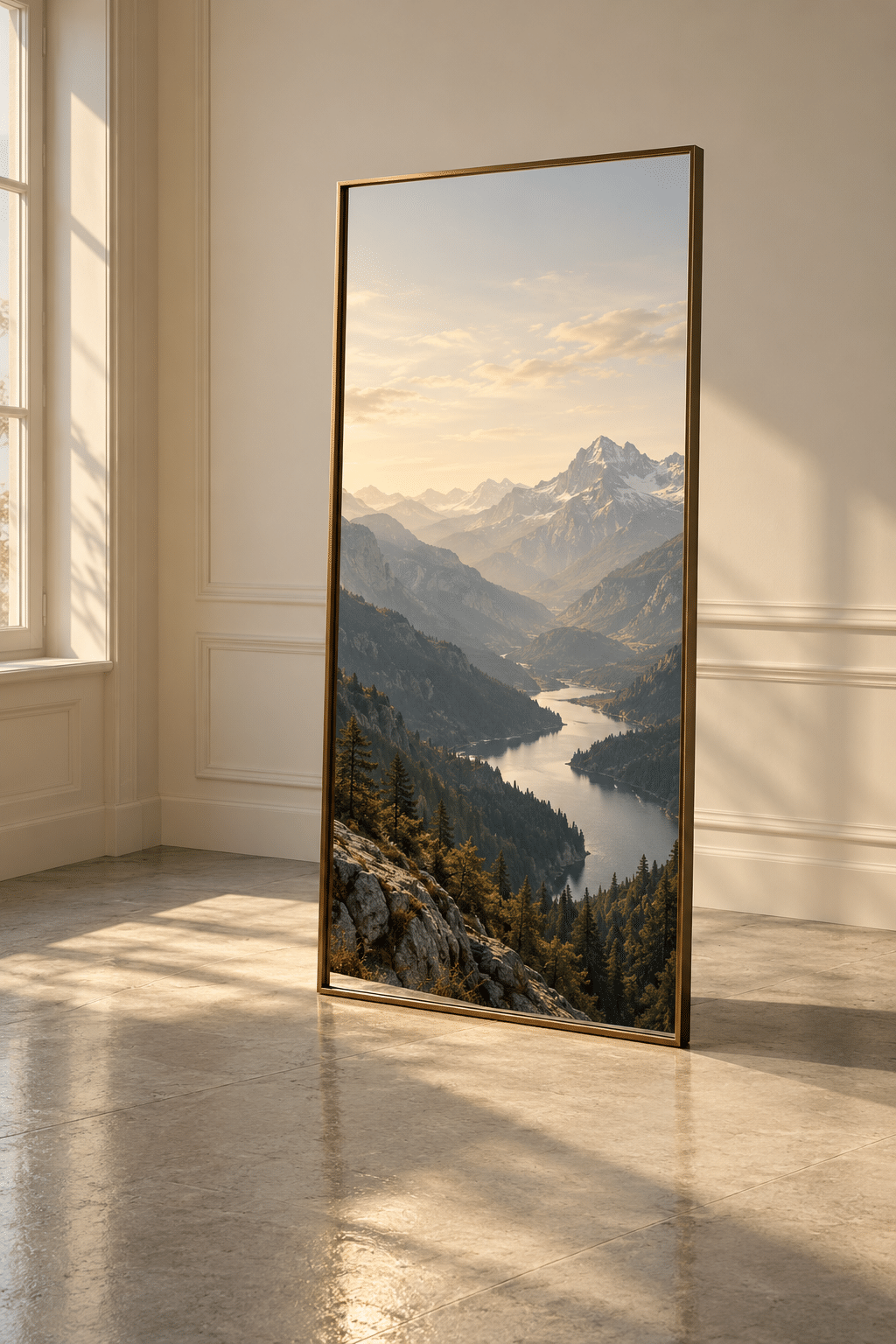
The banner asks why a sphere appears as a cube in a mirror. The cup sequence uses stable table perspective to make changing object size conspicuous. The mountain frame is more ambiguous: it can suggest a mirror, a picture or a portal. That ambiguity is worth naming rather than claiming the image proves one optical mechanism.
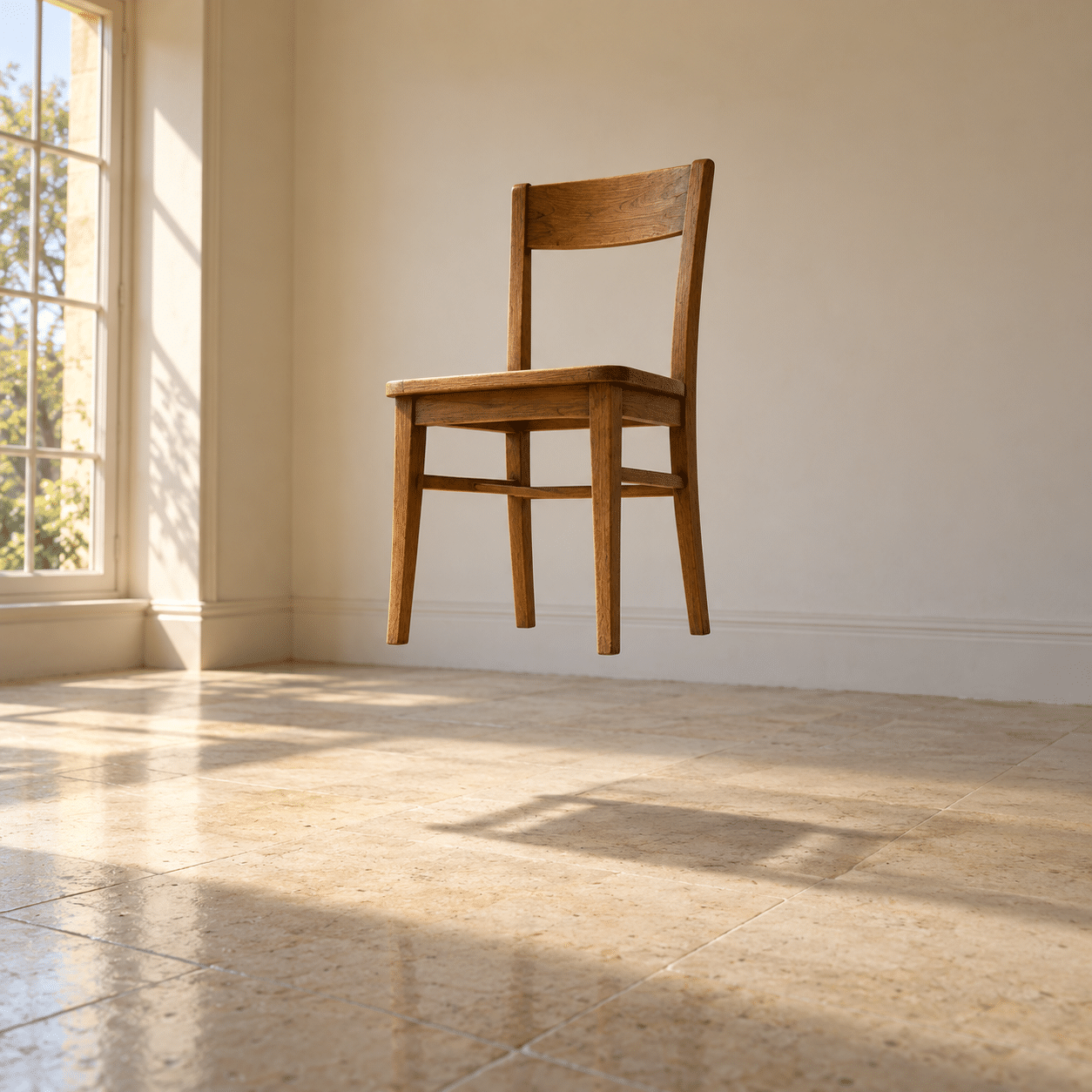
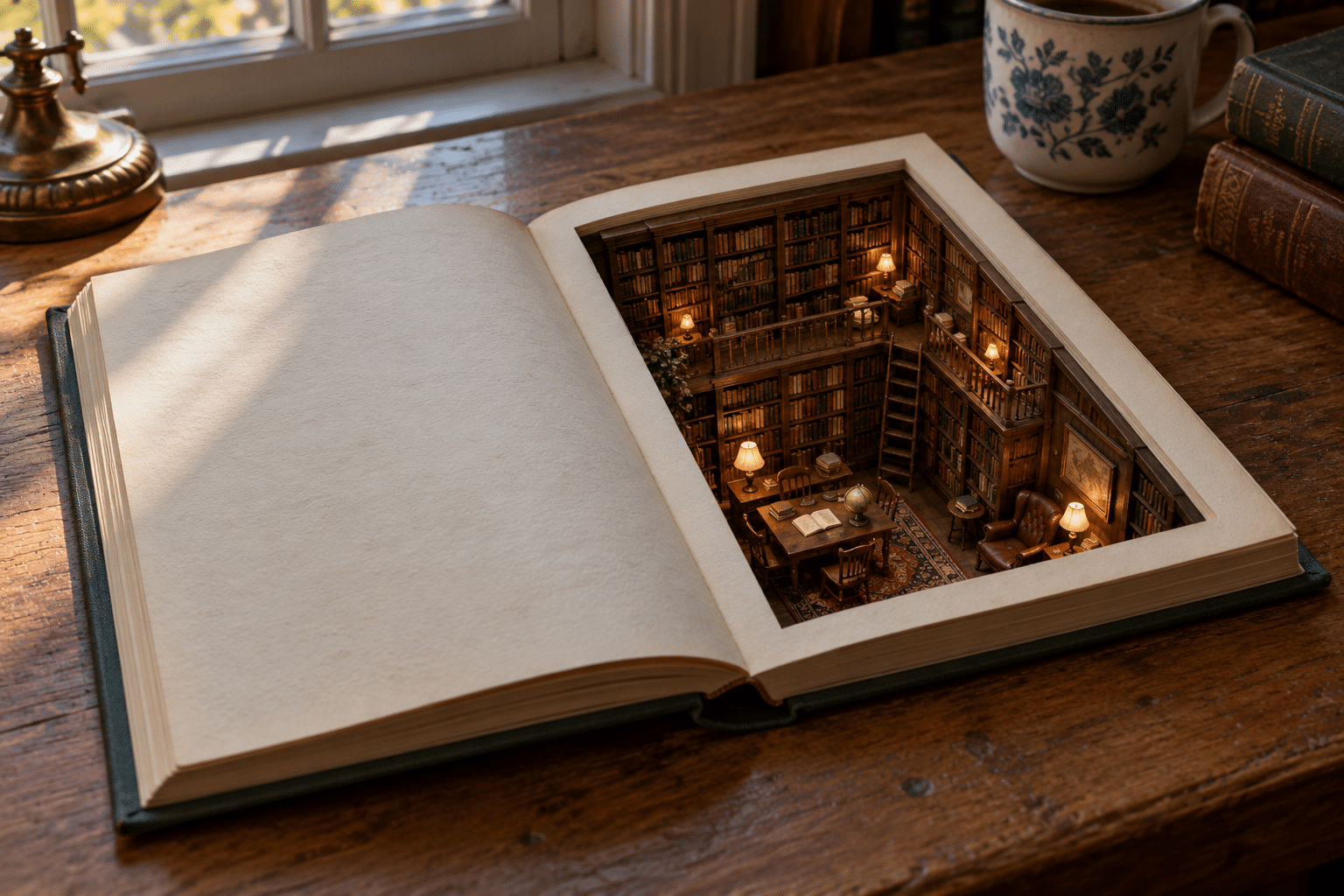
The floating chair changes support and gravity while preserving ordinary furniture construction. The book contains a room apparently deeper than its pages could accommodate. The cup-and-teapot study returns to an incompatible reflection. These are different visual propositions within the same framework of a stable setting and a local exception; they are not demonstrations of physically possible objects.
Positive editorial assessment — AI-authored
The proposal has a useful discipline: preserve enough normal space to make one exception meaningful. That gives an image a discoverable relationship rather than a general atmosphere of strangeness. It is particularly promising when ordinary objects provide an immediate scale reference and the viewer can trace the contradiction without explanatory prose.
Critical editorial assessment — AI-authored
The concept can collapse into familiar surrealism or into accidental perspective errors. Its name also risks implying scientific authority that the work does not have. Each image needs a specific altered rule and a visible baseline; otherwise the label adds little. Generated architectural details require particular care because a plausible mood can disguise an incoherent junction.
Neutral editorial assessment — AI-authored
Cognition Warp Style is an AOI experimental formulation for controlled spatial contradiction in a recognisable scene. It overlaps with impossible-object imagery, surreal environments and perceptual puzzles. It is neither a documented historical movement nor a medical model. Its usefulness depends on the clarity of the individual image’s altered relationship.
A small poetic detour
Original words from the AOI studio.
Poetry
The Room Keeps One Secret
The table stands where tables stand,
the window lends its ordinary light;
yet one small cup grows distant and immense,
and morning cannot put the measure right.
I trust the wall, the shadow and the chair.
One rule has slipped; the others hold it there.
The prompt workshop
Original creative exercises. These prompts create new illustrations, not documentary evidence.
One altered rule
Create an original quiet corridor with coherent perspective and daylight, except that identical doors become gradually larger with distance. Keep the floor and ceiling stable, restrained colours and precise edges. Make the scale contradiction readable.
An impossible return
Design an original architectural study of a simple stair reconnecting to its own earlier landing. Use one clear viewpoint, consistent material and a single side light; keep surrounding rooms ordinary so the contradiction can be traced.
Before and after
Create two matching views of an original dining table: one normal, one with a row of identical cups changing scale along its length. Same camera, light and room. The second image should alter one rule only.
Your next inspiration
Discover another art style
Follow a visual thread to the next subject.


A smile from the studio
Jokes
The room passed every inspection except the one conducted from its other end.