
Historical painting tradition
Early Netherlandish painting makes people, objects and sacred settings feel vividly present. Explore oil technique, intimate observation, portraiture and the difference between meaningful detail and decorative abundance.
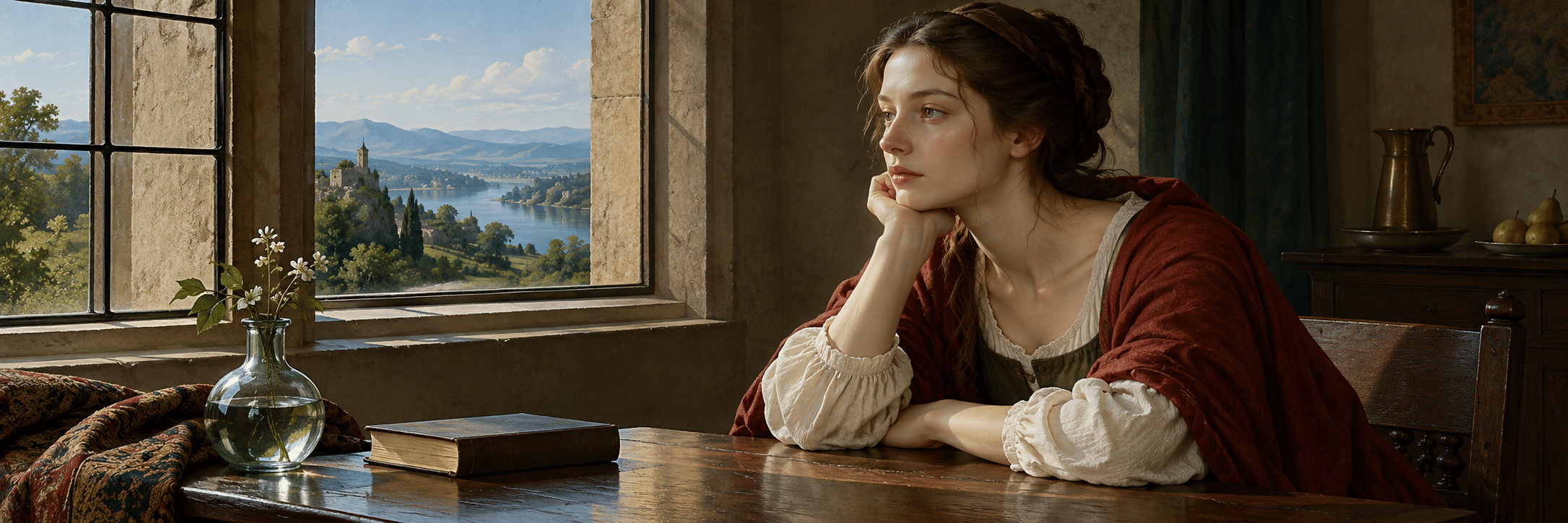
A visual introduction
Select an image for a closer look. Use the thumbnails, arrow keys or a swipe to compare examples. Zoom in to inspect details, or share the image that inspires you.
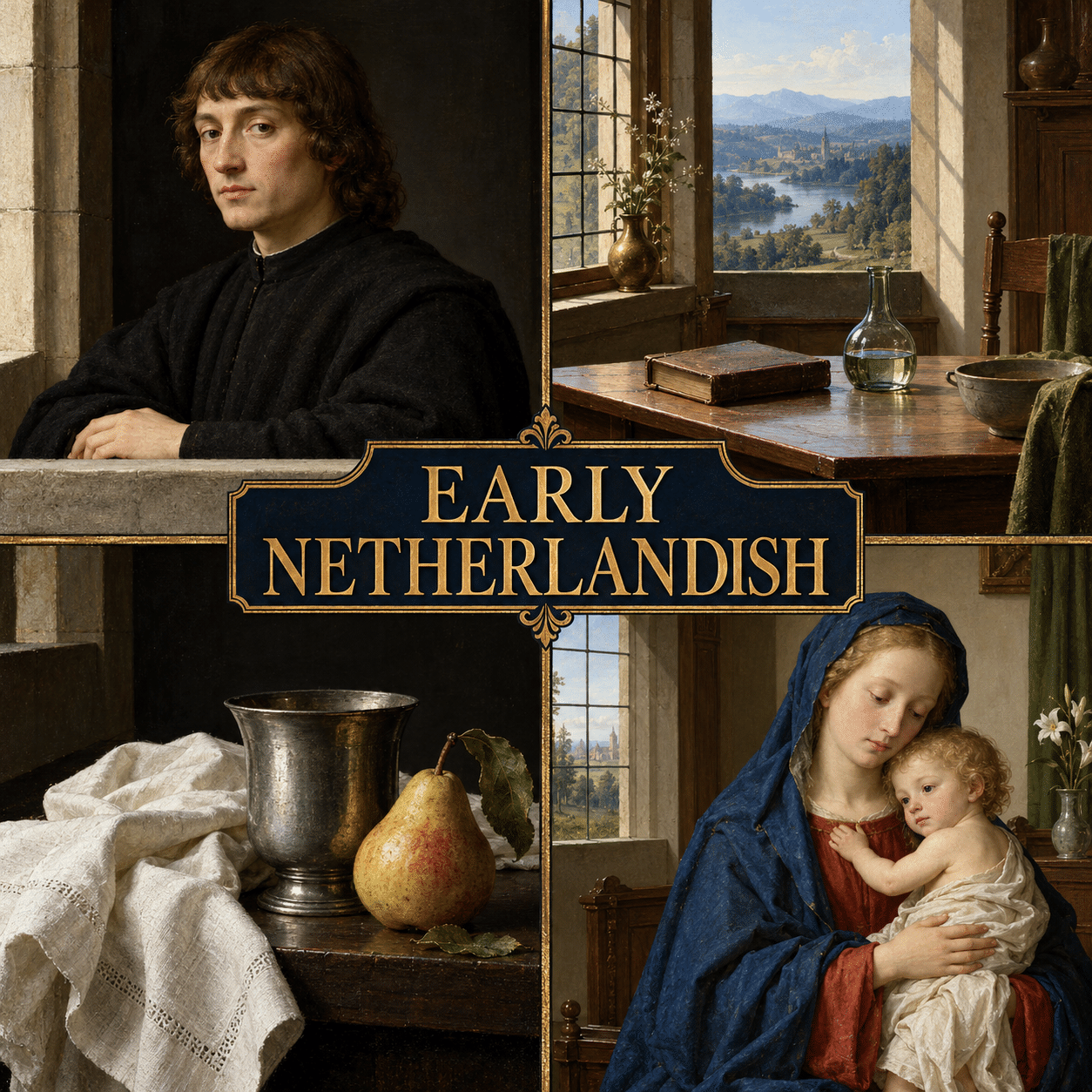
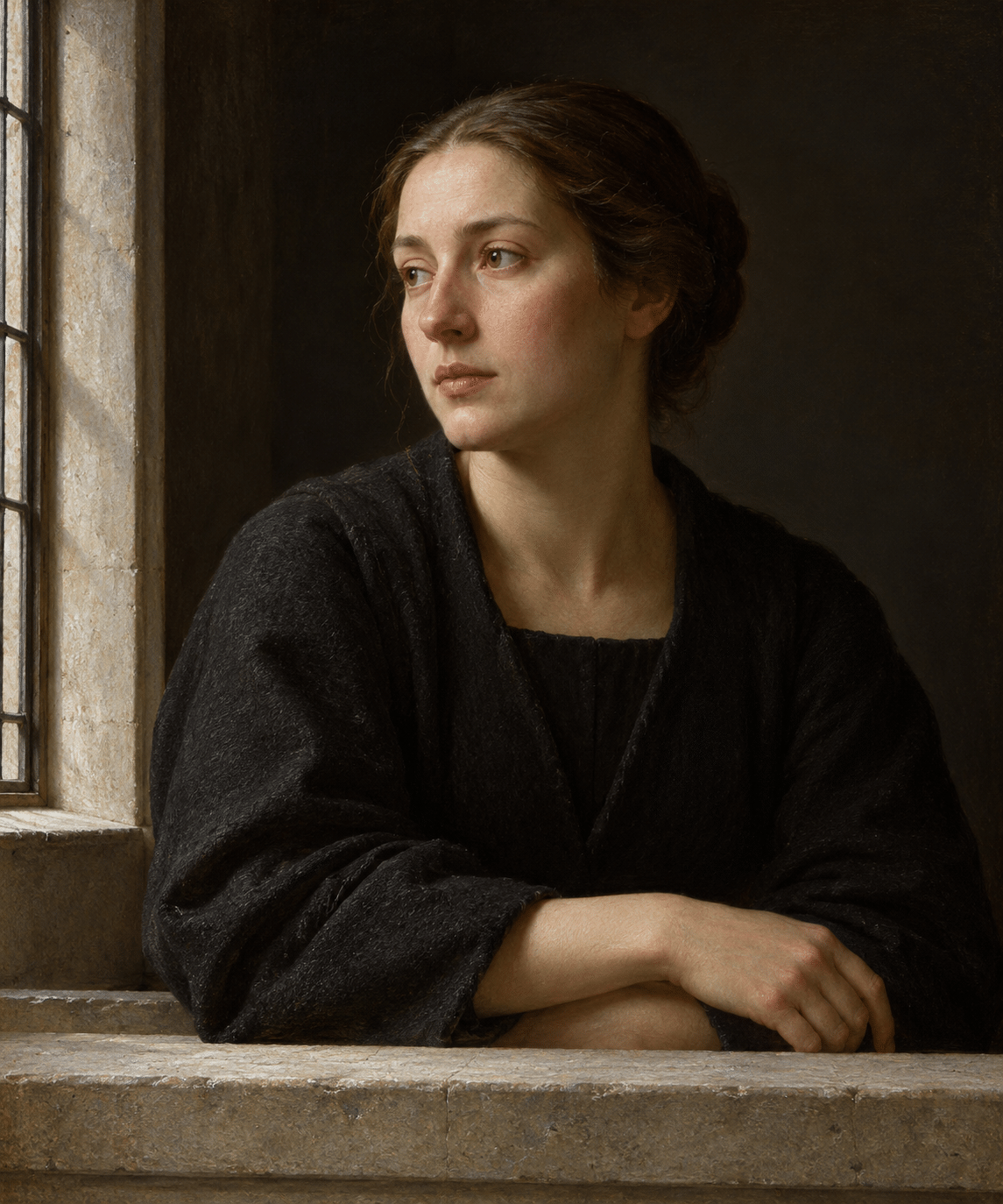
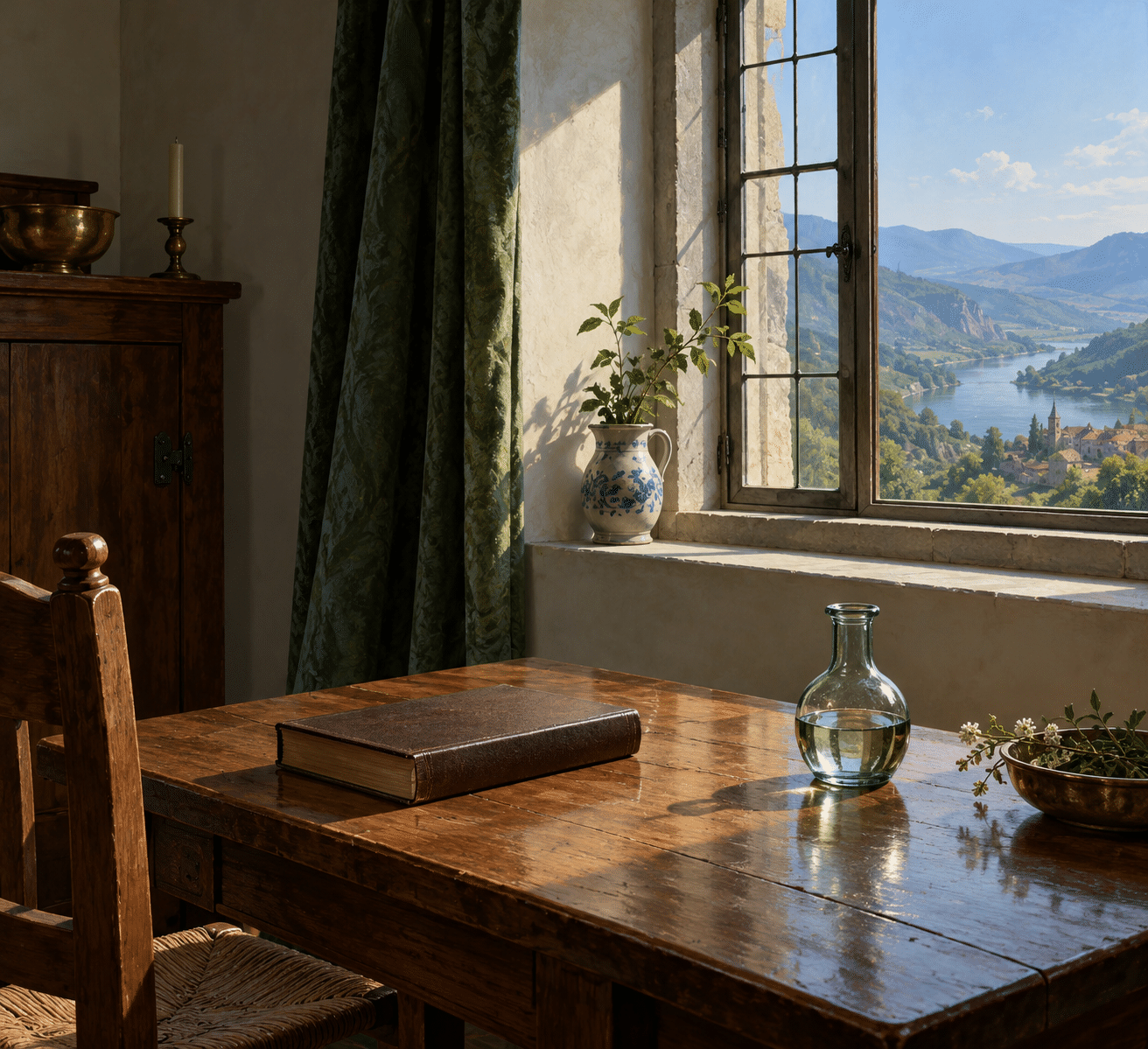


Creative toolbox · take this style further
Choose an input and a destination. Search sends your words to the chosen site; Copy & open puts them on your clipboard to paste there.
Create with AI
Turn your chosen input into an image prompt or a new creative direction.
ChatGPT
Copy your input and paste it into a ChatGPT conversation or image request.
Copy & open ChatGPT (new tab)Claude · Anthropic
Develop an image prompt or explore the style in a new Claude conversation.
Copy & open Claude · Anthropic (new tab)Midjourney
Paste your input into the Imagine bar on the Create page.
Copy & open Midjourney (new tab)Adobe Firefly
Copy your input, open Firefly, and paste it into the prompt field.
Copy & open Adobe Firefly (new tab)Leonardo.Ai
Copy your input, open Leonardo, and paste it into the generation field.
Copy & open Leonardo.Ai (new tab)Image search
Find visual references. Short, concrete keywords usually work best.
Lexica
Search AI images and prompts using your selected input.
Search with this input Lexica (new tab)Pexels
Search the photo and video library. Short keywords often work best.
Search with this input Pexels (new tab)Pixabay
Search photos, illustrations and other images.
Search with this input Pixabay (new tab)Unsplash
Search photographs using the style name or your own keywords.
Search with this input Unsplash (new tab)Wikimedia Commons
Search photographs, artworks and historical images. Check each file for its source and reuse terms.
Search with this input Wikimedia Commons (new tab)Art & research
Explore artists, collections and the ideas behind a style.
Wikipedia
Search for background reading. A style may not have its own article.
Search with this input Wikipedia (new tab)WikiArt
Copy your input into WikiArt’s search to explore artists and artworks.
Copy & open WikiArt (new tab)Europeana
Paste your keywords into the search to explore European museum, library and archive collections.
Copy & open Europeana (new tab)Inspiration
Discover portfolios and visual ideas from creative communities.
Instagram hashtags
Search a hashtag made from your input: spaces and punctuation are removed. Instagram may require sign-in.
Search with this input Instagram hashtags (new tab)ArtStation
Paste your input into artwork search for concept art, environments, characters and visual development.
Copy & open ArtStation (new tab)Behance
Paste your input into project search for illustration, design and visual storytelling.
Copy & open Behance (new tab)A closer look
Precisely observed surfaces; luminous layered colour; intimate interiors and distant landscapes; carefully staged portraits; sharp selective highlights; objects whose material presence can support symbolic meaning.
A regional tradition with international reach
Early Netherlandish painting is associated with the Low Countries, especially the remarkable developments of the fifteenth and early sixteenth centuries. The Metropolitan Museum frames its discussion broadly around 1420–1550 and emphasizes the importance of Jan van Eyck and Rogier van der Weyden. Courtly, religious and mercantile patronage all helped shape the paintings’ purposes.
The term covers more than one city, workshop or kind of image. The Rijksmuseum’s collection catalogue includes works from both the Northern and Southern Netherlands and stresses the importance of anonymous masters alongside named artists. Avoid treating the historical region as identical to a single modern nation or assuming that every detailed northern painting belongs to the same period.
Oil paint was developed, not invented by one painter
Jan van Eyck did not invent oil painting. The Met’s technical account describes earlier northern use of oil and explains how fifteenth-century Netherlandish painters brought exceptional control to the medium. Thin translucent passages could contribute to deep colour and subtle optical effects, alongside other kinds of paint handling.
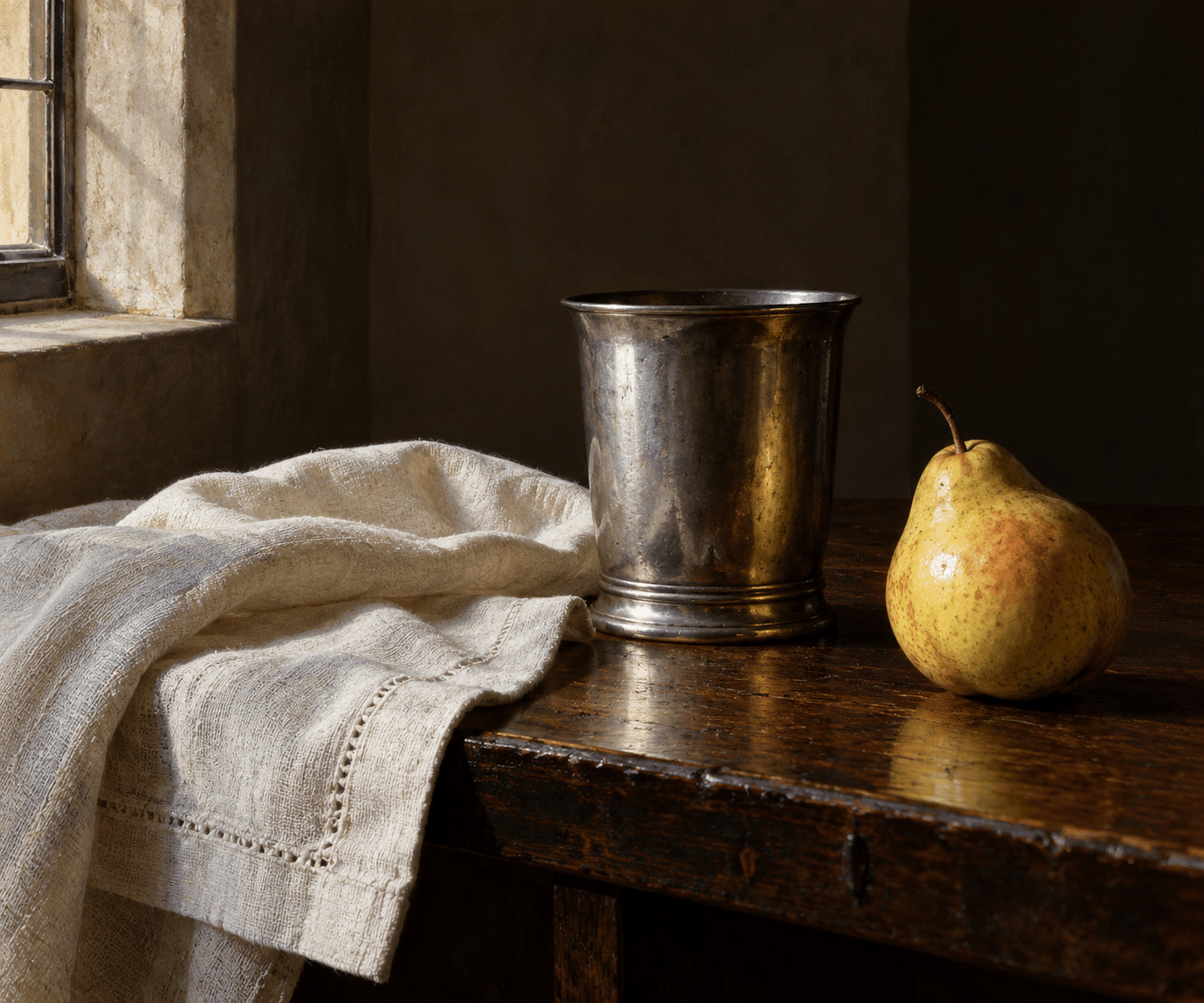
For a visual interpretation, the consequence is not simply “make everything shiny.” Different materials reflect light differently. A metal rim may carry a sharp highlight, cloth may absorb light, and skin may show a gradual transition. The image becomes convincing when these behaviours remain distinct within a coherent lighting situation.
Detail earns its place through relationships
A tiny reflected window, a seam in a garment or the grain of a wooden sill can make a scene feel closely observed. Yet detail works best when it supports the main encounter. Decide whether the viewer should first register a face, a gesture, a threshold or a devotional relationship. Secondary objects should enrich that reading rather than compete equally for attention.
Not every object requires an elaborate symbolic interpretation. Meaning depends on context, subject and evidence. A generated study can use a flower or a book as a compositional element without claiming a historically fixed code. When discussing an actual painting, separate documented interpretation from a plausible but uncertain reading.
The viewer stands at a threshold
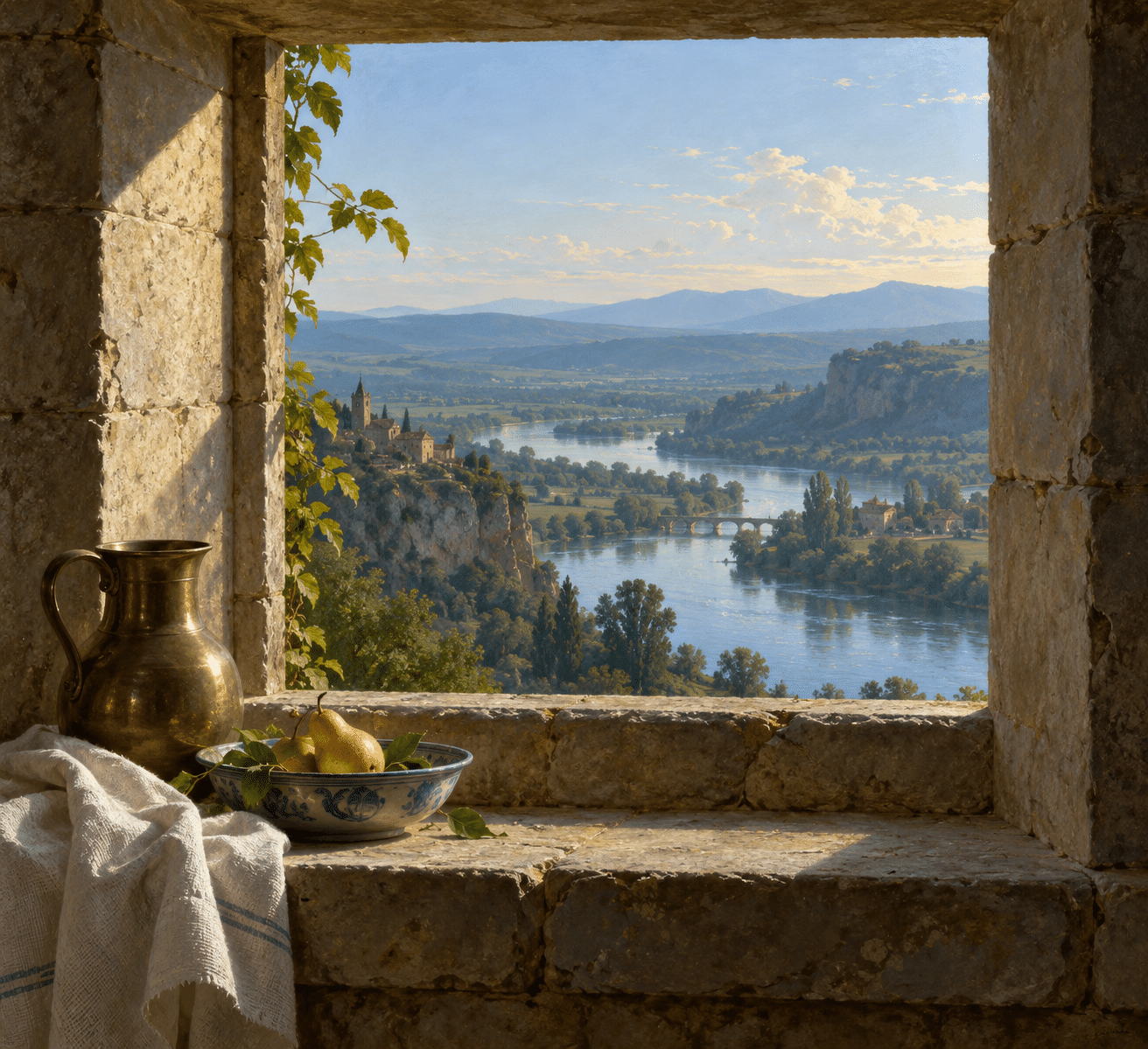
Portraits can establish a strong relationship between the sitter’s space and ours through a parapet, a frame-like opening or a carefully placed hand. A domestic interior may lead from a near object toward a window and distant landscape. These transitions make space feel inhabited without requiring an expansive scene.
Keep perspective and scale attentive to the chosen composition, but do not reduce the tradition to a contest in photographic accuracy. Expressive emphasis, devotional purpose and workshop practice can shape the arrangement. The most useful question is how the image makes its subject present to a particular viewer.
A varied contemporary study
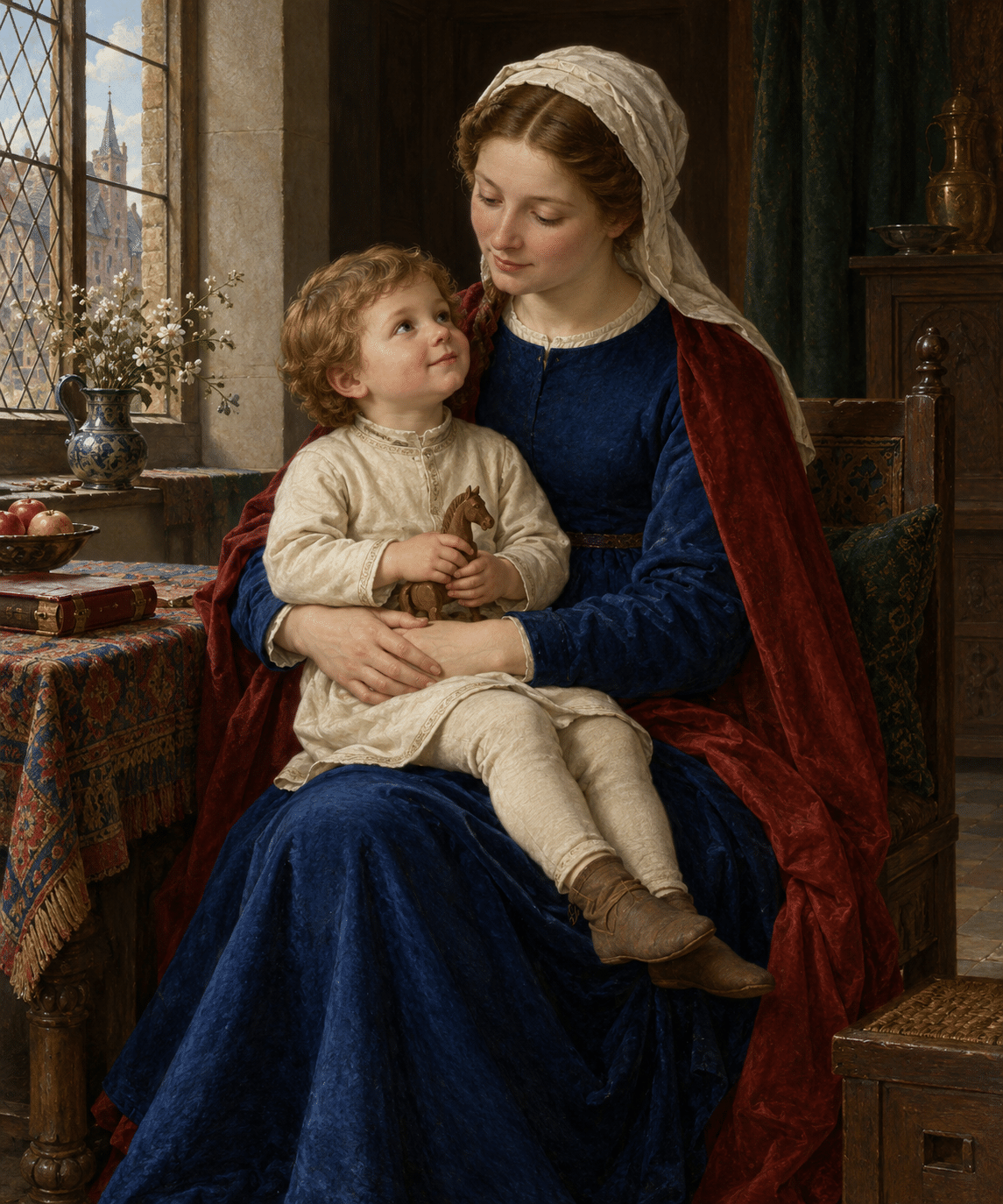
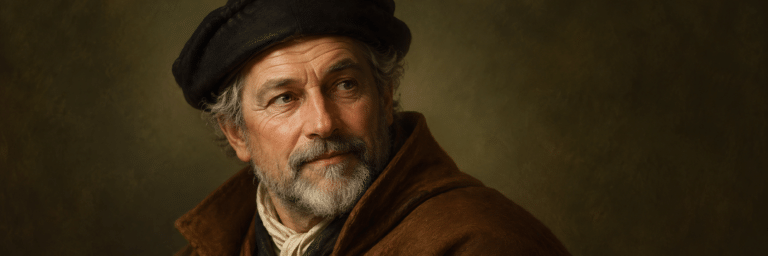
The new AI-generated gallery includes an original portrait, a quiet interior, a material-focused still life, a devotional-looking composition and a landscape seen through a window. These are educational interpretations, not newly discovered historical works or reconstructions of named paintings. The devotional study has no claim to liturgical authority or authentic provenance.
When prompting, name the subject, light source, surface contrasts and spatial threshold. “A restrained three-quarter portrait behind a stone sill, soft window light and carefully observed wool and skin” is more useful than “Renaissance masterpiece.” Avoid adding every possible luxury object, invented inscription and dramatic effect to the same small scene.
Positive editorial assessment — AI-authored
Early Netherlandish painting can make close attention feel emotionally consequential. Its material precision gives ordinary things weight, while subtle placement and gesture make the painted encounter unusually immediate. The strongest interpretations preserve that concentration instead of equating richness with an excess of objects.
Critical editorial assessment — AI-authored
Modern imitation often confuses microscopic detail with historical understanding. Uniform sharpness, glossy surfaces and arbitrary symbols can produce a convincing-looking but empty pastiche. Improve a study by establishing one coherent light source, differentiating materials and allowing the central relationship to determine the amount of detail.
Neutral editorial assessment — AI-authored
This tradition encompasses religious painting, portraiture and other subjects across changing workshops and audiences. Its visual principles offer useful studies in presence and material observation. Accurate historical discussion still requires particular works, technical evidence and patronage context rather than a generalized northern look.
A small poetic detour
Original words from the AOI studio.
Poetry
The window gathers in a day
and lays it on a sleeve of wool.
A little glass receives the grey,
a quiet room becomes less full.
The distant hills remain outside;
the hand rests close enough to know.
A painted threshold opens wide
where small reflections learn to glow.
The prompt workshop
Original creative exercises. These prompts create new illustrations, not documentary evidence.
An intimate portrait
Original Early-Netherlandish-informed portrait of an unknown adult in a plain dark wool garment behind a low stone sill, three-quarter view, soft window light, carefully differentiated skin cloth and stone. No copied painting, heraldry, signature or invented historical identity.
A room and a distant world
Original intimate interior with a wooden table, plain closed book and small glass vessel near a window opening onto a distant blue-green landscape. Restrained oil-paint-like handling, coherent daylight and meaningful space, no fake inscription or historical attribution.
Materials under one light
Original small still life of folded linen, a modest pewter cup and one pear on dark wood, luminous but restrained colour and precise selective highlights. Inspired by close material observation, clearly a modern AI study rather than a period artifact.
Your next inspiration
Discover another art style
Follow a visual thread to the next subject.
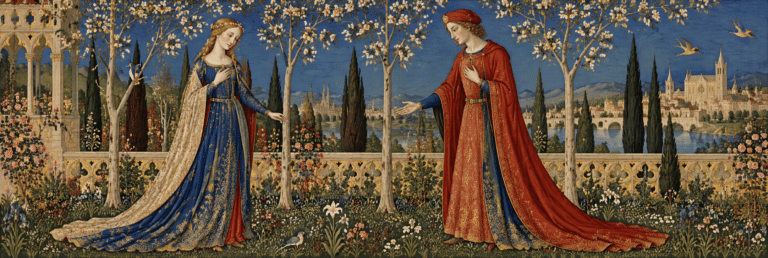
International Gothic: Courtly Elegance and Observed Detail
Compare overlapping late-medieval visual contexts.
Tronie: The Expressive Head Beyond the Commissioned Portrait
Explore a later Netherlandish tradition of expressive heads.
A smile from the studio
Jokes
The pewter cup requested more sparkle. The linen objected that they were all supposed to share the same window.
Sources and further exploration
The Met: Early Netherlandish Painting — historical range, patrons and pictorial presence
The Met: Painting in Oil in the Low Countries — technique and the Van Eyck invention myth
Rijksmuseum: Early Netherlandish Paintings — Northern and Southern collections and anonymous masters