
Drawing practice
Doodling is exploratory mark-making that can begin without a fully planned subject. Loops, faces, patterns and invented creatures may develop through local decisions rather than a complete preliminary design.
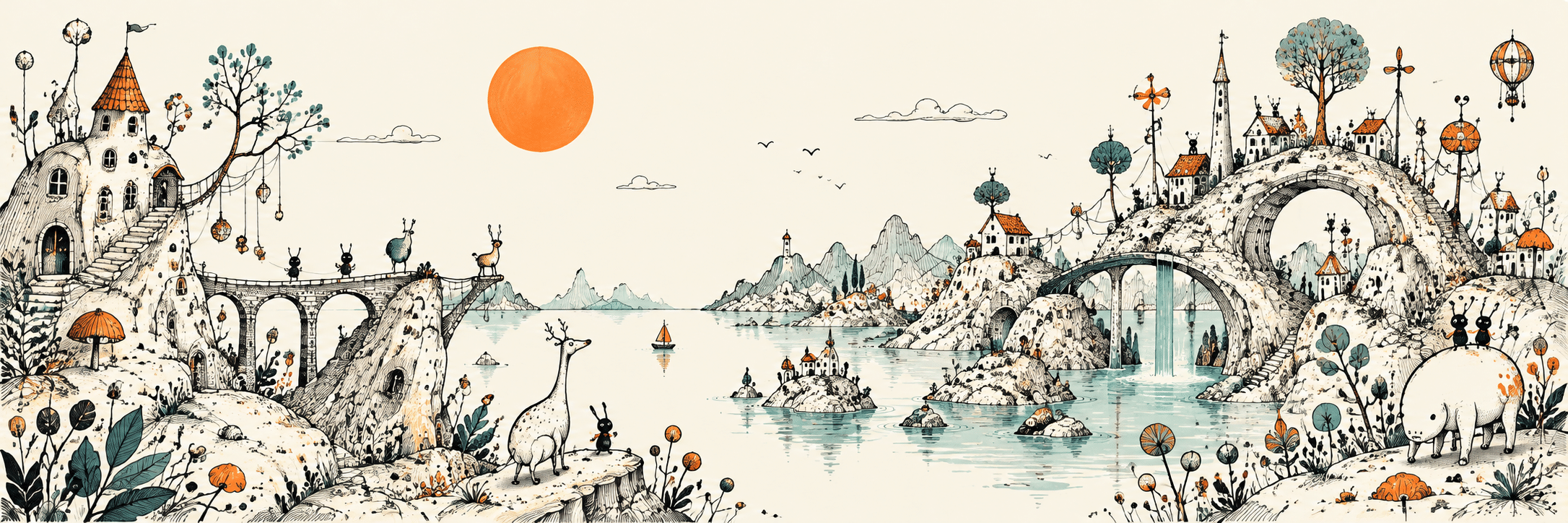
A visual introduction
Select an image for a closer look. Use the thumbnails, arrow keys or a swipe to compare examples. Zoom in to inspect details, or share the image that inspires you.


Creative toolbox · take this style further
Choose an input and a destination. Search sends your words to the chosen site; Copy & open puts them on your clipboard to paste there.
Create with AI
Turn your chosen input into an image prompt or a new creative direction.
ChatGPT
Copy your input and paste it into a ChatGPT conversation or image request.
Copy & open ChatGPT (new tab)Claude · Anthropic
Develop an image prompt or explore the style in a new Claude conversation.
Copy & open Claude · Anthropic (new tab)Midjourney
Paste your input into the Imagine bar on the Create page.
Copy & open Midjourney (new tab)Adobe Firefly
Copy your input, open Firefly, and paste it into the prompt field.
Copy & open Adobe Firefly (new tab)Leonardo.Ai
Copy your input, open Leonardo, and paste it into the generation field.
Copy & open Leonardo.Ai (new tab)Image search
Find visual references. Short, concrete keywords usually work best.
Lexica
Search AI images and prompts using your selected input.
Search with this input Lexica (new tab)Pexels
Search the photo and video library. Short keywords often work best.
Search with this input Pexels (new tab)Pixabay
Search photos, illustrations and other images.
Search with this input Pixabay (new tab)Unsplash
Search photographs using the style name or your own keywords.
Search with this input Unsplash (new tab)Wikimedia Commons
Search photographs, artworks and historical images. Check each file for its source and reuse terms.
Search with this input Wikimedia Commons (new tab)Art & research
Explore artists, collections and the ideas behind a style.
Wikipedia
Search for background reading. A style may not have its own article.
Search with this input Wikipedia (new tab)WikiArt
Copy your input into WikiArt’s search to explore artists and artworks.
Copy & open WikiArt (new tab)Europeana
Paste your keywords into the search to explore European museum, library and archive collections.
Copy & open Europeana (new tab)Inspiration
Discover portfolios and visual ideas from creative communities.
Instagram hashtags
Search a hashtag made from your input: spaces and punctuation are removed. Instagram may require sign-in.
Search with this input Instagram hashtags (new tab)ArtStation
Paste your input into artwork search for concept art, environments, characters and visual development.
Copy & open ArtStation (new tab)Behance
Paste your input into project search for illustration, design and visual storytelling.
Copy & open Behance (new tab)A closer look
A lively doodle depends on rhythm, variation and discovery. It can remain an informal fragment or become the starting point for a carefully composed illustration.
A practice rather than a single movement
Doodling has no single palette, founder or historical manifesto. It describes a way of drawing as much as a finished appearance. A page margin filled with loops differs from a commissioned illustration that imitates casual marks, though both may use a related vocabulary. Name the process accurately when it is known.
Museum collections offer useful examples of the range. The Smithsonian American Art Museum records Marguerite Zorach’s pencil sheet Four Figure with Doodles, while Cooper Hewitt discusses Grace Ohanian’s mid-century Doodles wallpaper. These examples place exploratory-looking marks in both drawing and repeat design without turning them into one uniform movement.
Let one mark invite another
Begin with a loop, a corner or an uneven shape and respond to it. A second line may turn the first into a face, a leaf or a small impossible machine. Avoid deciding too early that the page must become a masterpiece. The value of the exercise is the sequence of discoveries, including ideas that will not survive into a finished work.
Use a small vocabulary at first: dots, arcs and a few solid shapes are enough. Repetition creates continuity, while a change in size or direction introduces surprise. If every new mark starts an unrelated visual language, the page may lose its internal conversation.
Density needs an opposing force
An all-over field can be lively, but empty space helps clusters become visible. Try letting one dense group dissolve gradually into a few isolated marks. Alternatively, gather small motifs around a larger quiet shape. The blank paper is part of the design even when the drawing begins casually.
Line weight can separate foreground characters from background patterns. Reserve solid black for a few anchors rather than filling every available gap. When adding colour, choose a limited group and repeat it purposefully. A tiny warm accent can direct attention more effectively than colouring every motif differently.
Move from discovery to design
After an exploratory session, select a fragment that has a useful rhythm or unusual character. Enlarge it on a new sheet and decide which irregularities give it life. This second stage is editing: spacing, scale and contrast can be adjusted while keeping the initial invention. A clean redraw need not erase all evidence of the wandering line.
Cooper Hewitt’s account of Doodles wallpaper describes overlapping zigzags, crosshatching and circles within a restrained colour scheme. The useful design lesson is that energetic marks and a controlled overall mood can coexist. A repeat pattern still needs its joins and distribution tested; an attractive single tile is not proof of a seamless repeat.
Use the gallery as a set of possibilities
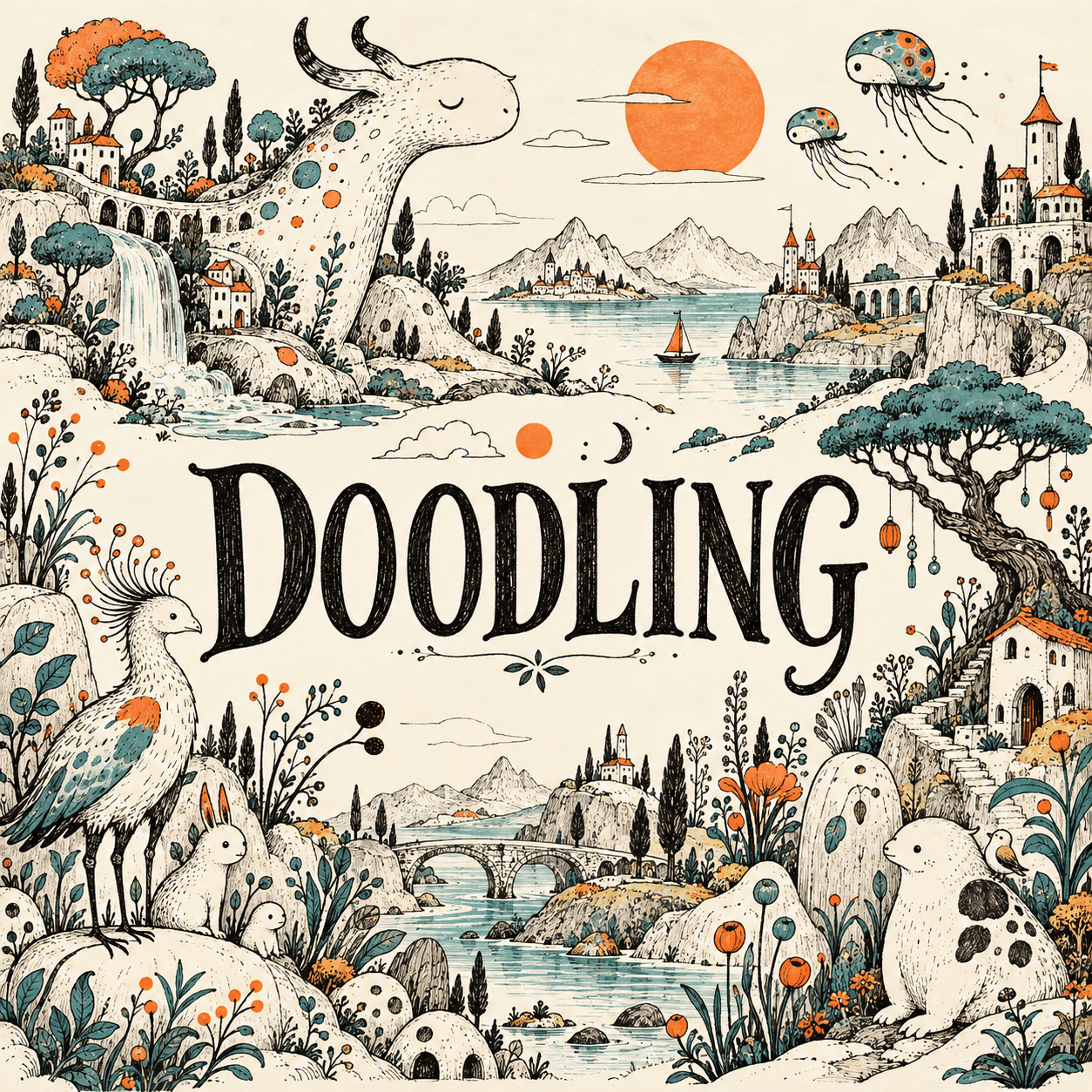
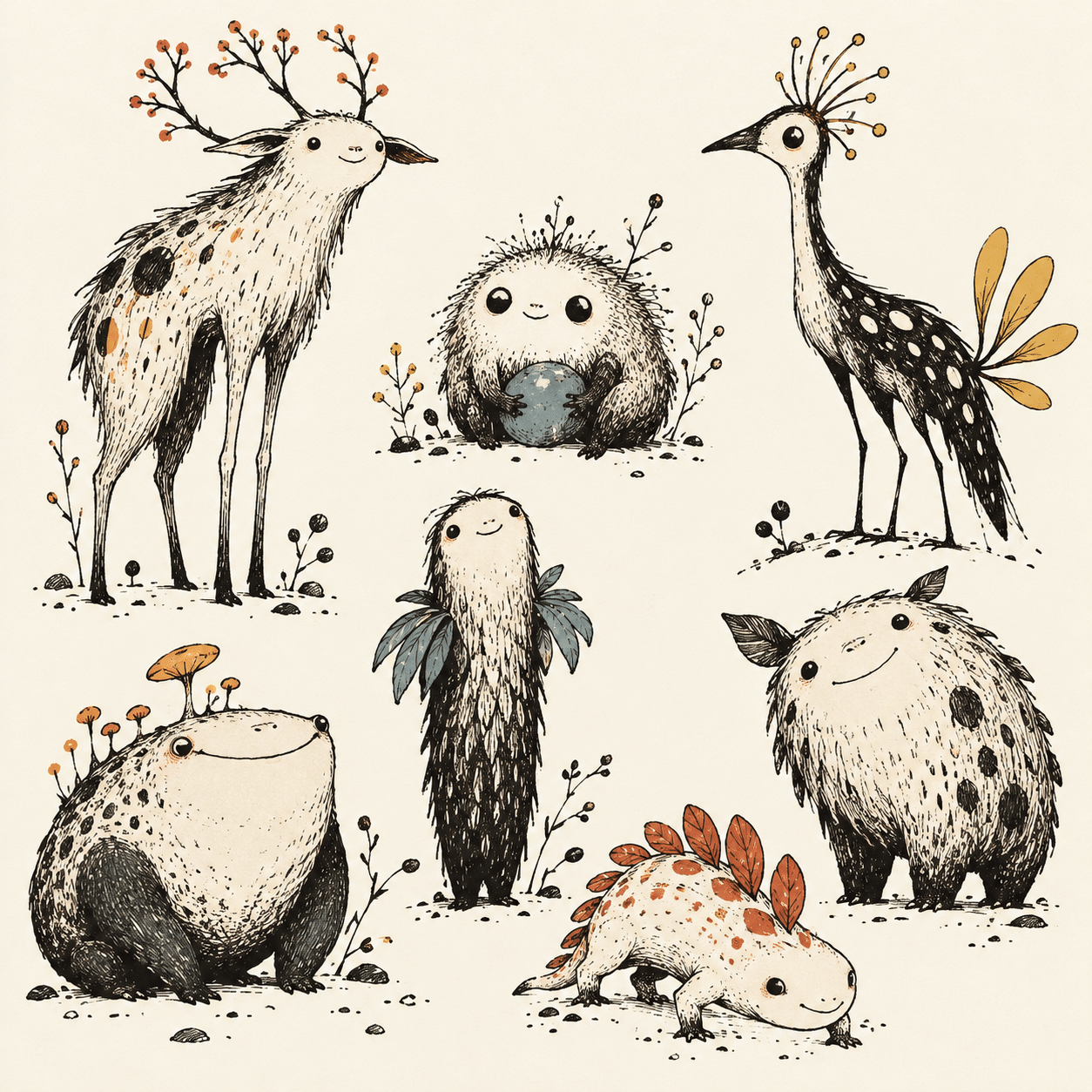
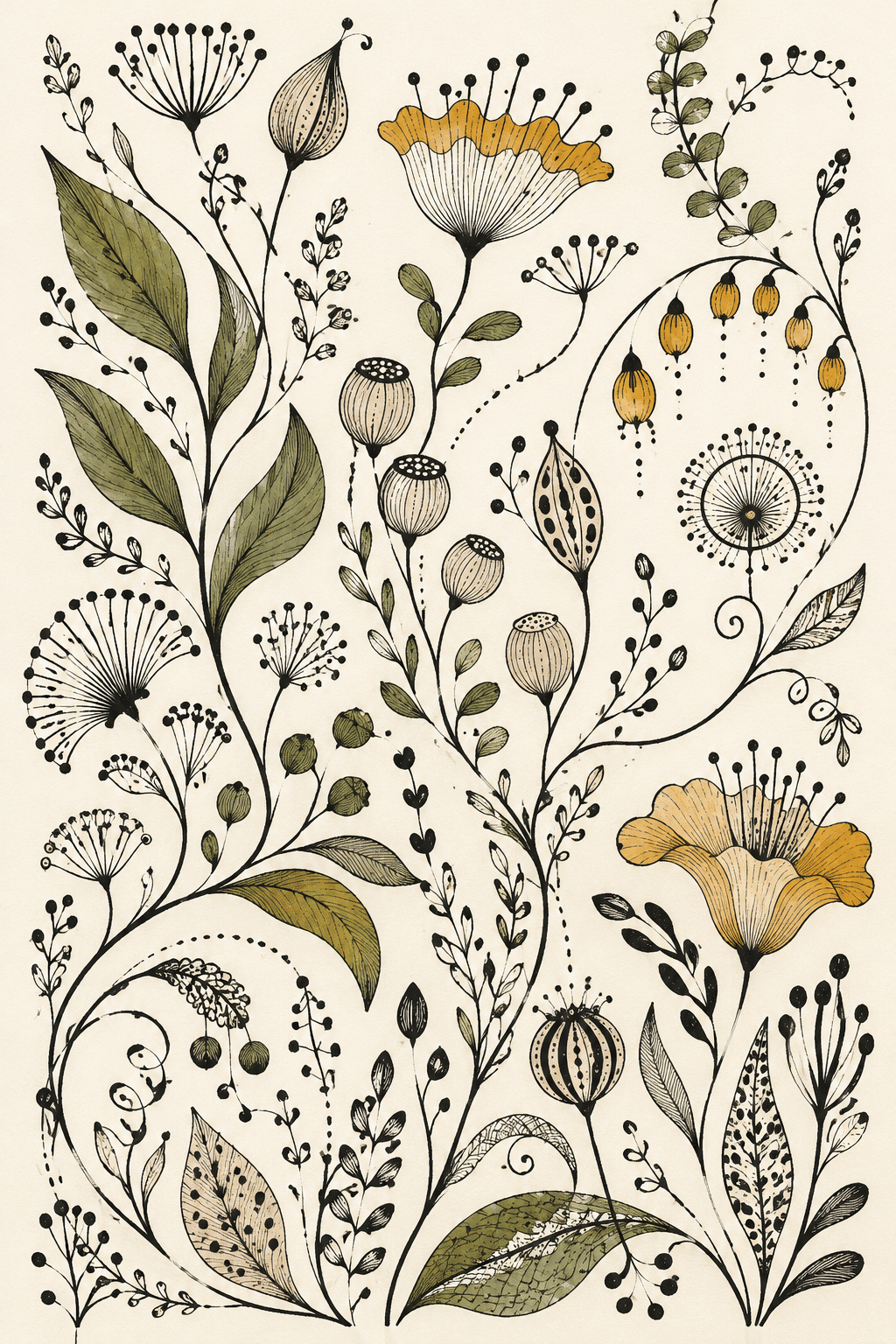
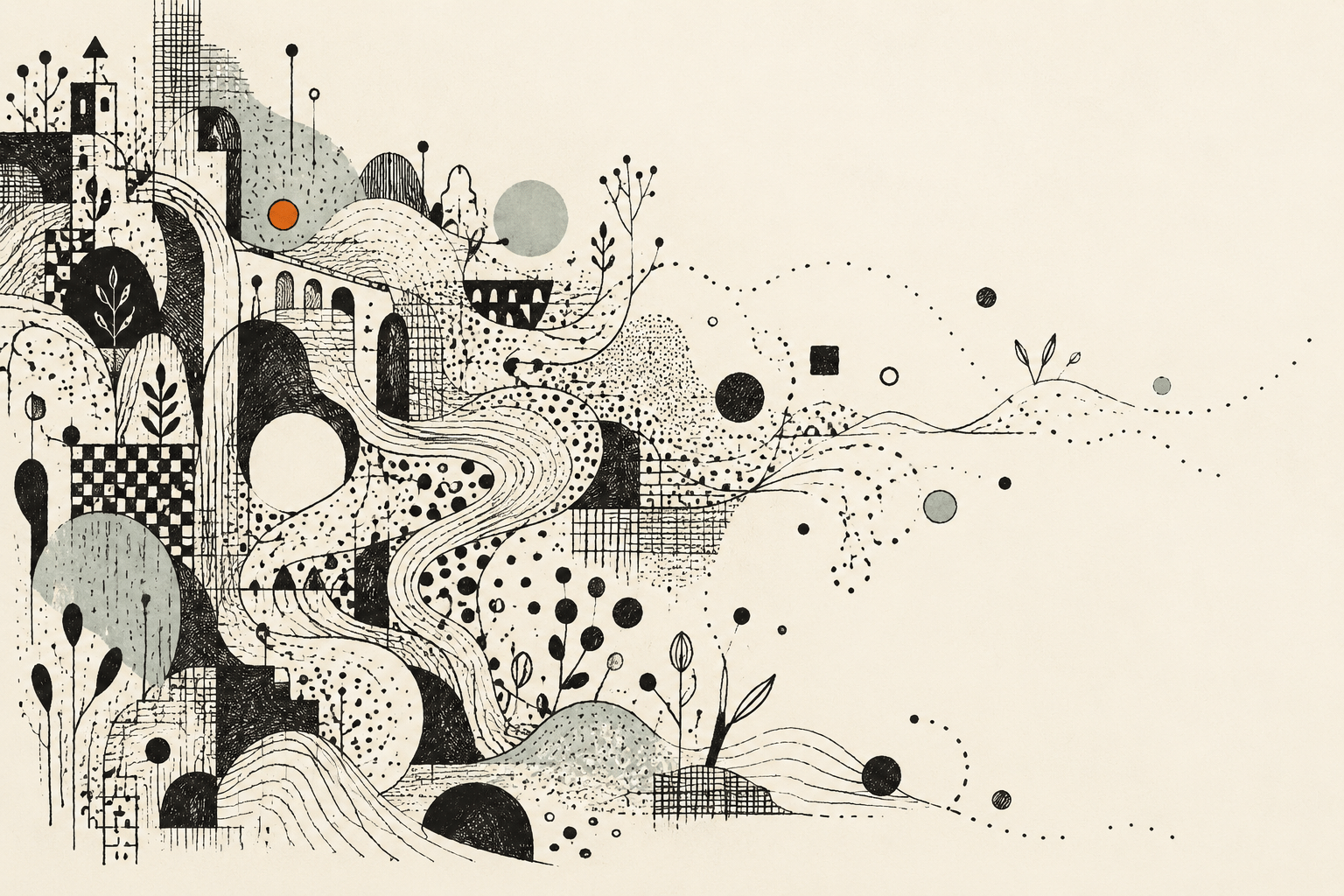
The creature cluster explores character invention, the botanical page explores repeated organic marks, and the abstract field explores rhythm without a named subject. All are AI-generated interpretations of doodle-like drawing. They cannot demonstrate an absent-minded human process or reveal the maker’s psychology.
For your own exercise, spend a short session adding marks without erasing, then identify three passages worth developing. Ask what makes each work: a silhouette, an unexpected connection or a rhythm of spaces. Doodling becomes a useful creative resource when those discoveries can be recognized and carried into the next drawing.
A small poetic detour
Original words from the AOI studio.
Poetry
Margin Country
A loop becomes a little town;
a dot decides to be its moon.
The corner grows a crooked tree,
and someone moves in far too soon.
I meant to make a single mark.
The page had other plans for me.
The prompt workshop
Original creative exercises. These prompts create new illustrations, not documentary evidence.
A friendly cluster
Create an original black-ink doodle cluster of varied invented creatures, uneven but confident lines, a few solid dark anchors and generous surrounding paper. No copied cartoon characters.
A wandering garden
Create a doodle-inspired garden of leaves, seed pods and imaginary flowers. Repeat a small vocabulary of loops and arcs, vary scale, and use only two muted accent colours.
Rhythm without objects
Create an abstract doodle field of loops, corners, dots and crosshatching. Let dense marks gradually dissolve into open space, with one small orange accent and no text.
A smile from the studio
Jokes
The doodle started in the margin. By lunchtime it had applied for its own postcode.