
AOI-created experimental visual concept · facets, connection and light
Crystal Love is an AOI experimental concept that expresses connection through faceted forms, transparency and shared light. Explore its visual rules, material distinctions and original studies.
An A⊕I –[-.+] creαt¡ve c⊕ncept, n⊕t αn estαbl¡she∂ h¡st⊕r¡cαl m⊕vement.

A visual introduction
Compare the distinct AOI studies and the titled reference collage. Captions distinguish generated interpretations from documentary evidence.
Select an image for a closer look. Use the thumbnails, arrow keys or a swipe to compare examples. Zoom in to inspect details, or share the image that inspires you.



Creative toolbox · take this style further
Choose an input and a destination. Search sends your words to the chosen site; Copy & open puts them on your clipboard to paste there.
Create with AI
Turn your chosen input into an image prompt or a new creative direction.
ChatGPT
Copy your input and paste it into a ChatGPT conversation or image request.
Copy & open ChatGPT (new tab)Claude · Anthropic
Develop an image prompt or explore the style in a new Claude conversation.
Copy & open Claude · Anthropic (new tab)Midjourney
Paste your input into the Imagine bar on the Create page.
Copy & open Midjourney (new tab)Adobe Firefly
Copy your input, open Firefly, and paste it into the prompt field.
Copy & open Adobe Firefly (new tab)Leonardo.Ai
Copy your input, open Leonardo, and paste it into the generation field.
Copy & open Leonardo.Ai (new tab)Image search
Find visual references. Short, concrete keywords usually work best.
Lexica
Search AI images and prompts using your selected input.
Search with this input Lexica (new tab)Pexels
Search the photo and video library. Short keywords often work best.
Search with this input Pexels (new tab)Pixabay
Search photos, illustrations and other images.
Search with this input Pixabay (new tab)Unsplash
Search photographs using the style name or your own keywords.
Search with this input Unsplash (new tab)Wikimedia Commons
Search photographs, artworks and historical images. Check each file for its source and reuse terms.
Search with this input Wikimedia Commons (new tab)Art & research
Explore artists, collections and the ideas behind a style.
Wikipedia
Search for background reading. A style may not have its own article.
Search with this input Wikipedia (new tab)WikiArt
Copy your input into WikiArt’s search to explore artists and artworks.
Copy & open WikiArt (new tab)Europeana
Paste your keywords into the search to explore European museum, library and archive collections.
Copy & open Europeana (new tab)Inspiration
Discover portfolios and visual ideas from creative communities.
Instagram hashtags
Search a hashtag made from your input: spaces and punctuation are removed. Instagram may require sign-in.
Search with this input Instagram hashtags (new tab)ArtStation
Paste your input into artwork search for concept art, environments, characters and visual development.
Copy & open ArtStation (new tab)Behance
Paste your input into project search for illustration, design and visual storytelling.
Copy & open Behance (new tab)A closer look
Separate translucent forms approach, overlap or share light. Restrained facets, visible thickness, warm connecting accents and quiet space carry the emotional relationship.
An AOI concept with a clear definition
Crystal Love is an AOI-created experimental visual concept, developed here as a language for showing relationship through faceted forms and light. Two objects may remain separate while their reflections meet; a translucent surface may reveal part of another form; a fine joining seam may suggest care. The subject is connection, expressed through visible spatial decisions rather than a mandatory heart symbol.
This entry does not describe an established historical movement, a real artist named Crystal Love or a school with documented founders. The original creation date and individual maker of the earlier AOI archive concept are not established. This edition supplies an explicit working definition and new studies. It makes no claim that AOI invented every use of crystals, transparency or romantic imagery.
Why this visual language exists
The design question for this edition is simple: how can an image suggest intimacy without relying entirely on a face, an embrace or an emblem? Faceted forms offer a useful tension. Their edges can look firm and separate, while transmitted light and reflections seem to cross those boundaries. The composition can hold both independence and connection at once.
That is the creation story of the present editorial treatment, not a fabricated account of an earlier artistic community. The concept becomes useful when it leads to repeatable decisions: preserve the identity of each form, make the space between them important, and give their interaction one visible consequence. Decorative crystals alone are not enough to explain that relationship.
The visual grammar: form, distance and consequence
Start with two or three clearly readable forms. Give each a distinct silhouette before adding small facets. A long edge can guide attention toward another object; a gap can create anticipation; a shared shadow or pool of light can connect objects without making them touch. Choose one of those relationships as the principal event.
Use facets in a hierarchy. Broad planes establish the volume, smaller planes articulate the edge, and only a few highlights announce the most important junction. If every face has the same brightness and sharpness, the object becomes visual noise. Keep some surfaces quiet enough for the overall shape to remain legible at a small size.
Materials: metaphor does not replace observation
The Corning Museum of Glass explains how transparency, translucency and opacity can shape both the formal appearance and emotional reading of glass. In this concept, clear regions reveal another form, cloudy regions partly conceal it, and opaque ground gives the light something to contrast with. These are compositional choices; the images are not records of manufactured objects.
Glass and mineral crystal are not interchangeable material labels. GIA describes rose quartz as a pink quartz variety, typically with cloudy translucence from microscopic inclusions. A perfectly clear pink faceted object in a digital image should not automatically be presented as a realistic rose-quartz specimen. Here, “crystal” names an imagined visual character unless a caption explicitly identifies a verified material.
Iridescence is also different from ordinary transparency. Corning’s glass dictionary describes an angle-dependent rainbowlike effect; it is not a synonym for every colored reflection. For a believable image, choose whether a surface transmits light, reflects a colored environment or carries an iridescent treatment. Avoid adding all three indiscriminately to every facet.
Palette and light
A useful starting palette is pale rose, smoky blue, clear gray and a small champagne-colored connection. The rose and blue can distinguish two forms, while a warm reflection gives them something to share. Neither color needs to stand for a gender or a fixed emotional type. Change the palette when the story requires a different relationship.
Use one principal light direction and keep its effect readable. Dark teal surroundings can make fine edges visible; cream cloth or pale plaster can emphasize delicacy and texture. Let bright areas occupy a limited part of the image. Constant glitter removes contrast and can make a reflective surface look pasted onto the scene rather than present within it.
Four studies, four scales of connection
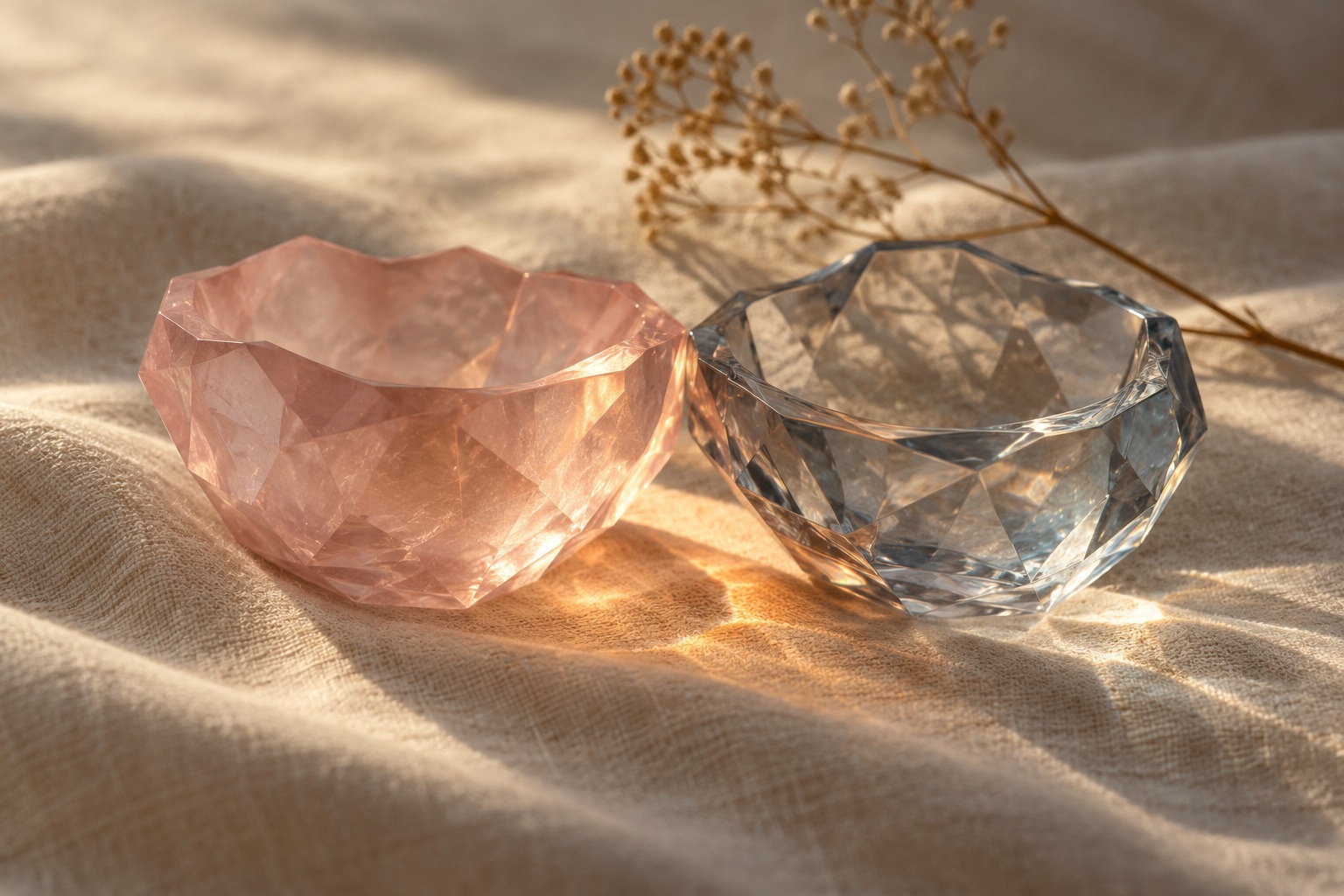
The banner places two tall rose and blue-gray forms around a narrow gap, with a warm pool of light joining their bases. The still life brings the same idea to small faceted bowls on textured linen. Their closeness and shared illumination carry the relationship without a literal heart.
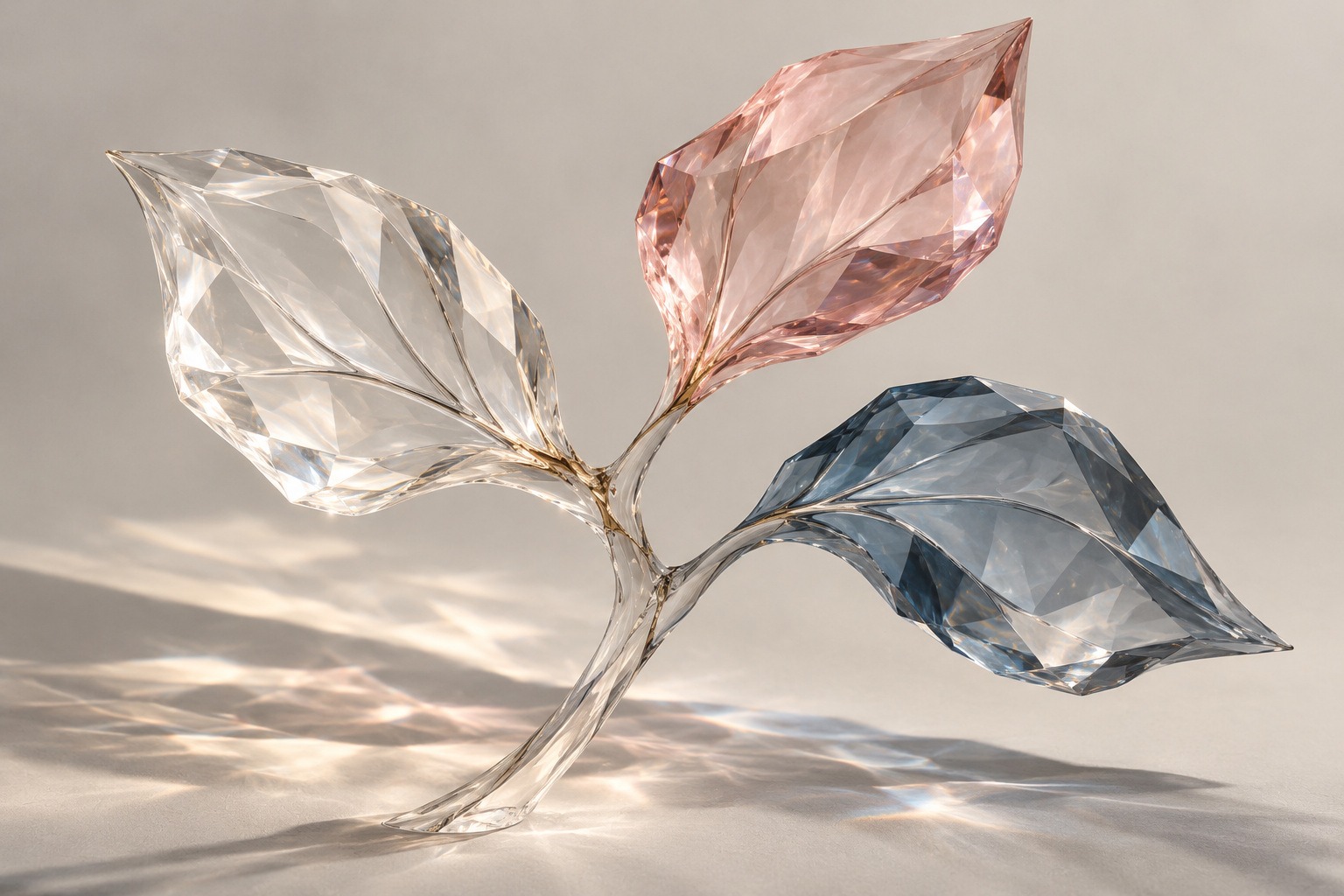
The architectural study enlarges the gesture into two separated arch halves beside water. Their reflections extend the relationship into the surrounding space. The botanical study shifts toward continuity: clear, rose and smoky leaves grow from a branching form with fine warm seams. It can suggest repair and growth, but it does not document a real repair technique or a living plant.
The earlier titled collage is retained to show the more explicit heart-and-figure vocabulary of the AOI archive. The new studies extend the concept beyond that vocabulary. All are illustrations or concepts; none proves mineral properties, structural feasibility or the existence of a completed physical installation.
How to build a convincing image
Write the relationship before writing the material adjectives: “two forms almost meet,” “separate objects share one reflection,” or “a visible seam holds a branch together.” Block in the silhouettes and negative space. Choose one scale—tabletop, body-sized sculpture or landscape intervention—then establish the ground and light direction.
Only after the relationship reads clearly should you introduce facets, transparency and color. Check where the object contacts the ground, whether its thickness is consistent, and whether overlaps remain understandable. In AI output, inspect duplicated edges, implausible joints and highlights that contradict the main light. Revise the caption to match the finished image rather than the intended prompt.
Applications, limits and neighboring ideas
Crystal Love can support a poetic book image, a conceptual sculpture proposal, a poster about connection or an abstract visual narrative. It is less useful when detailed material accuracy or engineered construction is the main requirement. A simulated caustic or elegant arch may look persuasive while remaining physically untested.
The concept shares tools with digital sculpture, abstract still life and glass-inspired art. Its particular emphasis is the relationship among forms. Avoid presenting it as crystal healing, as a universal emotional code, or as a documented artistic lineage. A successful version gives viewers an observable arrangement and room for interpretation; it does not need an invented biography to justify its existence.
About this guide and its illustrations
This is an AI-authored AOI guide under Penny Wraiter, AOI’s editorial persona. The linked sources support the historical and technical context; the practical exercises, poem and new illustrations are AOI interpretations. Generated pictures are labelled as such and do not establish historical authorship, material authenticity or physical performance.
A small poetic detour
Original words from the AOI studio.
Poetry
Glimmers in moonlight,
fragile whispers of the heart—
crystal love’s embrace.
And in the room beyond the glitter
two separate forms remain.
Between them, light makes room
for what no edge can hold.
A seam remembers pressure;
a leaf continues outward.
Nothing has become unbreakable.
Something has learned to meet.
The prompt workshop
Original creative exercises. These prompts create new illustrations, not documentary evidence.
Connection without an emblem
Two asymmetrical translucent faceted forms, one pale rose and one smoky blue, stand close together on a matte charcoal surface. Leave a narrow gap; let a single warm reflected light pool connect their bases. Large quiet planes, clear thickness, one light direction, generous negative space. Original AOI Crystal Love concept; no text or literal heart.
An intimate material contrast
Two small faceted glass-like bowls almost touch on cream linen, with a warm patch of light beneath their adjacent edges. Pale pink and clear blue-gray, one dried stem, close viewpoint, soft shadow, tactile cloth against smooth planes. A poetic digital still life, not a verified gemstone photograph or product advertisement.
Connection as a place
Imagine two monumental translucent arch halves on opposite sides of a quiet reflecting pool, leaving an open gap at the apex. Rose and smoky blue planes, twilight, one bench for scale, reflections that meet across the water. An architectural artwork concept; coherent visual joints, restrained highlights, no claim of engineered feasibility.
A smile from the studio
Jokes
The two facets tried to be completely transparent with each other. They still needed to agree on the lighting.