
Artist-used term and AOI experimental interpretation
Crackism is a name with existing artist usage, not a verified historical movement with a single agreed definition. This article distinguishes that usage from an original AOI visual proposal: compositions in which a fracture displaces a recognizable form and exposes a contrasting layer, while part of the subject remains continuous.
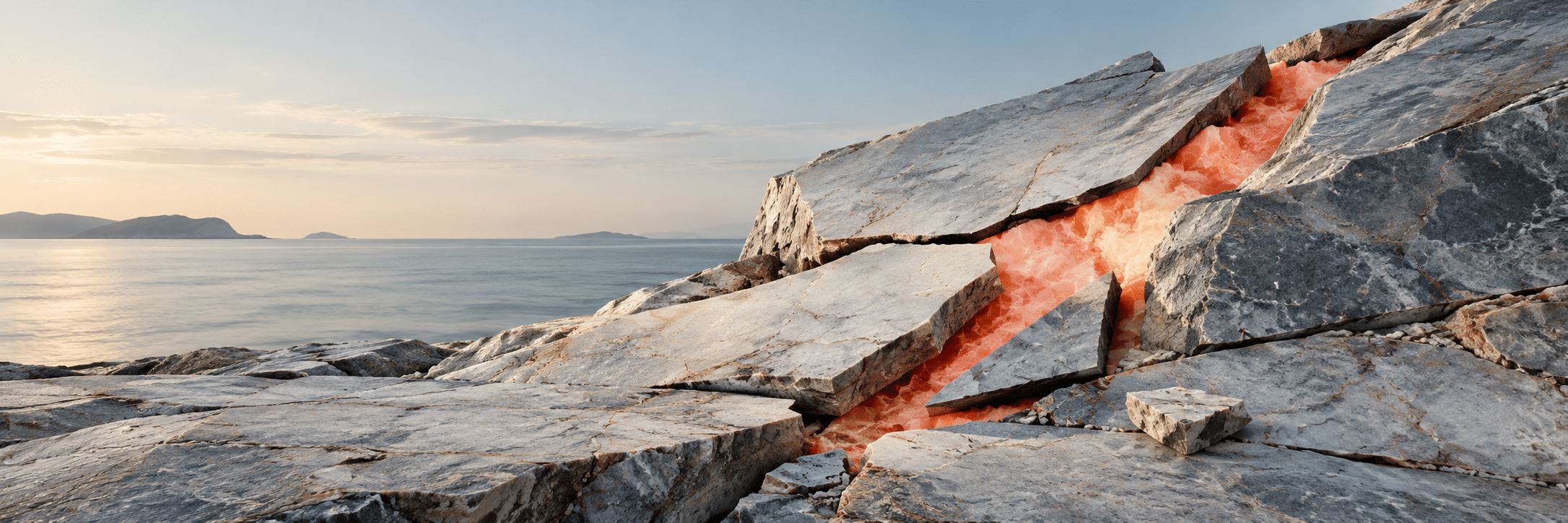
A visual introduction
Select an image for a closer look. Use the thumbnails, arrow keys or a swipe to compare examples. Zoom in to inspect details, or share the image that inspires you.


Creative toolbox · take this style further
Choose an input and a destination. Search sends your words to the chosen site; Copy & open puts them on your clipboard to paste there.
Create with AI
Turn your chosen input into an image prompt or a new creative direction.
ChatGPT
Copy your input and paste it into a ChatGPT conversation or image request.
Copy & open ChatGPT (new tab)Claude · Anthropic
Develop an image prompt or explore the style in a new Claude conversation.
Copy & open Claude · Anthropic (new tab)Midjourney
Paste your input into the Imagine bar on the Create page.
Copy & open Midjourney (new tab)Adobe Firefly
Copy your input, open Firefly, and paste it into the prompt field.
Copy & open Adobe Firefly (new tab)Leonardo.Ai
Copy your input, open Leonardo, and paste it into the generation field.
Copy & open Leonardo.Ai (new tab)Image search
Find visual references. Short, concrete keywords usually work best.
Lexica
Search AI images and prompts using your selected input.
Search with this input Lexica (new tab)Pexels
Search the photo and video library. Short keywords often work best.
Search with this input Pexels (new tab)Pixabay
Search photos, illustrations and other images.
Search with this input Pixabay (new tab)Unsplash
Search photographs using the style name or your own keywords.
Search with this input Unsplash (new tab)Wikimedia Commons
Search photographs, artworks and historical images. Check each file for its source and reuse terms.
Search with this input Wikimedia Commons (new tab)Art & research
Explore artists, collections and the ideas behind a style.
Wikipedia
Search for background reading. A style may not have its own article.
Search with this input Wikipedia (new tab)WikiArt
Copy your input into WikiArt’s search to explore artists and artworks.
Copy & open WikiArt (new tab)Europeana
Paste your keywords into the search to explore European museum, library and archive collections.
Copy & open Europeana (new tab)Inspiration
Discover portfolios and visual ideas from creative communities.
Instagram hashtags
Search a hashtag made from your input: spaces and punctuation are removed. Instagram may require sign-in.
Search with this input Instagram hashtags (new tab)ArtStation
Paste your input into artwork search for concept art, environments, characters and visual development.
Copy & open ArtStation (new tab)Behance
Paste your input into project search for illustration, design and visual storytelling.
Copy & open Behance (new tab)A closer look
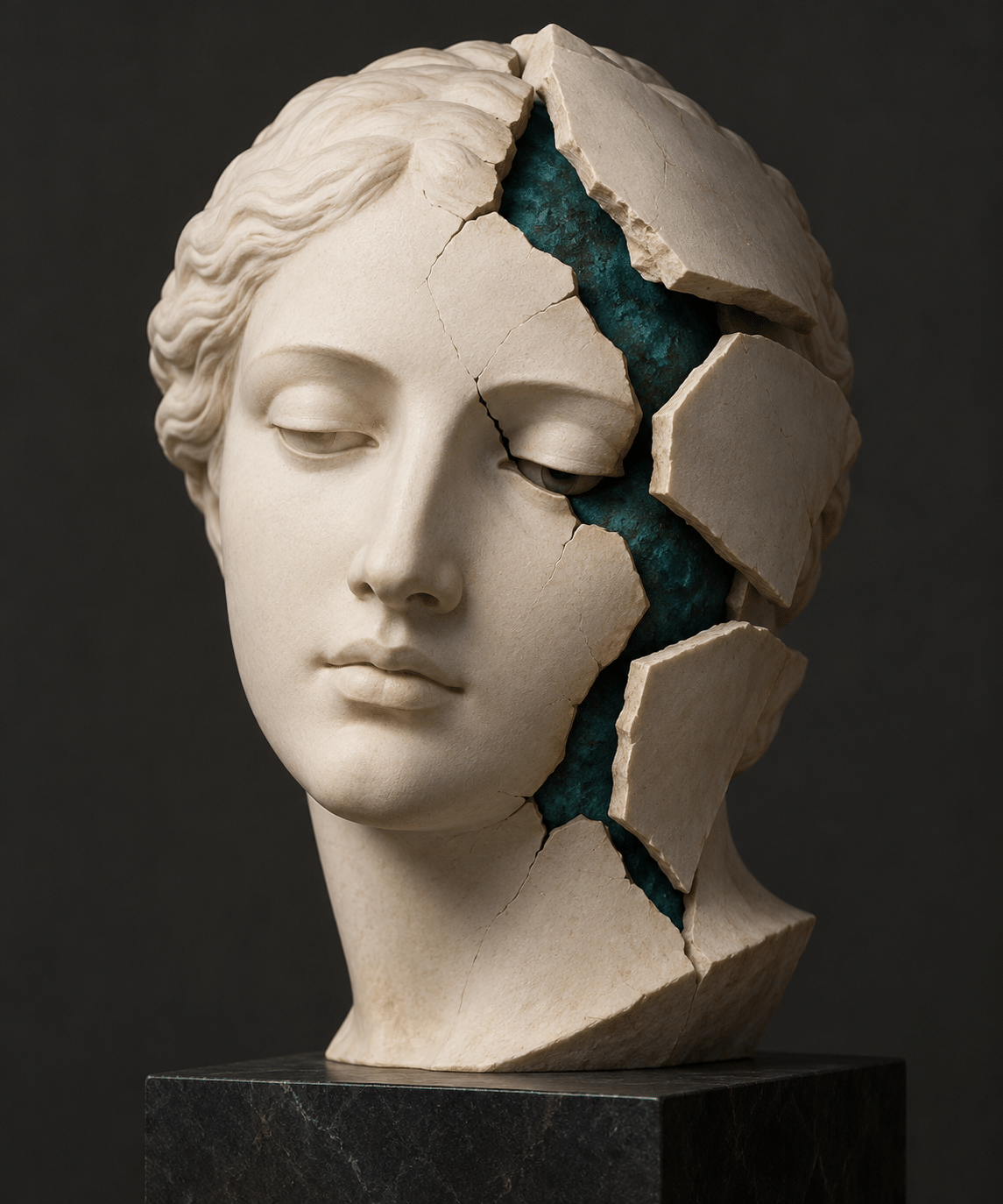
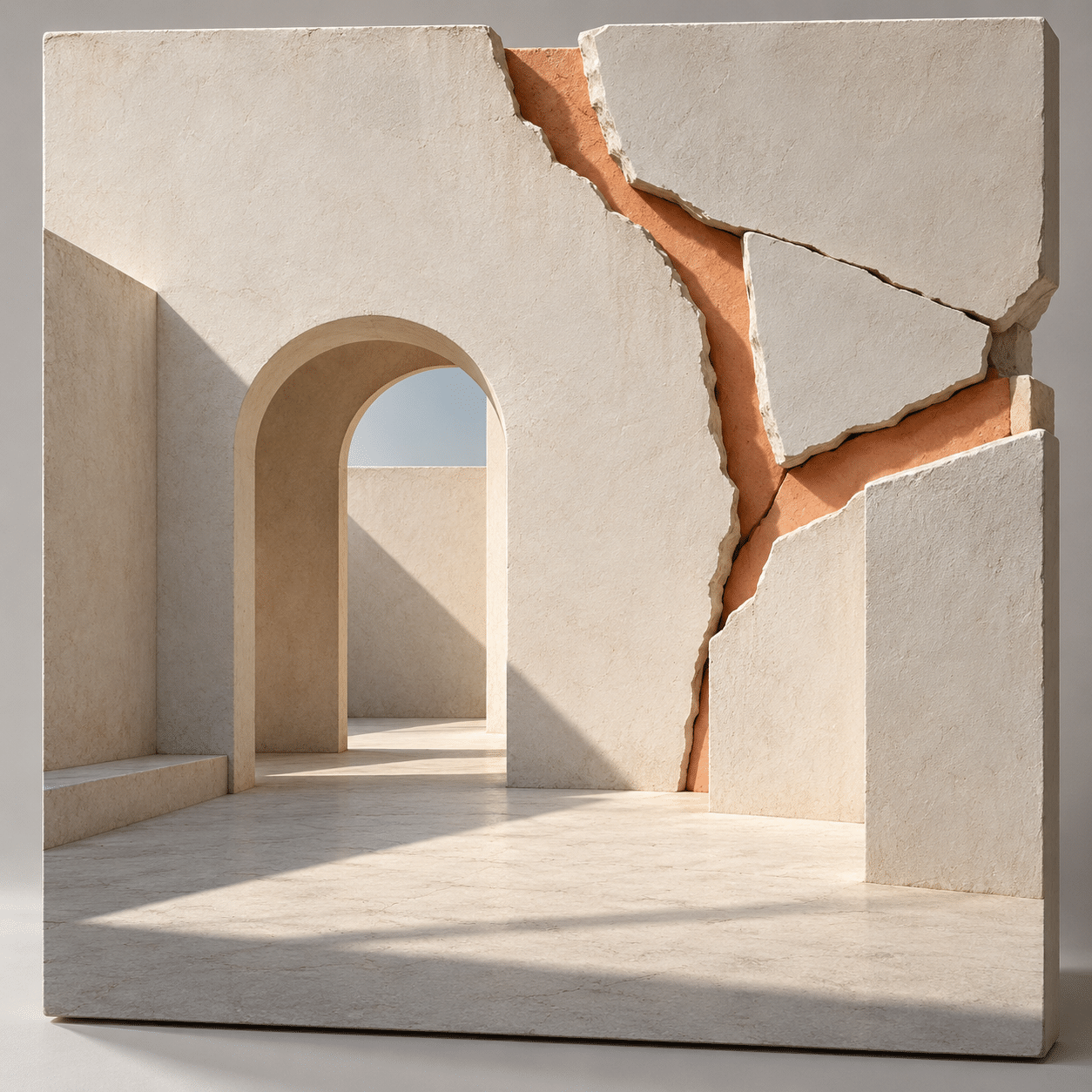
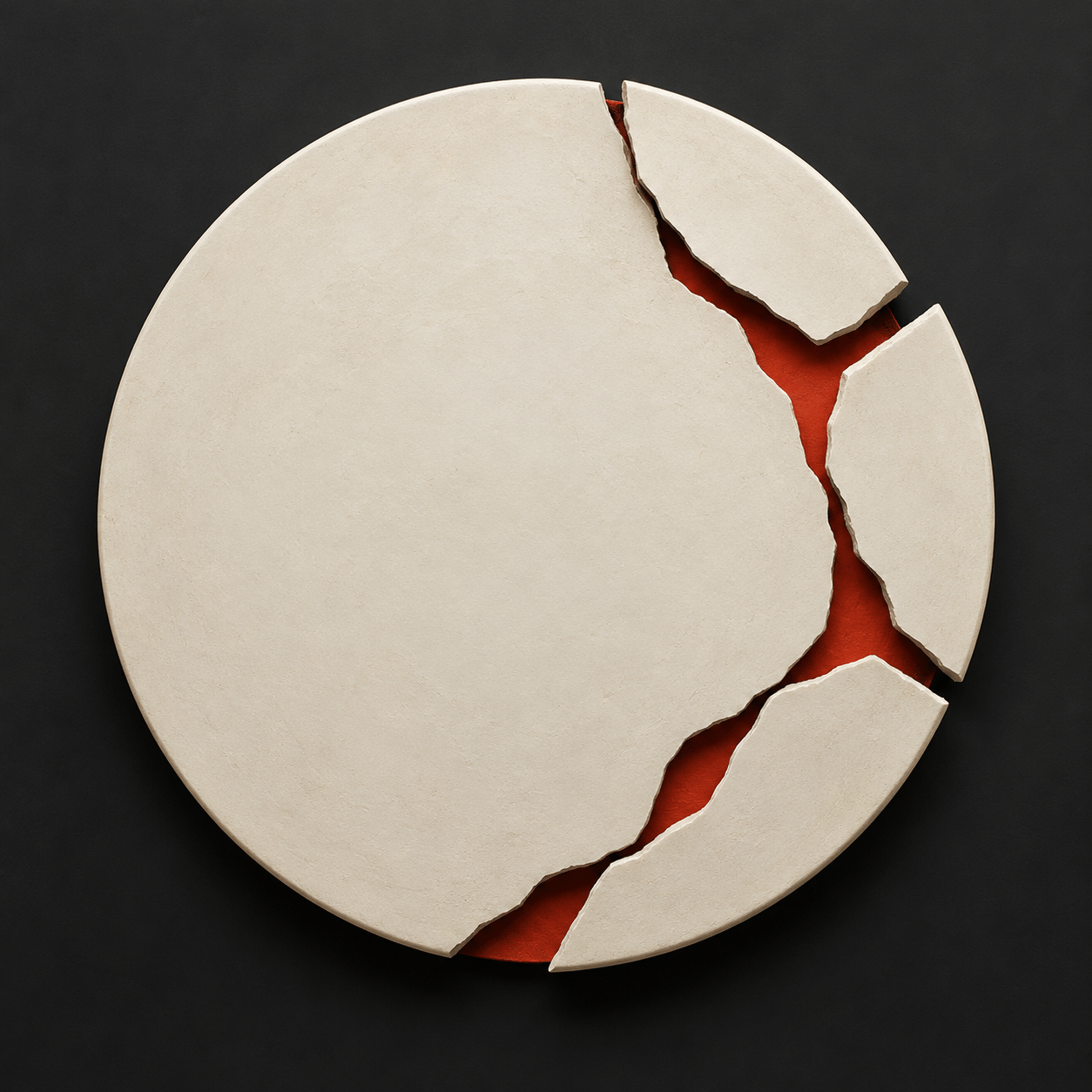
One dominant branching fissure; a stable, recognizable anchor; a small number of displaced surface plates; visible depth at the broken edges; and a contrasting inner colour or image that appears only where the surface opens.
Establishing the name without inventing a history
Artist David Edward uses CRACKISM in his Saatchi Art biography to describe a personal practice connected with life’s difficulties and resilience. His profile identifies acrylic and charcoal among his materials. This is evidence of his own use of the name; it does not establish a universal definition or a broad historical movement.
The fracture-based visual proposal developed below is an AOI interpretation, not a description of Edward’s methods, a reproduction of his work or a claim that AOI coined the word. Its rules, prompts and generated studies belong to this article’s creative experiment. Shared vocabulary must not become invented affiliation.
Correcting the inherited record
The earlier entry attached the name to an unsupported American movement and unrelated artist lists. Those claims are withdrawn. Keith Haring’s Crack is Wack is a documented 1986 mural: the Haring Foundation explains its warning about the crack epidemic in New York. That work’s title does not establish a movement called Crackism.
The present article makes no claims about a religion, a founding group or the membership of famous artists. Historical works should be understood through their documented contexts. The useful task here is to separate evidence about the name from a clearly stated new visual exercise.
The AOI proposal: continuity under pressure
Imagine an image whose surface has begun to move apart, but whose subject has not disappeared. One portion remains intact enough to establish a face, a vessel, a landscape or a geometric form. A dominant fracture interrupts it. Across that fracture, a few plates shift, revealing a second layer with a different colour, scale or visual rhythm.
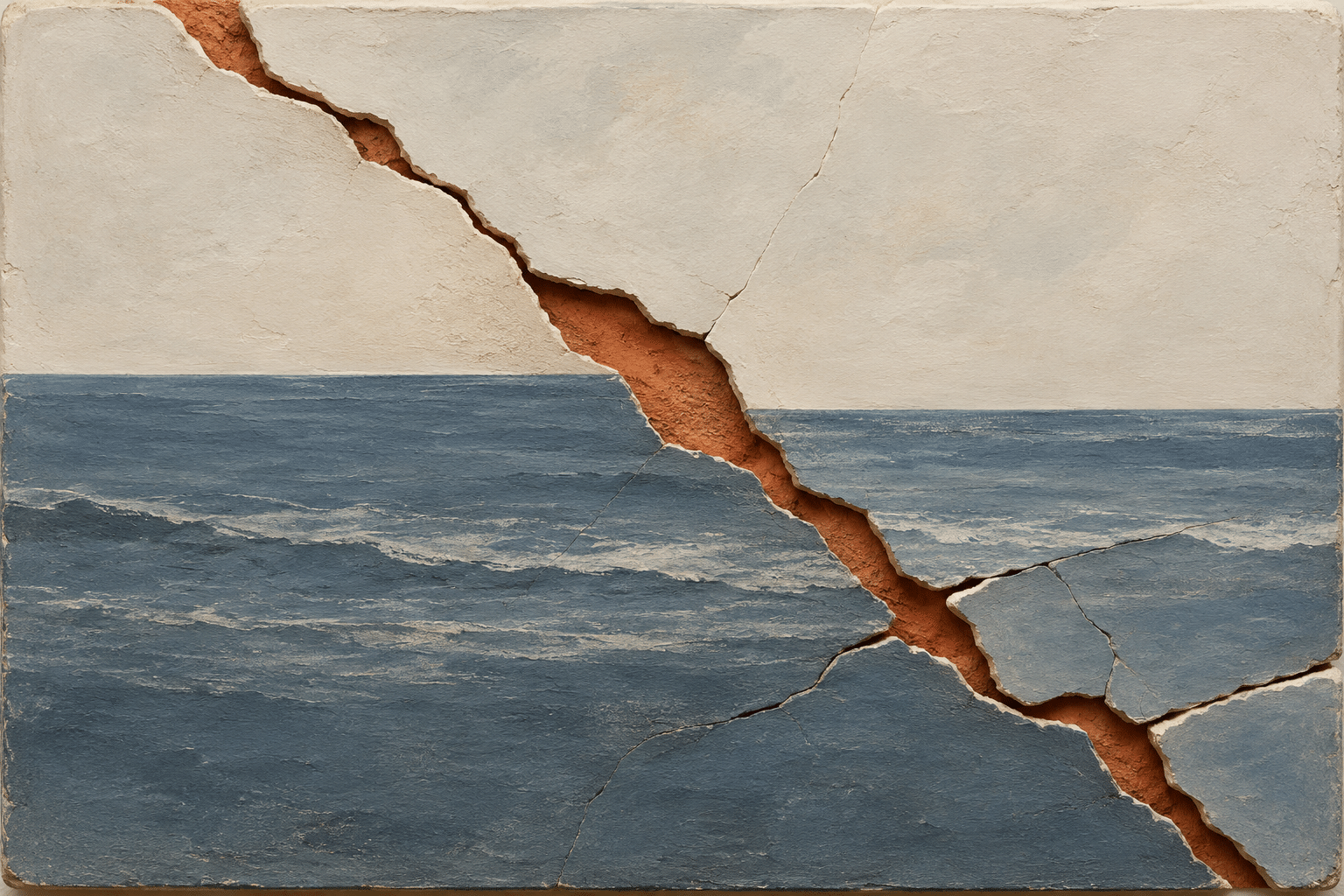
The central idea is that the break changes how the subject can be read. It should do more than suggest age or decorate a smooth object. A horizon might continue at two slightly different heights; the contour of a vessel might resume after an interval; a circular shape might retain its centre while its outer plates drift. The viewer reconstructs a relationship across the gap.
Three decisions make the grammar repeatable
First, choose the intact anchor. Keep enough of it unbroken for the image to have a stable point of reference. Second, choose the path and hierarchy of the fracture: one principal route with a few subordinate branches is usually clearer than a uniform network. Third, decide what the opening reveals and why that layer belongs beneath this subject.
These decisions can be repeated across very different images. A pale mineral surface opening onto deep blue suggests a different tension from a dark city facade revealing a quiet apricot sky. The proposal’s identity comes from the relationship between anchor, displacement and revelation, rather than from a mandatory texture or a fixed colour palette.
Material, palette and light
For a restrained study, begin with chalk, charcoal and one saturated interior colour. Let the intact surface occupy most of the image, the shadows describe the fracture depth and the accent appear only through openings. An alternative is warm terracotta against a cool inner field, or muted blue-grey interrupted by a small region of coral.
Choose a coherent material logic. A ceramic shell should have a readable thickness; stone-like plates should cast consistent shadows; a painted graphic version may use flat intervals instead of illusionistic depth. Do not mix every possible surface effect. Repeated gold seams, smoke and glowing particles can overwhelm the more interesting question of how the form continues.
Related ideas are comparisons, not a borrowed lineage
Kintsugi is a material repair practice, not another name for this proposal. The Kelsey Museum describes repaired ceramic vessels whose joins are emphasized with gold lacquer. The AOI study can leave gaps open and shift represented surfaces without repairing a physical object. A gold-coloured line alone does not make an image kintsugi.
Cubist fragmentation, collage and glitch effects offer other useful comparisons, but their aims and histories are distinct. Here the test is specific: can you identify an intact anchor, meaningful displacement and a revealed layer? If the same image would communicate the same thing after the cracks were removed, the fracture is probably still decorative.
An original making exercise
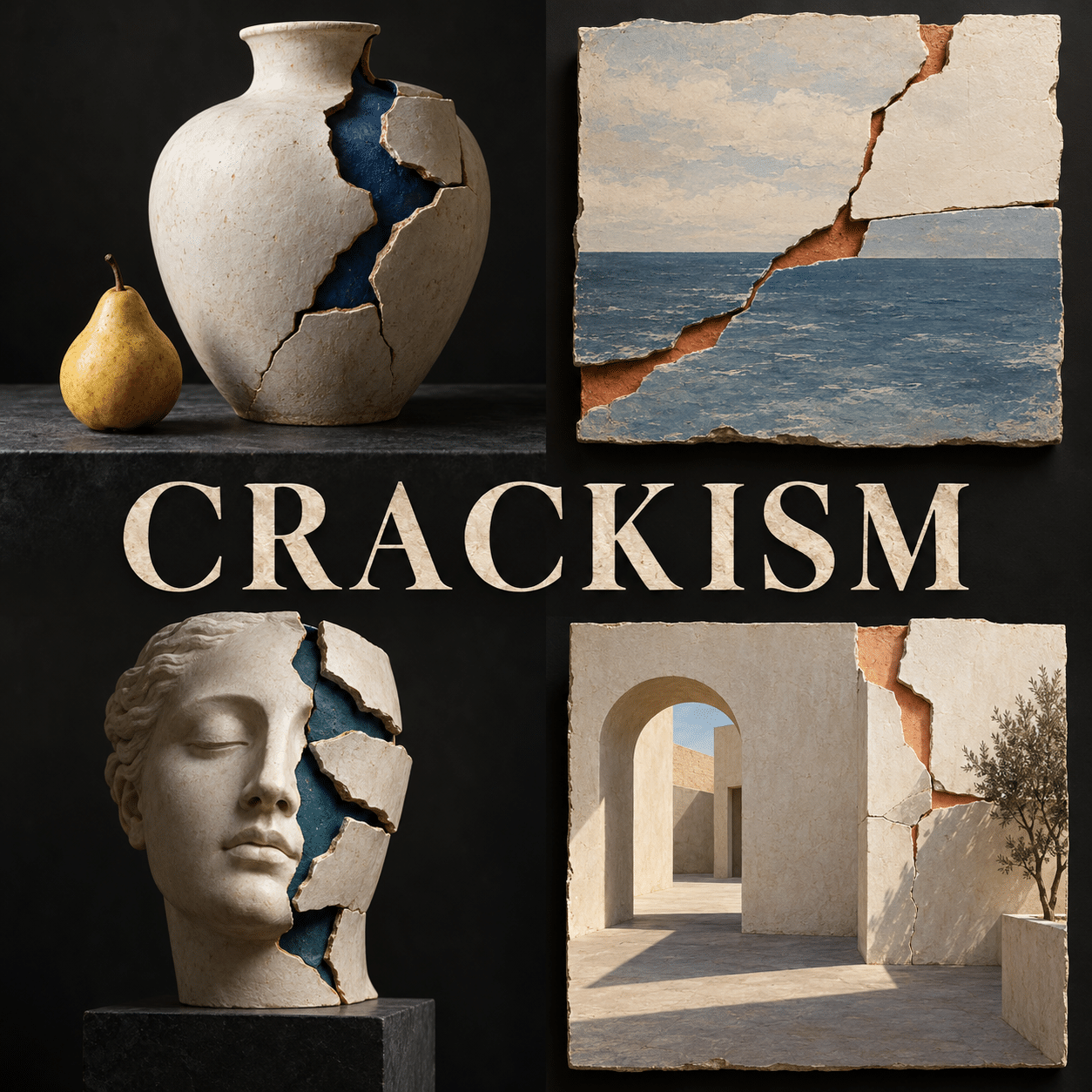
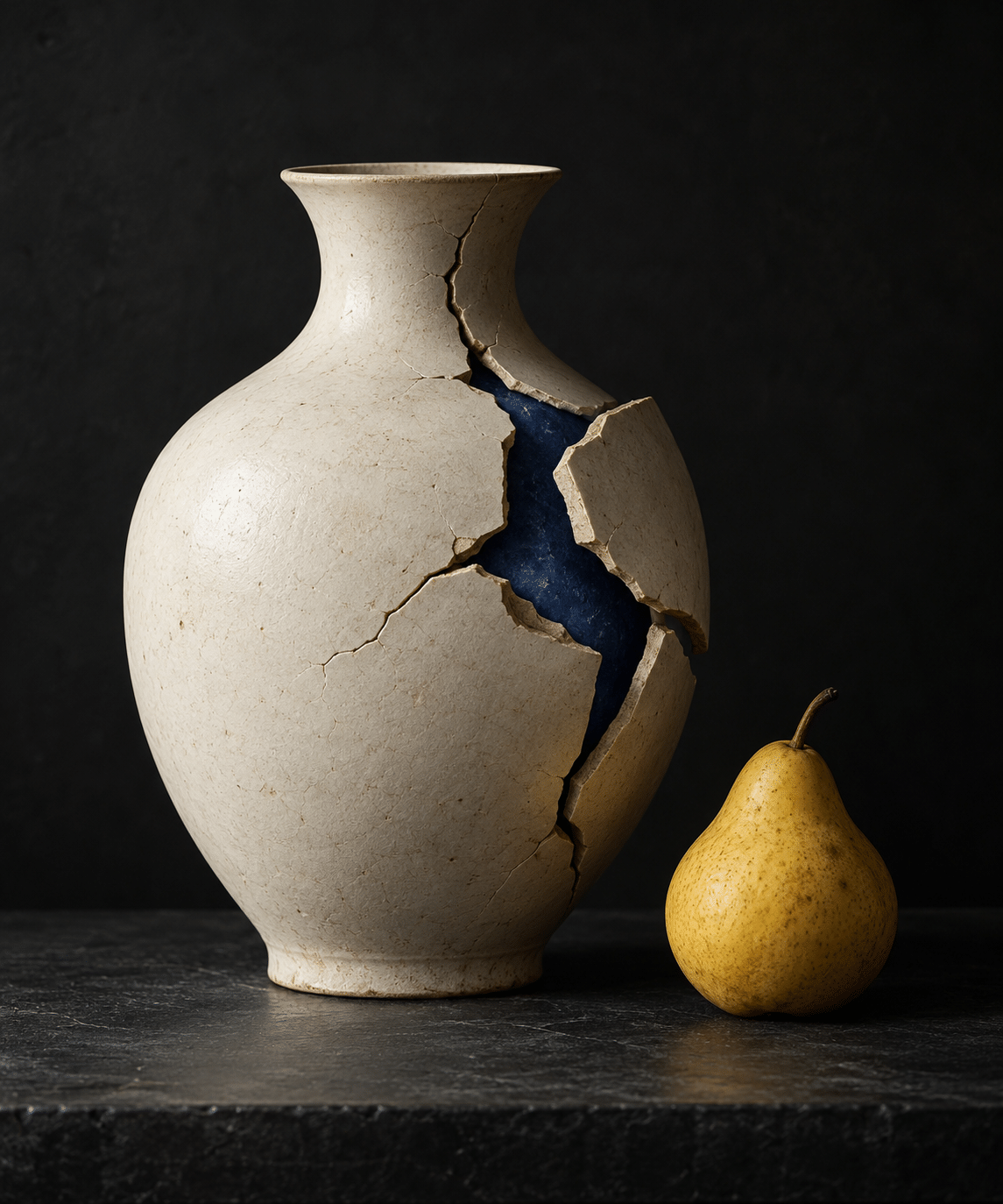
Begin with a simple still life containing one pear and one plain vessel. Establish their silhouettes and a quiet ground. Draw a single fracture route through the vessel, then shift only two neighbouring plates far enough to make their original relationship visible. Place a contrasting inner field behind the opening. Keep the pear intact so that it becomes the compositional anchor.
Compare three versions in which only the width of the opening changes. A hairline interruption may feel intimate; a wider interval may make the image feel architectural; a large separation can destroy the relationship you wanted to preserve. Choose the version whose fracture contributes most to the subject, rather than the one with the most effects.
What this gallery demonstrates
The new images are AI-generated AOI interpretations of the proposed grammar. They are not works by David Edward, Haring or other named artists, and they are not evidence of a historical school. The studies move between landscape, still life, a sculpted head, architecture and abstraction to test whether the same relationships remain legible.
The proposal remains open to revision. Its development in this article proceeds from a compositional question and a set of visual trials; no fictional exhibition, founder biography or discovery story is needed. A useful next step would be a handmade painting or constructed relief that tests how actual edges and shadows change the idea.
Positive editorial assessment — AI-authored
The proposed grammar can make an interruption carry the composition. An intact area gives the eye something to trust, while displaced edges invite it to reconstruct what has changed. Restrained colour and clear material depth can make that small act of reconstruction surprisingly absorbing.
Critical editorial assessment — AI-authored
Cracked textures are familiar and easily become a dramatic filter. This proposal earns its distinction only when displacement and the revealed layer affect the subject’s meaning or structure. Avoid automatic claims about trauma or healing; visual damage does not explain a person’s experience.
Neutral editorial assessment — AI-authored
This page combines documented artist usage of a name with a separately labelled AOI visual experiment. The experiment is suitable for painting concepts, graphic compositions and relief studies. Its quality should be judged through the actual relationships between parts, not through a claim of historical authority or exclusive invention.
Pocket-sized facts
David Edward uses CRACKISM in his own artist biography.
The fracture grammar and new illustrations on this page are a separately identified AOI interpretation.
No exclusive origin of the name or historical movement is claimed.
An intact anchor, displaced plates and a revealed layer define the AOI visual exercise.
A small poetic detour
Original words from the AOI studio.
Poetry
The edge remembers where it lay;
the other edge has moved a little.
A blue beneath the field of grey
becomes the question in the middle.
I leave one quiet corner whole,
one line that nearly meets its neighbour.
The gap is neither wound nor soul—
just space that asks the eye for labour.
The prompt workshop
Original creative exercises. These prompts create new illustrations, not documentary evidence.
A controlled opening
Create an original AOI fracture-study still life: one pale ceramic vessel and one intact yellow pear on a charcoal ground. A single branching fissure shifts two vessel plates slightly apart, revealing a muted ultramarine inner layer. Coherent shell thickness and shadows, large quiet areas, no gold repair, text or imitation of a named artist.
The displaced horizon
Create an original AOI fracture-study landscape as a matte mineral panel. Keep one low horizon continuous on the left; a dominant diagonal break displaces a few central plates and exposes a narrow coral inner field. Muted blue-grey sea, pale sky, believable edge shadows, no explosion, smoke or decorative crackle.
A circle remembers its centre
Create an original abstract AOI fracture study: a large ivory disc on charcoal, its central area intact and its outer rim separated into a few slightly displaced plates. Reveal a restrained red plane only through the gaps. Clear continuity across breaks, controlled shadows and generous negative space, no lettering or gold seams.
Your next inspiration
Discover another art style
Follow a visual thread to the next subject.
Cubism
Compare a documented historical approach to pictorial construction; no shared lineage is claimed.

Glitch Art: When the Image Reveals Its System
Compare disruptions associated with digital imagery and signal behaviour.

A smile from the studio
Jokes
The composition developed a fault. For once, the artist decided to keep a precise record of it.
Sources and further exploration
Kelsey Museum: Kintsugi — a material repair tradition used here only for comparison