
Context, institutions and artistic practice
Explore Context Art through setting, display, ownership and access, with sourced historical distinctions and visual studies of how surroundings shape meaning.
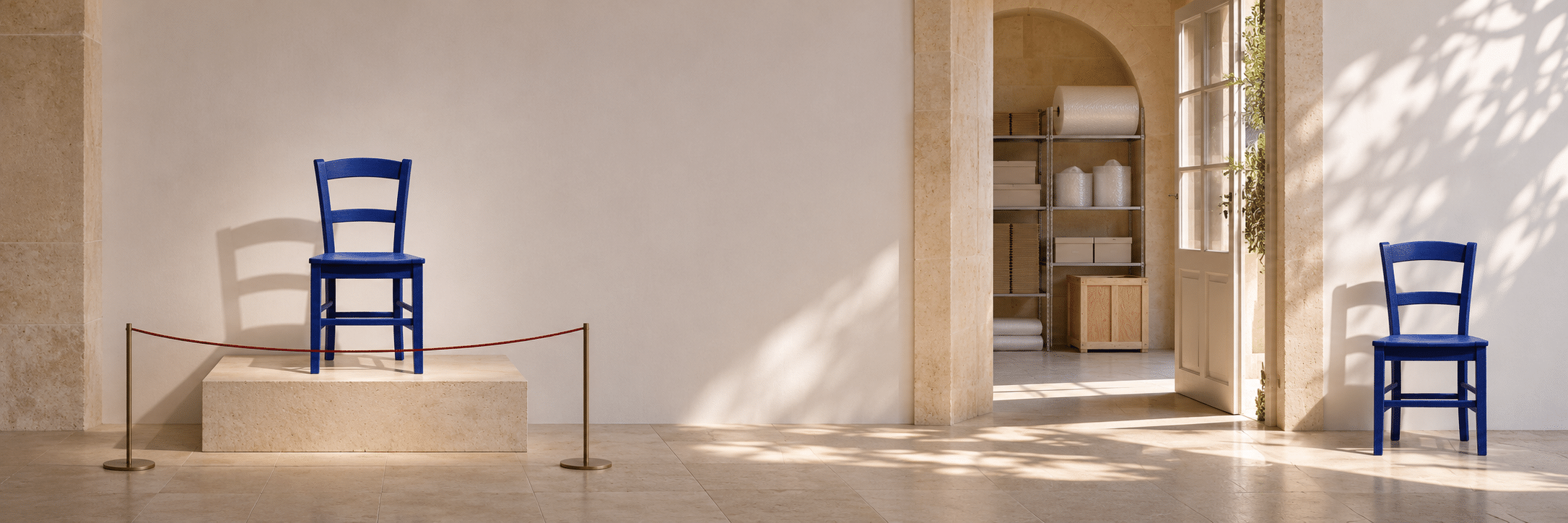
A visual introduction
A new AI-generated banner contrasts two chairs through display and access. The earlier seven visual studies and two archive illustrations remain available for comparison. These imagined teaching proposals do not reconstruct the historical works discussed in the article.
Select an image for a closer look. Use the thumbnails, arrow keys or a swipe to compare examples. Zoom in to inspect details, or share the image that inspires you.


Creative toolbox · take this style further
Choose an input and a destination. Search sends your words to the chosen site; Copy & open puts them on your clipboard to paste there.
Create with AI
Turn your chosen input into an image prompt or a new creative direction.
ChatGPT
Copy your input and paste it into a ChatGPT conversation or image request.
Copy & open ChatGPT (new tab)Claude · Anthropic
Develop an image prompt or explore the style in a new Claude conversation.
Copy & open Claude · Anthropic (new tab)Midjourney
Paste your input into the Imagine bar on the Create page.
Copy & open Midjourney (new tab)Adobe Firefly
Copy your input, open Firefly, and paste it into the prompt field.
Copy & open Adobe Firefly (new tab)Leonardo.Ai
Copy your input, open Leonardo, and paste it into the generation field.
Copy & open Leonardo.Ai (new tab)Image search
Find visual references. Short, concrete keywords usually work best.
Lexica
Search AI images and prompts using your selected input.
Search with this input Lexica (new tab)Pexels
Search the photo and video library. Short keywords often work best.
Search with this input Pexels (new tab)Pixabay
Search photos, illustrations and other images.
Search with this input Pixabay (new tab)Unsplash
Search photographs using the style name or your own keywords.
Search with this input Unsplash (new tab)Wikimedia Commons
Search photographs, artworks and historical images. Check each file for its source and reuse terms.
Search with this input Wikimedia Commons (new tab)Art & research
Explore artists, collections and the ideas behind a style.
Wikipedia
Search for background reading. A style may not have its own article.
Search with this input Wikipedia (new tab)WikiArt
Copy your input into WikiArt’s search to explore artists and artworks.
Copy & open WikiArt (new tab)Europeana
Paste your keywords into the search to explore European museum, library and archive collections.
Copy & open Europeana (new tab)Inspiration
Discover portfolios and visual ideas from creative communities.
Instagram hashtags
Search a hashtag made from your input: spaces and punctuation are removed. Instagram may require sign-in.
Search with this input Instagram hashtags (new tab)ArtStation
Paste your input into artwork search for concept art, environments, characters and visual development.
Copy & open ArtStation (new tab)Behance
Paste your input into project search for illustration, design and visual storytelling.
Copy & open Behance (new tab)A closer look
Look for relationships made visible: a threshold, an arrangement, a route, a label, an excluded object or the labor behind a display. No single palette or medium defines the approach.
What changes when the surroundings become the subject?
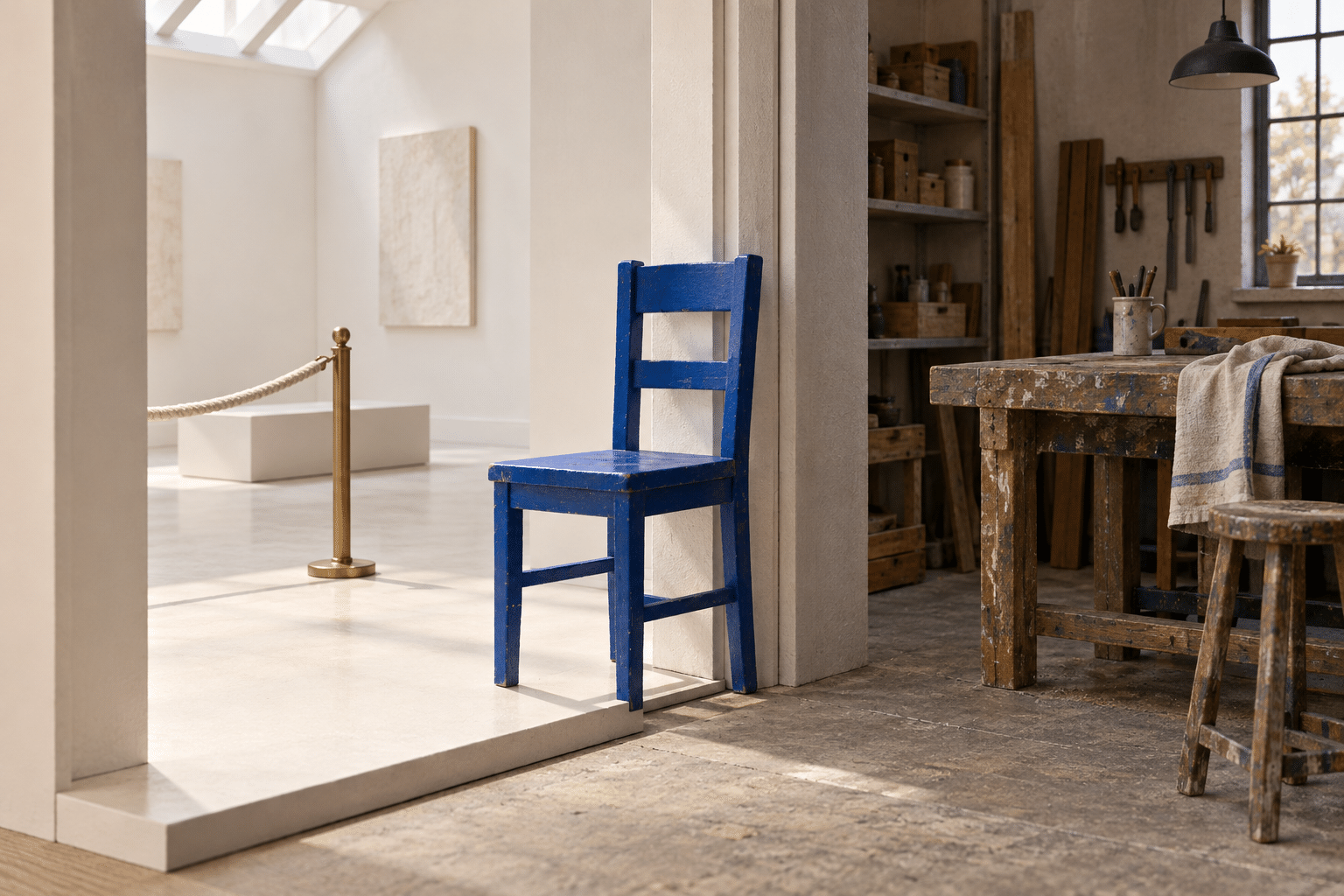
A chair behind a museum barrier and a chair offered to a visitor may be physically identical. Their permissions differ. One invites contemplation; the other invites sitting. A contextual approach asks who arranged that difference, who can cross the barrier, what histories the object carries and which people remain outside the frame. The setting is not merely a background added to an otherwise complete artwork. It can be part of the work’s material and argument.
Context Art is therefore poorly described as bright colors, simple shapes or pictures of everyday surroundings. None of those features is necessary. A photograph, a tour, a reading room, an administrative document or a distribution system can make contextual relationships perceptible. What matters is the particular relationship being examined and how the work gives a viewer access to it. This article uses Context Art as a historically anchored approach, while distinguishing related uses of the term.
Two histories that should not be collapsed
The Neue Galerie Graz archive identifies trigon 93: Kontext Kunst, curated by Peter Weibel, as an exhibition held from 2 October to 7 November 1993. Its account emphasizes the formal, social and ideological conditions under which art is produced and received, including relationships with ecological, economic, legal and social institutions. This is a specific curatorial formulation, not a license to rename every environmentally aware artwork Context Art. [1]
An earlier, distinct reference is Jan Świdziński’s contextual-art theory. The Ujazdowski Castle publication record documents his Twelve Points of Contextual Art from 1976 and the book Art, Society and Self-consciousness, first published in Canada in 1979. The institution explicitly warns that the word context has acquired multiple meanings. The similar English labels should not erase differences between this theoretical project and the Graz exhibition. [2]
The practical distinction is useful: a reader can investigate an artist’s theory, a historically situated exhibition or a general method of contextual interpretation. Those are related inquiries, but they do not establish one uniform movement with a single founder, palette or set of approved materials. Use the narrower name and source whenever making a historical claim.
Documented examples: display and institutional speech
Louise Lawler’s Pollock and Tureen, Arranged by Mr. and Mrs. Burton Tremaine, Connecticut (1984) is a photograph in the Metropolitan Museum’s collection. The museum describes the encounter between a Pollock painting and a soup tureen inside the collectors’ home. The relationship between art, furnishing and ownership enters the picture instead of being cropped away. Looking at the arrangement offers a way to ask how display participates in value. It does not prove that the photographed painting has only one possible meaning. [3]
Andrea Fraser’s Museum Highlights: A Gallery Talk (1989), documented by MoMA, used the role of a museum guide and language drawn largely from institutional publications. The tour included galleries, the cafeteria and lobby of the Philadelphia Museum of Art. Here the institutional voice and the route through a building become artistic material. The work directs attention to who appears authorized to speak, what receives praise and how a museum presents its own social role. [4]
Lawler and Fraser are also listed in the Graz exhibition archive. These examples offer specific points of entry into contextual and institutional practices, not a claim that their entire careers fit a single label. Follow the linked collection records to examine the documented works; the AOI-generated studies on this page are separate teaching illustrations. [1, 3, 4]
A visual grammar of relationships
The most useful visual unit is often a relationship: object and label, front room and service room, open door and locked gate, displayed collection and excluded remainder. Juxtaposition makes such relationships available for comparison. Scale can expose an imbalance, repetition can show a rule, and a carefully chosen viewpoint can disclose the machinery that a more flattering view conceals.
Composition still matters. Decide which threshold, sightline or grouping carries the question, then make it readable before adding detail. A dense wall of documents can overwhelm the very audience it hopes to inform. Conversely, an immaculate installation image can make a messy social process look settled. Pair a clear overview with details and enough explanation to state what the viewer can actually infer.
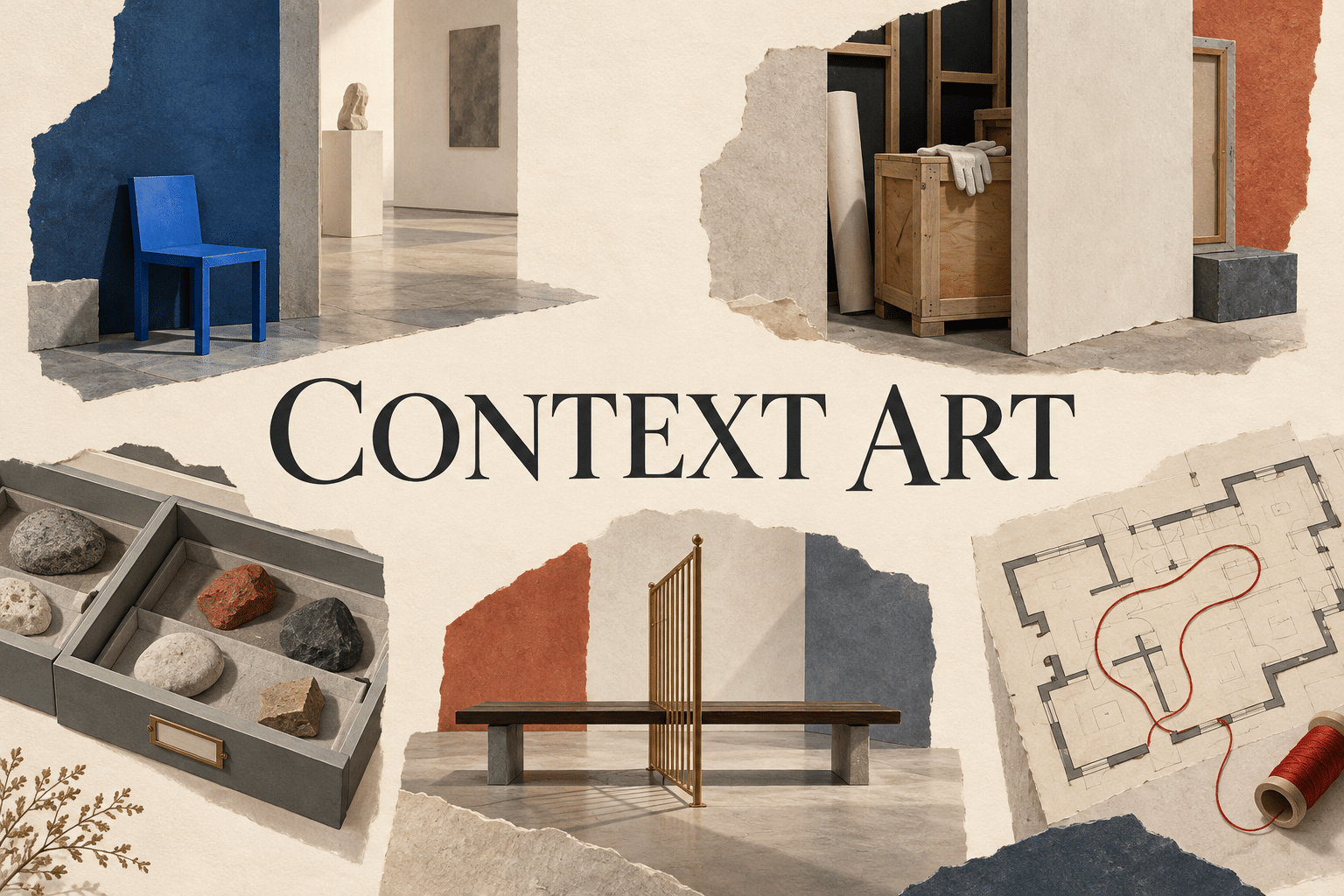
There is no historical Context Art palette. Color may organize evidence, distinguish routes or reproduce the visual codes of a setting. In the new AOI studies, cream and gray keep the architectural ground quiet, cobalt marks selected objects, and terracotta or red draws attention to a boundary or route. This is our editorial palette, chosen for comparison; it is not a rule inherited from the 1993 exhibition.
Five original studies, five different questions
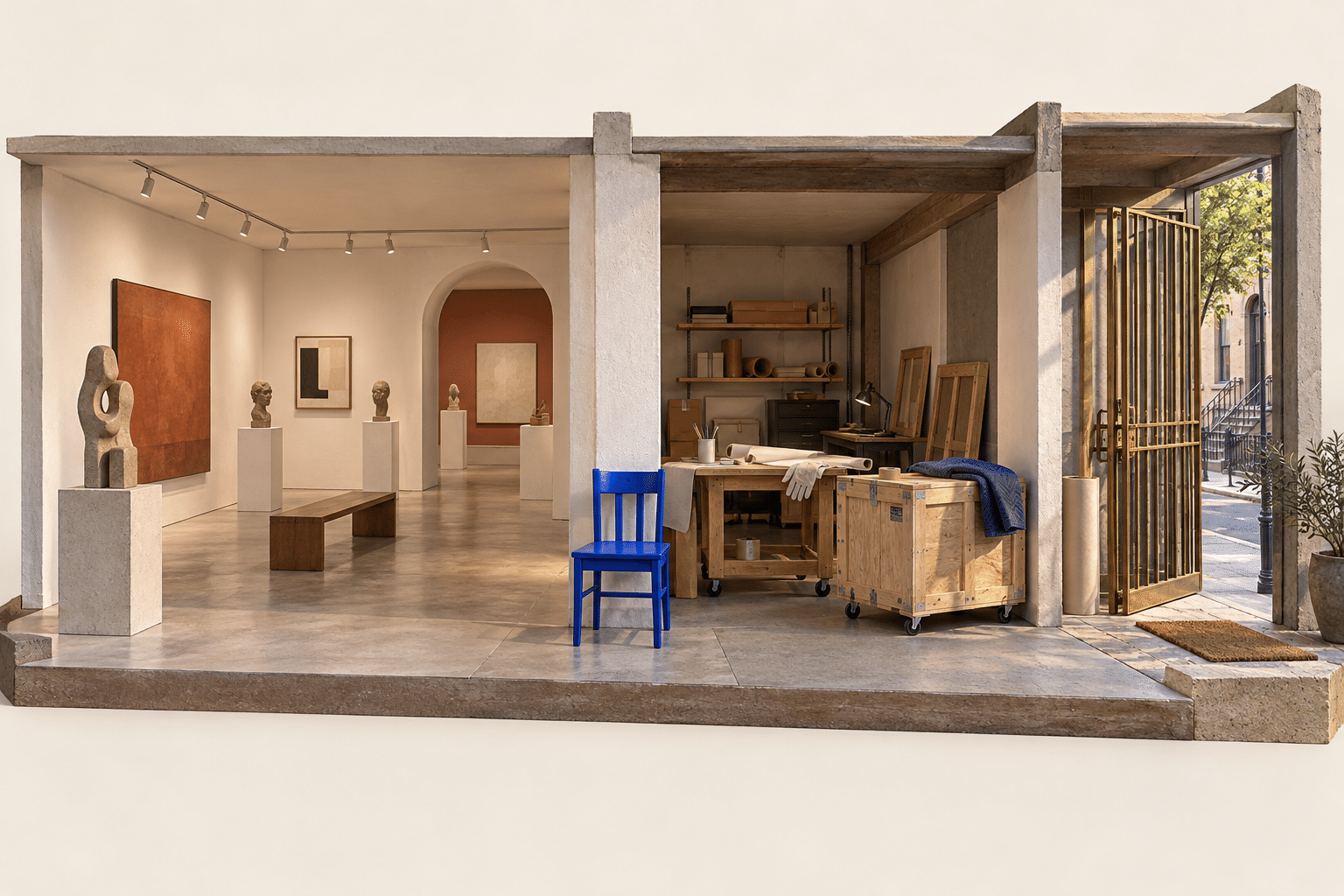
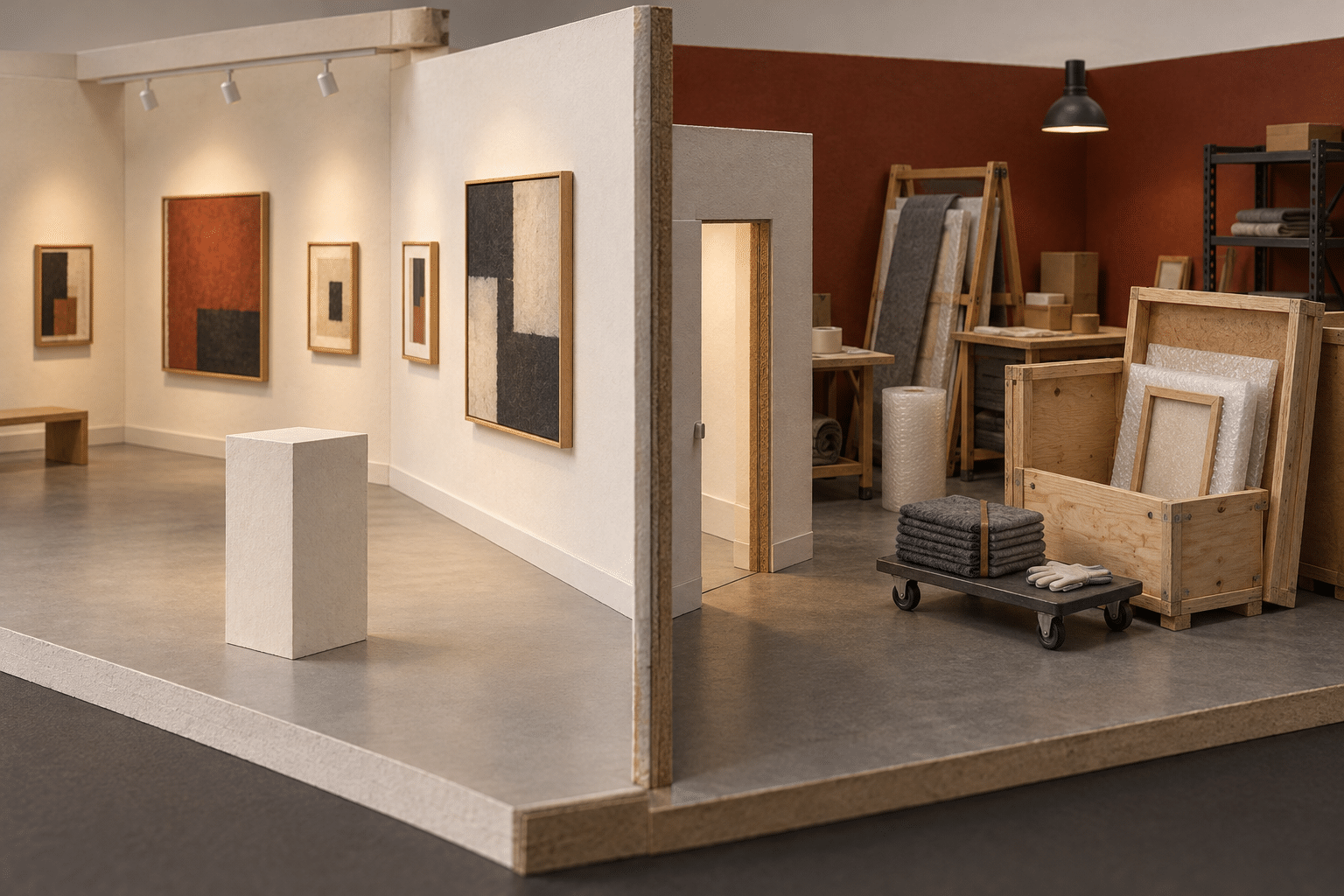
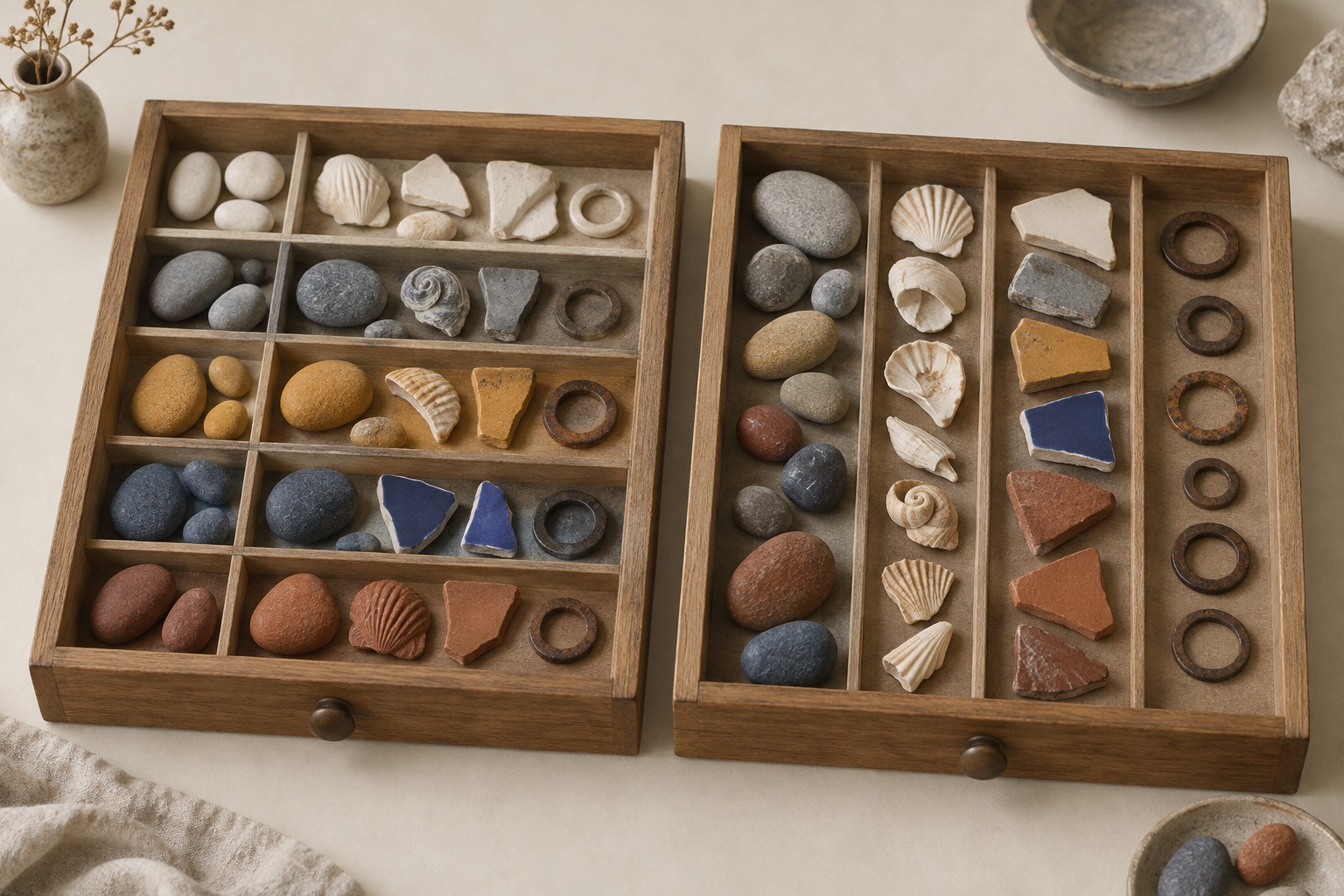
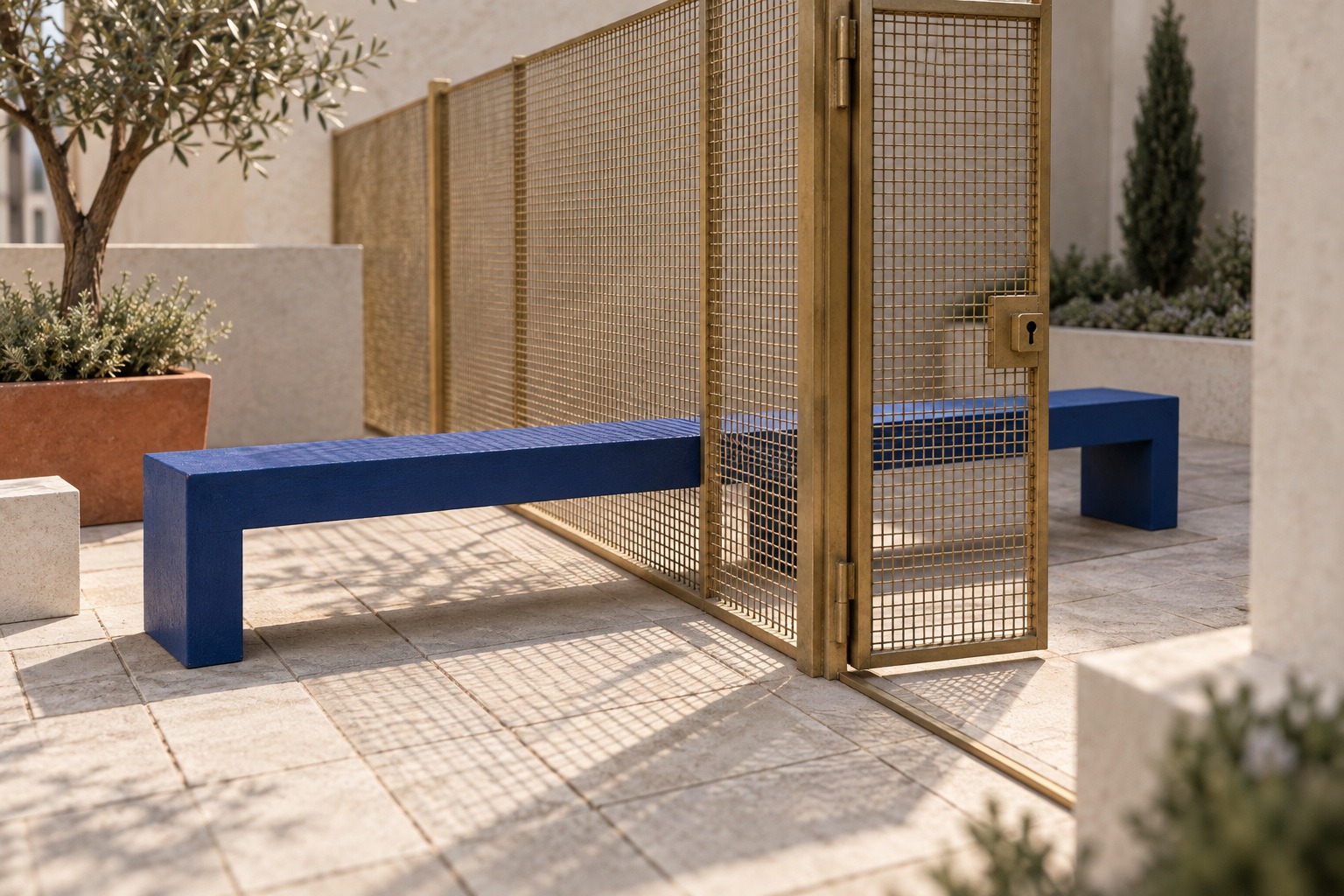
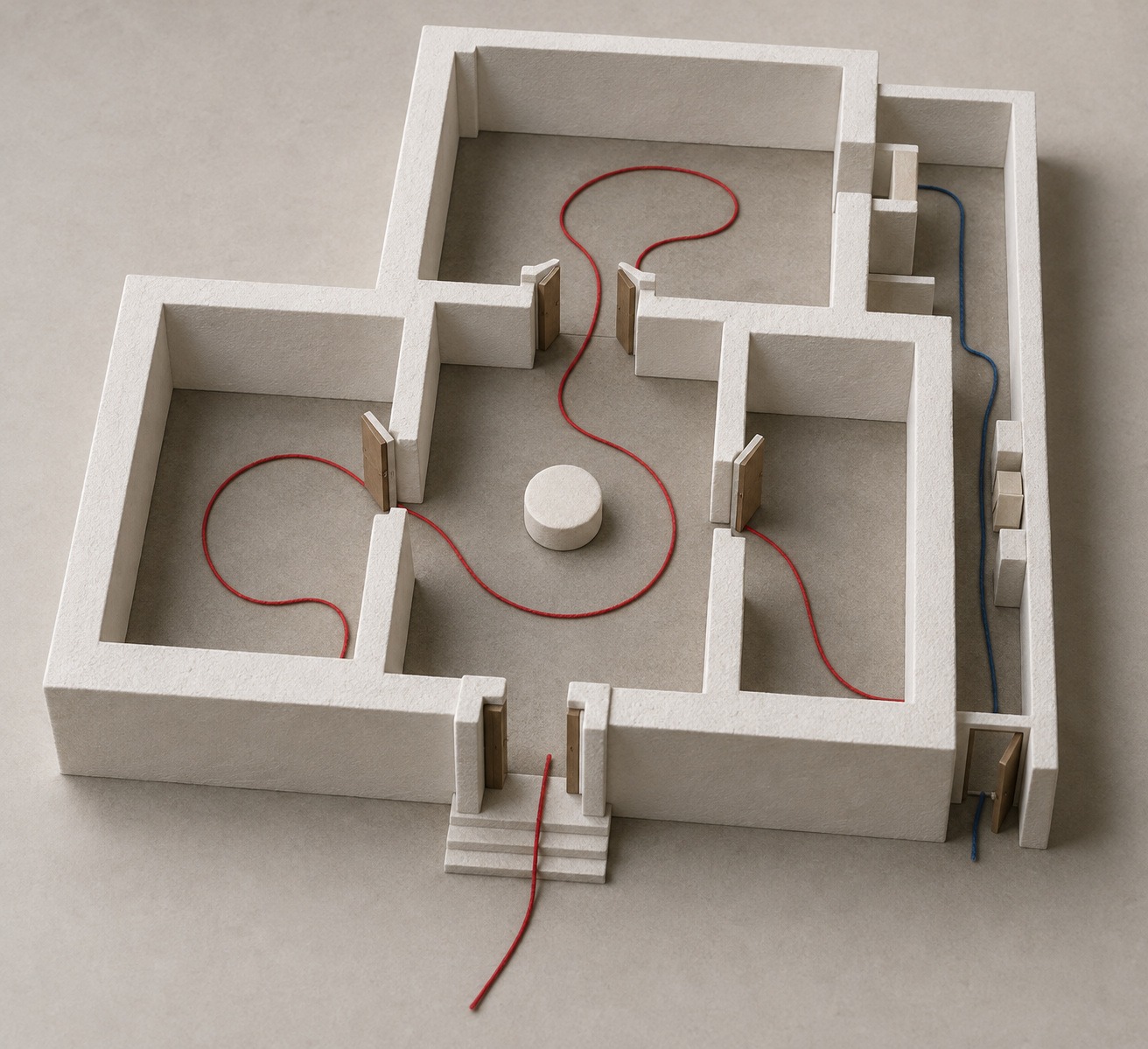
The threshold chair asks how display and use alter the status of one object. The backstage wall asks which labor a polished exhibition view makes invisible. The paired drawers ask how a sorting rule changes the pattern a collection seems to reveal. The divided bench asks how access changes the meaning of otherwise identical seating. The threaded floor plan asks how different routes produce different experiences of the same institution.
These studies deliberately share a crafted-model appearance so that changes of operation remain easy to compare. They are imagined proposals, not evidence that a workshop, collection, exclusion or exhibition actually existed. The two older abstract images remain in the archive portion of the gallery. Their generic modernist appearance illustrates why surface resemblance alone is an unreliable definition of Context Art.
The models also have limits. An empty bench cannot tell us who uses a real courtyard, and a miniature crate cannot establish employment conditions. A completed contextual project would need information from the actual setting and the people involved. The illustrations help formulate questions; they cannot supply the missing research.
Make a small contextual study
Choose a modest, accessible situation: a noticeboard, a shared shelf, a queue, a display label or the route between a public entrance and a service door. Write a precise question before making an image. “Who can change this notice?” is more actionable than “How does society work?” Identify what you know through observation, what someone has told you and what remains an interpretation.
Select one operation. You might compare the same object in two settings, map a route, re-sort a small collection of your own materials or show an overlooked support structure. Keep the change intelligible. If several things change at once, explain which relationship you want the audience to notice. Record the original situation as well as the intervention so that the comparison is not invented afterwards.
When people participate, discuss how their contributions will be credited, used and retained. Do not turn a community into a picturesque background for a conclusion you have already written. A useful project can reveal disagreement without claiming to speak for everyone. Document practical constraints, including permissions and what you were unable to observe.
Evaluate the result with three questions: can another viewer identify the relationship, is the supporting evidence sufficient, and does the form invite an interpretation beyond the caption? A beautiful photograph accompanied by an unsupported claim remains unsupported. A rigorously researched project also benefits from an intelligible visual invitation.
Prompting context without fabricating evidence
For image generation, name the relationship and the operation before choosing a visual finish. Useful vocabulary includes threshold, juxtaposition, display apparatus, backstage labor, sorting rule, public access, circulation, viewpoint, scale and route. Add material, lighting and palette only after the conceptual structure is clear. “Context art, masterpiece” does not tell a model what should change or why.
Use generated images for proposals, comparisons and speculative models. Do not invent archive photographs, participant testimony, ownership histories or institutional records to make the proposal seem established. A plausible label inside an image is still generated text, not evidence. Keep researched sources, original interpretations and generation prompts distinguishable.
Context Art overlaps with conceptual art, installation and institutional critique, but these terms ask different questions. Conceptual art foregrounds the idea or proposition; installation describes a spatial arrangement; institutional critique examines the systems that authorize and support art. Contextual analysis can work through any of them. A scenic background alone supplies none of these relationships.
Positive assessment — making the frame visible
AOI editorial assessment, AI-authored: the strongest contextual work changes what we are able to notice. A modest alteration of placement or speech can reveal that a supposedly neutral display already makes choices. Its power lies in specificity: one route, one rule or one transaction can open a larger question without pretending to summarize an entire society. The best formal decisions make that discovery available to the viewer rather than merely announcing that a critique has occurred.
Critical assessment — when explanation outruns the work
AOI editorial assessment, AI-authored: contextual language can become a protective fog. A familiar object placed beside an impressive paragraph may add little if the paragraph supplies every insight. Another risk is extracting stories from people while the artist receives the credit. Improve a weak project by narrowing its claim, showing the actual comparison, identifying missing evidence and making the terms of participation visible. More documentation is not automatically more accountability; the relevant document must support the specific claim.
Neutral assessment — a method with demands
AOI editorial assessment, AI-authored: this approach is useful for exhibition analysis, site-based research, public projects and critical design. It is less useful as a request for a repeatable decorative look. Its demands include research, careful attribution, legible presentation and attention to the setting’s participants. Success should be judged through the relationship between question, evidence and encounter, rather than through a fixed amount of visual novelty or a claim of measurable social impact.
About this AOI edition
This guide and its original visual studies were created with AI assistance for AOI. Penny Wraiter is an AI editorial persona. Historical claims are tied to the institutional sources below; generated scenes are teaching proposals, not records of real exhibitions.
A small poetic detour
Original words from the AOI studio.
Poetry
The frame was never empty.
Someone carried it upstairs,
someone chose the wall,
someone kept the key.
A chair waits at the doorway.
On one side: do not touch.
On the other: please sit down.
The wood has not changed.
Follow the hinge, the hand, the route—
the quiet work around the work.
What enters the picture
when we stop trimming its edges?
The prompt workshop
Original creative exercises. These prompts create new illustrations, not documentary evidence.
One object, two permissions
Create an original conceptual proposal showing one ordinary chair at the threshold between a display space and a shared workshop. Make the difference between looking and using visible through a barrier, seating access and surrounding tools. Tactile architectural-model illustration, restrained palette, plausible space, no logos or invented documentary labels. This is an imagined study, not a real exhibition.
Show the work behind the work
Design an original cutaway illustration of a gallery wall: a quiet display in front, and packing materials, a trolley and work gloves behind. Give both areas equal visual dignity. Use one doorway to connect them and one clear viewpoint to reveal the relationship. No identifiable institution, historical artwork or claim to document actual labor conditions.
Change the rule, compare the result
Create a paired visual study of ordinary objects in two shallow drawers. Sort a comparable collection by color in one drawer and by material in the other. Keep viewpoint and lighting stable so the sorting rule, rather than dramatic styling, creates the difference. No human remains, sacred objects, fabricated archive labels or lettering.
Your next inspiration
Discover another art style
Follow a visual thread to the next subject.
People & works to explore
References discussed in this article. Consult the sources below for context.
Artists and practitioners
Louise Lawler — documented photographic example; included in the 1993 Graz exhibition.
Andrea Fraser — documented performance example; included in the 1993 Graz exhibition.
Jan Świdziński — earlier, distinct contextual-art theory; not presented as the founder of the Graz exhibition.
Paintings and other works
Louise Lawler, Pollock and Tureen, Arranged by Mr. and Mrs. Burton Tremaine, Connecticut (1984), photograph; Metropolitan Museum of Art.
Andrea Fraser, Museum Highlights: A Gallery Talk (1989), performance recorded on video; documented by MoMA.
A smile from the studio
Jokes
The label announced that the chair challenged institutional authority. The guard asked me not to sit on it. The chair declined to comment.