
AOI creative concept · Color with a direction
Coloexplosionism turns color into an event: concentrated planes open, scatter or stream outward while a recognizable subject remains intact. This AOI creative concept works through tension between a stable anchor and expanding chromatic energy. The aim is not to use every color, but to make each burst travel somewhere.
An A⊕I –[-.+] creαt¡ve c⊕ncept, n⊕t αn estαbl¡she∂ h¡st⊕r¡cαl m⊕vement.
A visual introduction
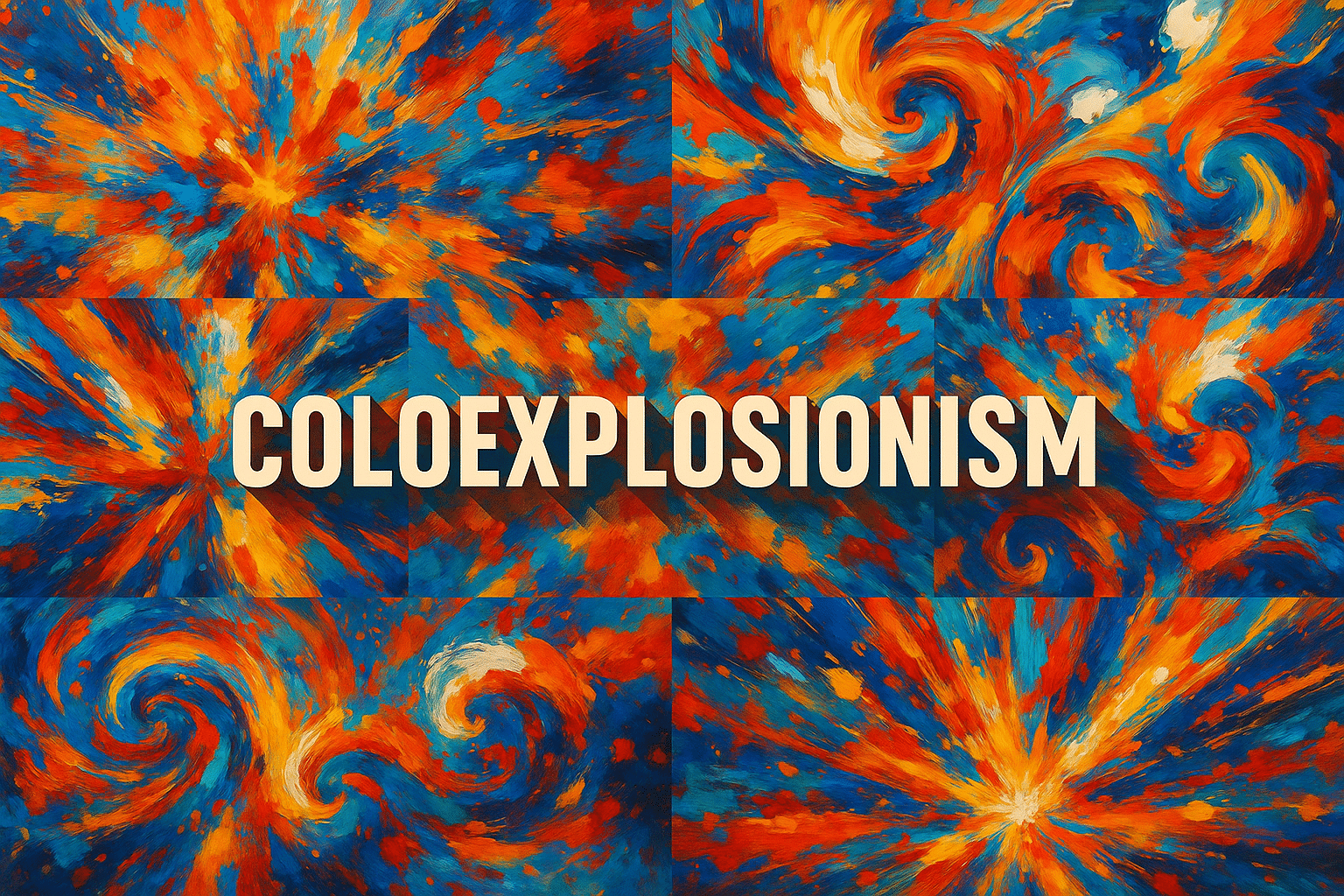
Five images: the retained bear and centrally titled collage, followed by three new AI-generated studies of radial bloom, quiet portrait and architectural color flow.
Select an image for a closer look. Use the thumbnails, arrow keys or a swipe to compare examples. Zoom in to inspect details, or share the image that inspires you.

Creative toolbox · take this style further
Choose an input and a destination. Search sends your words to the chosen site; Copy & open puts them on your clipboard to paste there.
Create with AI
Turn your chosen input into an image prompt or a new creative direction.
ChatGPT
Copy your input and paste it into a ChatGPT conversation or image request.
Copy & open ChatGPT (new tab)Claude · Anthropic
Develop an image prompt or explore the style in a new Claude conversation.
Copy & open Claude · Anthropic (new tab)Midjourney
Paste your input into the Imagine bar on the Create page.
Copy & open Midjourney (new tab)Adobe Firefly
Copy your input, open Firefly, and paste it into the prompt field.
Copy & open Adobe Firefly (new tab)Leonardo.Ai
Copy your input, open Leonardo, and paste it into the generation field.
Copy & open Leonardo.Ai (new tab)Image search
Find visual references. Short, concrete keywords usually work best.
Lexica
Search AI images and prompts using your selected input.
Search with this input Lexica (new tab)Pexels
Search the photo and video library. Short keywords often work best.
Search with this input Pexels (new tab)Pixabay
Search photos, illustrations and other images.
Search with this input Pixabay (new tab)Unsplash
Search photographs using the style name or your own keywords.
Search with this input Unsplash (new tab)Wikimedia Commons
Search photographs, artworks and historical images. Check each file for its source and reuse terms.
Search with this input Wikimedia Commons (new tab)Art & research
Explore artists, collections and the ideas behind a style.
Wikipedia
Search for background reading. A style may not have its own article.
Search with this input Wikipedia (new tab)WikiArt
Copy your input into WikiArt’s search to explore artists and artworks.
Copy & open WikiArt (new tab)Europeana
Paste your keywords into the search to explore European museum, library and archive collections.
Copy & open Europeana (new tab)Inspiration
Discover portfolios and visual ideas from creative communities.
Instagram hashtags
Search a hashtag made from your input: spaces and punctuation are removed. Instagram may require sign-in.
Search with this input Instagram hashtags (new tab)ArtStation
Paste your input into artwork search for concept art, environments, characters and visual development.
Copy & open ArtStation (new tab)Behance
Paste your input into project search for illustration, design and visual storytelling.
Copy & open Behance (new tab)A closer look
A legible dark-and-light structure, saturated color planes, one dominant outward route, progressively smaller fragments and a quiet area that lets the movement register. Brush ridges, cut-paper edges or digital planes can carry the same grammar. A radial flower, an expressive portrait and an architectural current show three distinct applications.
A stronger identity than bright paint everywhere
Coloexplosionism is presented here as an AOI creative concept, not a documented historical movement. The retained idea from the archive is useful: vivid color can suggest an image expanding beyond its ordinary boundaries. We develop that idea into a repeatable composition method rather than attach a fabricated origin story to it.
Start with an anchor, choose an escape route and leave a place to rest. The anchor might be an animal’s muzzle, a flower center, a face or a bridge. Color can radiate from it, peel away from it or pass behind it. When everything fragments equally, there is no stable reference and the effect becomes harder to read.
Real connections: color relationships and movement
MoMA’s account of Robert Delaunay’s Simultaneous Contrasts: Sun and Moon explains his interest in color interactions that produce sensations of depth and movement. The museum identifies that historical context with Orphism. It offers a useful comparison for our interest in chromatic motion; it does not establish Delaunay as a Coloexplosionist or a founder of this AOI concept.
The Josef and Anni Albers Foundation documents Interaction of Color as a teaching project built around practical color exercises. Its emphasis on studying relationships provides a second useful reference. For this article’s own exercise, repeat one orange shape against a cool blue field and then a muted warm field. Observe the difference before increasing saturation or adding texture.
The composition recipe: anchor, release, silence
Draw a three-value sketch first: a light ground, a middle plane and a dark structural shape. Choose the part that must remain readable at thumbnail size. Next, mark one main direction with a broad stroke. Let secondary marks support that route, with larger planes near the subject and fewer, smaller fragments farther away.
Use a limited palette with a dominant family and an opposing accent. The new studies combine blues with coral-orange and smaller magenta notes; those colors are choices for this series, not compulsory ingredients. Keep some edges clean. Soft transitions and broken pigment become more noticeable when a nearby edge supplies a firm comparison.
Read the retained bear and collage
The archive bear remains the featured image. Its dark muzzle, eyes and body gaps keep the animal recognizable while turquoise, yellow, pink and violet passages change the surface. The white ground is doing substantial compositional work: it prevents the colorful body from merging with an equally busy background.
The retained collage emphasizes warm-and-cool bursts, curls and radiating strokes, with COLOEXPLOSIONISM prominently centered. It demonstrates the abstract end of the concept. Its original generation prompt has not been verified, so the archive provenance is preserved without inventing one. Together, the bear and collage establish the figurative and abstract starting points for the new studies.
Study 01 · Radial bloom
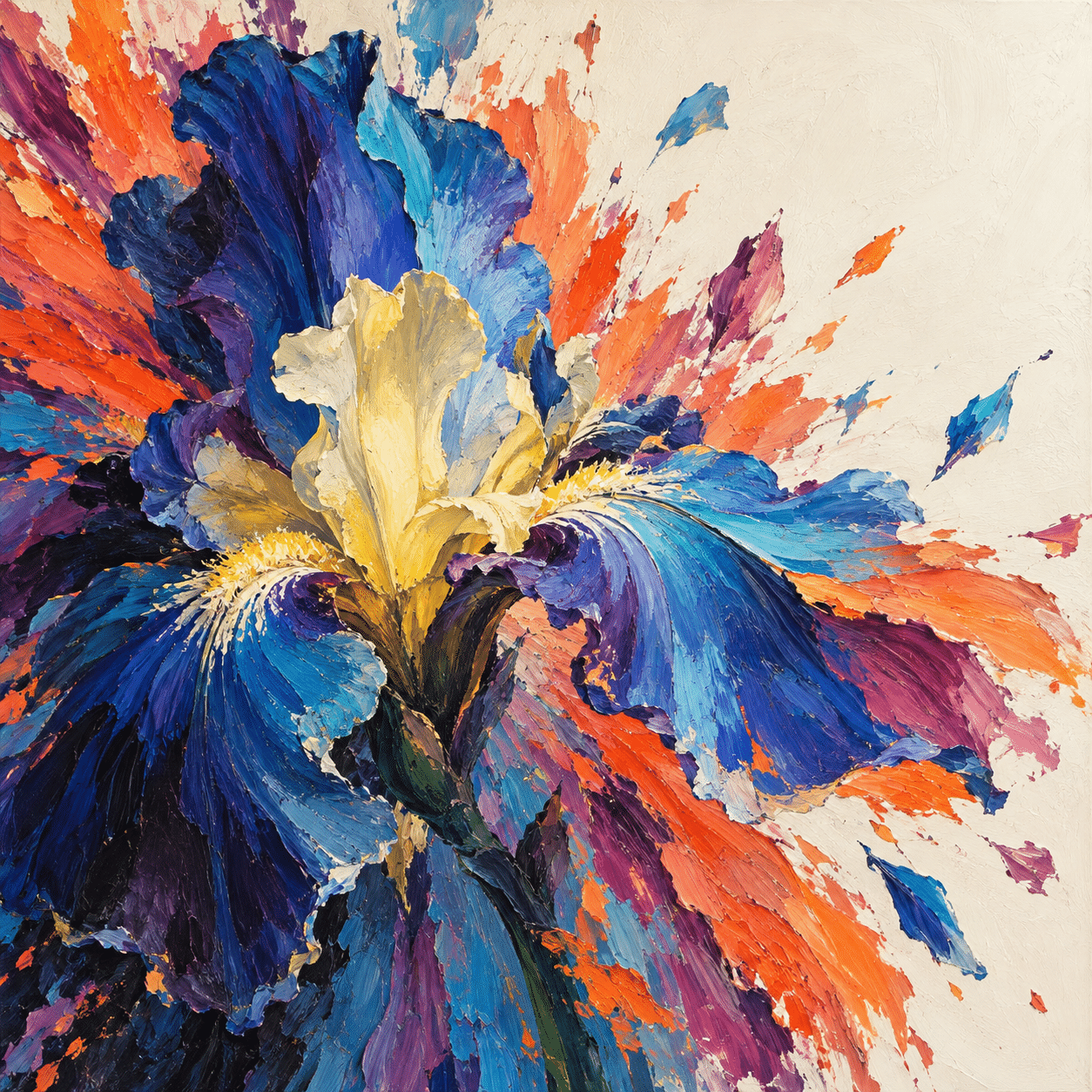
The iris study uses a pale center and dark indigo folds to anchor a bloom whose outer petals expand into blue, coral and violet brush planes. The ivory opening toward the upper right gives the burst somewhere to travel. The flower remains a subject, rather than becoming an excuse for uniform texture.
Try the same arrangement with fewer outward fragments. Then move the center closer to the margin while preserving the dominant direction. Compare how much tension comes from placement and how much comes from color. This study is an original AI-generated illustration, not a botanical reference plate.
Study 02 · Quiet face, released color
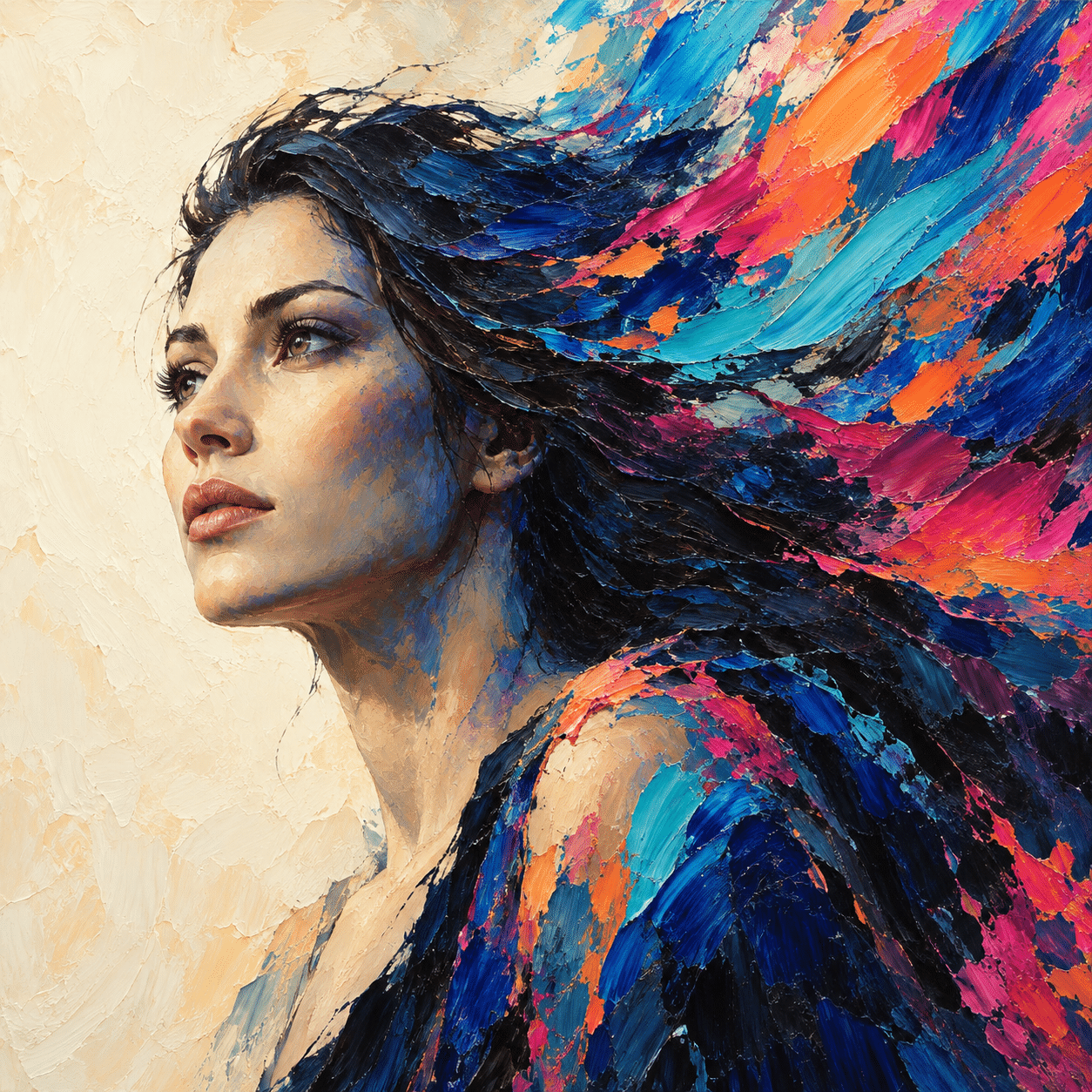
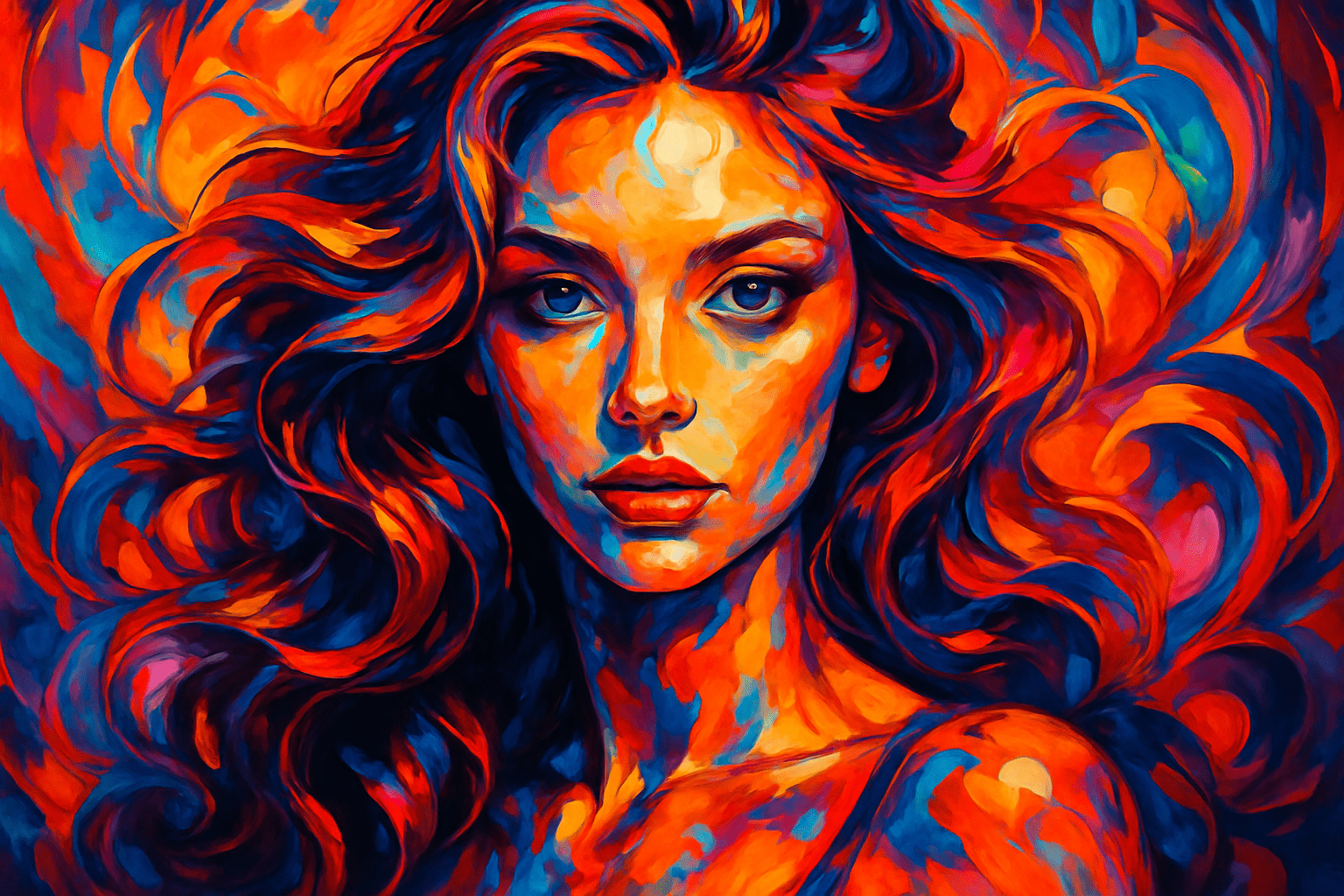
The portrait protects the eye, nose and facial outline while the hair and shoulder carry the expanding pigment. A calm expression contrasts with the diagonal motion. The ivory field beside the face gives the viewer a pause before the brighter ribbons pull attention across the picture.
This is a fictional adult, generated for the study. To adapt the exercise, keep the facial proportions fixed and change only the width and direction of the color bands. If the bands obscure the gaze, restore a clean boundary around the eye before adding anything else.
Study 03 · The city releases its color
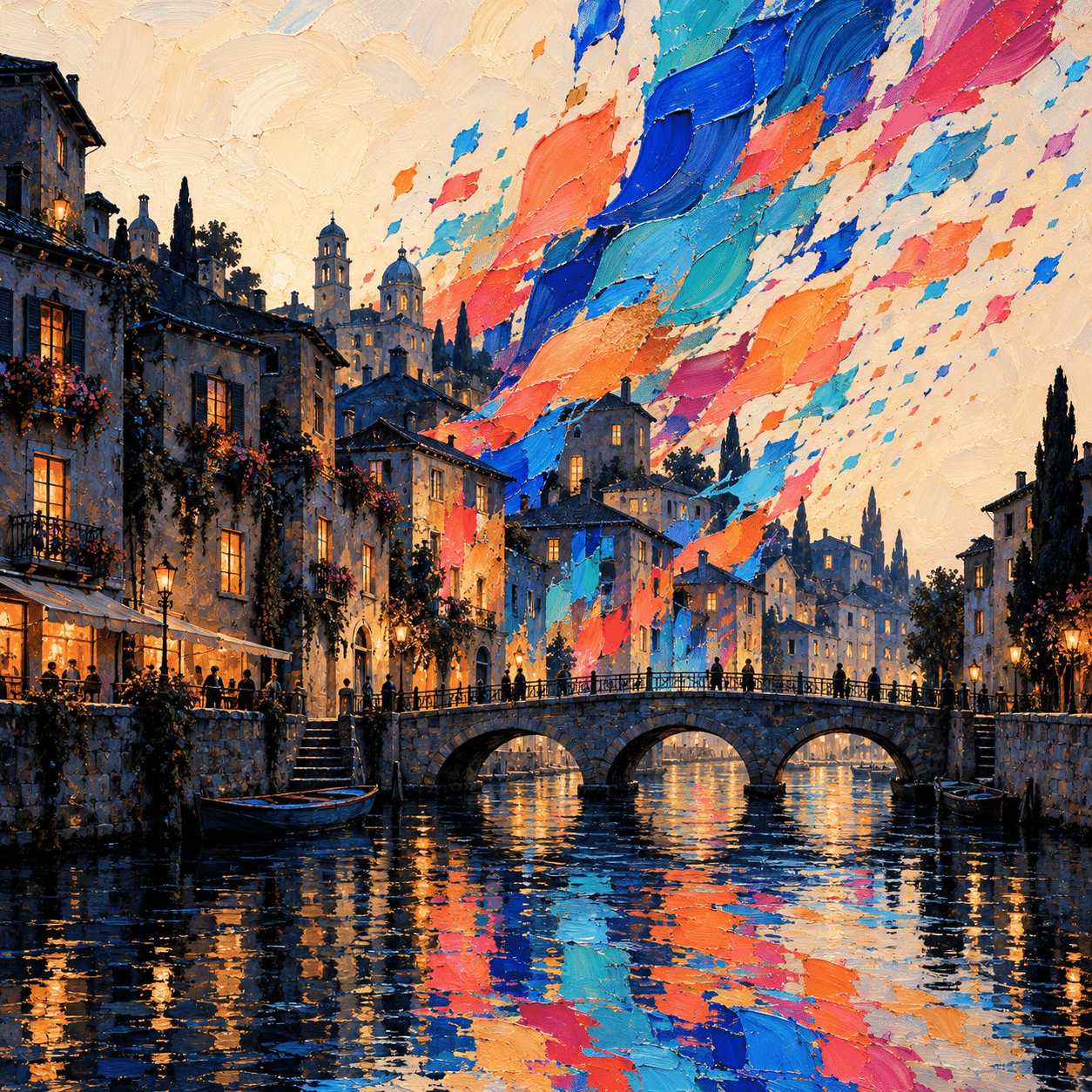
The city study keeps a dark roof rhythm, bridge and canal legible beneath a rising current of large color planes. Reflections echo the palette with smaller, interrupted marks. The visual release is metaphorical: the buildings are not exploding or collapsing.
Architecture tests whether the concept can coexist with perspective and repeated detail. Preserve the bridge’s silhouette and the relative heights of buildings, then simplify upper facades before extending color into the sky. A coherent setting makes the impossible color movement more convincing.
Finish with a controlled comparison
View the result as a small thumbnail, then inspect it without color. If the anchor disappears in both views, adding more saturated marks will not solve the structure. Adjust the light–dark boundary or reduce competing detail. Return to color only after the visual route is clear.
For a useful three-version experiment, keep the subject and palette fixed while testing radial release, diagonal flow and a contained burst inside the silhouette. The gallery’s flower, portrait and city vary their subjects deliberately; this final exercise isolates composition more strictly. The prompts below are starting points, not claims that an art-style name alone guarantees a result.
A small poetic detour
Original words from the AOI studio.
Poetry
A blue remembers where the orange ran;
A petal opens further than it can.
The quiet paper lets the colors roam,
While one dark line keeps showing them the home.
The prompt workshop
Original creative exercises. These prompts create new illustrations, not documentary evidence.
Archive-inspired · Bear with a clear silhouette
Original Coloexplosionism bear illustration on quiet ivory ground. Preserve a dark readable muzzle, eyes, paws and shoulder silhouette. Broad turquoise, violet and yellow planes follow the body before a few coral strokes release outward at one edge. Strong three-value structure, varied painterly edges, generous empty background, no uniform rainbow texture, no lettering or signature.
Study 01 · Radial bloom
Original Coloexplosionism iris study: pale lemon flower center and deep indigo petal folds remain legible as cobalt, turquoise, coral-orange and magenta planes expand from one off-center focal point. Tactile impasto, larger planes near the bloom, diminishing fragments toward the margins, quiet ivory upper-right field. Directional color movement, no uniform confetti, lettering or signature.
Study 02 · Quiet face, released color
Original Coloexplosionism portrait of a fictional adult woman looking left. Keep the eye, nose and facial outline calm and readable; release hair and shoulder into broad ultramarine, turquoise, coral and magenta ribbons toward the upper right. Quiet ivory field beside the face, dark structural anchor, tactile painterly ridges and selective crisp boundaries. No text or signature.
Study 03 · The city releases its color
Original Coloexplosionism canal city with a clear dark bridge, repeated roof silhouettes and coherent perspective. Large cobalt, turquoise, coral-orange and magenta planes rise diagonally from the facades into a quiet ivory sky; smaller reflected marks echo them in the water. Architecture remains intact. Painterly color movement as visual metaphor, not destruction; no lettering or signature.
Your next inspiration
Discover another art style
Follow a visual thread to the next subject.
A smile from the studio
Jokes
The palette asked for a quiet evening. Orange had already booked the fireworks.
The white space was accused of doing nothing. It replied, “You’re welcome for the contrast.”