
PRODAT / AOI studio formulation: coherent exaggeration
Hyperstylization amplifies selected visual rules until they become the image’s organizing language. In the PRODAT / AOI formulation, one deformation recurs at several scales, a recognizable anchor survives, and a quieter opposing shape keeps the exaggeration readable.
A visual introduction
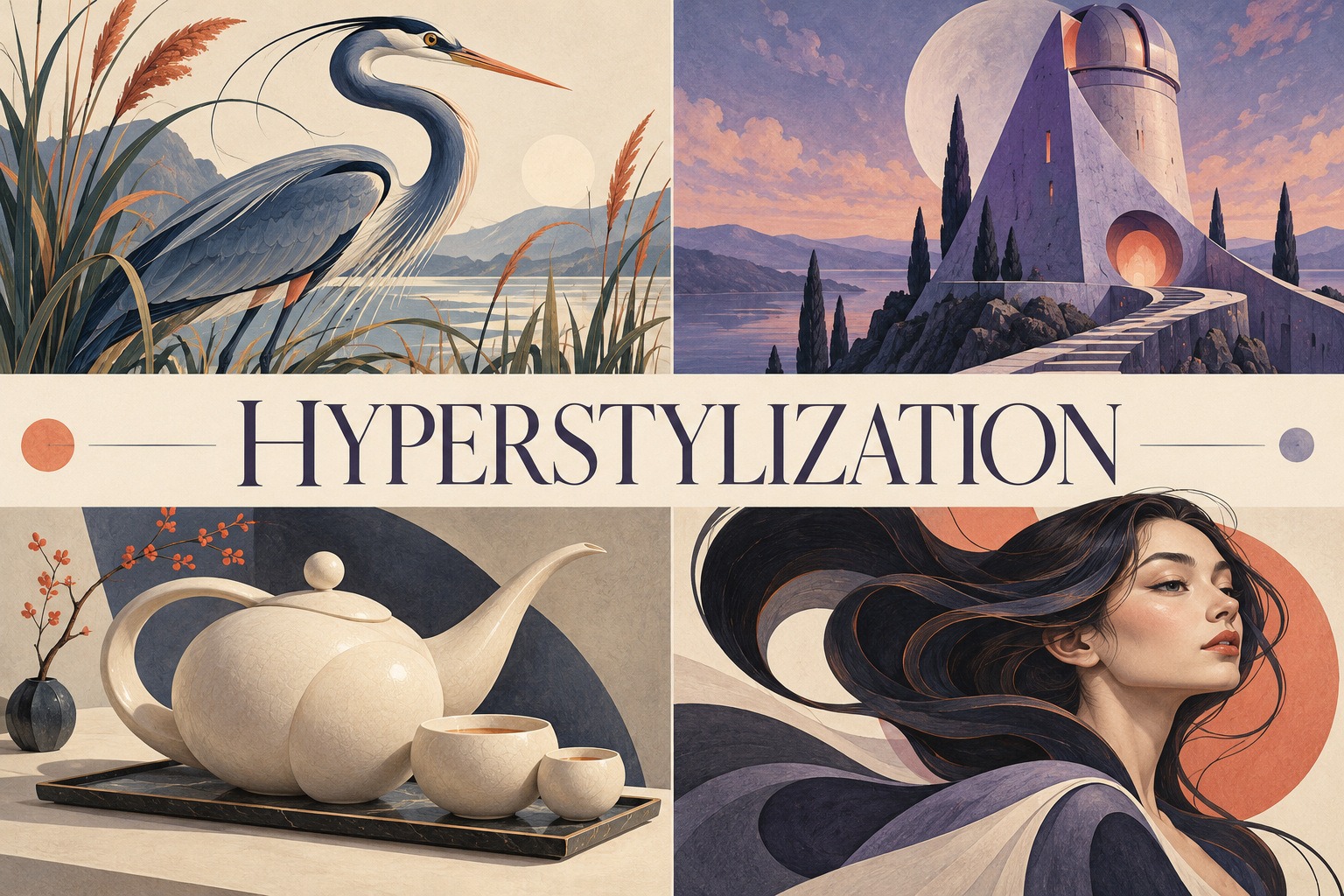
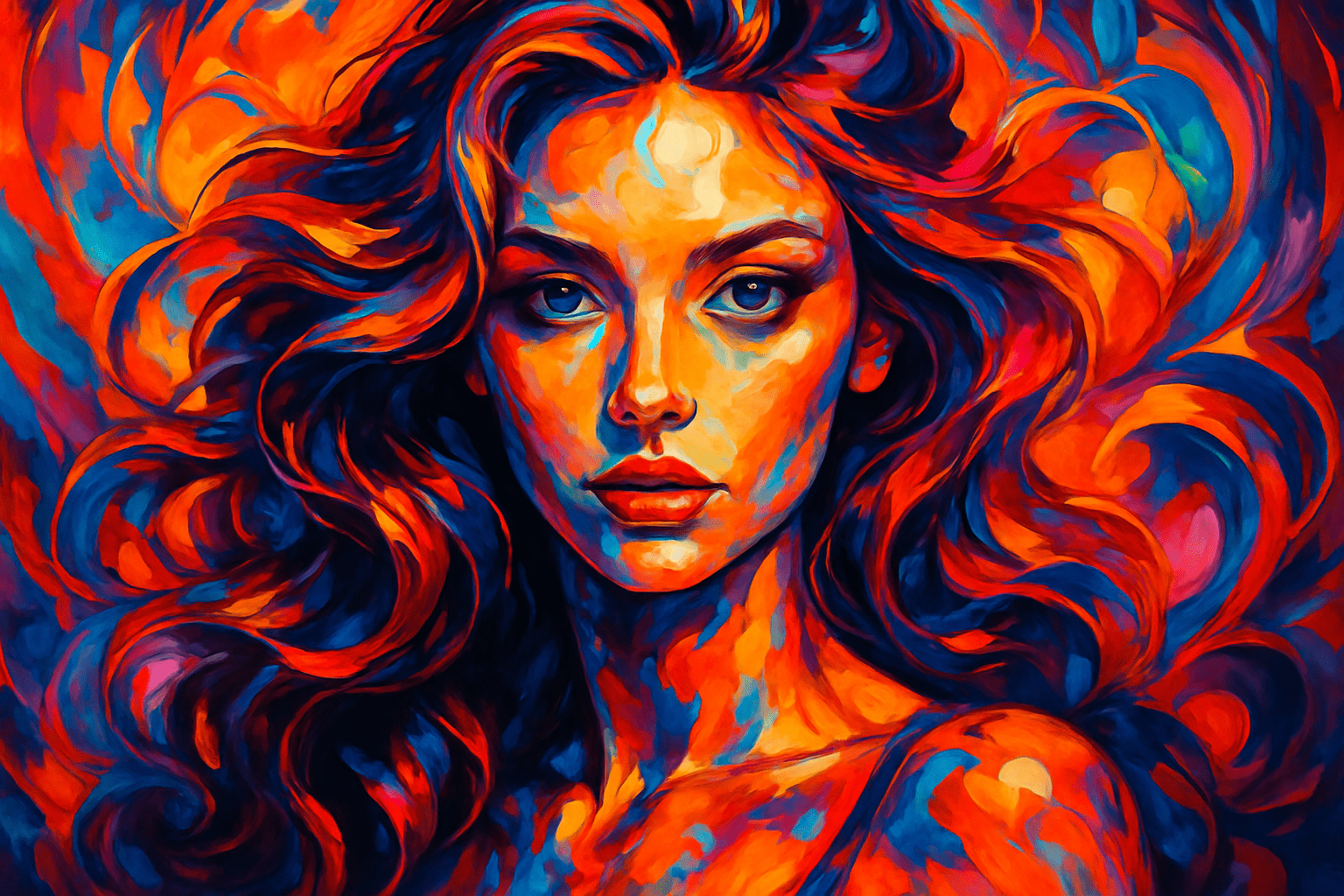
A new banner, collage and two object studies join a retained AOI portrait. The set compares elongated curves, repeated wedges, amplified rounded masses and expressive hair while preserving recognizable anchors.
Select an image for a closer look. Use the thumbnails, arrow keys or a swipe to compare examples. Zoom in to inspect details, or share the image that inspires you.
Creative toolbox · take this style further
Choose an input and a destination. Search sends your words to the chosen site; Copy & open puts them on your clipboard to paste there.
Create with AI
Turn your chosen input into an image prompt or a new creative direction.
ChatGPT
Copy your input and paste it into a ChatGPT conversation or image request.
Copy & open ChatGPT (new tab)Claude · Anthropic
Develop an image prompt or explore the style in a new Claude conversation.
Copy & open Claude · Anthropic (new tab)Midjourney
Paste your input into the Imagine bar on the Create page.
Copy & open Midjourney (new tab)Adobe Firefly
Copy your input, open Firefly, and paste it into the prompt field.
Copy & open Adobe Firefly (new tab)Leonardo.Ai
Copy your input, open Leonardo, and paste it into the generation field.
Copy & open Leonardo.Ai (new tab)Image search
Find visual references. Short, concrete keywords usually work best.
Lexica
Search AI images and prompts using your selected input.
Search with this input Lexica (new tab)Pexels
Search the photo and video library. Short keywords often work best.
Search with this input Pexels (new tab)Pixabay
Search photos, illustrations and other images.
Search with this input Pixabay (new tab)Unsplash
Search photographs using the style name or your own keywords.
Search with this input Unsplash (new tab)Wikimedia Commons
Search photographs, artworks and historical images. Check each file for its source and reuse terms.
Search with this input Wikimedia Commons (new tab)Art & research
Explore artists, collections and the ideas behind a style.
Wikipedia
Search for background reading. A style may not have its own article.
Search with this input Wikipedia (new tab)WikiArt
Copy your input into WikiArt’s search to explore artists and artworks.
Copy & open WikiArt (new tab)Europeana
Paste your keywords into the search to explore European museum, library and archive collections.
Copy & open Europeana (new tab)Inspiration
Discover portfolios and visual ideas from creative communities.
Instagram hashtags
Search a hashtag made from your input: spaces and punctuation are removed. Instagram may require sign-in.
Search with this input Instagram hashtags (new tab)ArtStation
Paste your input into artwork search for concept art, environments, characters and visual development.
Copy & open ArtStation (new tab)Behance
Paste your input into project search for illustration, design and visual storytelling.
Copy & open Behance (new tab)A closer look
Long arcs, compressed planes or enlarged masses repeat consistently through subject and setting. Selective simplification and a stable landmark prevent heightened design from becoming an accumulation of unrelated effects.
Make one decision travel through the picture
Hyperstylization begins with selection. Instead of increasing saturation, detail, distortion and ornament simultaneously, choose a governing change: lengthen arcs, flatten volumes, sharpen wedges or expand rounded masses. Apply that decision to the main subject, a supporting form and a small detail. The repetition creates a visual family across different scales.
Keep an anchor intact. In a portrait it might be the relationship between the eyes and mouth; in a bird, the beak and stance; in a building, the doorway and ground line. The anchor gives viewers enough evidence to recognize what has been transformed. A contrasting shape then interrupts the dominant rule: a small square beside broad arcs, or a quiet oval among sharp wedges.
A descriptive term and a specific PRODAT proposal
Hyperstylization already occurs as a descriptive term in criticism. Eric Ames’s 2012 chapter on Werner Herzog, for example, discusses it in relation to the baroque and documentary cinema. The word therefore cannot responsibly be presented as newly invented for this project or as the name of a single established historical movement.
PRODAT Informatik GmbH’s contribution here is the explicit AOI studio formulation developed in October 2026: a dominant deformation, repetition across scales, a preserved anchor and a contrasting shape. This is a proposed working method with examples and tests. It does not recruit historical artists as members, claim universal priority or assert a legal registration. The company attribution identifies the commissioning context of this formulation.
Visual grammar and a practical score
Start with three rough silhouettes. Choose the one whose main action reads without internal detail. Exaggerate only the selected shape rule, then repeat it in the background and one accessory. Remove details that contradict the rule unless they serve as the intended anchor. The result should become more specific as it becomes less naturalistic.
A useful review asks four questions. Can the subject still be named? Can the dominant deformation be described in one sentence? Does the same decision appear at more than one scale? Does an opposing shape make the main rhythm stronger? If every feature needs a different explanation, the picture may be eclectic, but it has not demonstrated this particular formulation.
Color and material should obey the hierarchy
A limited palette helps the shape system remain visible. Try one dominant hue family, one countercolor and a neutral interval. Assign the sharpest contrast to the anchor instead of outlining every edge equally. Hyperstylization can be quiet, nearly monochrome and spacious; visual intensity does not require maximum brightness.
Cut paper makes silhouette decisions unmistakable, while gouache can introduce softened transitions within a flat design. Sculpture can exaggerate mass and balance; a digital illustration can repeat a geometric rule with unusual precision. MoMA’s account of Matisse’s cut-outs provides a documented comparison for the relation between color, cutting and arrangement. It is a reference for studying decisions, not evidence that Matisse belonged to this proposed style.
Applications, failures and prompt vocabulary
Character design, editorial illustration, theatrical settings and object studies offer useful tests because recognition matters in each. The method can give a small image a strong identity. Its failure mode is mannerism without purpose: elongated everything, compulsory neon, identical faces or texture used to conceal a weak silhouette. Preserve variety in subjects while keeping the rule coherent.
Specify the deformation, the repeated scales, the anchor and the countershape in the prompt. Compare Swirlism when curves form a connected route, and Splatterism when impact marks organize the surface. Hyperstylization can incorporate either, but its defining question is how one selective exaggeration governs the whole. Generated studies should be labelled as interpretations; they are not authentic works by historical artists or proof that a physical object was made.
About this guide
This AI-authored AOI guide appears under Penny Wraiter, AOI’s editorial persona. Sources support the historical context; exercises, prompts and poetry are original editorial interpretations. Image captions distinguish generated studies from documented works.
A small poetic detour
Original words from the AOI studio.
Poetry
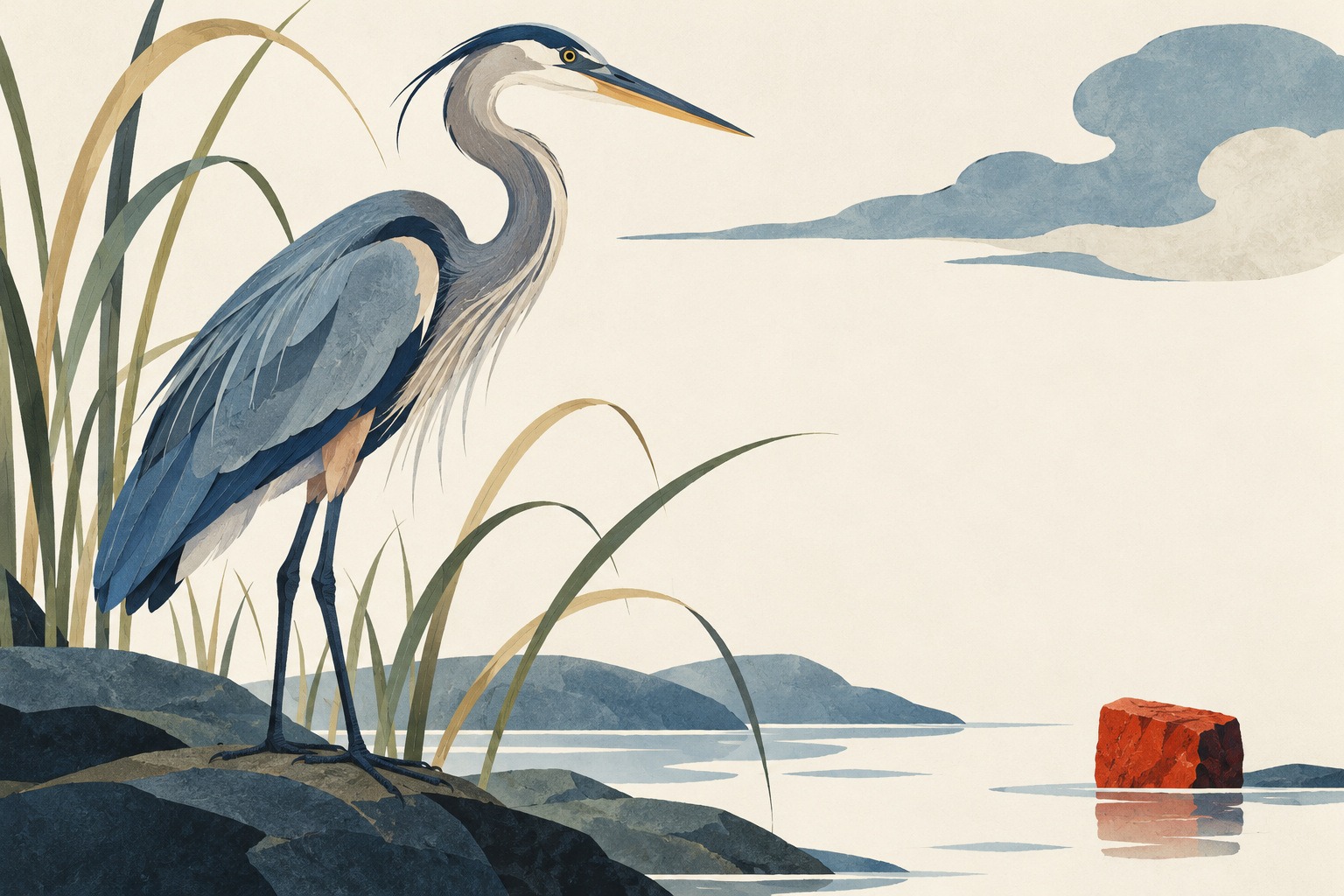
The heron borrows half the sky,
Its neck a long deliberate note;
A little stone explains nearby
Why every curve need not yet float.
The shape grows bold, the detail thins,
One patient landmark holds its ground;
The likeness ends where sense begins,
And sense returns through what is found.
The prompt workshop
Original creative exercises. These prompts create new illustrations, not documentary evidence.
Choose one exaggeration
Original illustration of a heron: elongated S-curves recur in neck, reeds and one cloud; preserve its recognizable beak and planted feet. One small rectangular stone interrupts the curves. Cream, slate blue and a vermilion accent, flat gouache, no text.
Unify a whole setting
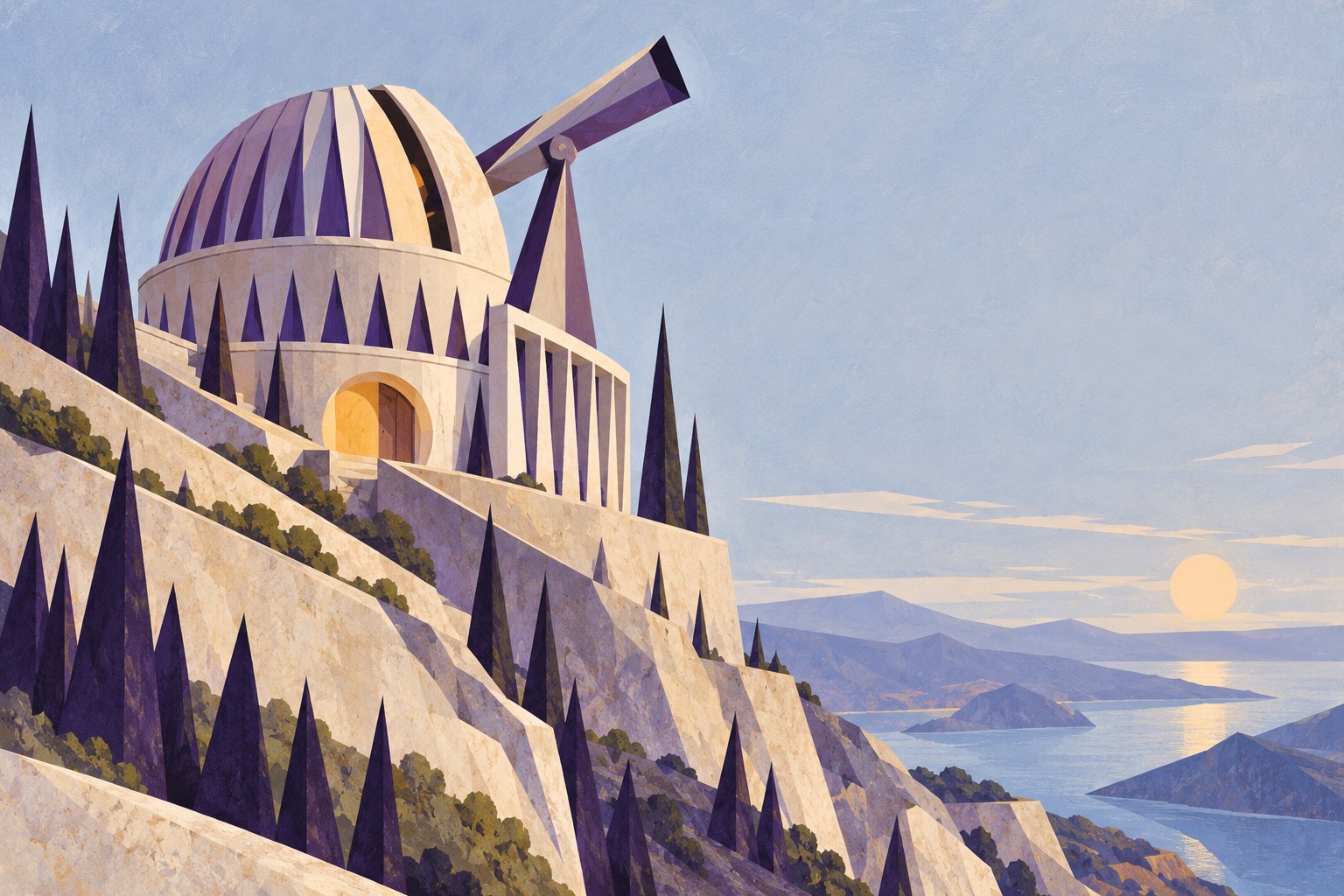
A small hillside observatory governed by tall narrow wedges: roof, hillside shadows and telescope support repeat the same angular rule. Preserve a round doorway as the anchor and countershape. Muted violet and warm limestone, clear silhouette, no lettering.
Make mass expressive
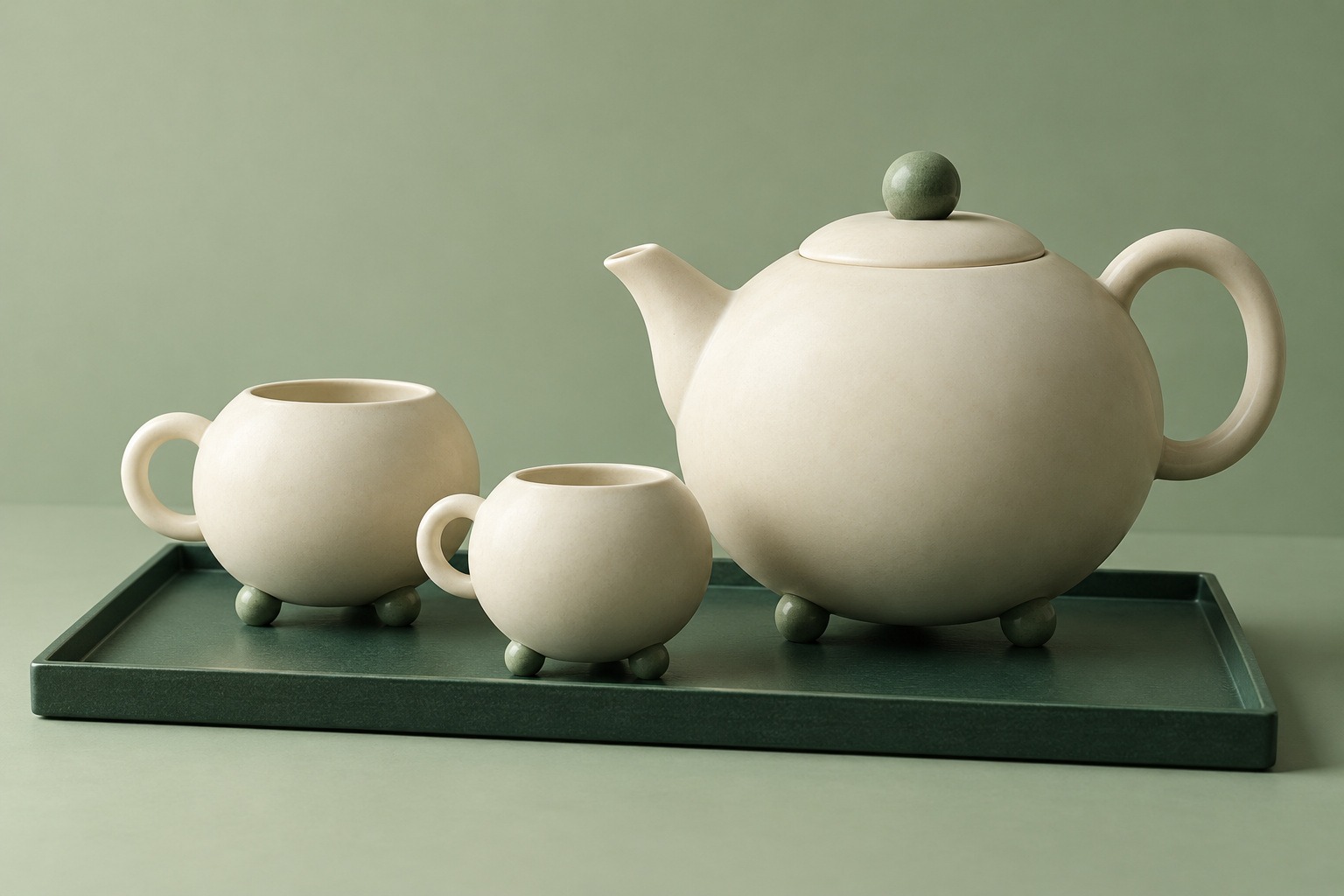
Sculptural still life of a teapot and two cups with greatly amplified rounded bodies and tiny stable feet. Repeat the same swelling proportions at three scales; preserve the functional spout and handles. One thin rectangular tray, matte ivory and deep green, no text.
A smile from the studio
Jokes
The designer enlarged every feature. The silhouette asked which one was supposed to be important.