
Urban view · Buildings, streets and lived scale
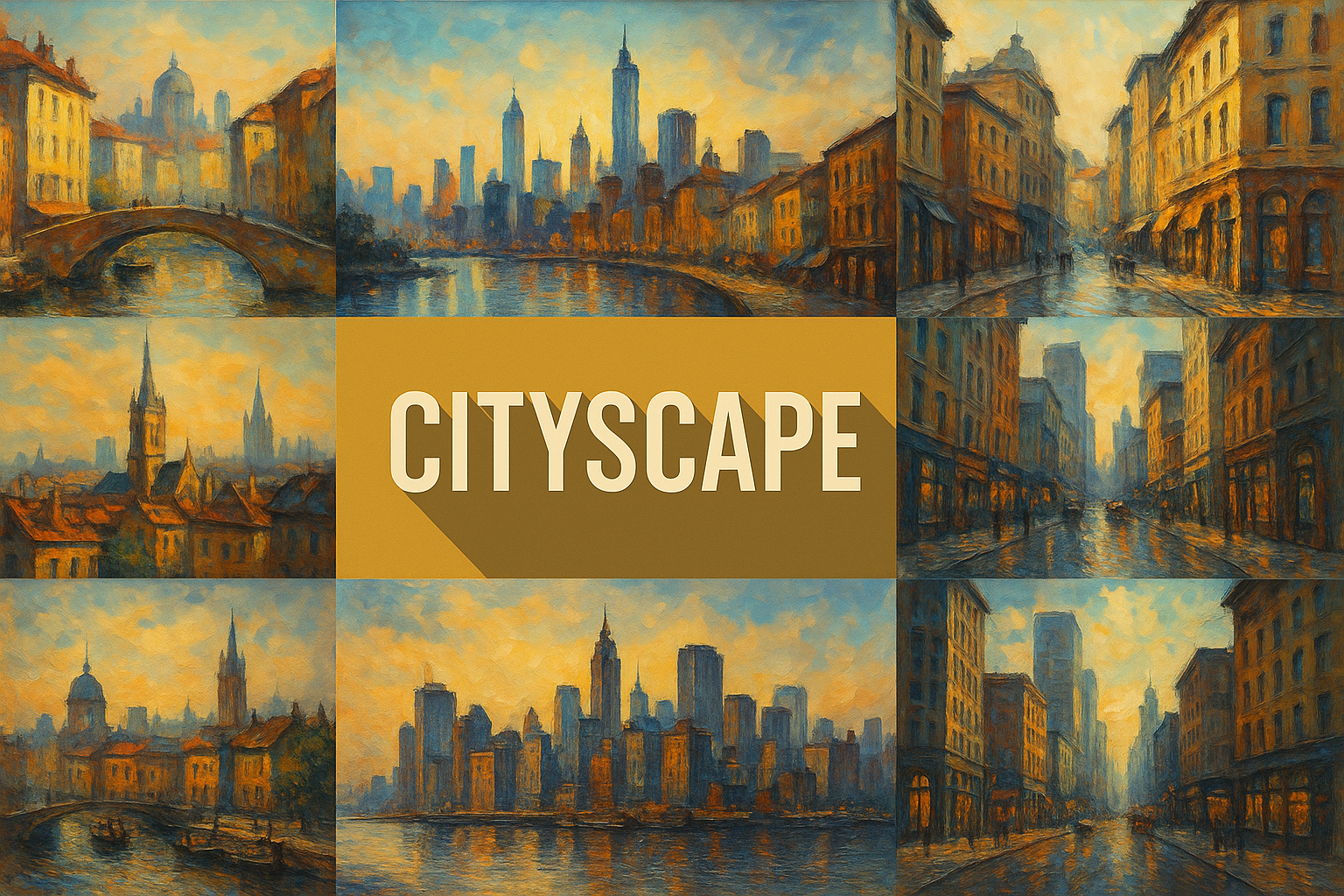
A cityscape makes the built environment the subject. It can record a recognizable place, rearrange it, or invent one, but its streets, facades and skyline establish a visual rhythm that a generic landscape cannot supply.
A visual introduction
Compare the retained AOI archive visual studies. These are illustrations, not documented historic artworks.
Select an image for a closer look. Use the thumbnails, arrow keys or a swipe to compare examples. Zoom in to inspect details, or share the image that inspires you.
Creative toolbox · take this style further
Choose an input and a destination. Search sends your words to the chosen site; Copy & open puts them on your clipboard to paste there.
Create with AI
Turn your chosen input into an image prompt or a new creative direction.
ChatGPT
Copy your input and paste it into a ChatGPT conversation or image request.
Copy & open ChatGPT (new tab)Claude · Anthropic
Develop an image prompt or explore the style in a new Claude conversation.
Copy & open Claude · Anthropic (new tab)Midjourney
Paste your input into the Imagine bar on the Create page.
Copy & open Midjourney (new tab)Adobe Firefly
Copy your input, open Firefly, and paste it into the prompt field.
Copy & open Adobe Firefly (new tab)Leonardo.Ai
Copy your input, open Leonardo, and paste it into the generation field.
Copy & open Leonardo.Ai (new tab)Image search
Find visual references. Short, concrete keywords usually work best.
Lexica
Search AI images and prompts using your selected input.
Search with this input Lexica (new tab)Pexels
Search the photo and video library. Short keywords often work best.
Search with this input Pexels (new tab)Pixabay
Search photos, illustrations and other images.
Search with this input Pixabay (new tab)Unsplash
Search photographs using the style name or your own keywords.
Search with this input Unsplash (new tab)Wikimedia Commons
Search photographs, artworks and historical images. Check each file for its source and reuse terms.
Search with this input Wikimedia Commons (new tab)Art & research
Explore artists, collections and the ideas behind a style.
Wikipedia
Search for background reading. A style may not have its own article.
Search with this input Wikipedia (new tab)WikiArt
Copy your input into WikiArt’s search to explore artists and artworks.
Copy & open WikiArt (new tab)Europeana
Paste your keywords into the search to explore European museum, library and archive collections.
Copy & open Europeana (new tab)Inspiration
Discover portfolios and visual ideas from creative communities.
Instagram hashtags
Search a hashtag made from your input: spaces and punctuation are removed. Instagram may require sign-in.
Search with this input Instagram hashtags (new tab)ArtStation
Paste your input into artwork search for concept art, environments, characters and visual development.
Copy & open ArtStation (new tab)Behance
Paste your input into project search for illustration, design and visual storytelling.
Copy & open Behance (new tab)A closer look
Look for a route through the scene, a scale cue and the relation between close facades and distant skyline. Ask whether the architecture is observed, idealized or openly imaginary.
A city is more than a silhouette
Cityscape names a subject, not one historical movement. A skyline can announce density, but ground-level doors, bridges and people tell us how space is used. Perspective may guide the eye down a street or hold the viewer across a river. Night colour, traffic and reflections are choices, not requirements of the category.
Observation and invention
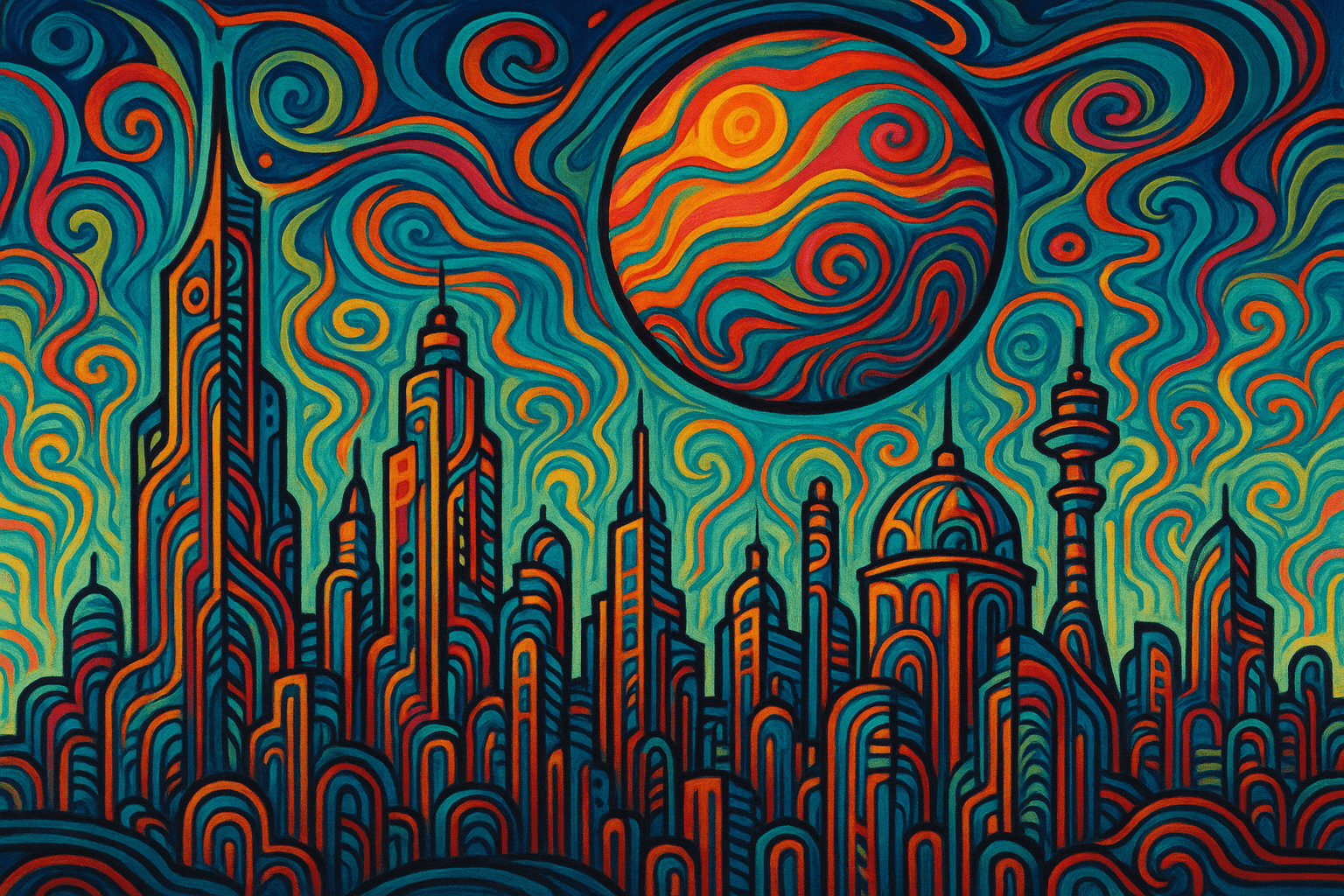
The Rijksmuseum notes that Vermeer’s View of Delft uses an unexpected approach instead of foregrounding the city’s most prominent buildings. That observation helps separate a composed view from a neutral map. The AOI image on this page is highly stylized, with orange and teal currents above a dense skyline; it is an invented city, not a document of Delft or any other place.
Design a readable urban scene
Pick one route: a street, canal, roof line or sequence of lit windows. Draw large building masses before details, decide how tall a human appears beside them, then control repeated windows so they reinforce depth. A skyline with every tower equally loud becomes a pattern; give one district or intersection a clear focal role.
A small poetic detour
Original words from the AOI studio.
Poetry
The windows count a waking street;
The rooflines rise and softly meet.
A river keeps the evening hue—
A city changes with the view.
The prompt workshop
Original creative exercises. These prompts create new illustrations, not documentary evidence.
Start here · Street and tower
Original cityscape viewed from a low pedestrian street, one distant tower as focal point, believable building scale, clear pavement route, late-afternoon side light, no named city or signage.
Richer scene · Riverfront at dusk
Original urban view across a river: near railing, two bridges at different distances and a varied skyline, restrained blue-violet dusk with selective warm windows, coherent reflections, people as small scale cues, no text.
Experiment · Rhythmic invented city
Original highly stylized cityscape with teal and ember-orange contour rhythms above a dense but readable skyline, one calm dark foreground and one focal illuminated dome, imaginative rather than documentary, no lettering.
Your next inspiration
Discover another art style
Follow a visual thread to the next subject.
A smile from the studio
Jokes
The skyline tried to stand out. Every building had the same idea.