
Imagined view · Architecture recomposed
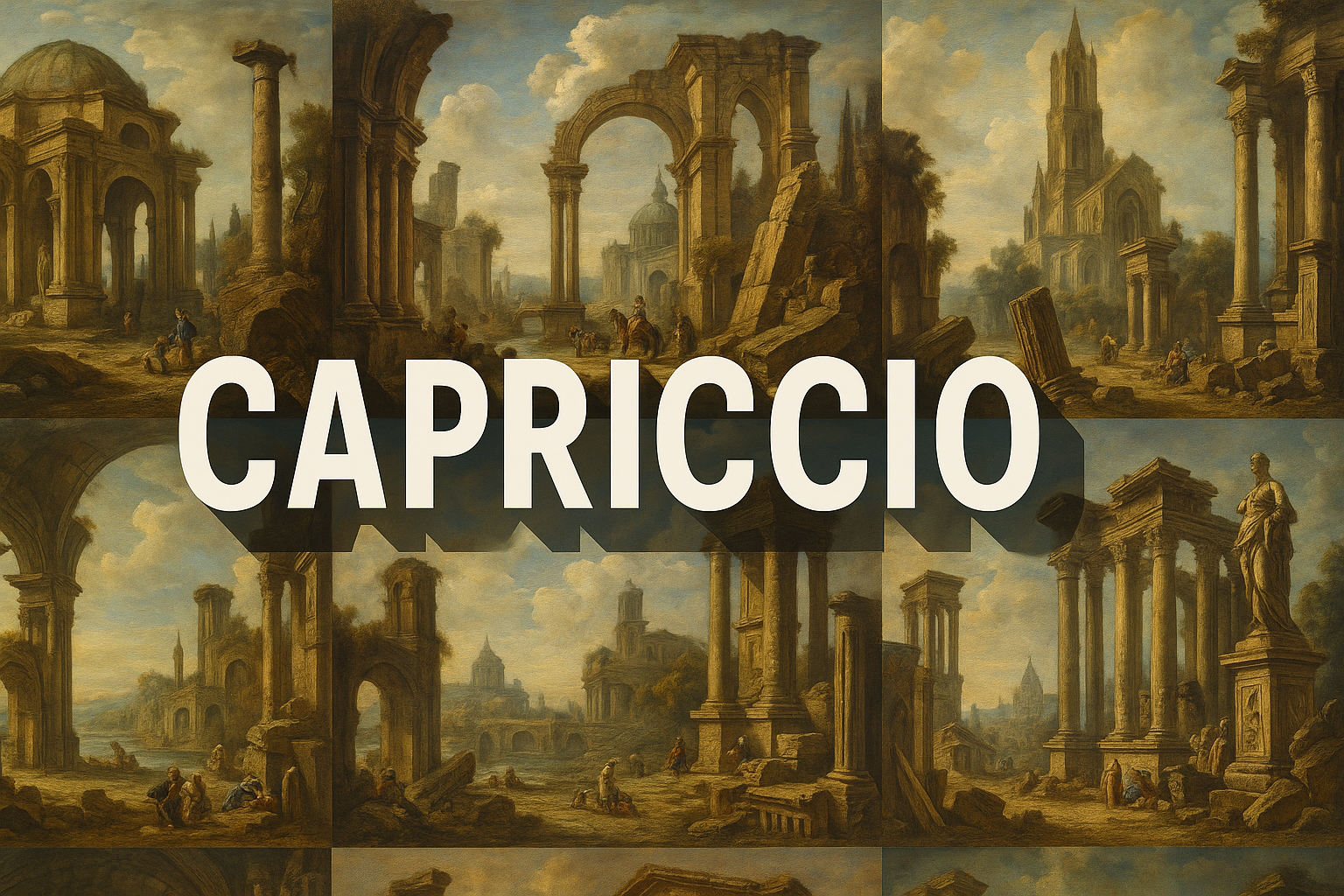
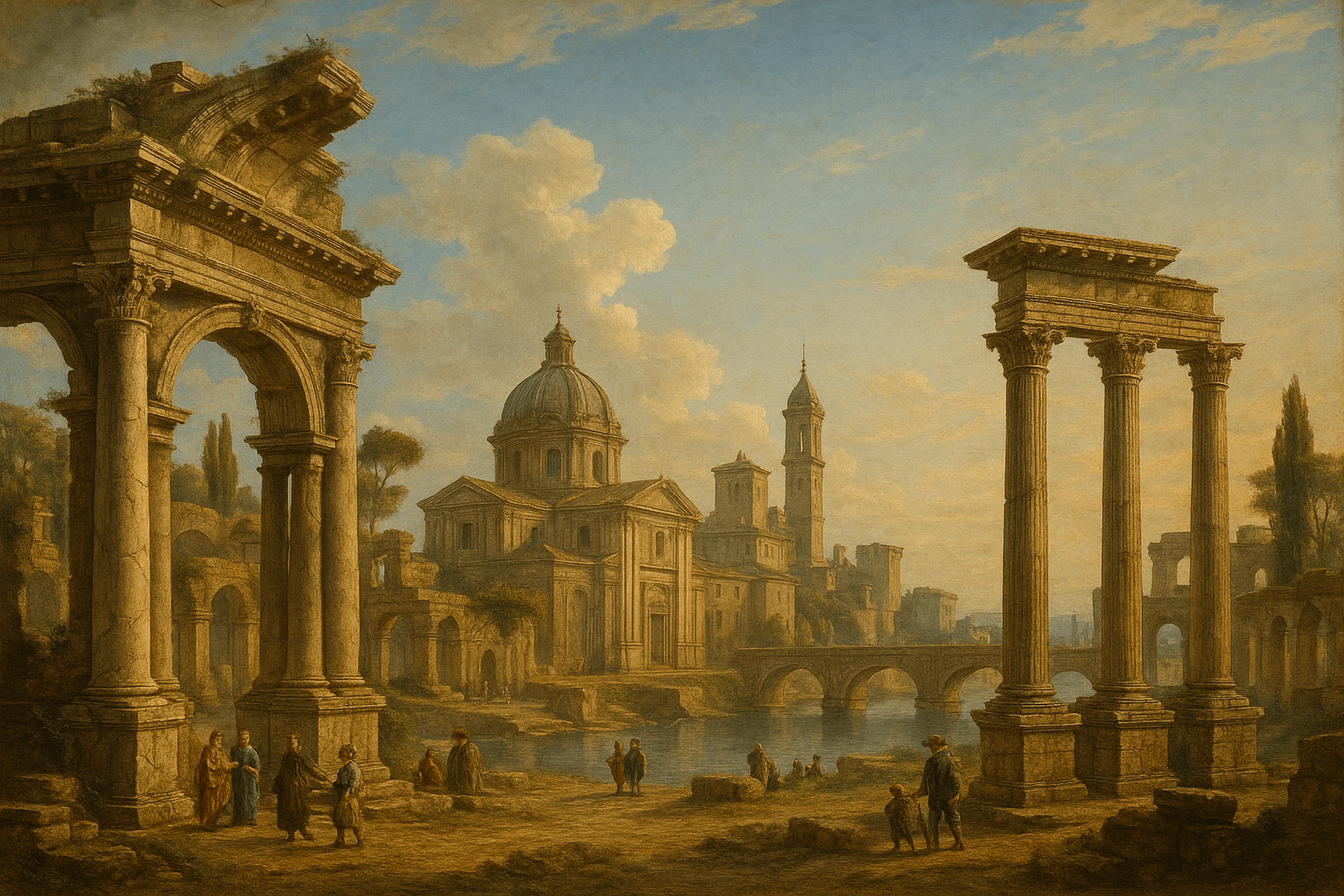
A capriccio is an invented view, often assembled from real and imagined architecture. Its arches, ruins and streets can feel plausible while refusing to correspond to one actual place.
A visual introduction
Compare the retained AOI archive visual studies. These are illustrations, not documented historic artworks.
Select an image for a closer look. Use the thumbnails, arrow keys or a swipe to compare examples. Zoom in to inspect details, or share the image that inspires you.
Creative toolbox · take this style further
Choose an input and a destination. Search sends your words to the chosen site; Copy & open puts them on your clipboard to paste there.
Create with AI
Turn your chosen input into an image prompt or a new creative direction.
ChatGPT
Copy your input and paste it into a ChatGPT conversation or image request.
Copy & open ChatGPT (new tab)Claude · Anthropic
Develop an image prompt or explore the style in a new Claude conversation.
Copy & open Claude · Anthropic (new tab)Midjourney
Paste your input into the Imagine bar on the Create page.
Copy & open Midjourney (new tab)Adobe Firefly
Copy your input, open Firefly, and paste it into the prompt field.
Copy & open Adobe Firefly (new tab)Leonardo.Ai
Copy your input, open Leonardo, and paste it into the generation field.
Copy & open Leonardo.Ai (new tab)Image search
Find visual references. Short, concrete keywords usually work best.
Lexica
Search AI images and prompts using your selected input.
Search with this input Lexica (new tab)Pexels
Search the photo and video library. Short keywords often work best.
Search with this input Pexels (new tab)Pixabay
Search photos, illustrations and other images.
Search with this input Pixabay (new tab)Unsplash
Search photographs using the style name or your own keywords.
Search with this input Unsplash (new tab)Wikimedia Commons
Search photographs, artworks and historical images. Check each file for its source and reuse terms.
Search with this input Wikimedia Commons (new tab)Art & research
Explore artists, collections and the ideas behind a style.
Wikipedia
Search for background reading. A style may not have its own article.
Search with this input Wikipedia (new tab)WikiArt
Copy your input into WikiArt’s search to explore artists and artworks.
Copy & open WikiArt (new tab)Europeana
Paste your keywords into the search to explore European museum, library and archive collections.
Copy & open Europeana (new tab)Inspiration
Discover portfolios and visual ideas from creative communities.
Instagram hashtags
Search a hashtag made from your input: spaces and punctuation are removed. Instagram may require sign-in.
Search with this input Instagram hashtags (new tab)ArtStation
Paste your input into artwork search for concept art, environments, characters and visual development.
Copy & open ArtStation (new tab)Behance
Paste your input into project search for illustration, design and visual storytelling.
Copy & open Behance (new tab)A closer look
Track where the invented space persuades you: consistent light, diminishing scale and carefully repeated masonry can make a fantastic combination feel walkable.
An imaginary topography
The National Gallery defines capricci as imaginary topographical scenes. Architectural fragments may be taken from actual sites and recombined for decorative effect. A capriccio differs from a documentary city view even when individual buildings seem familiar. The point is not to fool the viewer with a false survey, but to make an invented place coherent.
Look at a named example
The National Gallery describes Francesco Guardi’s Caprice View with Ruins as one of the imaginary views associated with Venice and tourist collecting. That example anchors the term in an actual work; it does not establish that every ruin-filled fantasy belongs to the same artist or century. The retained AOI image combines arches, a dome and columns as a new conceptual scene.
Build a convincing impossibility
Sketch a simple horizon and one perspective system before adding monuments. Select two architectural families that can share a believable scale. Use figures, paving and shadows to connect them. Let one impossible juxtaposition be the point of interest rather than mixing every famous ruin into a crowded postcard. Caption a generated result as imagined architecture.
A small poetic detour
Original words from the AOI studio.
Poetry
An arch remembers another street;
A borrowed dome and river meet.
The map gives up its certain lines—
A city forms where light aligns.
The prompt workshop
Original creative exercises. These prompts create new illustrations, not documentary evidence.
Start here · Quiet invented square
Original architectural capriccio of a small imaginary square with one weathered arch and one distant dome, coherent perspective, morning light, a few scale figures, painterly stone texture, no real-location claim or text.
Richer scene · Bridge of eras
Original invented riverside city where a classical colonnade meets a modest later bridge, consistent sun direction and water reflections, generous depth, restrained ochre and blue palette, not a reconstruction of any historic site.
Experiment · Ruins and a garden
Original capriccio in which fragmented arcades open onto an impossible elevated garden, one coherent vanishing point, believable steps and human scale, atmosphere of discovery, no copied painting or label.
Your next inspiration
Discover another art style
Follow a visual thread to the next subject.

A smile from the studio
Jokes
The capriccio asked for directions. The map replied, “You made this place up.”