
Artist profile · modernist painting and poetic imagery
Marc Chagall joined vivid colour, remembered places and intimate figures in a personal modernist language. Explore how associative space works, why cultural context matters and how different materials transform the image.
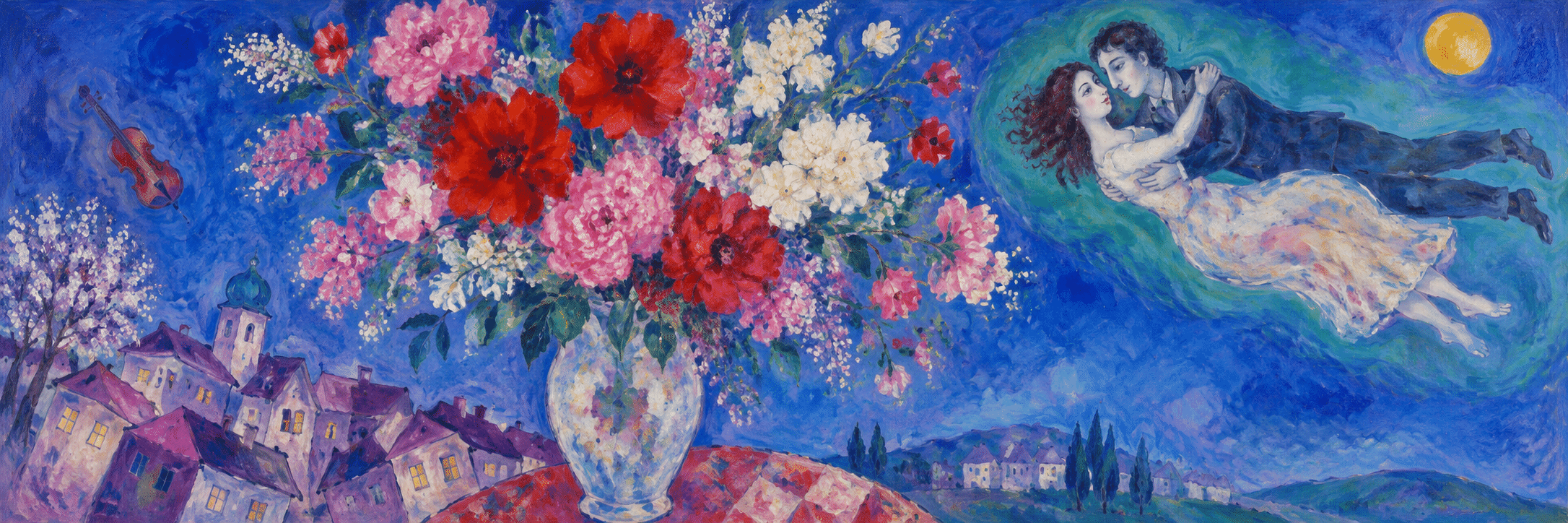
A visual introduction
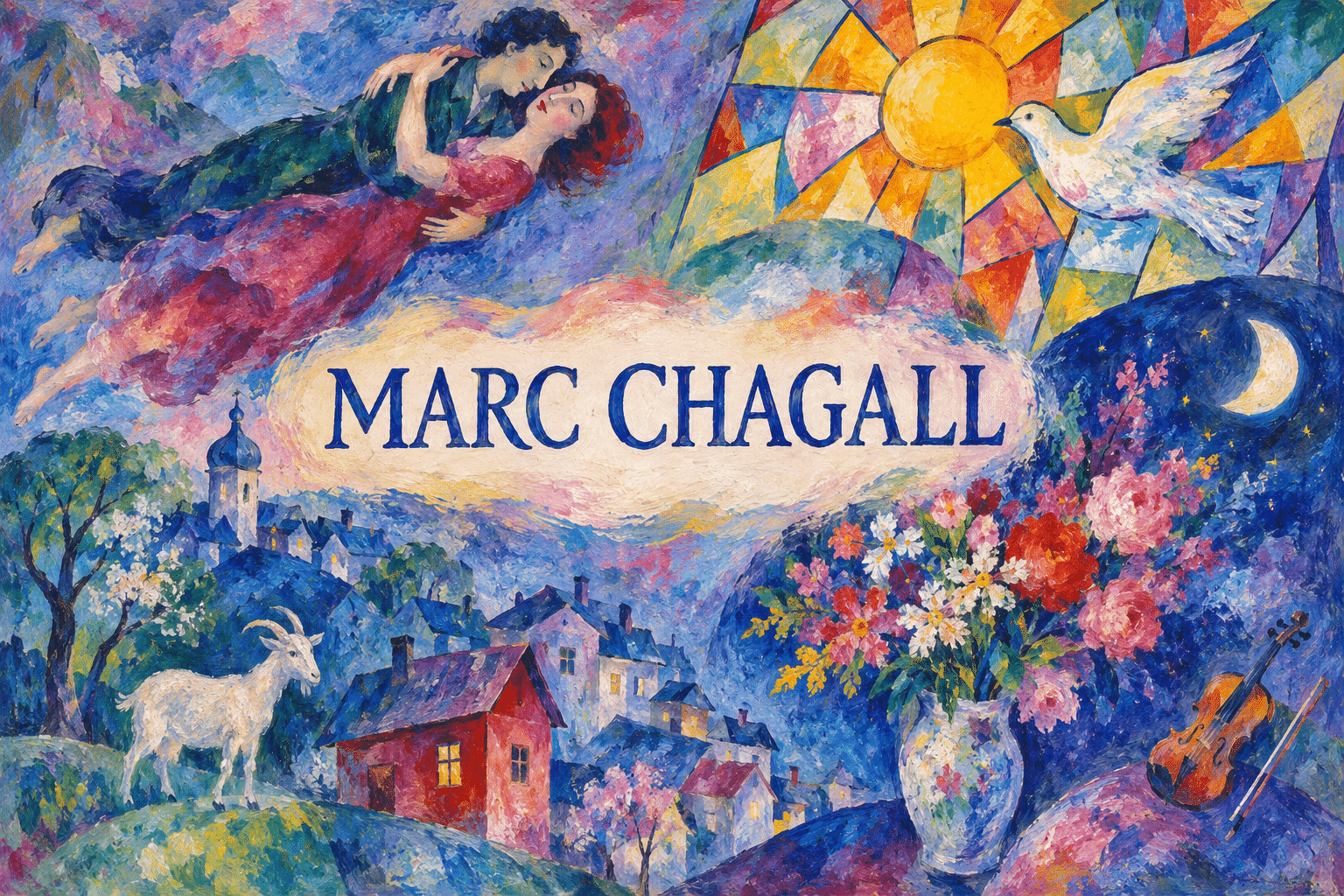
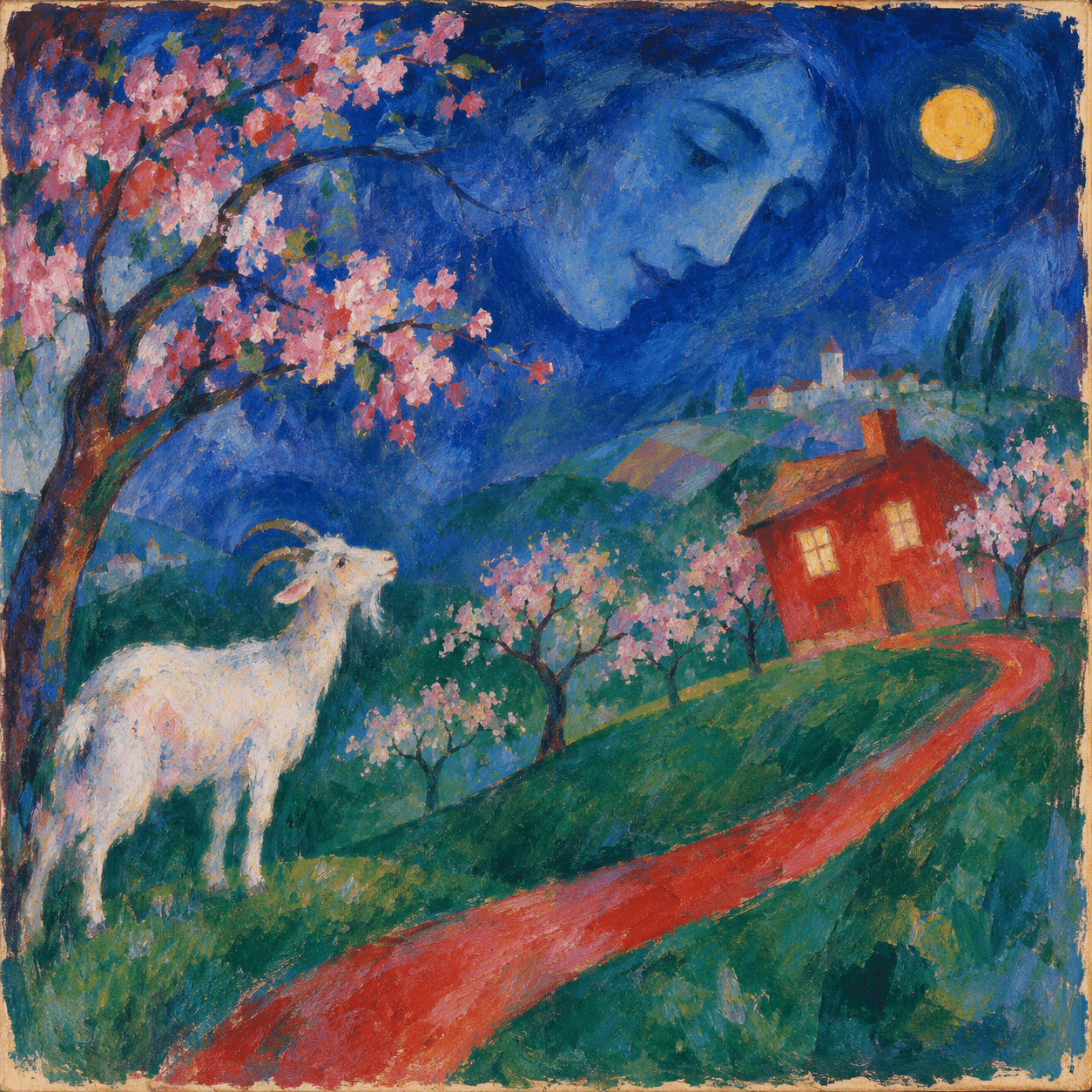
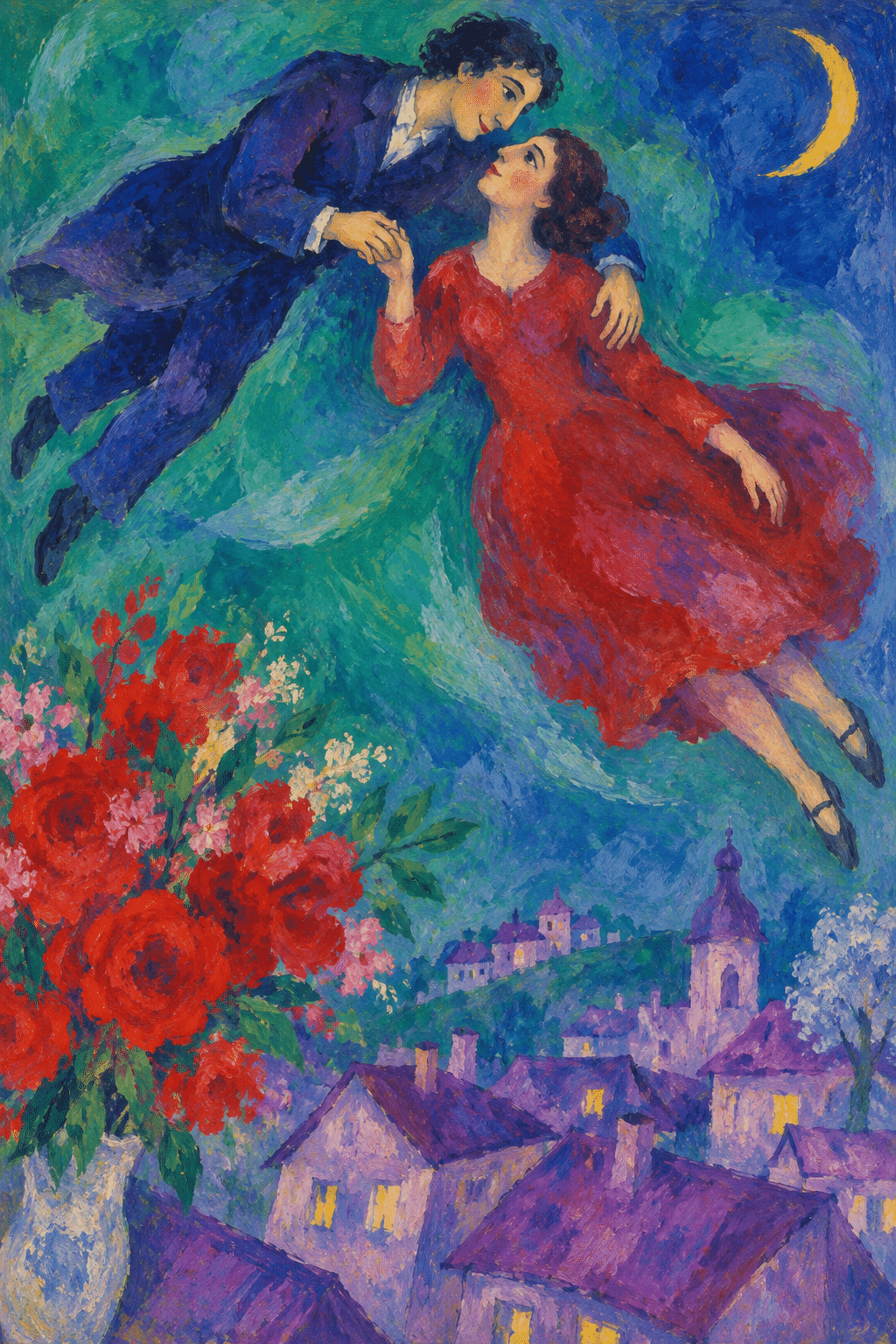
Original AI-generated AOI studies. These independent interpretations are not authentic artist works or official production images.
Select an image for a closer look. Use the thumbnails, arrow keys or a swipe to compare examples. Zoom in to inspect details, or share the image that inspires you.
Creative toolbox · take this style further
Choose an input and a destination. Search sends your words to the chosen site; Copy & open puts them on your clipboard to paste there.
Create with AI
Turn your chosen input into an image prompt or a new creative direction.
ChatGPT
Copy your input and paste it into a ChatGPT conversation or image request.
Copy & open ChatGPT (new tab)Claude · Anthropic
Develop an image prompt or explore the style in a new Claude conversation.
Copy & open Claude · Anthropic (new tab)Midjourney
Paste your input into the Imagine bar on the Create page.
Copy & open Midjourney (new tab)Adobe Firefly
Copy your input, open Firefly, and paste it into the prompt field.
Copy & open Adobe Firefly (new tab)Leonardo.Ai
Copy your input, open Leonardo, and paste it into the generation field.
Copy & open Leonardo.Ai (new tab)Image search
Find visual references. Short, concrete keywords usually work best.
Lexica
Search AI images and prompts using your selected input.
Search with this input Lexica (new tab)Pexels
Search the photo and video library. Short keywords often work best.
Search with this input Pexels (new tab)Pixabay
Search photos, illustrations and other images.
Search with this input Pixabay (new tab)Unsplash
Search photographs using the style name or your own keywords.
Search with this input Unsplash (new tab)Wikimedia Commons
Search photographs, artworks and historical images. Check each file for its source and reuse terms.
Search with this input Wikimedia Commons (new tab)Art & research
Explore artists, collections and the ideas behind a style.
Wikipedia
Search for background reading. A style may not have its own article.
Search with this input Wikipedia (new tab)WikiArt
Copy your input into WikiArt’s search to explore artists and artworks.
Copy & open WikiArt (new tab)Europeana
Paste your keywords into the search to explore European museum, library and archive collections.
Copy & open Europeana (new tab)Inspiration
Discover portfolios and visual ideas from creative communities.
Instagram hashtags
Search a hashtag made from your input: spaces and punctuation are removed. Instagram may require sign-in.
Search with this input Instagram hashtags (new tab)ArtStation
Paste your input into artwork search for concept art, environments, characters and visual development.
Copy & open ArtStation (new tab)Behance
Paste your input into project search for illustration, design and visual storytelling.
Copy & open Behance (new tab)A closer look
Luminous blue, green, red and rose fields connect tilted architecture, animals, flowers and floating figures. Scale and gravity can follow emotional relationships, while repeated curves and colour accents keep the composition readable.
A personal language rooted in particular places
Marc Chagall (1887–1985) grew up in a Hasidic Jewish community in Vitebsk, in what is now Belarus, then part of the Russian Empire. He moved to Paris in 1910. The National Gallery of Art describes a career spanning painting, murals, mosaics and stained glass. These different places and media are essential context for an artist whose work cannot be reduced to a floating-figures effect. [1]
Calling the images poetic is useful only if it leads to closer looking. A remembered house, an animal or a musician can carry a relationship to home, language and personal experience. They are not interchangeable decorations. Avoid turning Jewish cultural imagery into a generic collection of mystical symbols, and avoid assigning one fixed meaning to every recurring motif.
Look closely: I and the Village
MoMA identifies I and the Village as a 1911 oil painting made after Chagall arrived in Paris. Its account connects the image with memories of his home community and with the fragmented forms he encountered in Cubism. The face-to-face relationship between human and animal is an especially useful starting point for looking: the picture invites attention to connection rather than a literal inventory of village life. [2]
As an analytical exercise, trace the directions that bind two large forms. Then follow smaller echoes across the surface: a curve, a wedge of colour, a change in scale. Ask which connection would disappear if an object were moved. An associative composition still has structure; its order may depend on visual rhyme and attention rather than one horizon or a single vanishing point.
Colour can carry the architecture
In an original study, choose a dominant colour field before adding motifs. Deep blue can hold a scene together while a red shape supplies the principal interruption. A repeated green or warm white can connect forms at different scales. This is a compositional exercise, not a claim that any colour has one universal meaning in Chagall’s work.
Balance large quiet areas against small concentrated marks. Preserve a few firm edges where recognition matters, then allow translucent or broken passages elsewhere. If every shape is equally bright, sharp and busy, the image loses its pauses. A limited palette can feel more luminous than a catalogue of saturated colours when each accent has a clear role.
Gravity changes; relationships remain
Floating figures become expressive when their gestures remain legible. A pair can share a diagonal, exchange a glance or be linked by a bouquet even when the surrounding roofs tilt in another direction. Keep hands, faces and the main bodily relationship readable. The departure from ordinary space should strengthen tenderness, distance or recollection rather than merely advertise strangeness.
Start with two people and one remembered place. Write a sentence about their relationship, then decide which spatial rule to relax. Perhaps the room opens into a landscape, or the figures become larger than the house. Keep the other relationships simple. Randomly adding a violin, moon and goat does not automatically create a meaningful painting.
Read a cycle before explaining its symbols
The Musée National Marc Chagall presents the Song of Songs as five paintings within the Biblical Message cycle. Its interpretation links red and pink tonalities, recurring embracing figures and rounded compositional forms to the biblical love poem and the cycle’s musical, sacred and bodily dimensions. This is context for those particular works, not a universal dictionary for the artist’s entire output. [3]
An independent workshop can explore colour and association without borrowing a sacred authority. Choose imagery grounded in your own subject and state its status clearly. Historical interpretation requires evidence about the specific artwork, its date, medium and context; an attractive generated image provides none of those facts.
From painted pigment to transmitted light
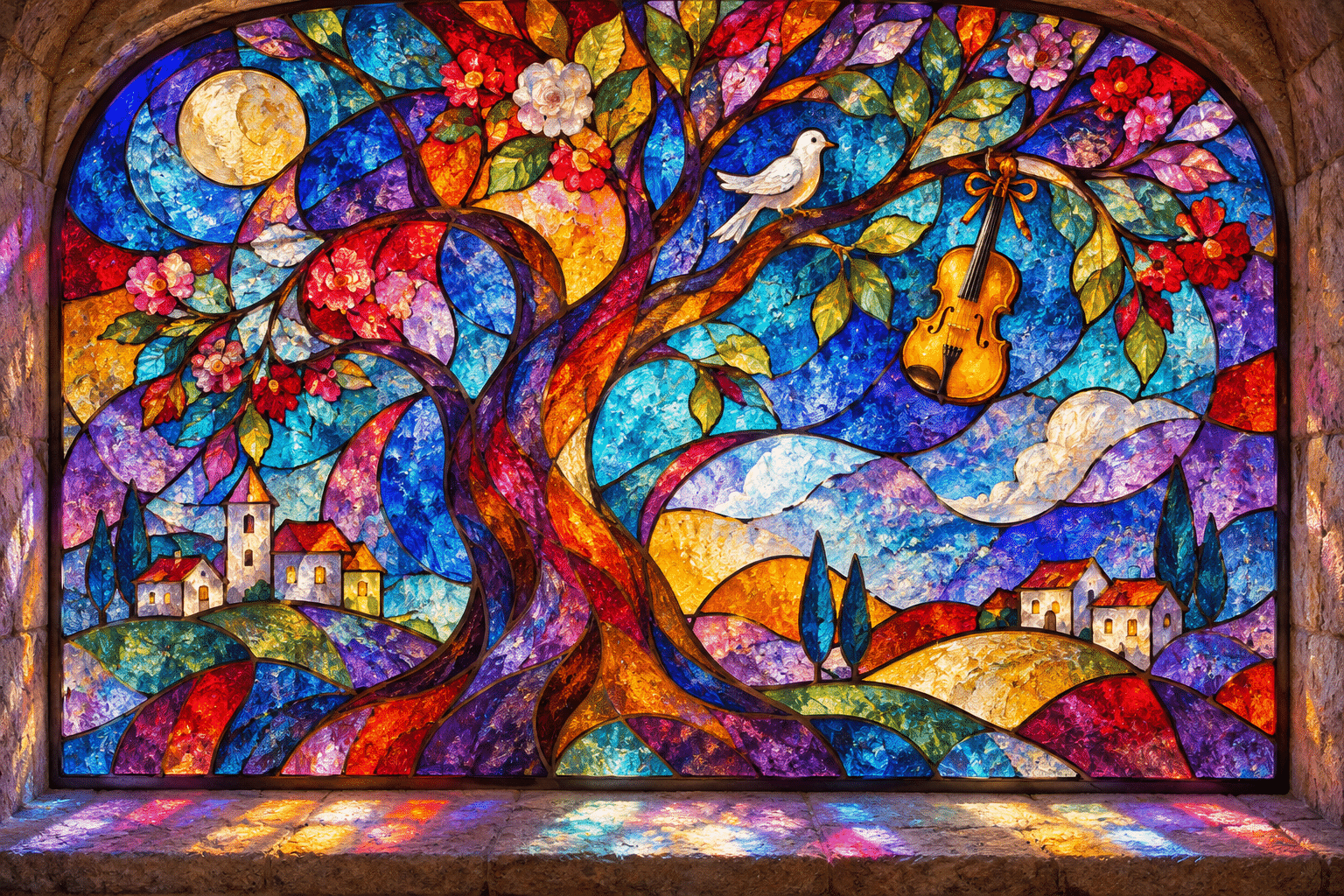
The distinction between painting and stained glass changes the practical problem. A painted field reflects light from a surface; a window also depends on light passing through coloured material. In a window-inspired study, consider the divisions between pieces, the scale of an architectural opening and the coloured light falling nearby. Do not simply place black outlines over a painting and call it a documented window.
The new AOI examples test three different relationships: an animal and remembered home, a floating couple over rooftops, and a tree-like window joining colour with material. They are original AI-generated interpretations, not authentic Chagall works or copies of named paintings. Use them to compare composition and material effects, then return to the museum sources to study the actual art.
A small poetic detour
Original words from the AOI studio.
Poetry
A House Carried in Blue — an original AOI poem
I folded up a street and took it home;
its roofs still leaned against the evening air.
A flower made a window of the room,
and all the roads remembered you were there.
No map could hold the distance of that blue;
no clock could weigh the colour of your hand.
The house grew small, the sky came softly through,
and love became the place where we could stand.
The prompt workshop
Original creative exercises. These prompts create new illustrations, not documentary evidence.
A remembered place
Create an original poetic painting of a musician recalling a riverside home, a floating paper boat and a flowering tree connected by a deep blue color field. Use clear recurring shapes and invented imagery.
Color connects a story
Create an original imaginative painting of two friends separated by rooftops but linked by a winding red ribbon, soft green sky and a few luminous flowers. Let color and gesture replace literal spatial continuity.
An ordinary dream
Create an original lyrical image of a kitchen table gently rising above a quiet garden, familiar objects kept readable and warm colors repeated across the scene. Avoid borrowed religious symbols or artist signatures.
A smile from the studio
Jokes
The village painter was asked to correct the perspective. “Of course,” she said, “whose memory shall I use?”