
Portrait and satirical drawing
Caricature changes proportions and emphasizes characteristic features to make a person or behaviour immediately readable. Its success depends on selection, resemblance and a clear point of view, not simply distortion.
A visual introduction
Select an image for a closer look. Use the thumbnails, arrow keys or a swipe to compare examples. Zoom in to inspect details, or share the image that inspires you.



Creative toolbox · take this style further
Choose an input and a destination. Search sends your words to the chosen site; Copy & open puts them on your clipboard to paste there.
Create with AI
Turn your chosen input into an image prompt or a new creative direction.
ChatGPT
Copy your input and paste it into a ChatGPT conversation or image request.
Copy & open ChatGPT (new tab)Claude · Anthropic
Develop an image prompt or explore the style in a new Claude conversation.
Copy & open Claude · Anthropic (new tab)Midjourney
Paste your input into the Imagine bar on the Create page.
Copy & open Midjourney (new tab)Adobe Firefly
Copy your input, open Firefly, and paste it into the prompt field.
Copy & open Adobe Firefly (new tab)Leonardo.Ai
Copy your input, open Leonardo, and paste it into the generation field.
Copy & open Leonardo.Ai (new tab)Image search
Find visual references. Short, concrete keywords usually work best.
Lexica
Search AI images and prompts using your selected input.
Search with this input Lexica (new tab)Pexels
Search the photo and video library. Short keywords often work best.
Search with this input Pexels (new tab)Pixabay
Search photos, illustrations and other images.
Search with this input Pixabay (new tab)Unsplash
Search photographs using the style name or your own keywords.
Search with this input Unsplash (new tab)Wikimedia Commons
Search photographs, artworks and historical images. Check each file for its source and reuse terms.
Search with this input Wikimedia Commons (new tab)Art & research
Explore artists, collections and the ideas behind a style.
Wikipedia
Search for background reading. A style may not have its own article.
Search with this input Wikipedia (new tab)WikiArt
Copy your input into WikiArt’s search to explore artists and artworks.
Copy & open WikiArt (new tab)Europeana
Paste your keywords into the search to explore European museum, library and archive collections.
Copy & open Europeana (new tab)Inspiration
Discover portfolios and visual ideas from creative communities.
Instagram hashtags
Search a hashtag made from your input: spaces and punctuation are removed. Instagram may require sign-in.
Search with this input Instagram hashtags (new tab)ArtStation
Paste your input into artwork search for concept art, environments, characters and visual development.
Copy & open ArtStation (new tab)Behance
Paste your input into project search for illustration, design and visual storytelling.
Copy & open Behance (new tab)A closer look
Compressed or enlarged forms, economical contours, expressive posture and carefully chosen props turn observation into a pointed visual statement.
Distortion needs something to hold on to
The National Portrait Gallery describes caricature through the exaggeration or distortion of characteristic features and places political caricature within a history that includes Gillray and Rowlandson. The practice is not just a collection of funny faces. Its marks make an argument about a recognizable subject or type of behaviour.
A caricature can be affectionate, satirical or sharply critical. Decide which relationship you want with the subject before drawing. An exaggerated nose without a broader observation may communicate little; a posture, expression and setting can reveal a more specific idea. The visual claim should be understandable without an invented quotation explaining it.
Choose a hierarchy of features
Start with the overall head shape, the placement of the main features and the characteristic angle of the body. Identify what makes this particular subject different from a generic face. Change a small number of relationships strongly while keeping enough other information stable to preserve recognition.
Exaggeration works through comparison. A long face can be made more apparent by narrowing it; a broad smile may become clearer when the eyes and cheeks support its rhythm. Enlarging every feature equally often cancels the effect. Leave some areas quiet so that the main observation has emphasis.
Gesture can do more than a large head
A person leaning over a tiny notebook, defending an enormous stack of papers or carefully balancing a cup may reveal a comic relationship through action. Hands, shoulders and the angle of the torso can be as expressive as facial features. Keep the action readable before adding decorative texture.
Props should support a specific observation. One oversized object can provide scale and meaning; a crowd of unrelated symbols can turn a concise drawing into a guessing game. When drawing an invented character, present it as fiction rather than suggesting that it documents a real person’s behaviour.
Line, value and economy
A few decisive contours can establish a silhouette, while small changes in line weight clarify overlaps. Use dark accents around selected features rather than outlining every plane with equal force. Crosshatching or wash can add volume, but it should not bury the expressive design.
Test the image at a small size. The essential gesture and relationship should survive. If the joke depends on a tiny incidental detail, enlarge that detail or simplify the composition. The best reduction preserves the observation, not merely the largest black areas.
What the gallery demonstrates
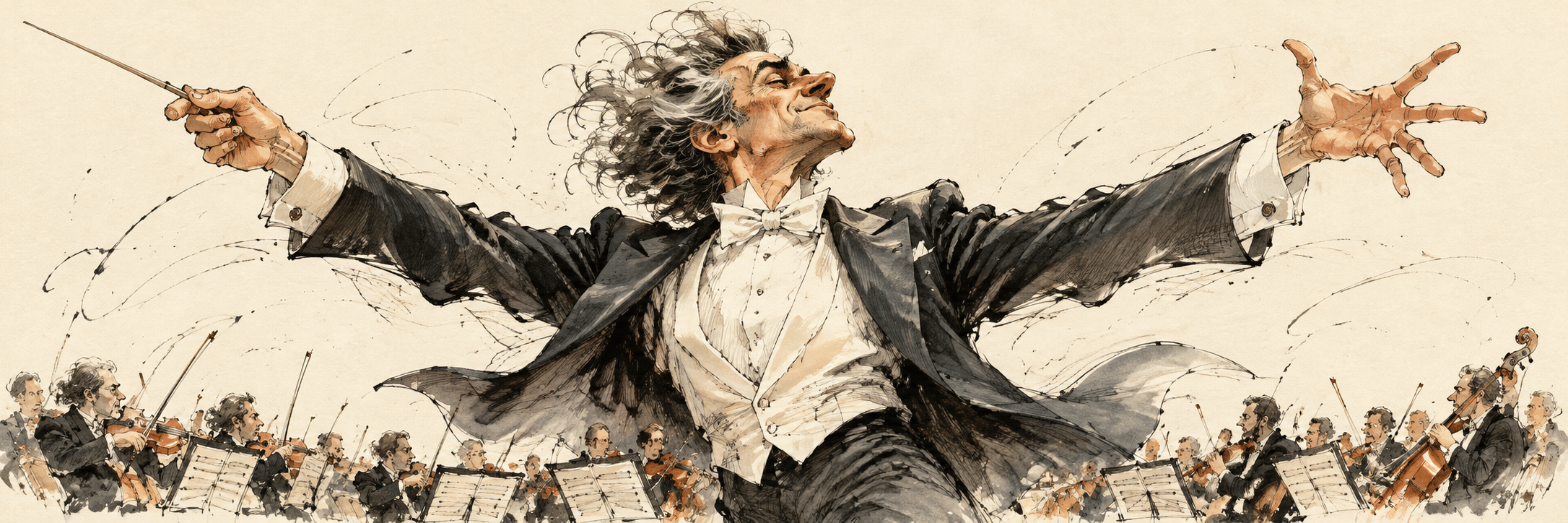
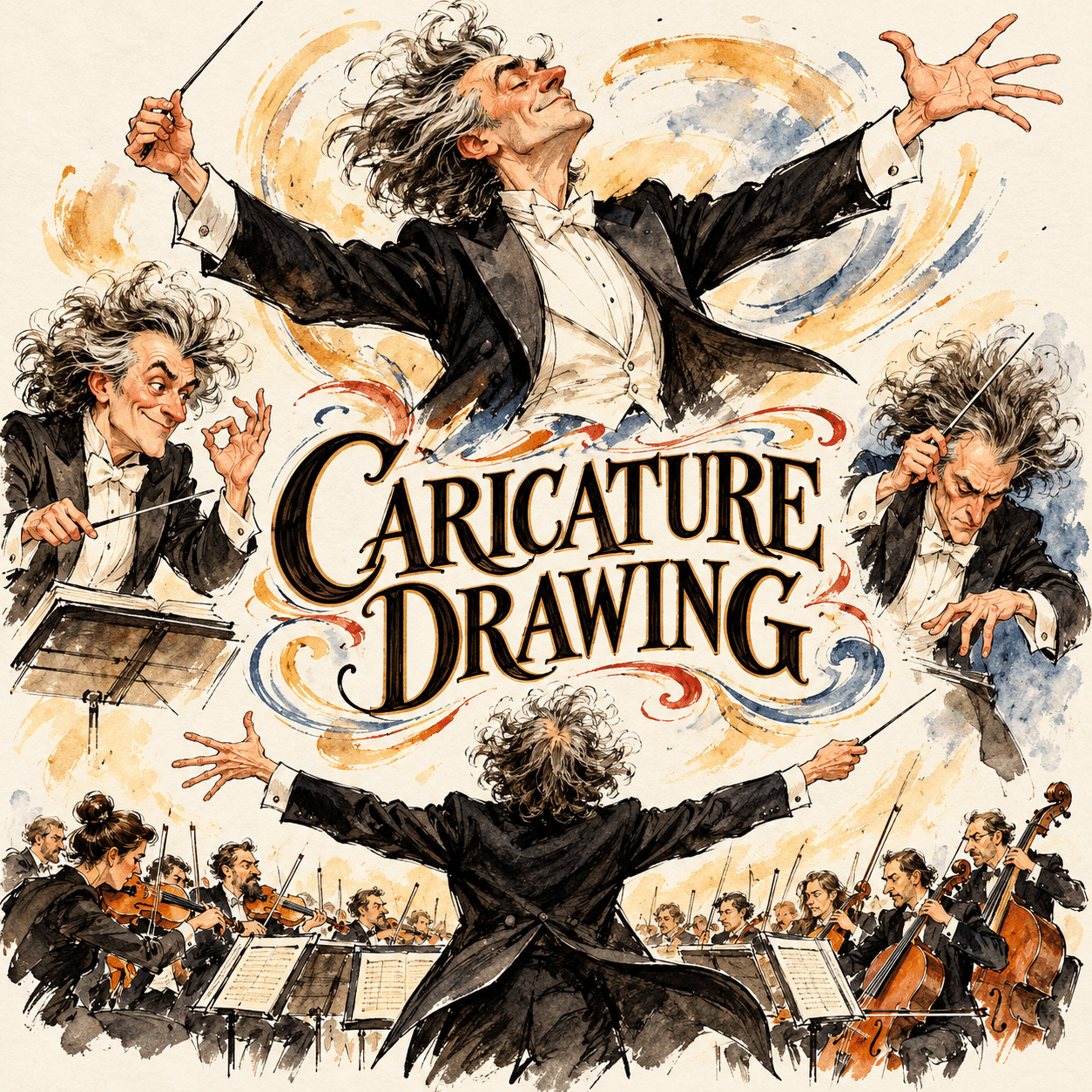
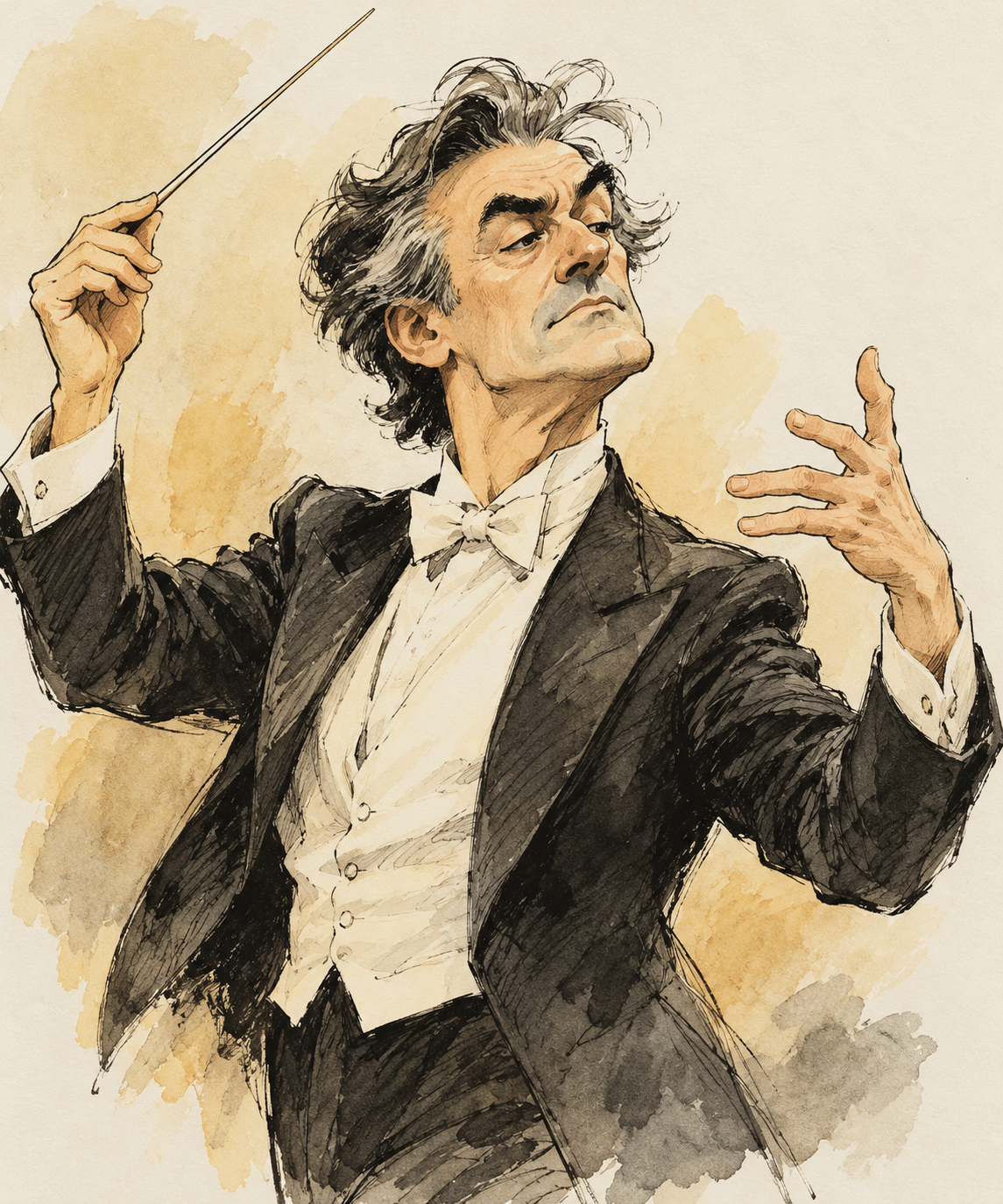
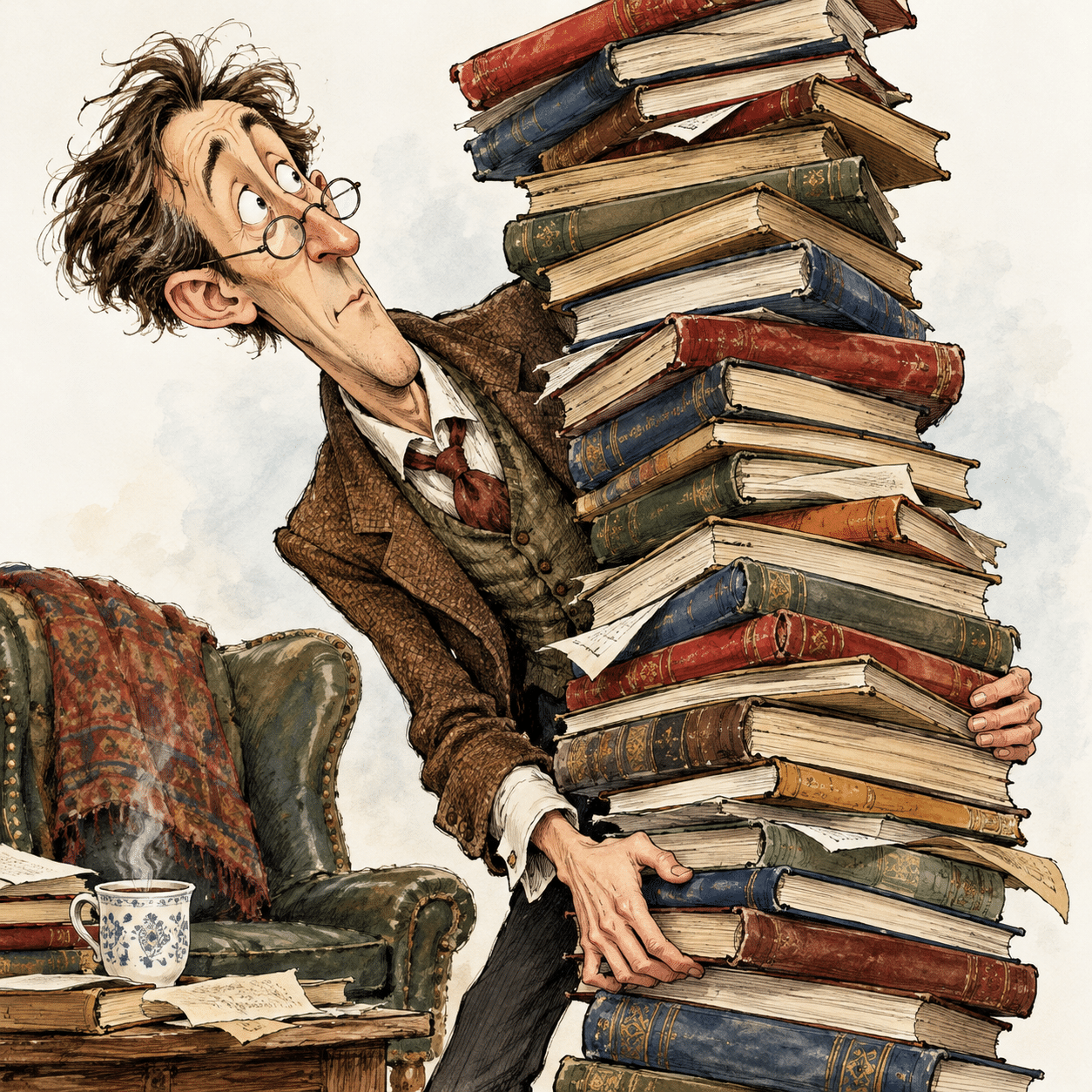
The new examples use invented adults: a conductor whose gesture seems larger than the performance, a reader surrounded by a precarious pile of books, and a gardener negotiating an oversized plant. They explore professional absorption, scale and posture without pretending to portray actual public figures.
All are AI-generated interpretive drawings. They demonstrate possible compositions, not a measured likeness exercise. For caricature of a real sitter, compare the drawing with observed references and consider how the exaggeration changes its meaning. Avoid using a generic stereotype in place of attention to the individual.
A practical exaggeration ladder
Make three small versions of the same invented character: nearly natural, moderately exaggerated and strongly exaggerated. Keep the expression and action consistent. Compare which version communicates the idea most clearly rather than assuming that the most distorted one is automatically best.
Then remove one prop and several internal lines. If the drawing becomes stronger, those details were not carrying the argument. Caricature is a discipline of choosing what to emphasize and what to leave out. Its humour often depends on that economy.
A small poetic detour
Original words from the AOI studio.
Poetry
A Little Larger
One eyebrow rose beyond the plan,
a shoulder carried half the room.
The line removed what mattered least
and left the gesture space to bloom.
A likeness bends, but does not fall:
the smallest truth grows rather tall.
The prompt workshop
Original creative exercises. These prompts create new illustrations, not documentary evidence.
A grand gesture
Create an original caricature of an invented adult conductor with an exaggerated sweeping arm and concentrated expression, small orchestra implied by a few music stands, crisp ink and restrained wash.
The absorbed reader
Draw an invented adult reader with a long expressive face and tiny spectacles, surrounded by an oversized leaning stack of books. Make posture and scale carry the humour, no captions.
One difficult plant
Create an original affectionate caricature of an adult gardener carefully supporting an enormous potted plant, expressive hands and clear silhouette, pen and light watercolor, no lettering.
A smile from the studio
Jokes
The portrait requested realism. The eyebrow had already booked a larger frame.
Sources and further exploration
National Portrait Gallery — definition and historical context of caricature