
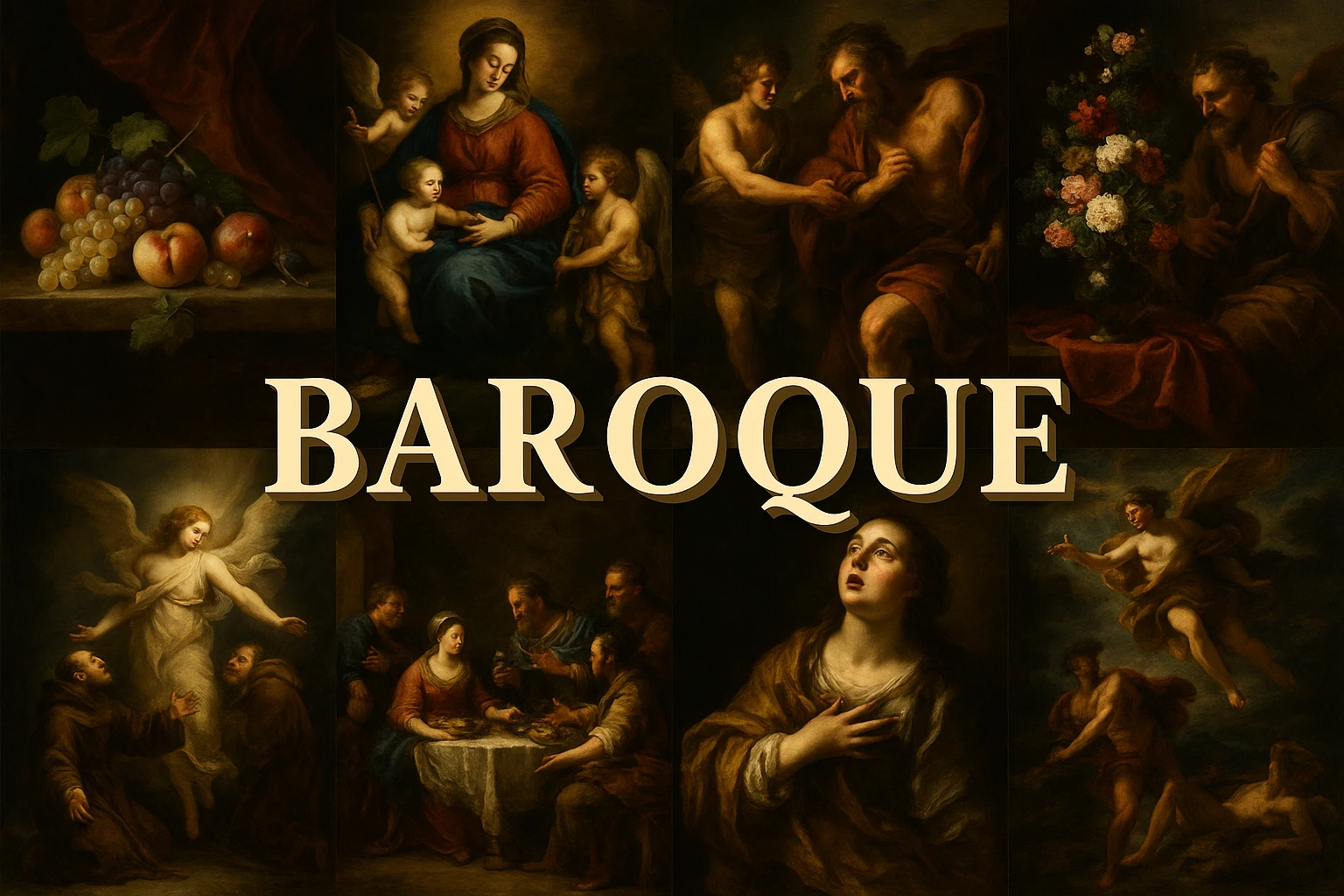
A quick brush with the subject · What catches the eye? · A closer look · Pocket-sized facts · Artists, objects, and paths to explore · The prompt workshop · A small poetic detour · A smile from the studio · Sources and further exploration
A quick brush with the subject
Baroque art knows how to make an entrance: a hand breaks into the light, a figure turns, a room seems to open beyond its walls. Yet spectacle is only part of the story. To understand the work, ask who commissioned it, what it was meant to do, and how it positions you as a viewer.
What catches the eye?
Look for a directed movement of attention: contrasts of light and shadow, diagonals, turns of the body, and gestures that suggest an action still unfolding. Decoration can be lavish, but a tightly framed figure against darkness can be just as compelling. These are useful clues, not a checklist that every work must satisfy.
A closer look
Baroque is a historical term for art, architecture and design that flourished in the seventeenth and early eighteenth centuries. The V&A traces its beginnings to Italy and emphasizes the way painting, sculpture and architecture could work together to address the senses. Churches and courts used that coordinated effect to persuade and impress. The term therefore describes more than an ornate surface: it can describe a relationship between an artwork, its setting and its audience.
Consider Caravaggio's The Supper at Emmaus, painted in 1601. The National Gallery identifies the scene as the moment when two disciples recognize the resurrected Christ during a meal. Their surprise takes physical form: a chair is about to be left behind and arms spread outward. Strong lighting makes the ordinary table setting feel urgent. The painting offers a clear way to study drama without confusing it with decorative excess. Follow the gestures and notice how they carry the story toward the edge of the canvas.
Artemisia Gentileschi's Self Portrait as Saint Catherine of Alexandria, about 1615–17, creates intensity on a smaller scale. The National Gallery identifies the broken spiked wheel and palm as the saint's attributes. Gentileschi uses her own likeness, a close crop and a direct gaze. Looking carefully matters here: the image is both a self-portrait and a portrayal of a saint. Its controlled concentration is more revealing than a blanket description such as grand or extravagant.
The label also needs geographical care. The V&A describes how Baroque forms travelled through trade, missionary activity and colonial expansion, changing with local materials and purposes. A single European model cannot explain every result. When comparing objects, keep their locations and makers visible rather than treating the word Baroque as a substitute for their histories.
Try a simple viewing exercise. First trace the strongest diagonal with your eyes. Then find the brightest area and ask whether it marks the main action or distracts from it. Finally imagine the object in its original setting: close to a private viewer, high on an altar, or part of an architectural ensemble. These questions turn a vague impression of drama into something you can describe and test against the work. The illustration on this page is an AOI experiment, not evidence for a historical attribution.
Pocket-sized facts
Period: broadly the seventeenth and first half of the eighteenth century; dates and forms vary by place and medium.
Baroque is not a synonym for Impressionism or Modernism, and a list of Renaissance masterpieces does not establish Baroque examples.
Chiaroscuro describes the handling of light and dark. In Caravaggio's Supper at Emmaus it supports the dramatic moment; it does not by itself identify an artist or date.
Artists, objects, and paths to explore
Caravaggio — The Supper at Emmaus, 1601, oil on canvas. National Gallery, London, NG172. Study the relationship between light, outstretched arms and recognition.
Artemisia Gentileschi — Self Portrait as Saint Catherine of Alexandria, about 1615–17, oil on canvas. National Gallery, London, NG6671. Compare the direct gaze with the tightly cropped wheel and arm.
The prompt workshop
Creative corner: original AOI material, not historical evidence.
An invented studio scene: a musician pauses just before playing, one hand raised, warm side light against a dark background, a diagonal sweep of red cloth. Organize the drama around a single gesture rather than filling every surface with ornament. No copied painting or historical attribution.
A fictional architectural interior in which a painted ceiling, carved figures and a curved doorway lead the eye toward one bright opening. Describe the viewing position and the direction of light. Present the result as a contemporary Baroque-inspired experiment.
A small poetic detour
Creative corner: original AOI material, not historical evidence.
One hand finds the light.
The curtain keeps its secret;
Stillness takes a bow.
A smile from the studio
Creative corner: original AOI material, not historical evidence.
The painter asked for a little drama. The curtain arrived with its own spotlight.
Sources and further exploration
V&A — The Baroque style: period, settings and international circulation
National Gallery — Caravaggio, The Supper at Emmaus
National Gallery — Artemisia Gentileschi, Self Portrait as Saint Catherine of Alexandria
Creative studies to try
Explore these collected prompts as creative interpretations. They are starting points for image-making, not reproductions of historical artworks or evidence about a tradition.
Visual cues: deep shadow, directional light, dramatic contrast
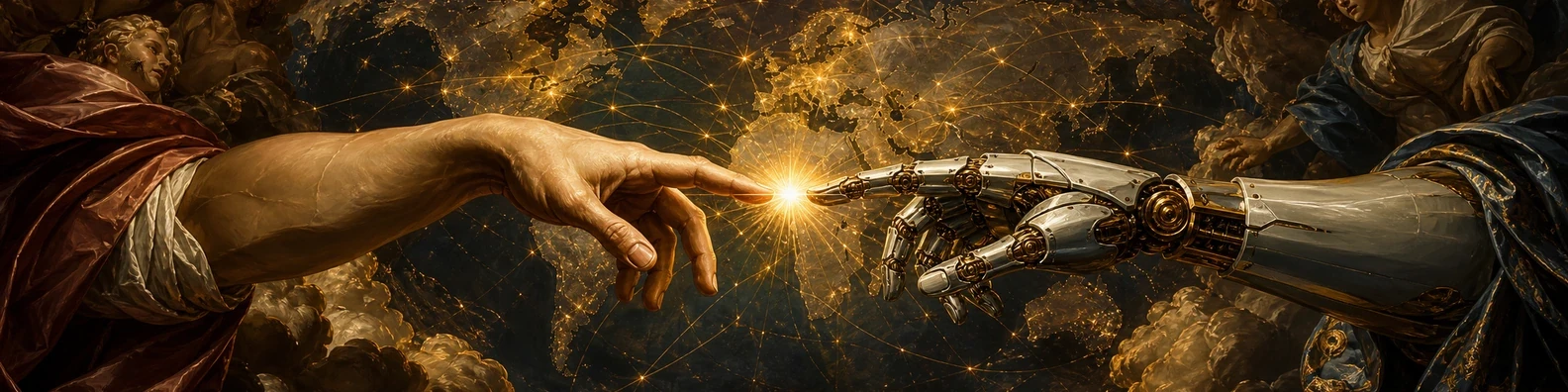
Study 1 — Baroque
Ultra-wide panoramic banner, a human hand and a sleek robotic hand reaching toward each other, fingertips almost touching, a bright luminous spark of intelligence between them, a subtle world map behind them with global data network lines, symbolizing human-AI collaboration and digital transformation, rendered in Baroque style, with dramatic gesture, refined anatomy, theatrical lighting, rich painterly depth, high quality, high detail, balanced composition, no text, no logo, no watermark, exact aspect ratio 1584:396
Prompt source: 1001 Art Styles. Select the text to copy, then adapt the subject and composition.