
Painting movement
Australian Tonalism builds a convincing world from carefully judged masses of light and dark. Explore its Melbourne context, restrained colour, lost edges and quiet spatial depth.
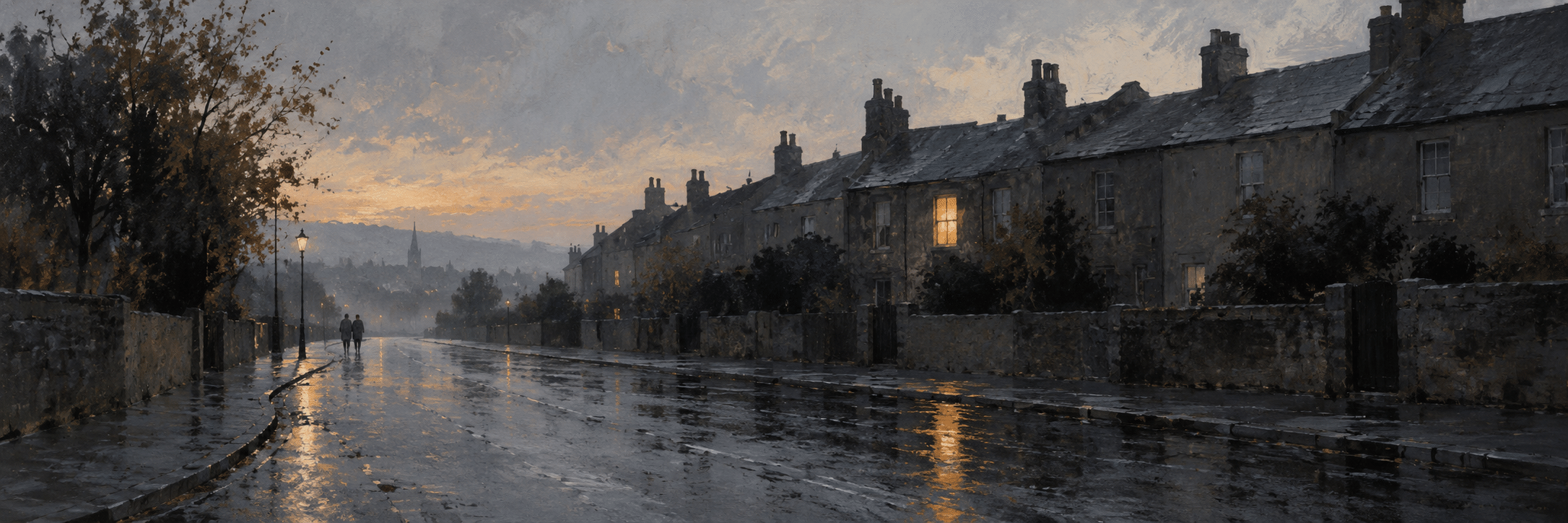
A visual introduction
Select an image for a closer look. Use the thumbnails, arrow keys or a swipe to compare examples. Zoom in to inspect details, or share the image that inspires you.
Creative toolbox · take this style further
Choose an input and a destination. Search sends your words to the chosen site; Copy & open puts them on your clipboard to paste there.
Create with AI
Turn your chosen input into an image prompt or a new creative direction.
ChatGPT
Copy your input and paste it into a ChatGPT conversation or image request.
Copy & open ChatGPT (new tab)Claude · Anthropic
Develop an image prompt or explore the style in a new Claude conversation.
Copy & open Claude · Anthropic (new tab)Midjourney
Paste your input into the Imagine bar on the Create page.
Copy & open Midjourney (new tab)Adobe Firefly
Copy your input, open Firefly, and paste it into the prompt field.
Copy & open Adobe Firefly (new tab)Leonardo.Ai
Copy your input, open Leonardo, and paste it into the generation field.
Copy & open Leonardo.Ai (new tab)Image search
Find visual references. Short, concrete keywords usually work best.
Lexica
Search AI images and prompts using your selected input.
Search with this input Lexica (new tab)Pexels
Search the photo and video library. Short keywords often work best.
Search with this input Pexels (new tab)Pixabay
Search photos, illustrations and other images.
Search with this input Pixabay (new tab)Unsplash
Search photographs using the style name or your own keywords.
Search with this input Unsplash (new tab)Wikimedia Commons
Search photographs, artworks and historical images. Check each file for its source and reuse terms.
Search with this input Wikimedia Commons (new tab)Art & research
Explore artists, collections and the ideas behind a style.
Wikipedia
Search for background reading. A style may not have its own article.
Search with this input Wikipedia (new tab)WikiArt
Copy your input into WikiArt’s search to explore artists and artworks.
Copy & open WikiArt (new tab)Europeana
Paste your keywords into the search to explore European museum, library and archive collections.
Copy & open Europeana (new tab)Inspiration
Discover portfolios and visual ideas from creative communities.
Instagram hashtags
Search a hashtag made from your input: spaces and punctuation are removed. Instagram may require sign-in.
Search with this input Instagram hashtags (new tab)ArtStation
Paste your input into artwork search for concept art, environments, characters and visual development.
Copy & open ArtStation (new tab)Behance
Paste your input into project search for illustration, design and visual storytelling.
Copy & open Behance (new tab)A closer look
Broad tonal masses; softened transitions; selective sharp accents; subdued warm and cool greys; figures and objects emerging from atmosphere.
A way of seeing before a surface effect
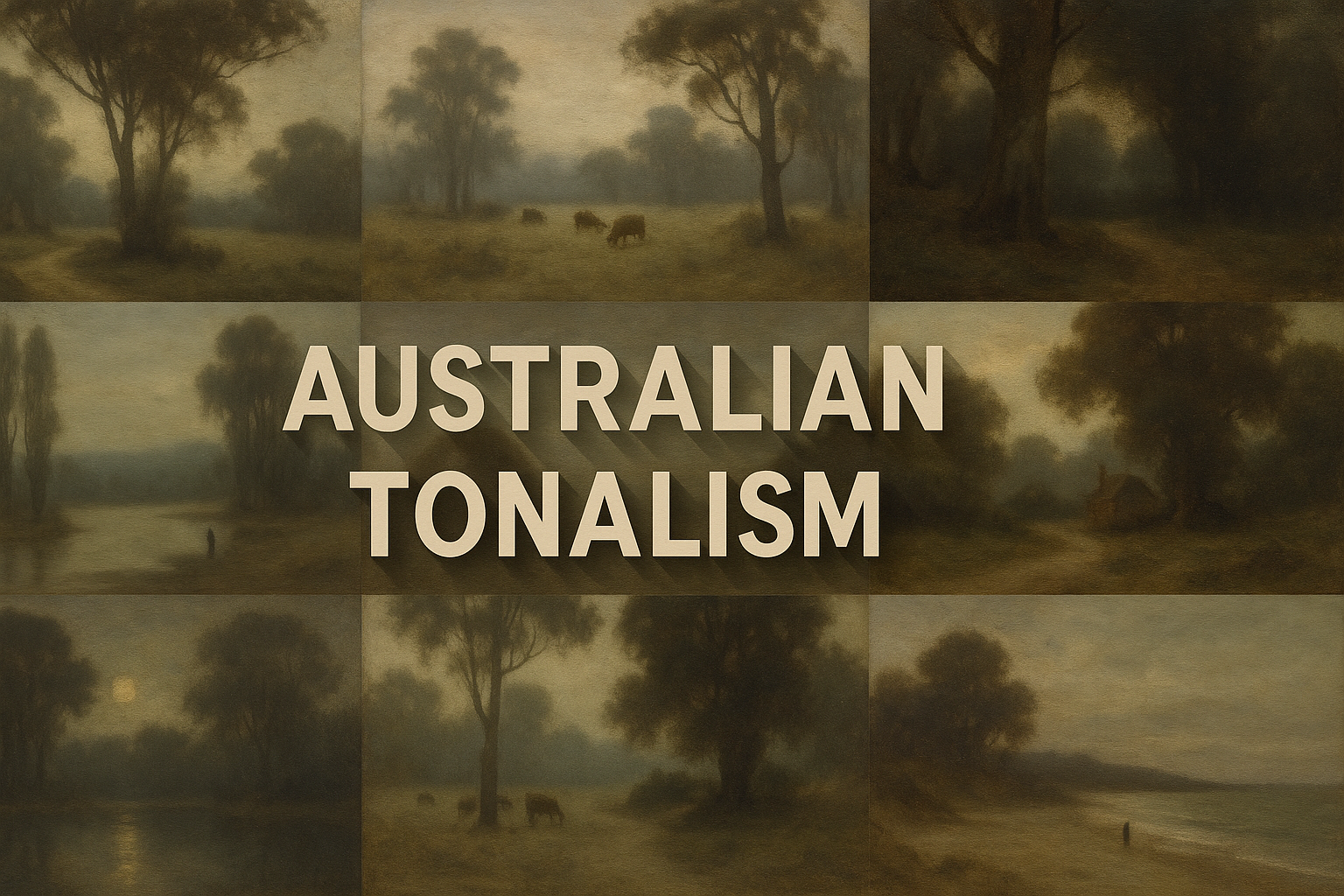
Australian Tonalism is a painting approach associated with Max Meldrum and his students and followers. It organizes the visible scene through relationships of tone: how light or dark one area appears beside another. The apparent simplicity of a misty street or dark still life can conceal very exact judgments. Blur alone does not produce tonal structure. A convincing painting still tells the eye where the ground ends, where an object turns and how far away a light is.
The National Gallery of Victoria records Meldrum establishing his Melbourne school in 1916 and identifies the influence of his teaching on artists including Clarice Beckett, Colin Colahan and others. Museum accounts describe a method concerned with tonal impressions rather than elaborate preliminary outlines. This Australian movement should be distinguished from the broader use of tonal harmony in painting and from American Tonalism; related atmospheric effects do not make their histories interchangeable.
How the image holds together
Begin by grouping the scene into a few large value families. A dusk sky may be one pale mass, the road a middle value and the buildings a connected dark. Small variations belong inside these groups. If every window, leaf and reflection receives equal contrast, the scene loses the hierarchy that made it legible.
Edges are a second organizing instrument. Let a coat merge briefly with a doorway, then recover its shoulder against a lighter wall. This lost-and-found contour makes the figure belong to the same light as its surroundings. Reserve the sharpest edge or brightest small note for the point of attention. Atmospheric softness should be selective: an entire picture softened identically resembles an unfocused photograph.
Colour, subjects and practical decisions
A restrained palette can include warm earth colours, greyed blues, subdued greens and small luminous accents. Low saturation does not mean colourlessness. Compare a violet-grey shadow with a green-grey sky or an amber lamp with a cool road; these temperature differences can carry the image without breaking its tonal unity.
Streets, beaches and parks are familiar subjects, but portraits, interiors and still lifes reveal the same principles. Choose a motif with a clear lighting situation and readable big shapes. In a digital interpretation, establish the value structure before adding texture; avoid using a fog filter to conceal unresolved drawing. On a small screen, the picture should still read as a few deliberate masses.
Reading these studies
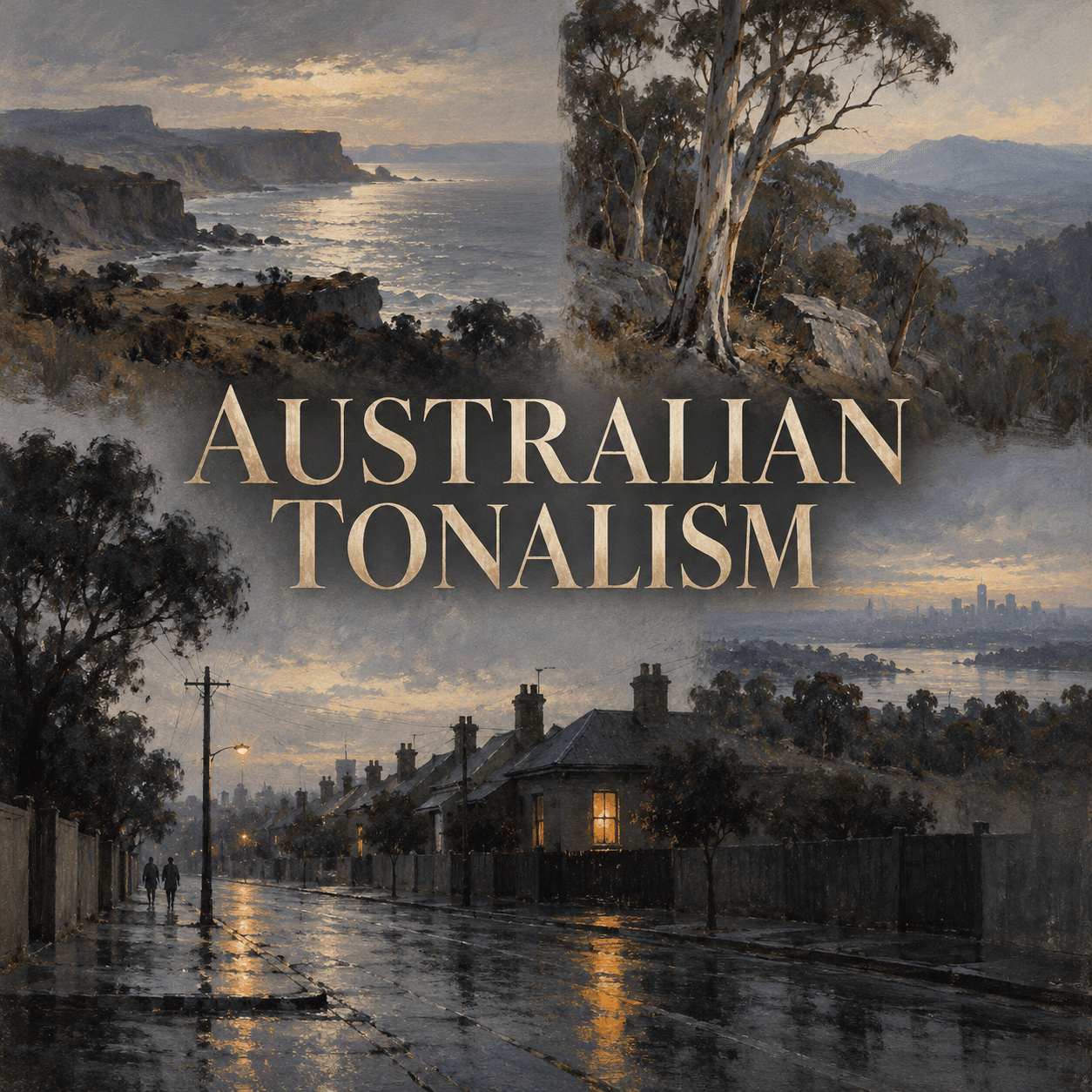
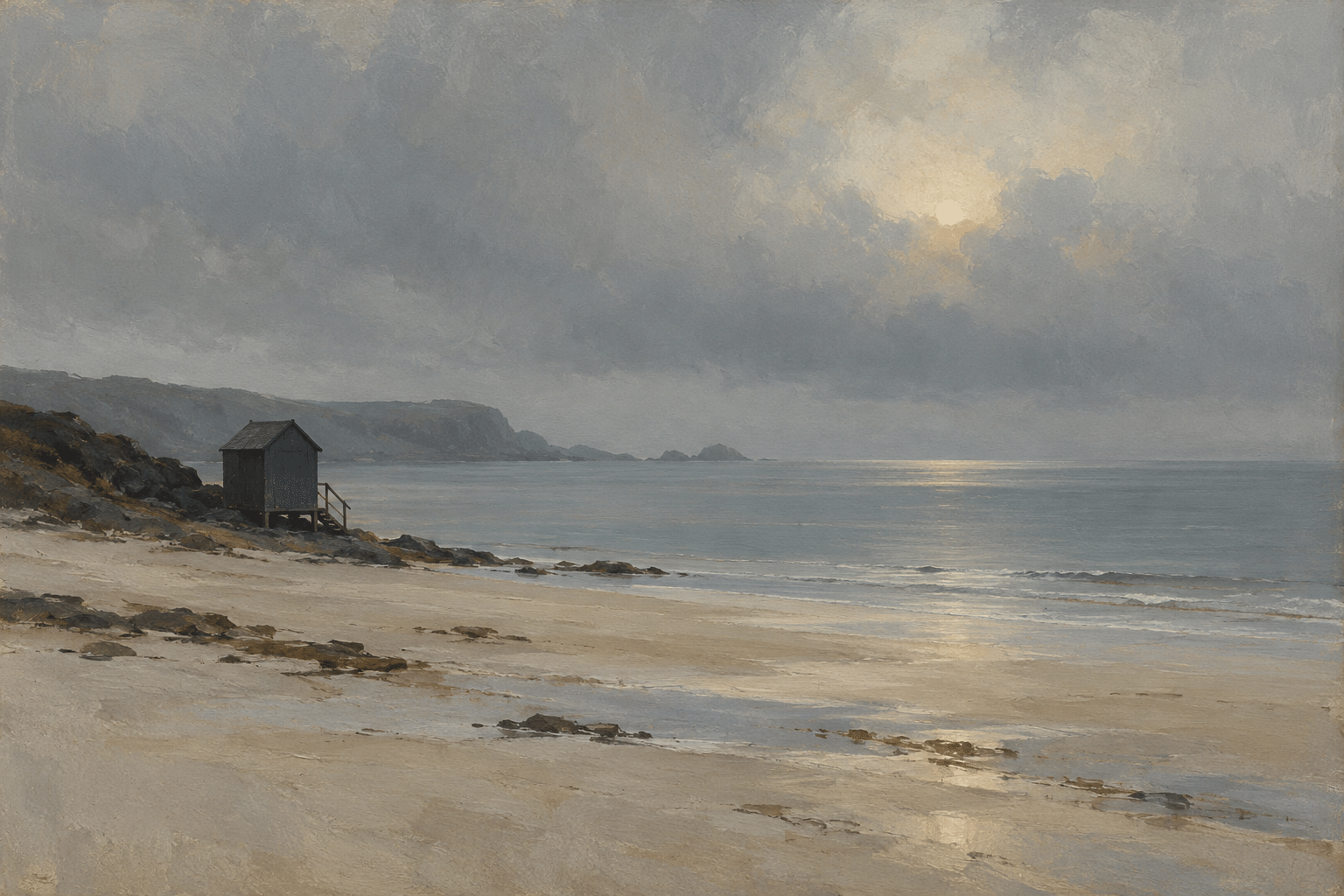
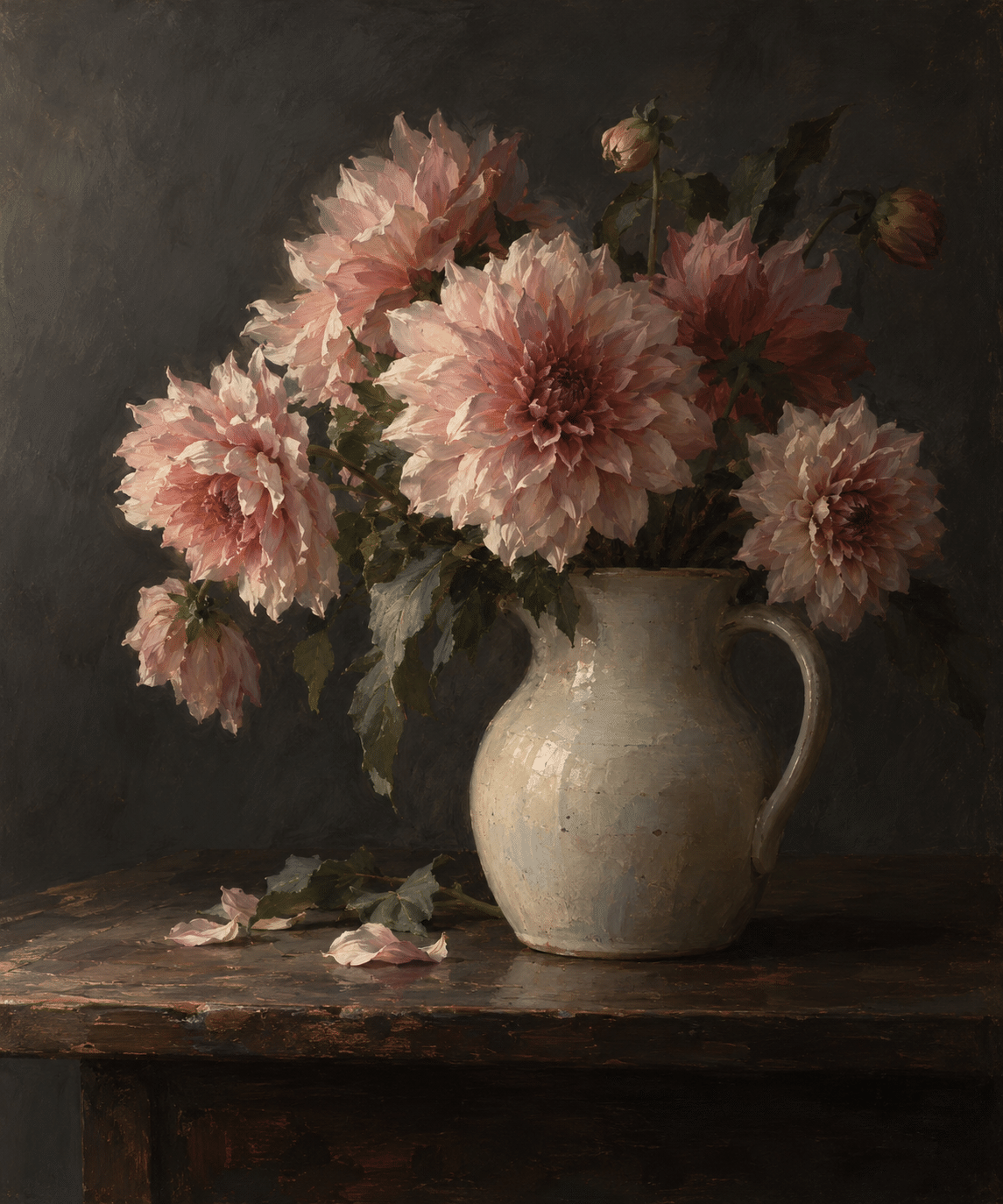
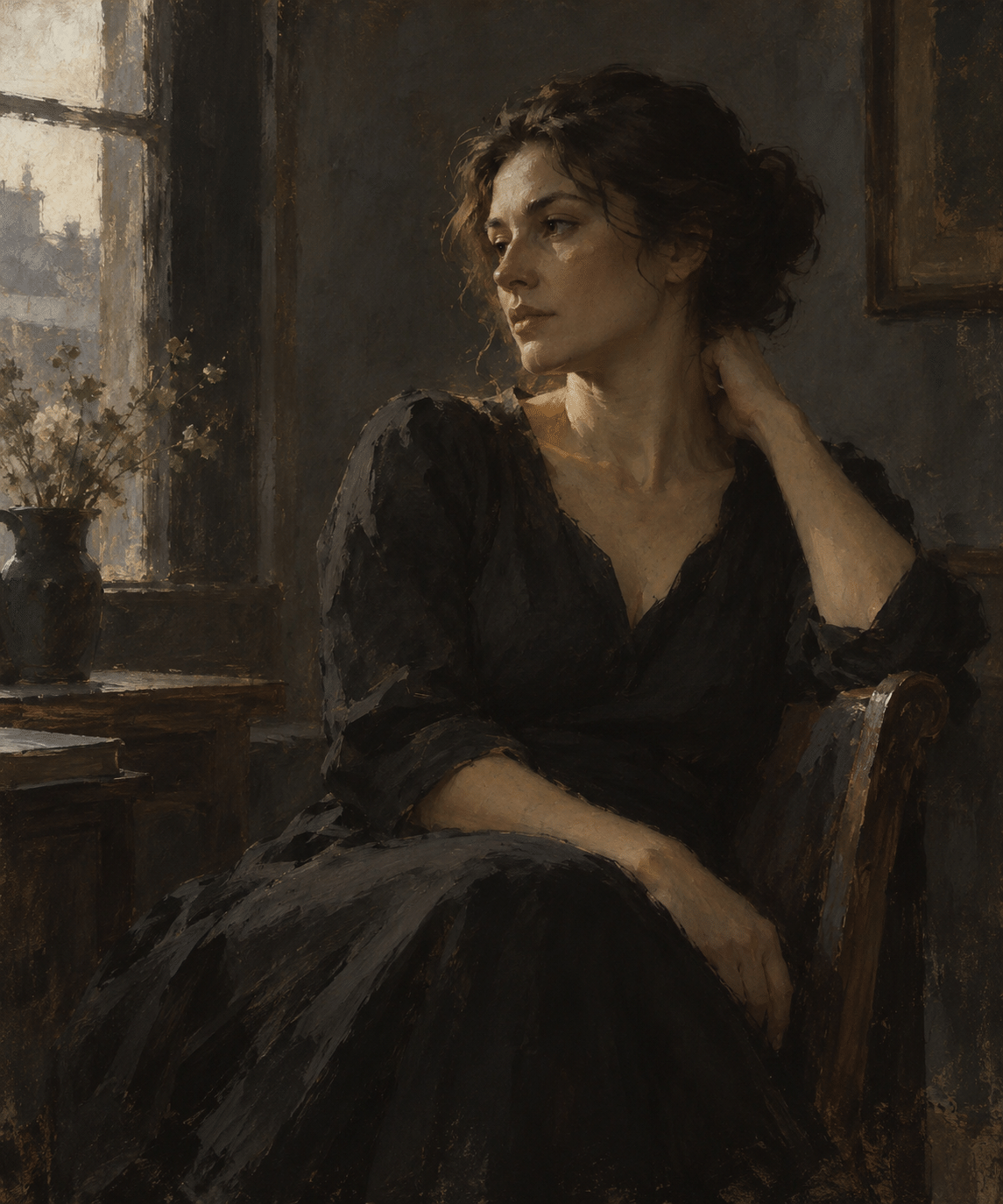
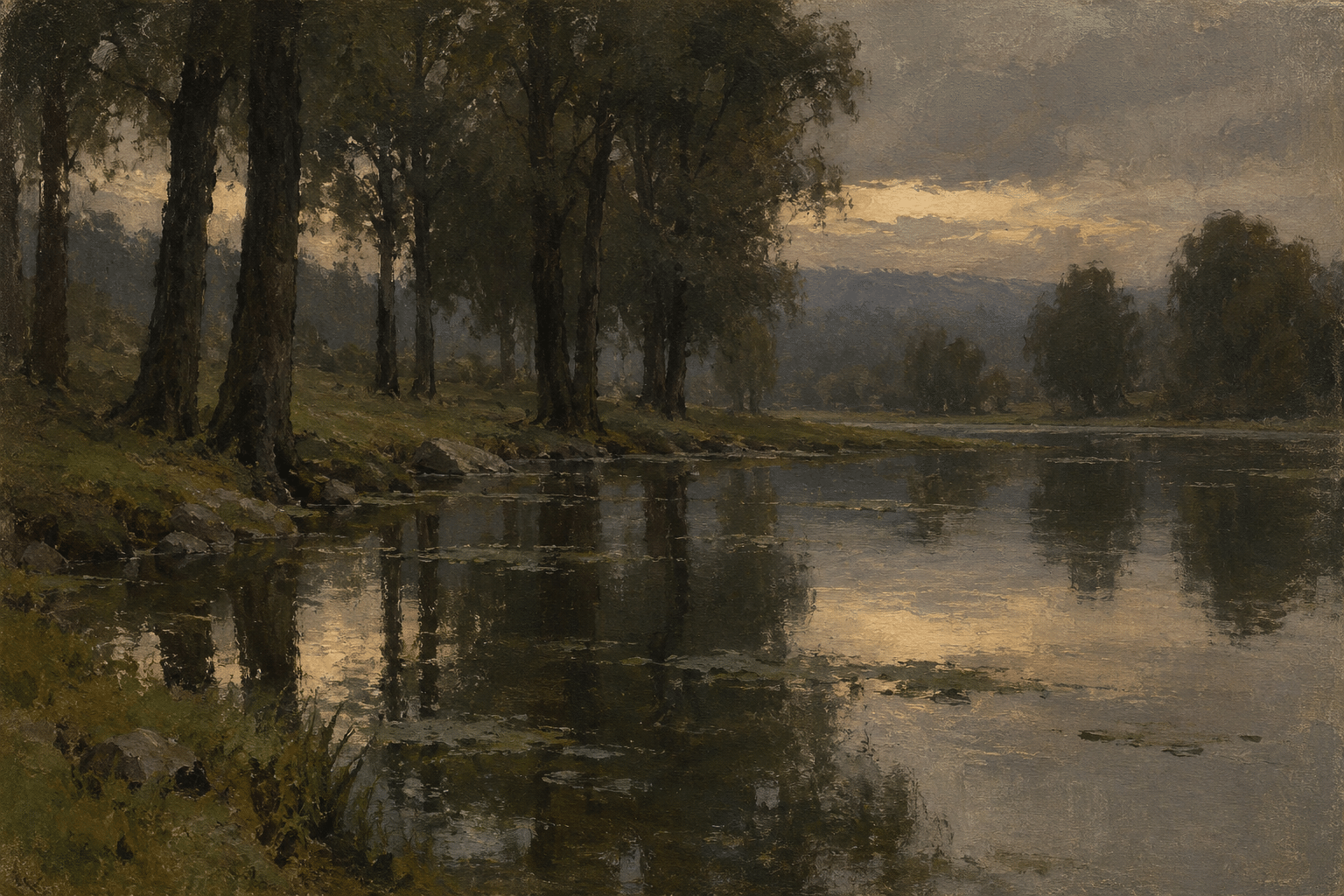
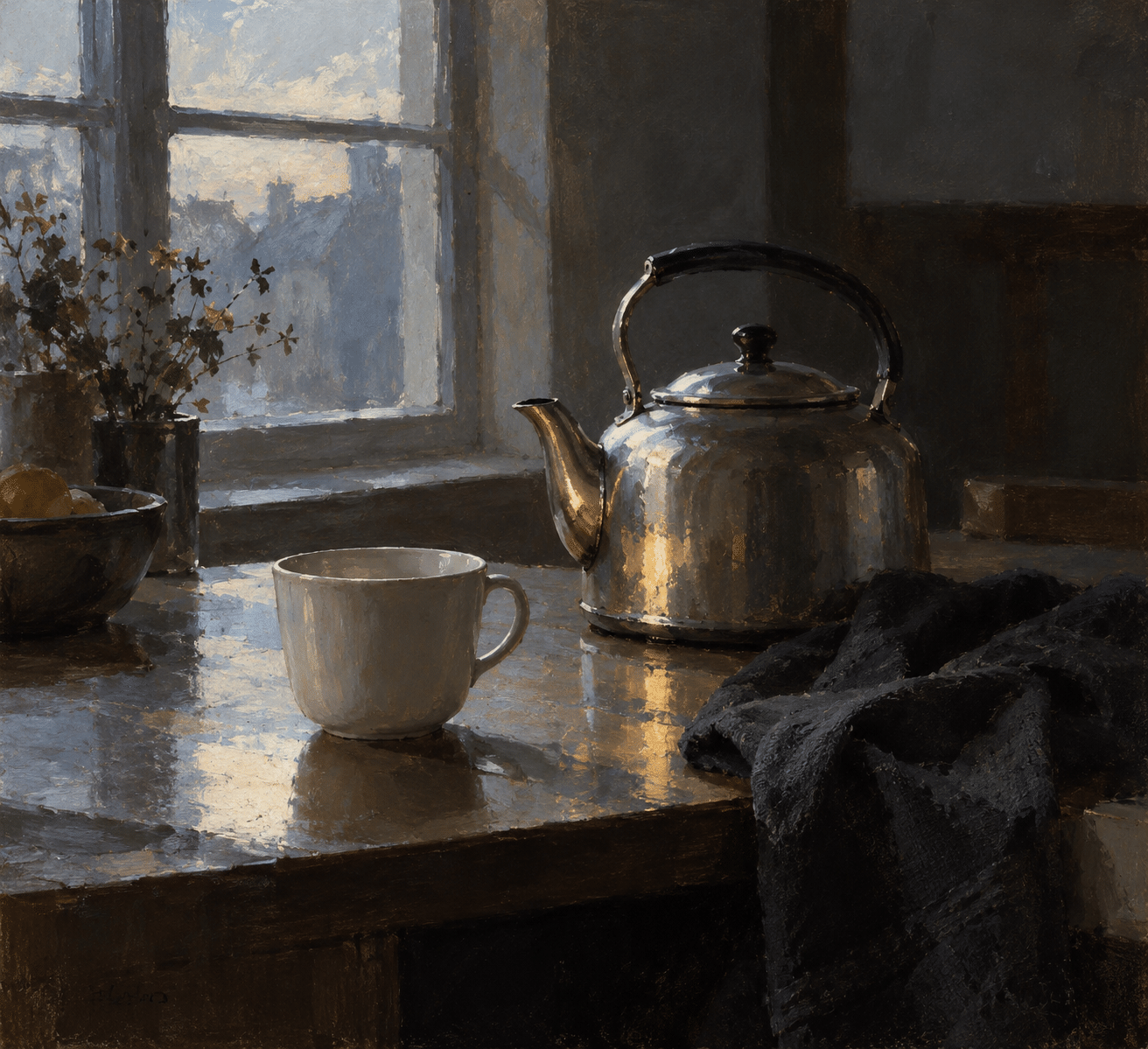
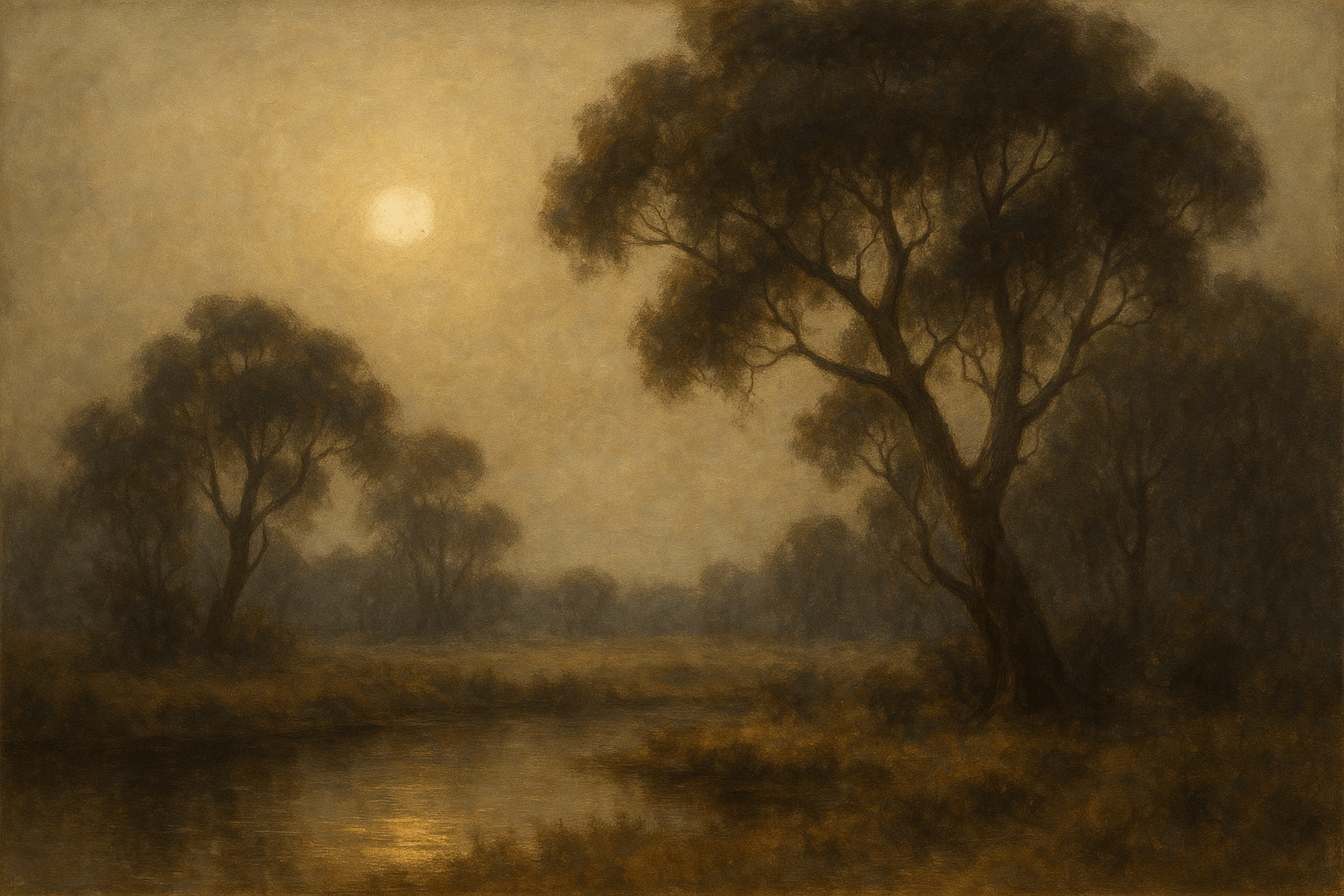
The new gallery explores a wet street, a coastal shelter, a flower still life, an interior portrait and trees beside water. These are original AI-generated interpretations of tonal relationships, not works by Meldrum or Beckett, historical documents or evidence of a particular physical paint process. The variations test whether the method survives changes of subject rather than repeating a single misty-road formula.
A useful exercise is to compare each image at thumbnail size and then enlarged. Which dark shape anchors it? Which edge becomes decisive? Which apparently minor warm or cool note changes the mood? Related approaches include landscape painting, atmospheric perspective and Impressionism, but the emphasis here is on mass relationships rather than a uniform vocabulary of broken colour.
Positive editorial assessment — AI-authored
At its strongest, Australian Tonalism makes modest subjects feel spatially complete. A few controlled differences between road, sky and building can evoke damp air more persuasively than a catalogue of details. Its restraint rewards sustained looking: an almost lost reflection or warm window can carry an entire composition.
Critical editorial assessment — AI-authored
The main weakness of a superficial imitation is indiscriminate softness. Grey paint and fog can become a mood preset that obscures weak design. Strengthen such an image by clarifying its largest values, varying edge firmness and choosing one consequential accent. Quietness is a compositional achievement, not an excuse for an unresolved image.
Neutral editorial assessment — AI-authored
This approach suits intimate landscapes, low-light streets, still lifes and portraits where atmosphere matters more than descriptive inventory. It is less suited to tasks requiring precise technical information or many equally readable objects. Historical understanding benefits from comparing several artists rather than treating Meldrum’s teaching as a single compulsory appearance.
A small poetic detour
Original words from the AOI studio.
Poetry
The road keeps what the evening lends,
a pale seam under passing feet.
A window warms; its small light bends
across the rain and leaves the street.
No leaf insists upon its name,
no doorway asks to be explained.
The distances are not the same—
they deepen where the light is restrained.
The prompt workshop
Original creative exercises. These prompts create new illustrations, not documentary evidence.
First tonal study
Create an original painting interpretation of a quiet coastal shelter at dusk: three large tonal masses, cool grey water, warm grey sand, one dark roof, selective lost edges and one small clear highlight. No signature or historical attribution.
A more complex scene
Paint an imagined rain-darkened suburban street with two distant pedestrians, a broad pale sky and a single amber shop window. Group buildings into one connected dark, keep reflections subordinate, and use sharp edges only near the focal area. Restrained colour, convincing depth, no uniform blur.
Experimental variation
Apply tonal-mass thinking to a contemporary kitchen still life: a metal kettle, white cup and dark folded cloth. Use temperature shifts inside close values, let one edge disappear, and build depth without detailed outlines. Original digital study, no simulated artist signature.
Your next inspiration
Discover another art style
Follow a visual thread to the next subject.

Hudson River School: Landscape, Light and the Composed View
Compare two different histories of landscape painting.
A smile from the studio
Jokes
The painter removed seventeen unnecessary details. The eighteenth was still arguing that it was the subject.