
Art history · individual practices and the limits of a style label
Art Brut concerns the circumstances and independence of artistic creation as well as the appearance of the resulting work. It cannot be reduced to rough drawing, unusual faces or dense patterns. To encounter it seriously is to pay attention to particular makers, their materials and their sustained imaginative worlds.
Creative toolbox · take this style further
Choose an input, adjust it, then open a tool. Search links pass your text to the destination. Copy & open copies it for you to paste into the generator; you start generation there.
ChatGPT
Copy your input and paste it into a ChatGPT conversation or image request.
Copy & open ChatGPT (new tab)Claude · Anthropic
Develop an image prompt or explore the style in a new Claude conversation.
Copy & open Claude · Anthropic (new tab)Midjourney
Paste your input into the Imagine bar on the Create page.
Copy & open Midjourney (new tab)Adobe Firefly
Copy your input, open Firefly, and paste it into the prompt field.
Copy & open Adobe Firefly (new tab)Leonardo.Ai
Copy your input, open Leonardo, and paste it into the generation field.
Copy & open Leonardo.Ai (new tab)Lexica
Search AI images and prompts using your selected input.
Search with this input Lexica (new tab)Pexels
Search the photo and video library. Short keywords often work best.
Search with this input Pexels (new tab)Pixabay
Search photos, illustrations and other images.
Search with this input Pixabay (new tab)Unsplash
Search photographs using the style name or your own keywords.
Search with this input Unsplash (new tab)Wikipedia
Search for background reading. A style may not have its own article.
Search with this input Wikipedia (new tab)WikiArt
Copy your input into WikiArt’s search to explore artists and artworks.
Copy & open WikiArt (new tab)Instagram hashtags
Search a hashtag made from your input: spaces and punctuation are removed. Instagram may require sign-in.
Search with this input Instagram hashtags (new tab)A closer look
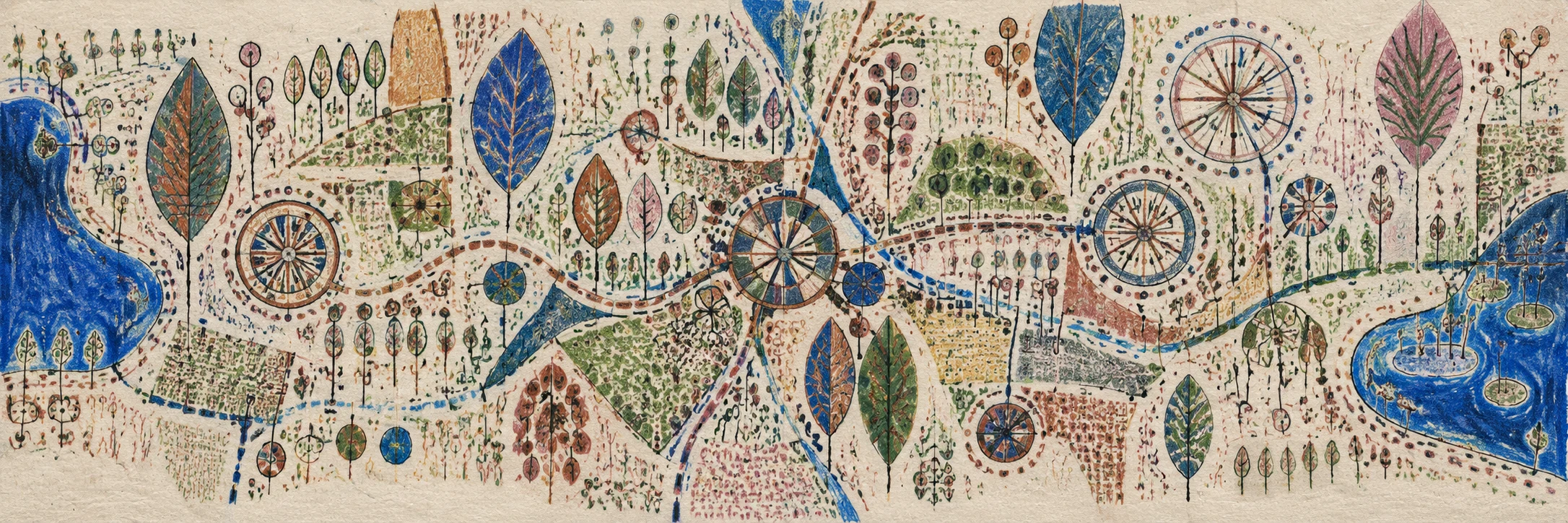
The banner is an AI-generated editorial study of invented marks and recurring forms. It is not an Art Brut work. A commercially trained image model can imitate visual devices, but those devices do not give its output the history or conditions of an individual creator’s practice.
A category built around a difficult question
Jean Dubuffet began collecting and defining Art Brut in 1945. The Collection de l’Art Brut’s history places this project within his search for creation outside established cultural expectations. That account explains the origins of a concept; it does not make every artist in the collection a follower of Dubuffet’s personal painting style. [1]
The central question is not whether a drawing looks professionally polished. It is how a person developed a practice in relation to artistic institutions, conventions and audiences. Those relationships require evidence. They cannot be diagnosed from a jagged line or an unconventional use of colour.
Outsider art is a related term with its own range of uses, rather than a perfectly interchangeable translation for every situation. When discussing a particular maker, use the terminology of the relevant collection or research and explain the context instead of treating a label as a complete biography.
Look at a maker’s decisions before their diagnosis
Aloïse Corbaz offers a concrete point of entry. The Lausanne collection describes her use of supports including wrapping paper, envelopes and calendar backs, sometimes joining paper to obtain larger formats. It also records the personal imagined world she developed. These are specific artistic choices worth examining. [2]
A biography may include institutionalisation or illness, but an artwork is not a visual symptom to decode at a glance. Do not turn a maker’s circumstances into a sensational caption. Attend to how images expand across a support, how motifs recur and how materials enable a particular scale or rhythm.
The same care applies to the word self-taught. It does not mean without skill, memory, influences or disciplined effort. Repetition may embody years of concentrated practice. Apparent freedom from one convention can coexist with demanding rules established by the artist.
Why a generic style recipe fails
Instructions such as draw badly, use childish faces or make it look insane replace individual work with stereotypes. They also miss the formal complexity that close looking can reveal. A dense page may have an elaborate internal hierarchy; an apparently simple object may involve highly inventive construction.
The banner’s repeated wheel and leaf-like forms demonstrate only an editorial exercise in mark-making. Their repetition can be discussed visually, but it provides no evidence of marginality, compulsion or independence from the art world. We deliberately keep that limitation visible in its caption.
If you use an image generator, describe the formal experiment accurately: layered pencil marks, invented symbols, unusual paper joins or a recurring motif. Do not fabricate an artist’s life story to lend the result authenticity. The distinction makes the exercise more useful, not less imaginative.
An exercise in making your own rules
Choose three marks that interest you and one ordinary support. Spend a session developing relationships between them without importing a famous artist’s signature imagery. Keep the working decisions: where you repeat, where you interrupt and when you change the scale. The record of making may teach more than a single polished result.
Next, study one documented maker through a museum source. Compare the questions their practice raises with your own exercise, while keeping the two identities separate. Similar-looking surfaces do not establish similar lives or motivations.
The most generous encounter with Art Brut does not ask every work to confirm a fantasy of pure, effortless creativity. It allows a particular person’s invention to remain particular. Begin with the maker, then give the marks enough time to become more than a label.
A small poetic detour
Original words from the AOI studio.
Poetry
The mark belongs to someone;
leave room for the name.
The prompt workshop
Original creative exercises. These prompts create new illustrations, not documentary evidence.
Describe form honestly
Original editorial mark-making study with layered coloured-pencil traces, recurring invented forms and warm irregular paper; do not present it as authentic Art Brut or imitate a named maker.
Original AOI exercise; a generated image is not historical or documentary evidence.
Develop a personal rule
An invented garden map built from three recurring motifs, varied scale and deliberate interruptions, pencil and ink textures, no diagnostic imagery, no copied artist symbols, no legible text.
Original AOI exercise; a generated image is not historical or documentary evidence.
Compare two systems
Make two original mark studies using the same three invented shapes: one organised by repetition, one by interruption. Discuss their formal differences without inventing a biography or claiming Art Brut provenance.
Original AOI exercise; a generated image is not historical or documentary evidence.
People & works to explore
References discussed in this article. Consult the sources below for context.
Artists and practitioners
Aloïse Corbaz — documented creator
Jean Dubuffet — originator of the category and collector
Paintings and other works
Aloïse Corbaz’s drawings and joined-paper works in the Collection de l’Art Brut
Sources and further exploration
Creative studies to try
Explore these collected prompts as creative interpretations. They are starting points for image-making, not reproductions of historical artworks or evidence about a tradition.
Visual cues: raw sincerity, direct mark-making, deliberate awkwardness
Study 1 — Art Brut
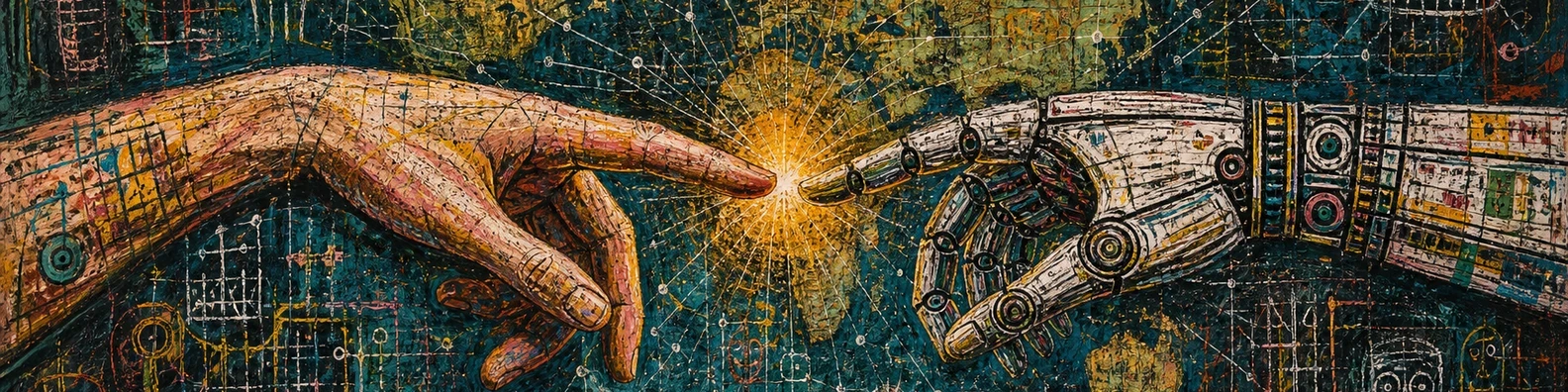
Ultra-wide panoramic banner, a human hand and a sleek robotic hand reaching toward each other, fingertips almost touching, a bright luminous spark of intelligence between them, a subtle world map behind them with global data network lines, symbolizing human-AI collaboration and digital transformation, rendered in Art Brut style, with refined composition, distinctive materials, elegant lighting, high-detail artistic finish, high quality, high detail, balanced composition, no text, no logo, no watermark, exact aspect ratio 1584:396
Prompt source: 1001 Art Styles. Select the text to copy, then adapt the subject and composition.