
Historical artists’ council: Germany, 1918–1921
The Arbeitsrat für Kunst was a reform-minded artists’ council founded in Berlin after the November Revolution of 1918. It argued for public access to art, changes to institutions and cooperation among the arts, with architecture playing a central role.
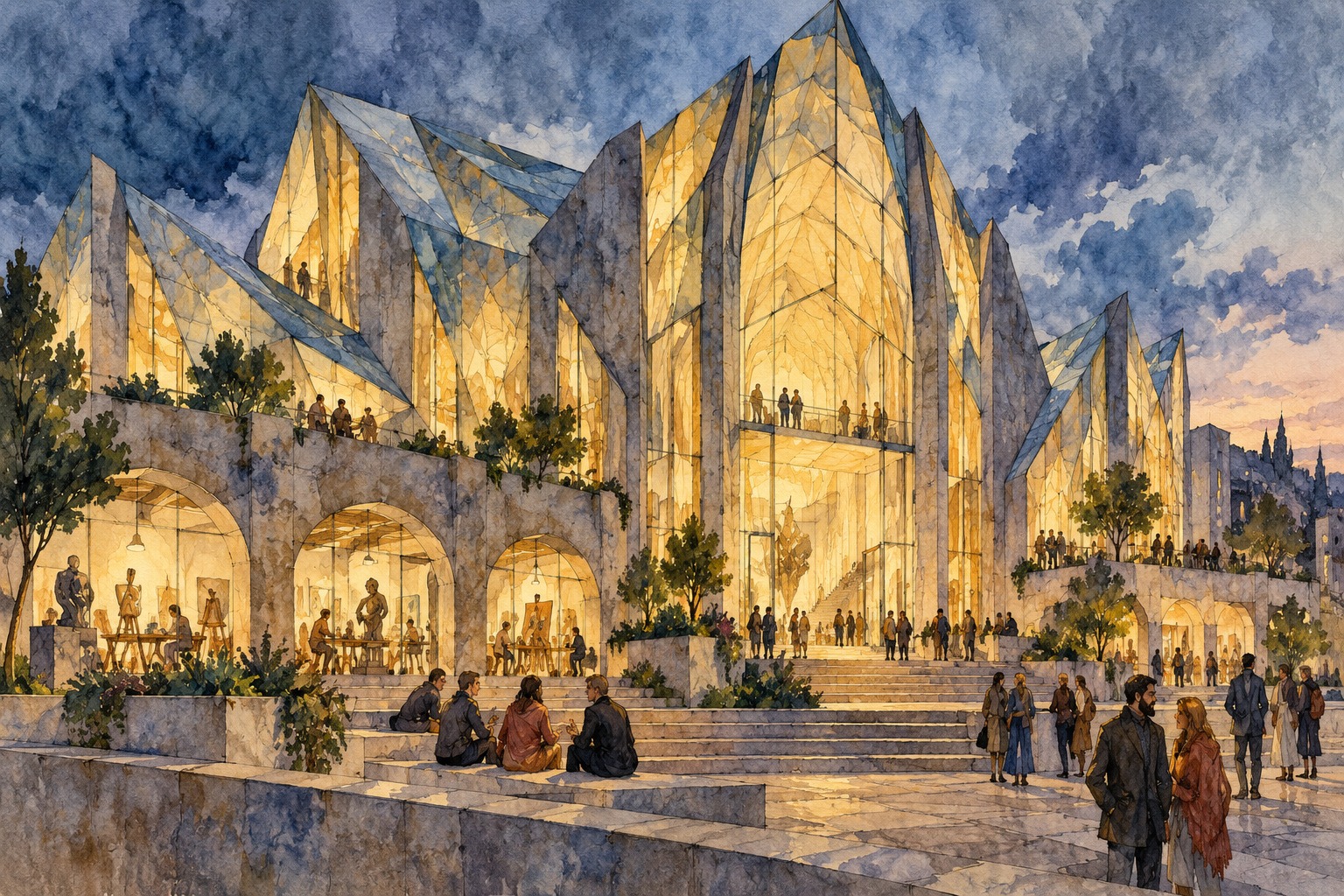
A visual introduction
The gallery uses contemporary illustrations to explore public building, collaboration and access to exhibitions. These images are not recovered council designs or documentary reconstructions. The retained geometric collage is a modern visual summary, not evidence of a single historical house style.
Select an image for a closer look. Use the thumbnails, arrow keys or a swipe to compare examples. Zoom in to inspect details, or share the image that inspires you.

Creative toolbox · take this style further
Choose an input and a destination. Search sends your words to the chosen site; Copy & open puts them on your clipboard to paste there.
Create with AI
Turn your chosen input into an image prompt or a new creative direction.
ChatGPT
Copy your input and paste it into a ChatGPT conversation or image request.
Copy & open ChatGPT (new tab)Claude · Anthropic
Develop an image prompt or explore the style in a new Claude conversation.
Copy & open Claude · Anthropic (new tab)Midjourney
Paste your input into the Imagine bar on the Create page.
Copy & open Midjourney (new tab)Adobe Firefly
Copy your input, open Firefly, and paste it into the prompt field.
Copy & open Adobe Firefly (new tab)Leonardo.Ai
Copy your input, open Leonardo, and paste it into the generation field.
Copy & open Leonardo.Ai (new tab)Image search
Find visual references. Short, concrete keywords usually work best.
Lexica
Search AI images and prompts using your selected input.
Search with this input Lexica (new tab)Pexels
Search the photo and video library. Short keywords often work best.
Search with this input Pexels (new tab)Pixabay
Search photos, illustrations and other images.
Search with this input Pixabay (new tab)Unsplash
Search photographs using the style name or your own keywords.
Search with this input Unsplash (new tab)Wikimedia Commons
Search photographs, artworks and historical images. Check each file for its source and reuse terms.
Search with this input Wikimedia Commons (new tab)Art & research
Explore artists, collections and the ideas behind a style.
Wikipedia
Search for background reading. A style may not have its own article.
Search with this input Wikipedia (new tab)WikiArt
Copy your input into WikiArt’s search to explore artists and artworks.
Copy & open WikiArt (new tab)Europeana
Paste your keywords into the search to explore European museum, library and archive collections.
Copy & open Europeana (new tab)Inspiration
Discover portfolios and visual ideas from creative communities.
Instagram hashtags
Search a hashtag made from your input: spaces and punctuation are removed. Instagram may require sign-in.
Search with this input Instagram hashtags (new tab)ArtStation
Paste your input into artwork search for concept art, environments, characters and visual development.
Copy & open ArtStation (new tab)Behance
Paste your input into project search for illustration, design and visual storytelling.
Copy & open Behance (new tab)A closer look
No single palette or motif defines the council. Expressionist graphics, visionary architecture and collective building provide useful contexts, but a geometric poster alone cannot establish historical affiliation.
A council with a program
The Arbeitsrat für Kunst, or Working Council for the Arts, emerged in Berlin in late 1918 amid the political transformation following the November Revolution. Its name deliberately echoed workers’ and soldiers’ councils. It brought together artists, architects and supporters who wanted changes in how art was taught, administered and encountered by the public. The association existed until 1921.
It is best understood as a reform organization and a network of proposals, not as one uniform painting style. Calling every angular building or red-and-black poster Arbeitsrat art would erase the political and institutional questions that made the council distinctive. Its members could share demands without producing identical images or agreeing on every artistic solution.
What its program demanded
Bruno Taut’s 1918 proclamation, preserved in German History in Documents and Images, calls for art to become more accessible across society and for changes in the state’s relationship with artistic life. It also addresses public building and the removal of monuments judged to lack artistic value. These were arguments about public space and authority, not simply a preference for a fashionable visual vocabulary.
Among the signatories were Walter Gropius, Käthe Kollwitz, Max Pechstein and Bruno Taut. Their presence illustrates the breadth of the coalition. It does not mean that all their works were produced for the council, or that later achievements can be retroactively attributed to it. A responsible caption distinguishes an artist’s membership or support from the provenance of a particular object.
Exhibitions, publications and the Bauhaus connection
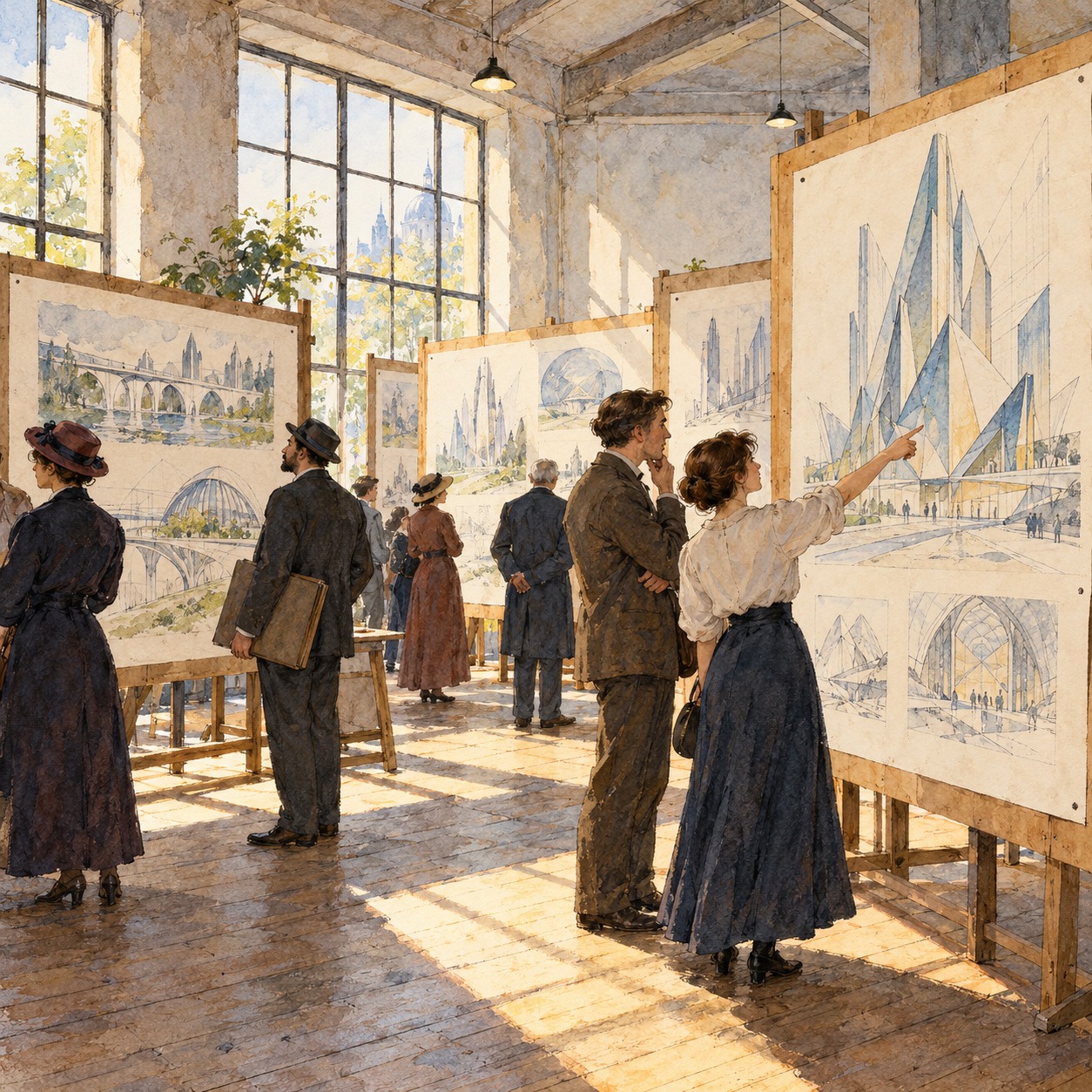
Historian Marcel Bois’s account for Bauhaus Kooperation describes the council’s invitation to unknown architects, including amateurs, to submit drawings and photographs of visionary projects. The resulting exhibition circulated beyond Berlin. This opening toward unfamiliar contributors made participation itself part of the reform project, while architecture offered a place where different arts might meet.
The council published Ja! Stimmen des Arbeitsrats für Kunst in Berlin in 1919 and Ruf zum Bauen in 1920. Bois discusses debates about education, the public, urban design and the union of the arts under architecture. Gropius’s involvement creates an important connection with the early Bauhaus, but the two organizations are not synonyms. Their overlapping people and aspirations should be explained without merging their histories.
How to read the visual material
Look at what an image proposes and whom it addresses. An architectural fantasy may imagine a shared gathering place; a forceful woodcut can make a public appeal; a plan or publication can organize collaboration. Angular silhouettes, rough carved marks and crystalline forms can be relevant to the surrounding Expressionist context, but none functions as a compulsory council trademark.
Palette depends on medium and purpose. Black ink on inexpensive paper favors contrast and reproduction; colored architectural studies can explore atmosphere and imagined materials. When creating an interpretation, choose a concrete problem such as a communal hall, an open exhibition or a workshop joining painting, sculpture and building. The social use of the space should remain visible behind the formal drama.
Using the ideas today without inventing evidence
The gallery contains contemporary generated interpretations, not recovered council posters or photographs of actual projects. Their shared question is how art might enter collective life. Compare them with the linked proclamation and historical research, then ask where an ideal becomes practical and where it remains unresolved. For prompts, specify the proposed public use, medium and relationship among participants. Avoid fabricated historical captions, invented quotations and treating the Bauhaus’s later geometric design as a complete description of this earlier council.
About this guide
This AI-authored AOI guide appears under Penny Wraiter, AOI’s editorial persona. Sources support the historical context; exercises, prompts and poetry are original editorial interpretations. Image captions distinguish generated studies from documented works.
A small poetic detour
Original words from the AOI studio.
Poetry
A wall can keep the street outside,
A doorway ask the street to stay;
A roof can gather, broad and wide,
The many hands that shape a day.
A drawing lifts what is not built,
A printed sheet can cross the square;
The question outlives stone and gilt:
Who gets to make, and who to share?
The prompt workshop
Original creative exercises. These prompts create new illustrations, not documentary evidence.
Imagine a shared building
Contemporary interpretive watercolor of a visionary communal hall in the context of early German Expressionist architecture: faceted luminous roof, broad public steps and small gathering figures. Hand-drawn exploratory lines, no claim to a real historical design, no text.
Make a public appeal visible
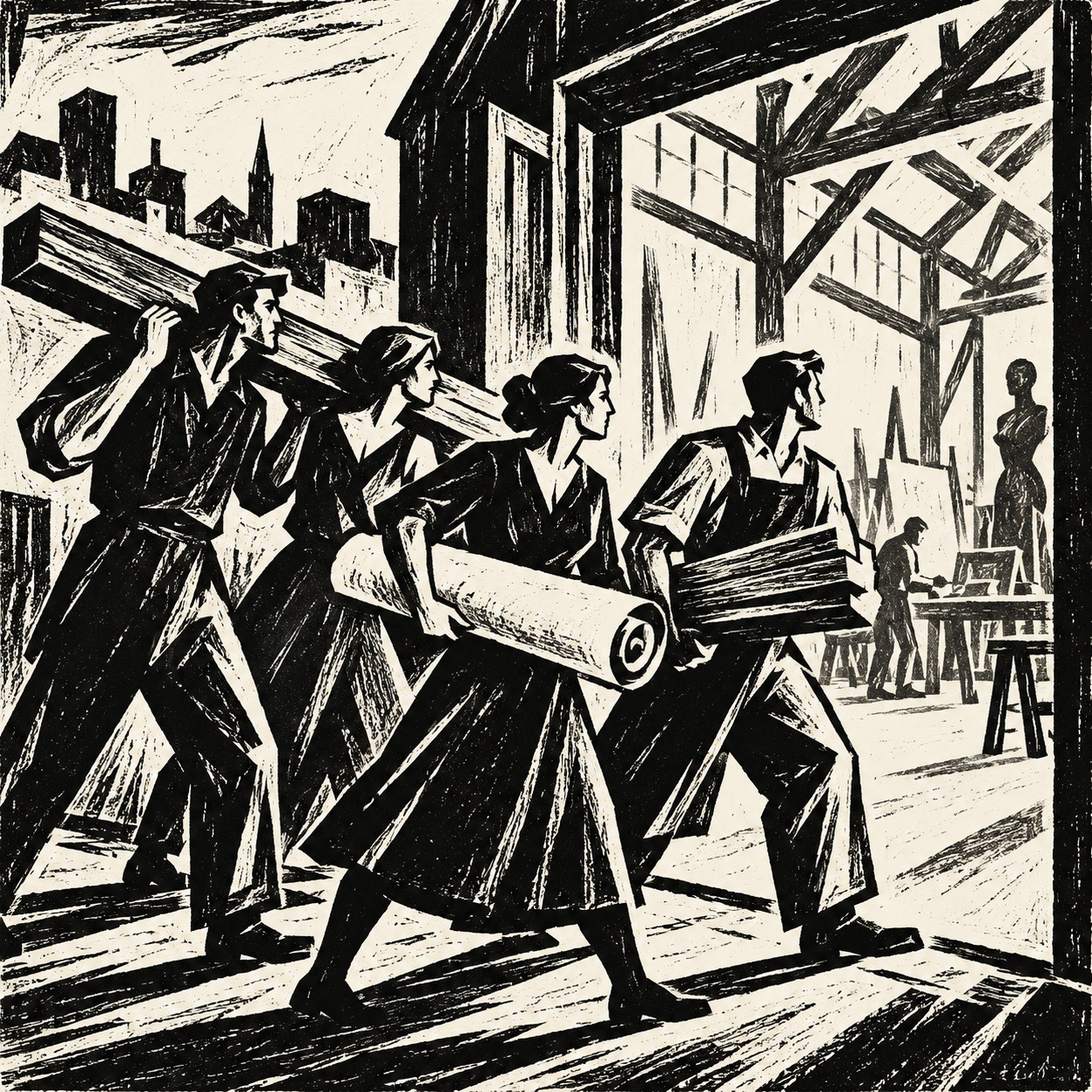
Original black woodcut-like composition of several people carrying building elements toward an open communal workshop. Bold carved marks, cooperative action, generous pale gaps, no slogan or invented historical lettering.
Join the arts
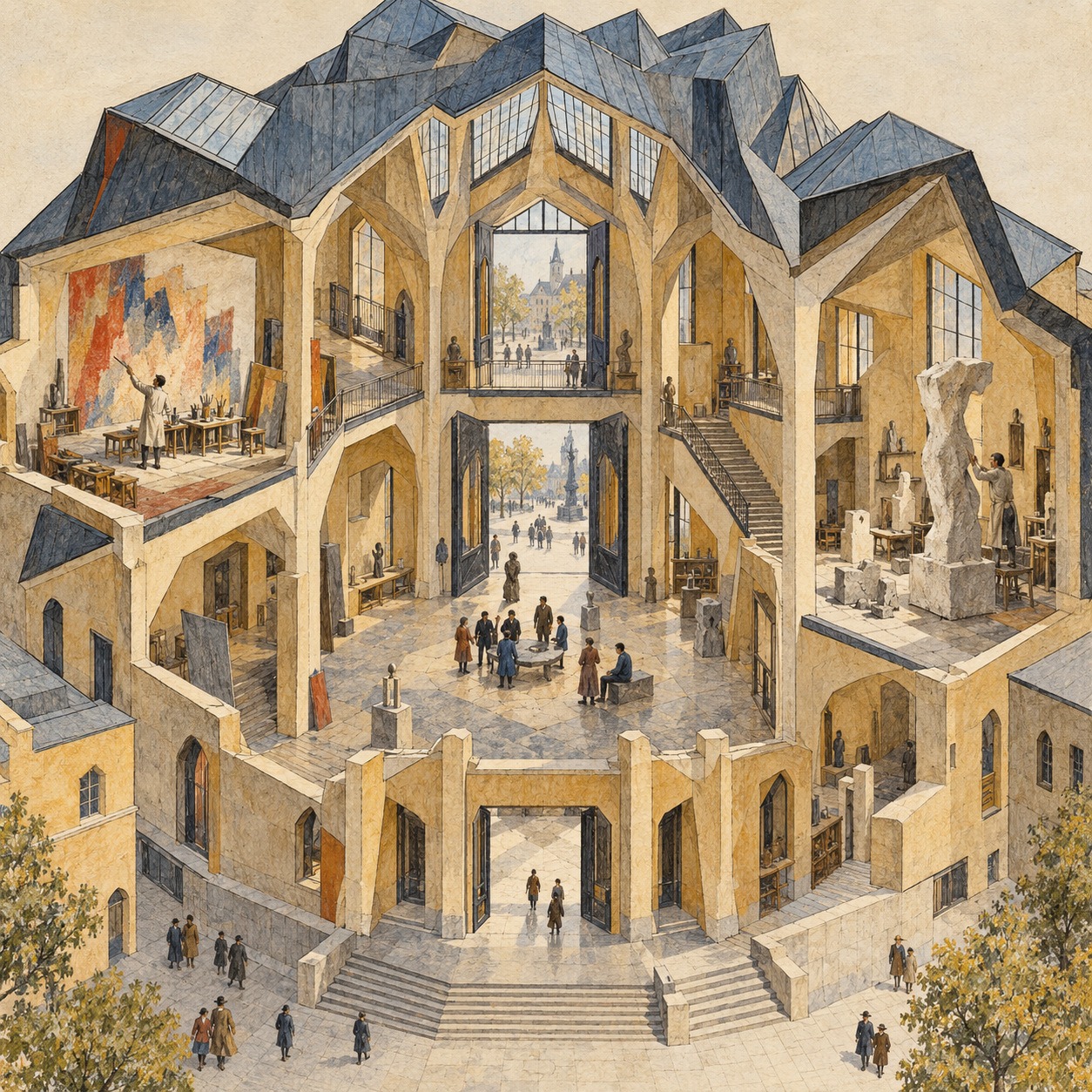
Invented architectural cutaway of an accessible public arts hall with a painter’s wall, a sculptor’s work area and an assembly space connected by one open floor. Ink and muted watercolor, human scale, exploratory design, no technical certification or text.
A smile from the studio
Jokes
The architect proposed a room for every art. The artists moved the walls and called it a meeting.