Australian art history · a group and a debate, not a single visual recipe
The Antipodeans brought seven painters and art historian Bernard Smith together around a defence of recognisable imagery. Their single group exhibition took place in Melbourne in August 1959. The dispute matters because it asks what painting can communicate through subjects, figures and stories—not because it supplies one compulsory palette or brushstroke. [1]
A visual introduction
Open any image to look closer, then browse the examples.
Creative toolbox · take this style further
Choose an input, adjust it, then open a tool. Search links pass your text to the destination. Copy & open copies it for you to paste into the generator; you start generation there.
ChatGPT
Copy your input and paste it into a ChatGPT conversation or image request.
Copy & open ChatGPT (new tab)Claude · Anthropic
Develop an image prompt or explore the style in a new Claude conversation.
Copy & open Claude · Anthropic (new tab)Midjourney
Paste your input into the Imagine bar on the Create page.
Copy & open Midjourney (new tab)Adobe Firefly
Copy your input, open Firefly, and paste it into the prompt field.
Copy & open Adobe Firefly (new tab)Leonardo.Ai
Copy your input, open Leonardo, and paste it into the generation field.
Copy & open Leonardo.Ai (new tab)Lexica
Search AI images and prompts using your selected input.
Search with this input Lexica (new tab)Pexels
Search the photo and video library. Short keywords often work best.
Search with this input Pexels (new tab)Pixabay
Search photos, illustrations and other images.
Search with this input Pixabay (new tab)Unsplash
Search photographs using the style name or your own keywords.
Search with this input Unsplash (new tab)Wikipedia
Search for background reading. A style may not have its own article.
Search with this input Wikipedia (new tab)WikiArt
Copy your input into WikiArt’s search to explore artists and artworks.
Copy & open WikiArt (new tab)Instagram hashtags
Search a hashtag made from your input: spaces and punctuation are removed. Instagram may require sign-in.
Search with this input Instagram hashtags (new tab)A closer look
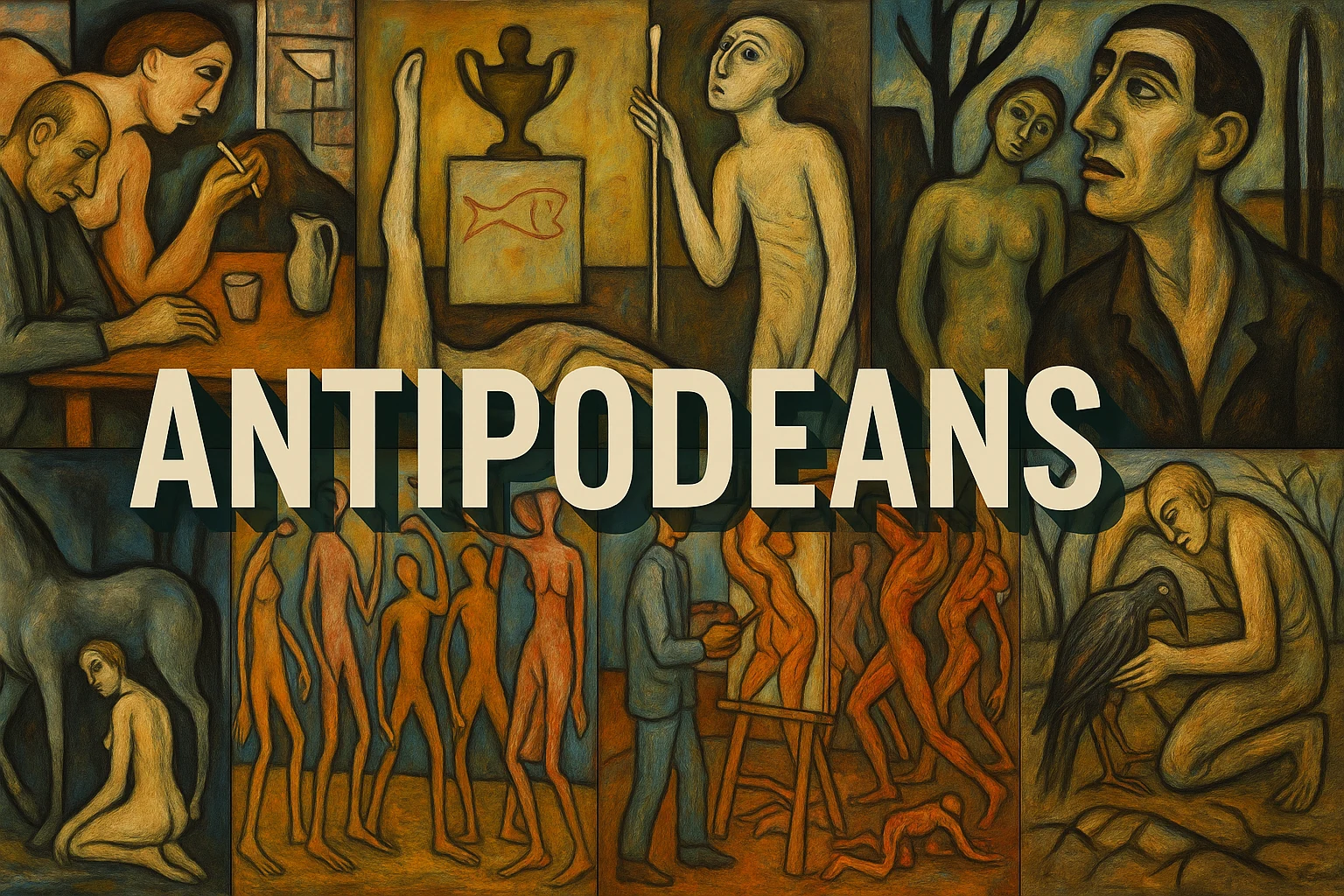
Our archive collage places figures, faces, animals and interior scenes within a dark ochre-and-blue arrangement. Compressed spaces and elongated bodies suggest psychological tension. These are features of this synthetic illustration, not a catalogue of authentic Antipodean works or a shared formula used by all seven painters.
Who belonged to the group
The exhibiting artists were Charles Blackman, Arthur Boyd, David Boyd, John Brack, Robert Dickerson, John Perceval and Clifton Pugh. Smith wrote the accompanying Antipodean Manifesto. The Art Gallery of Western Australia identifies the Victorian Artists Society as the exhibition venue and situates the group within debates over the growing reception of abstraction. [1]
A group formed around a position can contain markedly different artistic practices. Membership is therefore a historical fact to check, not a resemblance you can infer from a moody face or a strong colour. Our earlier entry incorrectly described the Antipodeans as abstract artists and supplied an unreliable membership account. This revision withdraws those claims.
What was at stake in 1959
The manifesto defended the importance of recognisable imagery and opposed non-figurative art. AGWA also cautions that the group did not present itself as a representative national cultural identity. Calling the Antipodeans simply “Australian Abstract Expressionists” reverses their stated position; calling their work a universal Australian style makes a different mistake. [1]
The debate can still be useful without requiring us to choose a permanent winning side. Ask what a particular image gains from being recognisable. Does a face make an encounter more specific? Does a room suggest social relations? Then ask what remains unresolved by recognition. Naming a figure does not explain its isolation, just as an abstract shape does not automatically lack feeling.
Look at one painting before applying a label
John Brack’s Collins St, 5p.m. (1955), held by the National Gallery of Victoria, offers a concrete starting point. The museum describes Melbourne office workers moving homeward, with repetition and a muted palette establishing the routine while individualised figures complicate it. The painting is oil on canvas and predates the group’s 1959 exhibition. It is a work by a later member, not evidence that the group existed in 1955. [2]
Use the linked museum reproduction to examine the relationship between one person and a crowd. Notice how a composition can repeat a form without making every instance identical. Then look again at the faces and their spacing. A catalogue label should help you ask more precise questions of a painting; it should not become permission to stop looking.
Figuration is not photographic imitation
A recognisable body can be elongated, a room compressed and a landscape rearranged. Representational subject matter and formal invention can coexist. For a practical exercise, keep the subject readable while changing one relationship: scale, distance, direction of gaze or the amount of empty space. Observe what happens to the emotional pressure of the scene.
Our collage is useful at that limited level. Separate panels suggest different situations, but the repeated dark contours and close framing make them feel related. Do not treat its invented scenes as lost paintings, attribute them to a named member or read its uniform colouring as a historical rule. The original works and their collection records remain the evidence.
Build a subject-led composition
Sketch three people waiting in a small room. Decide what the viewer should notice first: a shared direction of gaze, one empty chair or the distance between two figures. Make a second version with the same subject and a changed arrangement. Give each version a sentence describing what the formal decision made possible.
If using an image model, describe that arrangement explicitly instead of relying only on “Antipodeans style.” Inspect hands, gazes and overlaps; a plausible-looking crowd may still fail to communicate the relationship you intended. Label the result as a contemporary AI interpretation. The useful question is not whether the machine has learned a movement’s name, but whether your picture has something specific to say.
A small poetic detour
Original words from the AOI studio.
Poetry
Seven brushes disagree.
Across the room, a painted face
still asks to be seen.
The prompt workshop
Original creative exercises. These prompts create new illustrations, not documentary evidence.
The empty chair
Create an original figurative painting of three people waiting in a narrow room, one empty chair between two figures, recognisable poses, compressed space, restrained ochre and cool blue, directional gazes, no text or signature. Contemporary interpretive exercise; do not reproduce a known artwork.
Original AOI exercise; generated interpretations are not historical evidence.
Change the relationship
Create two original figurative composition studies with the same three invented adults: first close together, then separated by large areas of empty space. Keep their gestures readable, use a limited palette and visible brush texture. No historic attribution, lettering or logo.
Original AOI exercise; generated interpretations are not historical evidence.
People & works to explore
References discussed in this article. Consult the sources below for context.
Artists and practitioners
Charles Blackman
Arthur Boyd
David Boyd
John Brack
Robert Dickerson
John Perceval
Clifton Pugh
Bernard Smith — art historian and manifesto author
Paintings and other works
The Antipodean Manifesto (1959) — exhibition-catalogue essay by Bernard Smith
John Brack, Collins St, 5p.m. (1955), oil on canvas — predates the group exhibition